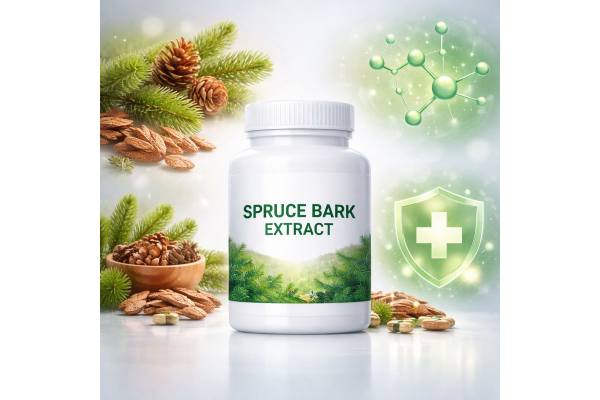
Spruce bark extract is an emerging botanical ingredient derived mainly from the bark of Norway spruce (Picea abies) and black spruce (Picea mariana). For decades, spruce bark was treated as a low-value forestry by-product, but it is now recognised as a rich source of polyphenols, stilbene glucosides (resveratrol-like molecules), flavonoids, tannins, and terpenes with marked antioxidant and antimicrobial activity.
Researchers are exploring spruce bark extract in several areas: as a natural preservative in foods, as a UV-protective and soothing agent in skincare, and as a potential dietary supplement to support oxidative balance and vascular health. Early findings are promising yet still mostly experimental, so expectations should remain measured.
This guide explains what spruce bark extract is, how it works, realistic benefits, typical ways to use it, what is known (and unknown) about dosage, and key safety considerations so you can discuss it more confidently with a healthcare professional.
Key Insights
- Spruce bark extract is rich in polyphenols and stilbenes that show strong antioxidant and antimicrobial activity in laboratory studies.
- It is used in skincare, food preservation, and some supplements, but robust human clinical evidence is still limited.
- Typical supplemental intakes fall roughly between 100 and 300 mg per day of standardised spruce bark extract, depending on the product.
- People who are pregnant, breastfeeding, on blood thinners, or with tree allergies should avoid spruce bark extract unless advised otherwise by a clinician.
Table of Contents
- What is spruce bark extract?
- What are the main benefits of spruce bark extract?
- How to use spruce bark extract in daily life
- How much spruce bark extract per day?
- How to choose a quality spruce bark supplement
- Side effects, interactions, and who should avoid it
- What does current research say about spruce bark extract?
What is spruce bark extract?
Spruce bark extract is a concentrated preparation made from the outer and inner bark of spruce trees, especially Norway spruce in Europe and black spruce in North America. In timber and paper production, bark is typically removed and used as fuel or discarded. Chemical analysis revealed that this by-product is actually rich in protective plant compounds, which triggered interest in extracting them for nutritional and cosmetic applications.
The bark contains several major classes of bioactive molecules. Polyphenols and tannins account for much of its antioxidant capacity. Stilbene glucosides, such as astringin, isorhapontin, and piceid, are structurally related to resveratrol and may share some of its biological actions. Flavonoids like catechin and epicatechin, as well as resin acids and volatile terpenoids such as α- and β-pinene, contribute additional antioxidant, antimicrobial, and aromatic effects.
To obtain spruce bark extract, producers use extraction techniques that aim to maximise polyphenol yield while reducing solvent residues and environmental impact. Common methods include hydroalcoholic extraction, hot-water extraction, ultrasound-assisted extraction, microwave-assisted extraction, and supercritical fluid extraction. Carefully optimised versions of these methods produce extracts with high total phenolic content and strong free-radical-scavenging capacity.
In practice, “spruce bark extract” can mean slightly different things from one manufacturer to another. Some products are standardised to total polyphenols or stilbene glucosides, others to resveratrol equivalents, and some simply to overall antioxidant capacity. Commercial forms include oral capsules or powders, liquid tinctures, and cosmetic-grade ingredients used in creams, serums, and sunscreens.
It is important not to confuse spruce bark extract with pine bark extract or spruce essential oil. All are derived from conifer trees, but they have distinct compositions, extraction processes, and evidence bases.
What are the main benefits of spruce bark extract?
Most information about spruce bark extract’s benefits comes from laboratory and animal work, with only limited human data so far. The effects described below should therefore be viewed as promising mechanisms rather than fully proven clinical outcomes.
The best-established property is antioxidant activity. Spruce bark extracts show high total phenolic content and strong scavenging of free radicals in multiple standard tests. In model systems, adding spruce bark extract to fats and oils slows lipid oxidation, which suggests a protective role for cell membranes and food products exposed to oxidative stress. This antioxidant action underpins many of the proposed health and cosmetic benefits.
A second key property is antimicrobial activity. Hydroalcoholic and water-based spruce bark extracts can inhibit the growth of a range of bacteria, especially several Gram-positive strains. Activity against some Gram-negative bacteria has also been reported, though often at higher concentrations. These dual antioxidant and antimicrobial effects explain why the extract is being studied as a natural preservative in foods and as a protective ingredient in topical products for irritated or blemish-prone skin.
Skin health and photoprotection form another important area of interest. Stilbene-rich spruce bark extracts have been incorporated into experimental sunscreen formulas, where they act as natural UV absorbers and help improve the stability of the product under sunlight. In cell models, they can reduce UV-induced oxidative damage and support collagen structures, suggesting potential anti-ageing and anti-wrinkle applications when used on the skin. However, well-controlled human trials in cosmetic settings are still needed to quantify these effects.
There are also early signals of anti-inflammatory and anti-proliferative effects. Extracts from black spruce bark, for example, have shown activity against selected cancer cell lines and have been explored as potential agents for inflammatory skin conditions such as psoriasis in mechanistic models. These findings support traditional uses of spruce preparations for skin and joint complaints, but they do not mean that over-the-counter spruce bark supplements can treat these conditions on their own.
Taken together, current evidence supports an overall view of spruce bark extract as a potent antioxidant with additional antimicrobial, photoprotective, and potentially anti-inflammatory actions. Real-world benefits for skin quality, oxidative balance, and product stability are plausible but still need confirmation in robust human studies.
How to use spruce bark extract in daily life
Most people will encounter spruce bark extract first in skincare or “clean label” food products rather than as a stand-alone supplement. How you use it depends on your goals and the type of product you choose.
In topical skincare, spruce bark extract usually appears in ingredient lists under names such as “Picea abies bark extract” or “Picea mariana bark extract.” It may be included in antioxidant serums, day creams, eye creams, or sunscreens, often alongside vitamin C, vitamin E, niacinamide, or plant oils. You generally apply these products once or twice daily according to the label, focusing on areas prone to sun exposure or ageing. If you have reactive or sensitive skin, patch-test on a small area for several days before applying it widely.
As an oral supplement, spruce bark extract may be sold on its own or as part of blends marketed for oxidative balance, cardiovascular support, or joint comfort. These typically take the form of capsules, tablets, or powders. In this setting, it is important to follow the manufacturer’s directions, take the product with food to reduce the chance of digestive upset, and avoid combining several high-dose antioxidant supplements unless your healthcare provider has recommended that approach.
Spruce bark extracts are also being evaluated as natural preservatives and “functional” ingredients in foods such as cured meats, oils, and baked goods. When added to these products, the primary goals are improved shelf life and protection against oxidation rather than direct health effects. If you see spruce bark extract mentioned on a label, it is usually there for technological reasons, even if the manufacturer highlights its antioxidant origin.
Traditional herbal practices sometimes use spruce bark, needles, or buds in teas, decoctions, and baths for respiratory and musculoskeletal complaints. Modern clinical evidence for these uses is limited, but spruce baths and inhalations remain popular in some spa traditions, where they are valued for their aromatic, warming, and relaxing qualities. If you choose to explore these options, it is safer to rely on commercially prepared products with clear instructions rather than harvesting tree bark yourself, which raises issues of correct identification, dosing, and environmental impact.
Whatever form you choose, spruce bark extract should be seen as a complement to, not a replacement for, a balanced diet, sufficient sleep, physical activity, and appropriate medical care. It may contribute additional antioxidant or skin-supportive benefits, but it cannot make up for gaps in core health behaviours.
How much spruce bark extract per day?
There is currently no universally accepted, clinically validated oral dosage for spruce bark extract. Most studies focus on laboratory and animal models or on its use in food and cosmetic formulations, rather than on long-term supplementation in humans. As a result, dosage guidance is largely based on common practice and analogy with related bark extracts rather than strict clinical evidence.
In dietary supplements, spruce bark extract is often standardised to a certain percentage of total polyphenols or stilbene glucosides. Daily intakes in commercial products often fall between about 100 and 300 mg of standardised extract, usually taken in one or two doses with meals. This range is similar to that used for other bark-derived antioxidant supplements, though direct comparisons are imperfect because spruce extracts can differ significantly in potency, composition, and bioavailability.
Some multi-ingredient antioxidant formulas include smaller quantities of spruce bark extract, such as 25–100 mg per day, alongside other polyphenol sources like grape seed, green tea, or pine bark. In these formulations, the goal is to create a balanced blend where no single extract dominates the total active content. If you already use other high-dose polyphenol products, it is important to think about the cumulative load when adding a spruce bark supplement.
For topical formulations, spruce bark extract concentrations commonly range from about 0.1 percent to 2 percent of the total formula. Experimental sunscreen products and antioxidant creams often fall in the mid-range of this spectrum. These amounts are chosen primarily for formulation stability, compatibility with other ingredients, and local skin effects, rather than systemic dosing concerns, since large polyphenol molecules have limited ability to penetrate deeply into the circulation through intact skin.
Traditional teas or decoctions made from spruce bark or buds may use around 1–2 grams of dried plant material per cup, steeped in hot water. However, these herbal preparations are not standardised, and their actual content of active compounds can vary widely depending on how they are prepared and which plant parts are used. They also have not been rigorously evaluated in modern clinical trials, so any dosage assumptions remain rough estimates.
In practice, a cautious, practical approach to dosage would be:
- follow the dosage on a reputable product’s label,
- begin at the lower end of the suggested intake,
- avoid taking multiple high-dose antioxidant supplements at the same time without professional guidance, and
- seek advice from a healthcare professional if you plan long-term or high-dose use, especially if you have chronic medical conditions or take prescription medications.
How to choose a quality spruce bark supplement
Since spruce bark extract is still relatively new to the supplement market, product quality can vary considerably. A structured checklist can help you identify more reliable options.
First, confirm the plant identity. Look on the label for the full Latin name, such as “Picea abies bark extract” or “Picea mariana bark extract.” This detail shows that the manufacturer knows and discloses which species and plant part they are using. Vague terms like “spruce extract” without specifying the bark or species make it harder to understand the product’s composition and compare it with research findings.
Second, look for some type of standardisation. Higher-quality products often state the percentage of total polyphenols, stilbene glucosides, or other defined marker compounds. Because phenolic content in spruce bark can vary with tree age, growing conditions, and extraction method, standardisation helps ensure more consistent potency from batch to batch. Products without any quantitative description of active content are more difficult to evaluate.
Third, consider the extraction method. Labels that mention “water extract,” “ethanol–water extract,” “hydroalcoholic extract,” or “supercritical CO₂ extract” provide useful information about how the product was made. Different methods can yield extracts with different profiles of active compounds. Processes that use food-grade solvents and aim to minimise environmental impact are generally preferable.
Fourth, assess quality control measures. Reputable brands often highlight third-party laboratory testing for heavy metals, microbial contamination, and solvent residues, and some offer certificates of analysis on request. For topical products, look for manufacturers that follow cosmetic good manufacturing practice (GMP) guidelines and perform stability testing to ensure the formula remains safe and effective across its shelf life.
Fifth, examine the overall formula. Spruce bark extract is frequently combined with other antioxidants and botanicals. Thoughtful combinations can be beneficial, but very complex formulas sometimes make it harder to understand what each ingredient contributes and whether dosages are reasonable. If you already use other polyphenol-rich products, choose a spruce bark supplement that adds value without pushing your total antioxidant intake to unnecessarily high levels.
Finally, pay attention to claims and marketing language. Because human evidence is limited, it is not realistic for a spruce bark extract product to promise dramatic disease reversal, rapid anti-ageing, or full replacement of conventional sunscreen. Brands that present spruce bark extract as a supportive antioxidant and skin-care ingredient, framed within a broader healthy lifestyle, are usually more aligned with current knowledge than products that make sweeping medical promises.
Side effects, interactions, and who should avoid it
Available information suggests that spruce bark extract is generally well tolerated in the short term at amounts used in supplements and cosmetic products. However, formal long-term safety data in humans remain limited, so it is sensible to approach it with the same caution you would use for any concentrated plant extract.
With oral use, possible side effects are similar to those seen with other polyphenol-rich supplements. These may include mild digestive discomfort, nausea, bloating, or loose stools, especially when large doses are taken on an empty stomach. Some people may experience headache or a general unwell feeling if they are sensitive to polyphenol-rich products. Reducing the dose, taking it with food, or discontinuing use typically resolves these issues.
Individuals with allergies to conifer trees, resins, or related plant extracts may be at higher risk of allergic reactions such as skin rash, itching, swelling, or respiratory symptoms. Anyone with a history of such allergies should avoid spruce bark extract or use it only under specialist supervision.
Spruce bark extract contains stilbene glucosides that are structurally related to resveratrol. At high doses, resveratrol has been linked to mild blood-thinning effects and possible interactions with hormonal pathways. Although the stilbene content in spruce bark supplements is usually lower than in high-dose resveratrol products, people who take blood-thinning medications, have bleeding disorders, or are scheduled for surgery should be cautious. In these situations, it is important to discuss any planned use of spruce bark extract with a healthcare professional and follow their advice, which may include avoiding it.
The anti-inflammatory and immune-modulating effects observed in experimental models also warrant caution in people with autoimmune conditions or those taking immunosuppressive drugs. While modest antioxidant support may be acceptable for many, the impact of concentrated spruce bark extracts on immune function is not fully understood.
For topical use in skincare, spruce bark extract is generally considered low risk when formulated at appropriate concentrations. However, like many plant-derived ingredients, it can still irritate sensitive skin or contribute to allergic contact dermatitis in susceptible individuals. To reduce this risk, it is advisable to:
- perform a patch test on a small area of skin for 24–48 hours before first use,
- avoid applying new products to broken, inflamed, or freshly shaved skin, and
- discontinue use if burning, swelling, or persistent redness develops.
Certain groups should avoid using spruce bark extract unless a clinician familiar with their case explicitly recommends it:
- pregnant or breastfeeding individuals,
- children and adolescents,
- people with severe liver or kidney impairment,
- individuals with known allergies to spruce, pine, or other conifers, and
- people currently receiving treatment for cancer or serious autoimmune diseases, unless their medical team agrees that use is safe.
As with any relatively new botanical, the absence of documented harm does not prove long-term safety. Choosing reputable products, using moderate doses, and keeping your healthcare providers informed are practical steps that help reduce risk.
What does current research say about spruce bark extract?
Over the past decade, scientific interest in spruce bark extract has grown steadily, especially in regions with strong forestry industries. Research efforts span chemistry, extraction technology, food science, dermatology, and environmental sustainability.
Phytochemical studies have mapped the main constituents of spruce bark in detail, describing high levels of glycosylated stilbenes, tannins, and flavonoids. These investigations show how factors such as tree age, climate, and storage conditions influence stilbene and polyphenol levels. Understanding these variables helps manufacturers design better harvesting and storage practices to preserve active compounds from bark that would otherwise be discarded.
Extraction research compares methods such as hot water, ethanol–water mixtures, pressurised liquid extraction, ultrasound-assisted extraction, and supercritical fluid extraction. Many studies focus on maximising phenolic content and antioxidant capacity while using environmentally friendly solvents. Results show that optimised techniques can produce extracts with very strong radical-scavenging and lipid-protective activity, making them attractive alternatives to synthetic antioxidants in food and cosmetic formulations.
In food science, spruce bark extract has been tested as a natural preservative in fat-rich foods, meats, and emulsions. These studies often find that adding extract slows the development of rancid flavours and reduces lipid oxidation markers compared with untreated products. In some cases, modest antibacterial effects are also observed. This aligns with the broader move toward replacing synthetic antioxidants and preservatives with plant-derived options where feasible.
Dermatological and cosmetic research explores spruce bark extract as an ingredient for UV protection and skin support. Experimental work has shown that stilbene-rich spruce bark extracts can serve as nature-inspired sun blockers, improving the UV-absorbing and photostability properties of sunscreen formulations. Other investigations point to potential benefits in modulating skin inflammation and supporting barrier function when bark-derived polyphenols are applied topically, although clinical studies in humans are still limited.
Finally, there is preclinical research into potential roles of spruce bark-derived compounds in inflammatory and proliferative diseases, including models relevant to psoriasis and certain cancers. These studies suggest that individual stilbenes and other polyphenols from spruce bark can influence signalling pathways involved in inflammation, cell growth, and oxidative stress. While this adds biological plausibility to some of the traditional uses of spruce, it remains too early to draw direct therapeutic conclusions for everyday supplements or cosmetics.
Overall, the research landscape supports seeing spruce bark extract as a promising, sustainable source of antioxidants and bioactive compounds with clear utility in foods and cosmetics and potential future roles in health-supporting supplements. The major gap is high-quality, controlled human clinical trials using well-characterised extracts and defined doses. Until such studies are more widely available, it is prudent to treat spruce bark extract as a supportive ingredient rather than a stand-alone treatment.
References
- Phytochemical Profile and Biological Effects of Spruce (Picea abies) Bark Subjected to Ultrasound Assisted and Microwave-Assisted Extractions, 2021 (Experimental Study)
- Bioactive Compounds from Norway Spruce Bark: Comparison Among Sustainable Extraction Techniques for Potential Food Applications, 2019 (Experimental Study)
- Spruce Bark Stilbenes as a Nature-inspired Sun Blocker for Sunscreens, 2022 (Experimental Study)
- Fate of Antioxidative Compounds within Bark during Storage: A Case of Norway Spruce Logs, 2020 (Experimental Study)
- Approaches to Extracting Bioactive Compounds from Bark as a Forest and Agricultural Waste, 2025 (Topical Review)
Disclaimer
The information in this article is intended for general educational purposes only and does not replace personalised medical advice, diagnosis, or treatment. Spruce bark extract is an emerging ingredient with limited human research, and its safety and effectiveness for specific health conditions have not been fully established. Always consult a qualified healthcare professional before starting, stopping, or changing any supplement, particularly if you are pregnant, breastfeeding, taking medications, or living with chronic health conditions. Never disregard professional medical advice or delay seeking it because of something you have read here.
If you found this guide useful, you are welcome to share it on Facebook, X (formerly Twitter), or any platform you prefer, and to follow our work on social media. Your support through thoughtful sharing helps our team continue producing careful, evidence-informed content.