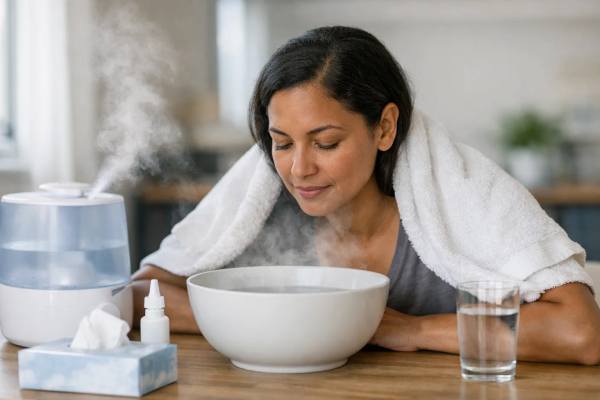
Steam has a long history as a “blocked nose” remedy, and it can feel reassuring: warm air, a little loosened mucus, and the sense that you are doing something active to recover. Used thoughtfully, warmth and humidity may temporarily ease nasal dryness, soften thick secretions, and make breathing feel less tight for a short window. That said, steam is often misunderstood. It does not kill cold and flu viruses in real-world conditions, it does not “pull infection out,” and it does not shorten the typical timeline of illness.
The bigger issue is safety. Traditional bowl-and-towel steam setups are a known cause of scald burns, especially in children, and the risk can outweigh the modest, short-lived symptom relief. This guide explains what steam can realistically do, why it sometimes helps, when it can backfire, and which safer options usually deliver better results.
Core Points for Safer Relief
- Steam may briefly reduce nasal dryness and make thick mucus easier to clear, but it does not shorten most respiratory infections.
- Bowl-and-towel steaming carries a real scald-burn risk, especially for children, and is generally not the safest choice.
- If you try humidity, favor low-risk methods like a warm shower or a properly cleaned humidifier.
- Avoid adding essential oils to hot water, and stop immediately if coughing, wheezing, or throat irritation increases.
Table of Contents
- What steam can and cannot do
- How heat and humidity change symptoms
- A safer home steam routine
- Risks you should not ignore
- Safer options that work better
- Who should avoid steam and when to get care
What steam can and cannot do
Steam inhalation sits in a gray zone: it can make you feel better, but that “better” is often temporary and easy to over-interpret. The most realistic benefit is comfort—especially when congestion is paired with dryness, crusting, or thick mucus that feels “stuck.” Warm, humid air can reduce that dry, scratchy sensation and may make blowing your nose or clearing post-nasal drip easier for a while.
Where steam is routinely oversold is in claims about curing infection. Colds, flu, RSV, and many other respiratory viruses multiply inside airway cells. The heat and humidity you can tolerate at home do not meaningfully change that process. At best, symptom relief can support rest and hydration—both of which matter for recovery—but steam itself is not an antiviral treatment.
It also helps to separate nasal congestion from the feeling of congestion. A stuffy sensation may come from:
- Swollen nasal lining (inflammation)
- Thick mucus and impaired mucus clearance
- Dryness and irritated tissue
- Post-nasal drip that triggers coughing
Steam might help the dryness and mucus piece, but it has little effect on the inflammatory swelling that truly narrows nasal passages. That is why people sometimes report a pleasant five-to-fifteen-minute “opening,” followed by a return to baseline.
If you decide to use steam, frame it as a comfort tool—similar to warm tea or a hot shower—not as a remedy that should stop symptoms from progressing. The moment steam becomes a routine that replaces proven basics (rest, fluids, symptom-appropriate medication when needed, and medical evaluation for warning signs), it becomes less helpful.
Finally, a practical reality: the most traditional method (a bowl of hot water and a towel) is also the most injury-prone. Even if steam did offer mild symptom relief, a treatment that can cause significant burns is not a good trade for many households.
How heat and humidity change symptoms
To understand why steam sometimes feels like it “works,” it helps to look at the mechanics of your upper airway. Your nose and sinuses are lined with a moist surface and tiny hair-like structures (cilia) that move mucus backward toward the throat. This is a normal cleaning system. During a cold or allergy flare, that system can get overwhelmed: mucus thickens, swelling increases, and airflow becomes turbulent and uncomfortable.
Steam and humid air may help in a few symptom-level ways:
Moisture can thin and mobilize secretions
When mucus is very thick, adding moisture may reduce its stickiness. This can make it easier to clear with gentle nose blowing, saline rinsing, or coughing. People often describe this as “loosening” congestion.
Warmth can change airflow sensation
Warm air can feel less harsh than cold, dry air on inflamed tissue. Even when nasal swelling remains, the perception of breathing can improve because the lining is less irritated.
Humidity can reduce dryness-driven coughing
A dry throat plus post-nasal drip often triggers a repetitive, nonproductive cough. Humidity may reduce that dryness and interrupt the cough-irritation cycle for a short period.
But there are important limits:
- Swelling dominates congestion for many people. Viral and allergic inflammation can narrow nasal passages regardless of how thin the mucus is.
- Too much humidity can feel “heavy.” Some people feel more air hunger or chest tightness in very humid air.
- Steam does not sterilize sinuses. The temperatures required to meaningfully reduce viral activity are not safely applied to nasal tissues at home.
- Symptom relief can be mistaken for improvement in illness. A short comfort window can lead to overuse—especially if someone repeats steaming every time symptoms return.
A useful mental model is “steam is a conditioner, not a cure.” It may optimize the environment on the surface of your airway—comfort, lubrication, mucus texture—but it does not remove the underlying trigger. If the trigger is a virus, the immune system will still run its course. If it is allergies, the immune system will keep reacting until the exposure and inflammation are addressed.
A safer home steam routine
If you want the benefits of humidity without the classic burn hazard, the goal is simple: get warm, moist air in a controlled way that does not involve handling scalding water near your lap or face. For many people, a warm shower does the job with far less risk.
Option 1: Warm shower or “steamy bathroom” approach
This is often the safest and most practical method.
- Run a warm shower (not painfully hot).
- Sit or stand comfortably in the bathroom, breathing normally through the nose as tolerated.
- Limit sessions to about 10–15 minutes, once or twice a day, based on comfort.
- Afterward, gently blow your nose (one side at a time) and drink water to replace fluid losses.
This approach avoids a bowl of hot water, reduces spill risk, and provides whole-airway humidity rather than concentrated steam.
Option 2: Humidifier for overnight dryness and cough
A humidifier is not “steam inhalation,” but it is a safer way to add moisture to air—especially overnight.
- Aim for a comfortable indoor relative humidity (many people do well in a moderate range).
- Place the device where it cannot be tipped or touched easily by children.
- Clean and dry it as directed, because stagnant water can grow microbes that worsen irritation.
If a humidifier makes you feel more congested, you may be over-humidifying the room or triggering irritation from poor cleaning.
Option 3: Warm compress for sinus pressure
For facial pressure or heaviness, a warm compress across the cheeks and nose bridge can provide localized relief without inhalation or burn risk. It is a low-effort option when you feel miserable and want comfort without fuss.
What to avoid in most households
- Bowl-and-towel steaming. It is easy to spill, easy to misjudge temperature, and risky around children, pets, or anyone who is dizzy or fatigued.
- Boiling water anywhere near the face. A moment of distraction is enough for injury.
- Essential oils added to hot water. Strong vapors can irritate eyes, nose, and lungs, and some oils are unsafe for children and pets.
If you use any method and you start coughing more, wheezing, or feeling chest tightness, treat that as a stop signal—not a sign to push through.
Risks you should not ignore
Steam inhalation is often framed as harmless, but real-world injury patterns say otherwise. Scald burns can be severe, and they tend to happen during ordinary moments—moving a bowl, adjusting a towel, or a child bumping an adult’s arm. Reports from burn services describe significant injuries linked to steam inhalation setups, including hospital admissions and, in some cases, surgery. In one adult series, inpatient stays averaged about a week, and care costs were substantial. Other hospital analyses note that steam inhalation injuries are not rare in seasonal spikes and can affect the face, chest, and legs—exactly the areas exposed when a bowl tips.
Beyond burns, there are several physiologic reasons steam can backfire:
Airway reactivity and asthma
Very warm, humid air can provoke coughing or bronchospasm in some people, especially those with asthma, reactive airways, or a history of wheezing with infections. If steam causes chest tightness, wheeze, or a sense of “can’t get a full breath,” it is not the right tool.
Essential oil irritation and chemical sensitivity
Adding essential oils may sound soothing, but concentrated vapors can irritate the mucosal lining and trigger coughing or headaches. Some oils are particularly problematic for young children. “Natural” does not mean gentle, especially when heated and inhaled.
Skin and eye injury
Even without a spill, hot vapor close to the face can irritate eyes and worsen facial flushing or skin sensitivity. This matters for people with rosacea, eczema flares, or very inflamed sinuses where the skin barrier is already stressed.
False reassurance
One of the most overlooked risks is behavioral: feeling temporary relief can delay care when symptoms are actually escalating. For example, worsening shortness of breath, persistent high fever, dehydration, or severe facial pain are not problems to “steam away.”
A final safety note for families: children are at higher risk because their skin burns faster, their coordination is still developing, and they are more likely to make sudden movements around a hot container. If a method depends on perfect stillness and uninterrupted attention, it is not a safe household remedy.
Safer options that work better
If your goal is to breathe more easily and sleep, there are several approaches that tend to outperform steam—either because they work more reliably, last longer, or carry less risk.
Saline for the nose: spray, drops, or rinse
Saline directly addresses thick mucus and dryness without heat. It can:
- Hydrate irritated tissue
- Loosen crusts
- Improve the effectiveness of gentle nose blowing
For many adults, a saline spray used a few times a day is enough. For thicker congestion or heavy post-nasal drip, a larger-volume rinse (with sterile or properly prepared water) can be more effective. If you are unsure, start with spray and escalate only if needed.
Warm fluids and targeted throat care
Warm beverages do more than comfort: they support hydration and can temporarily reduce throat irritation that feeds coughing. Pair warm fluids with:
- Honey (for adults and children over one year) for cough soothing
- Lozenges or hard candy (for older children and adults) to increase saliva and reduce throat friction
These are low-risk, high-comfort tools when used appropriately.
Medication when it fits your symptoms
Steam does not reduce inflammation; some medications can.
- Pain relievers can reduce the overall misery that worsens sleep and recovery.
- Decongestants (when appropriate for you) can reduce nasal swelling and may work better than humidity alone for a truly blocked nose.
- Nasal steroid sprays can help when congestion is allergy-driven or persistent inflammation is the main issue. These take time and work best with consistent use.
If you have high blood pressure, heart rhythm conditions, prostate issues, glaucoma, pregnancy, or you are choosing medications for a child, be selective and follow label guidance or a clinician’s advice.
Humidification with hygiene
If dry air is your main trigger, humidification can help—but the device must be clean. A humidifier that is not maintained can spread irritants into the air, which defeats the purpose. If your symptoms worsen after starting humidification, stop and reassess cleaning, water quality, and room humidity levels.
Sleep and positioning
Congestion and post-nasal drip often worsen when you lie flat. A modest head elevation, side sleeping, and a consistent bedtime routine can reduce nighttime coughing and mouth breathing. This is not glamorous, but it can be more powerful than any single remedy.
Steam can still have a place—especially as a warm shower that relaxes you before bed—but in most cases, these alternatives provide a better blend of effectiveness and safety.
Who should avoid steam and when to get care
Steam is not a universal tool. In some situations, it is more likely to irritate than to soothe, and in others it can distract from symptoms that deserve prompt medical attention.
Consider skipping steam if you have
- Asthma or reactive airways, especially if humidity triggers coughing or wheeze
- Frequent bronchitis or a history of infection-related breathing difficulty
- Very young children in the home, because burn risk rises sharply with bowls and hot containers
- Neurologic conditions, dizziness, or fainting risk, where heat and standing in a warm bathroom could be unsafe
- Severe nasal inflammation where heat worsens swelling or triggers headaches
- Skin sensitivity (for example, facial dermatitis) that flares with heat
If you still want humidity, choose a warm shower or a carefully maintained humidifier rather than direct steam from hot water.
Red flags that should change your plan
Congestion is common, but these signs suggest the situation is bigger than routine viral discomfort:
- Trouble breathing, rapid breathing, or shortness of breath at rest
- Chest pain, bluish lips or face, or severe weakness
- Dehydration signs (very dark urine, dizziness, dry mouth, inability to keep fluids down)
- Fever that is high, persistent, or returns after improvement
- Severe facial pain, swelling around the eyes, or one-sided sinus pain that keeps worsening
- Ear pain with significant hearing change, drainage, or severe pressure
- Symptoms lasting beyond the expected window, or worsening after day 5–7 instead of gradually improving
When children need extra caution
For kids, prioritize low-risk strategies: fluids, saline drops or spray, a cool-mist humidifier if dryness is obvious, and age-appropriate symptom relief. Avoid any setup that involves carrying hot water. Children can move suddenly, and a single spill can cause a life-altering burn.
Finally, if you suspect influenza, COVID-19, or another infection that could benefit from time-sensitive treatment, do not let home remedies delay testing or care. Comfort measures should support recovery—not postpone it.
References
- Heated, humidified air for the common cold 2017 (Systematic Review)
- Humidification of indoor air for preventing or reducing dryness symptoms or upper respiratory infections in educational settings and at the workplace 2021 (Systematic Review)
- Severe scalds sustained during steam inhalation therapy in an adult population: Analysis of patient outcomes and the financial burden to healthcare services 2022
- Sick Becomes Seriously Ill—Scald Injuries due to Domestic Medical Self‐Treatment: A Six‐Year Single Center Retrospective Study 2025
- NHS and British Burn Association issue public safety warning: steam inhalation causes burns 2025 (Public Safety Statement)
Disclaimer
This article is for general education and is not a substitute for personalized medical advice, diagnosis, or treatment. Respiratory symptoms can overlap across viral infections, allergies, asthma, and bacterial illnesses, and the right approach depends on your age, medical history, medications, and symptom severity. Seek urgent care for breathing difficulty, chest pain, confusion, dehydration, blue lips or face, or rapidly worsening symptoms. For children, older adults, pregnant people, and anyone with chronic lung or heart disease, a lower threshold for professional guidance is appropriate.
If you found this helpful, consider sharing it on Facebook, X (formerly Twitter), or any platform you prefer so others can make safer choices when congestion hits.