Stearic acid is a long-chain saturated fatty acid (C18:0) that appears in everyday life more often than most people realize. It is naturally present in foods such as cocoa butter, dark chocolate, beef, lamb, and some plant fats, and it also plays a central role in many skincare products, soaps, and candles as a thickener and stabilizer. In the body, stearic acid is not simply an inert fat: it is metabolized, converted to other fatty acids, and can influence mitochondrial function, blood lipids, and energy use.
Unlike some other saturated fats, stearic acid tends to have a neutral effect on LDL (“bad”) cholesterol when eaten in moderate amounts as part of a balanced diet. At the same time, very high intakes or concentrated industrial exposure can still cause problems, from digestive upset to skin or respiratory irritation. This guide explains what stearic acid is, how it behaves in food and on skin, its potential benefits, realistic dosage ranges, and the people who should be especially cautious with supplemental or occupational exposure.
Quick Summary
- Stearic acid is a saturated fatty acid common in cocoa butter, meat fat, and skincare products, with relatively neutral effects on blood cholesterol in typical dietary amounts.
- In human and animal studies, stearic acid can influence mitochondrial function, fat distribution, and some cardiometabolic markers, but effects depend strongly on dose and overall diet.
- For most adults, dietary stearic acid within a typical range of about 5–15 g per day from whole foods is considered acceptable when total saturated fat intake remains within guideline limits.
- People with cardiovascular disease who must strictly limit saturated fat, those with rare fat metabolism disorders, and individuals who react to stearic-acid-containing products should avoid high-dose supplements or concentrated exposures.
Table of Contents
- What is stearic acid
- Stearic acid health benefits
- How to use stearic acid safely
- Stearic acid dosage and intake
- Stearic acid side effects and who should avoid it
- What science says about stearic acid
What is stearic acid
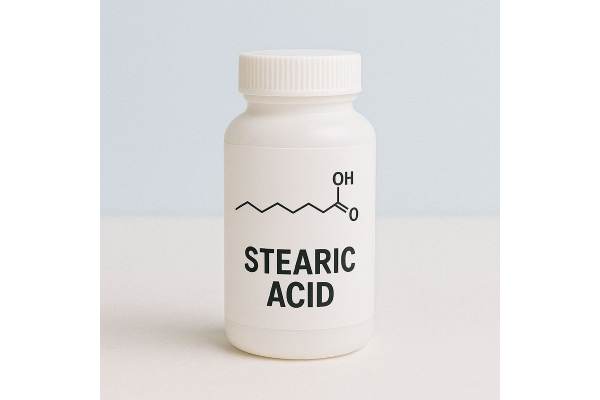
Stearic acid is an 18-carbon saturated fatty acid, often written as C18:0. Chemically, it is a straight chain of carbon atoms with hydrogen atoms saturating every possible bond, plus a carboxylic acid group at one end. This structure makes it solid at room temperature and gives it “waxy” properties that are valuable in food manufacturing and personal care products.
In foods, stearic acid occurs as part of triglycerides, mainly in animal fat and certain plant fats. Rich sources include cocoa butter, dark chocolate, beef tallow, lard, lamb fat, and some tropical fats such as shea butter. When you eat these foods, stearic acid is released in the gut, absorbed, and then either oxidized for energy, stored in adipose tissue, or converted by the enzyme stearoyl-CoA desaturase to oleic acid, a monounsaturated fat.
Stearic acid is also widely used as a functional ingredient in industry:
- In skincare and cosmetics, it acts as an emulsifier, thickener, and stabilizer in creams, lotions, and makeup.
- In soaps and detergents, it helps harden the bar and improve lather.
- In supplements and medications, magnesium stearate and other stearates are used as lubricants and flow agents in tablets and capsules.
- In candles, stearic acid is added to improve hardness and burn quality.
From a nutritional standpoint, stearic acid is interesting because it behaves differently from other long-chain saturated fats such as palmitic acid (C16:0). While palmitic acid tends to raise LDL cholesterol, stearic acid often has a neutral or even slightly LDL-lowering effect when substituted for other saturated fats in controlled feeding studies. That difference is part of why modern research treats individual saturated fatty acids separately rather than assuming they all behave the same.
Stearic acid is not considered an “essential” fatty acid: your body can make it from other fats, and there is no defined deficiency state. Instead, the key question is how much stearic acid is reasonable and safe, given your overall diet, cardiovascular risk, and exposure from non-food sources such as skincare.
Stearic acid health benefits
Stearic acid’s potential benefits are best understood in context: it is not a miracle nutrient, but compared with some other saturated fats it may be more metabolically neutral and may even offer specific advantages in certain settings.
The clearest area of interest is cardiovascular health. Controlled human trials comparing stearic acid with other fats show that, when stearic acid replaces other saturated fatty acids like palmitic acid, LDL cholesterol often falls or remains unchanged, and the ratio of total to HDL cholesterol may improve. When stearic acid replaces unsaturated fats, however, it behaves more like a typical saturated fat, sometimes nudging LDL upward. In other words, stearic acid is “better” than some saturated fats but still not superior to unsaturated fats for cholesterol management.
A second emerging benefit involves mitochondrial function and energy metabolism. Human and experimental work suggests that stearic acid can act as a signaling molecule that influences mitochondrial shape, fusion, and oxygen consumption. In one human study, a single stearic-acid-rich meal triggered measurable changes in mitochondrial fusion within hours, pointing to a role in short-term energy regulation. Experimental models also suggest that stearic acid can shift fat distribution, for example reducing visceral adipose tissue in animals fed stearic-acid-enriched diets compared with other fat blends.
In body composition and metabolic health, stearic acid appears to be a relatively poor substrate for triglyceride synthesis compared with some other saturated fats. That means that, calorie for calorie, it may be less prone to drive very high blood triglyceride spikes. This does not mean that large amounts of stearic-acid-rich fat promote weight loss, but it helps explain why stearic-acid-heavy fats like cocoa butter often have a more neutral impact on traditional lipid markers than their saturated fat content alone would suggest.
In the skin and barrier function domain, stearic acid is a component of the skin’s natural lipid layer and helps maintain a stable, semi-occlusive surface that limits water loss. In cosmetics, it can improve product texture and contribute to a smoother skin feel. Most people tolerate stearic acid in skincare well, which is one reason it appears in thousands of formulations, including products for sensitive skin.
Taken together, these findings suggest that stearic acid is a relatively “gentle” saturated fat. It can play a role in a heart-conscious diet when it replaces more atherogenic saturated fats, and it contributes to effective skincare formulations. The benefits, however, depend strongly on the overall dietary pattern and product formulation—stepping back to evaluate the whole picture is always more important than focusing on one fatty acid in isolation.
How to use stearic acid safely
Most people “use” stearic acid every day without realizing it, simply by eating mixed diets and applying common skincare products. Safe use is less about avoiding stearic acid altogether and more about understanding context, dose, and form.
From a dietary standpoint, the safest way to include stearic acid is through whole foods and minimally processed fats, for example:
- Small portions of dark chocolate or cocoa-rich products.
- Moderate intake of unprocessed red meat and dairy within guideline limits for saturated fat.
- Occasional use of cocoa butter or shea-based spreads in place of more atherogenic fats.
Because stearic acid comes bundled with other nutrients and fatty acids, food-based intake fits naturally into a balanced eating pattern. Priorities remain the same: emphasize vegetables, fruits, whole grains, legumes, nuts, seeds, and marine or plant sources of unsaturated fats, while keeping total saturated fat (from stearic acid and others) within recommended limits.
In skincare and personal care products, stearic acid is widely considered safe when used at typical concentrations. It serves as:
- An emulsifier to keep oil and water mixed.
- A thickener to give creams and lotions structure.
- A stabilizer to prevent separation or graininess.
People with very sensitive or reactive skin can still develop irritation or contact dermatitis from almost any ingredient, including stearic acid, especially when it appears in high concentrations or in combination with fragrances and other potential irritants. Patch testing a new product on a small area of skin for several days before full-face or body use is a sensible precaution if your skin tends to react easily.
Regarding supplements, a distinction is crucial:
- Stearic acid used as part of magnesium stearate or similar stearate excipients in tablets is present in small amounts and is generally recognized as safe for most people.
- Dedicated stearic acid capsules or powders providing gram-level daily doses are far less studied. Some people use them in experimental “mitochondrial support” or low-palmitic-fat regimens, but long-term data are limited.
If you are considering targeted stearic acid supplementation beyond what is found in normal foods and tablet excipients, it is wise to:
- Discuss it with a clinician who understands your cardiovascular and metabolic risk profile.
- Keep total saturated fat within guideline limits, even if some of that saturated fat is stearic acid.
- Start low and avoid very high bolus doses that may cause digestive upset.
Finally, for occupational use (candle making, soap making, industrial processing), powdered stearic acid can irritate the respiratory tract and eyes if inhaled or if dust contacts mucous membranes. Basic protective gear—gloves, eye protection, and dust masks or local ventilation—minimizes these risks.
Stearic acid dosage and intake
Unlike vitamins or essential fatty acids, stearic acid has no official recommended daily allowance. Instead, intake is considered in the broader context of total fat and saturated fat consumption.
In typical Western diets, stearic acid usually accounts for roughly 2–7% of total energy, depending on how much chocolate, meat, and dairy a person eats. For an adult consuming about 2,000 kcal per day, that translates to a rough range of 4–15 g of stearic acid per day. Intake is on the higher end in diets rich in beef tallow, cocoa butter, and certain processed foods that use stearic-acid-rich fats as structuring agents.
When researchers design feeding studies to test stearic acid’s metabolic effects, they often compare diets in which stearic acid provides around 5–10% of total energy, either substituting it for other saturated fatty acids or for unsaturated fats. These levels are similar to or slightly above what many people already obtain from common foods. Within that range, stearic acid has generally shown neutral or modestly favorable effects on LDL cholesterol when replacing more atherogenic saturated fats.
For everyday nutrition, practical guidance looks like this:
- Try to keep total saturated fat (including stearic, palmitic, lauric, and myristic acids) within current guideline limits—often around 10% or less of total energy, and lower for individuals at high cardiovascular risk.
- Allow stearic acid to make up part of that saturated fat “budget,” ideally coming mostly from minimally processed foods.
- Avoid dramatically increasing stearic-acid-rich fats at the expense of unsaturated fats such as olive oil, nuts, seeds, and fatty fish, which have stronger cardiovascular benefit data.
For supplemental stearic acid, there is no widely accepted therapeutic dose. Experimental protocols sometimes use several grams per day, often 3–6 g daily, typically divided with meals. Because safety data are limited, especially over years, it is prudent not to exceed intakes substantially higher than those seen in controlled feeding studies unless under specialist supervision. Individuals already consuming diets high in saturated fat have even less margin to add concentrated stearic acid without overshooting heart-health thresholds.
On the topical side, safety evaluations for cosmetics report stearic acid being used at concentrations up to about 20–37% of a product formulation, depending on product type, with typical daily exposure still well below levels associated with systemic toxicity. For consumers, this translates not into mg per day, but into choosing reputable products from established manufacturers and using them as directed.
Overall, the safest “dose” of stearic acid is the one that fits within a balanced diet rich in unsaturated fats, keeps total saturated fat in check, and avoids large supplemental boluses that have not been tested long term in diverse populations.
Stearic acid side effects and who should avoid it
For most healthy adults, typical dietary and cosmetic exposures to stearic acid are well tolerated. Still, side effects and risks can arise in certain situations, especially with high-dose supplementation or occupational exposure.
Digestive effects
Large single doses of stearic acid, especially in supplement form or very high-fat meals, can cause:
- Nausea or a feeling of heaviness after eating.
- Loose stools or mild diarrhea, as unabsorbed fat reaches the lower gut.
- Occasionally, abdominal cramping or bloating.
These effects are similar to what people can experience with any sudden large increase in fat intake and are often dose-related. Reducing the amount per dose, taking stearic acid with meals rather than on an empty stomach, and keeping total fat in a moderate range can reduce discomfort.
Skin and respiratory irritation
In skincare products, stearic acid is usually well tolerated. However:
- Pure stearic acid powders, or very concentrated formulations, may irritate sensitive skin, leading to redness, itching, or dryness.
- Inhalation of stearic acid dust in industrial or hobby settings (for example, candle or soap making) can irritate the nose, throat, and lungs, causing coughing or throat scratchiness.
People with asthma, chronic respiratory conditions, or a history of contact dermatitis should handle pure stearic acid with particular care, using gloves, eye protection, and masks or ensuring good ventilation.
Cardiometabolic risk
Although stearic acid is comparatively neutral among saturated fats, cardiometabolic risk still depends on the overall pattern:
- Very high intakes of total saturated fat, even if a large share is stearic acid, can contribute to weight gain and adverse lipid patterns if they displace unsaturated fats and whole plant foods.
- When stearic acid replaces unsaturated fats, blood lipids and certain clotting markers may move in a less favorable direction, even if changes are modest.
Therefore, people with established cardiovascular disease, familial hypercholesterolemia, or diabetes should treat high-dose stearic acid supplementation with caution and prioritize diets rich in unsaturated fats.
Who should be especially cautious or avoid high-dose stearic acid
- Individuals with known cardiovascular disease or very high LDL cholesterol who are already advised to strictly limit saturated fat.
- People with rare fat metabolism disorders or pancreatic insufficiency, where fat absorption is impaired.
- Those with documented allergic or irritant reactions to stearic-acid-containing products.
- Workers regularly exposed to stearic acid dust without adequate protective equipment.
Pregnant or breastfeeding individuals do not need to avoid normal food or cosmetic exposures, but high-dose stearic acid supplements are best avoided due to limited targeted safety data.
If you notice new or worsening chest pain, shortness of breath, persistent digestive symptoms, or significant skin reactions after a change in diet or supplement regimen involving stearic acid, consult a healthcare professional promptly and mention any new products or supplements you have started.
What science says about stearic acid
Modern research paints a nuanced picture of stearic acid. Rather than being “good” or “bad,” it appears metabolically distinct from other saturated fats and may have specific physiological roles.
Cardiovascular and lipid effects
Human trials that compare stearic acid with other fats consistently show that when stearic acid replaces industrial trans fats or more atherogenic saturated fats, LDL cholesterol usually falls or remains neutral. Ratios such as total-to-HDL cholesterol may also improve in this substitution context. In contrast, when stearic acid replaces unsaturated fats, lipid profiles tend to move in a less favorable direction, reinforcing guidelines that prioritize unsaturated fats for long-term heart health.
More recent analyses focusing on individual saturated fatty acids indicate that stearic acid tends to be less strongly associated with adverse cardiometabolic markers than some other saturated fats. This has led experts to describe stearic acid as relatively neutral within the saturated fat family, though not protective in the same way as omega-3 or monounsaturated fats.
Mitochondrial and metabolic effects
Mechanistic research in humans has shown that a single stearic-acid-rich meal can rapidly alter mitochondrial dynamics, increasing the proportion of fused, elongated mitochondria and raising oxygen consumption in blood cells. This suggests stearic acid can act as a short-term metabolic signal rather than just a passive energy source.
Experimental work in cells and animals adds further detail:
- Stearic acid can modulate inflammatory and oxidative stress pathways.
- It interacts with nuclear receptors involved in adipogenesis and insulin sensitivity, partly through conversion to oleic acid.
- In some animal models, diets enriched in stearic acid reduce visceral fat and alter tumor behavior compared with certain control fats, although these findings are preliminary.
Absorption, energy use, and adiposity
Classic metabolic studies found that stearic acid is absorbed slightly less efficiently than some other long-chain fats. It appears to be a less efficient substrate for triglyceride synthesis, which may contribute to more modest post-meal triglyceride rises compared with certain other saturated fats. This does not mean stearic acid promotes weight loss, but it helps explain why stearic-acid-rich fats can behave more benignly than their total saturated fat numbers might suggest.
Safety in cosmetics and everyday products
Regulatory safety assessments for cosmetics have reviewed large amounts of data on stearic acid and related fatty acids used in creams, lotions, makeup, and soaps. These reviews conclude that stearic acid is safe in cosmetic formulations when used at typical concentrations and when products are designed to be non-irritating and used as directed. Eye and respiratory irritation from powdered stearic acid are mainly concerns for workers handling bulk materials without proper protection.
Overall, the scientific consensus is that:
- Stearic acid is less harmful than several other saturated fatty acids with respect to LDL cholesterol and some cardiometabolic markers.
- Health impact depends heavily on what stearic acid replaces in the diet and on total saturated fat intake.
- Normal food and cosmetic exposures are generally safe, while gram-level supplementation and long-term high-dose use remain areas where more research is needed and caution is appropriate.
References
- Stearic acid metabolism in human health and disease – PubMed 2025 (Review)
- Dietary stearic acid regulates mitochondria in vivo in humans | Nature Communications 2018 (Human Mechanistic Study)
- Cardiovascular disease risk of dietary stearic acid compared with trans, other saturated, and unsaturated fatty acids: a systematic review – PubMed 2010 (Systematic Review)
- Impact of Replacement of Individual Dietary SFAs on Circulating Lipids and Other Biomarkers of Cardiometabolic Health: A Systematic Review and Meta-Analysis of Randomized Controlled Trials in Humans – PubMed 2022 (Systematic Review and Meta-analysis)
- Safety Assessment of Fatty Acids & Fatty Acid Salts as Used in Cosmetics 2019 (Safety Assessment)
Disclaimer
This article is intended for general information and educational purposes only and does not constitute medical, nutritional, or cosmetic formulation advice. Stearic acid’s health effects depend on many factors, including total diet, genetics, existing medical conditions, and concurrent medications. Do not start, stop, or change any treatment, supplement, or major dietary pattern based solely on this information. Always consult a qualified healthcare professional or registered dietitian for personalized guidance, especially if you have cardiovascular disease, diabetes, fat metabolism disorders, chronic skin conditions, or concerns about your lipid profile. For skincare and occupational use, follow product directions and safety guidelines provided by manufacturers and regulatory authorities.
If you found this guide useful, we kindly invite you to share it on Facebook, X (formerly Twitter), or any social platform you prefer, and to follow our work there. Your support in sharing our articles helps our team continue creating in-depth, evidence-informed resources for readers around the world.