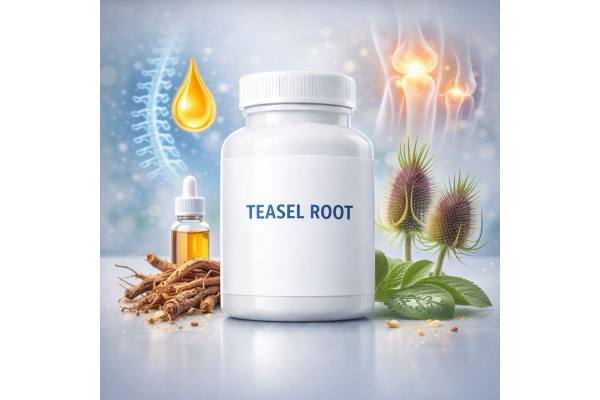
Teasel root, from plants in the Dipsacus genus, sits at the intersection of folk herbalism and modern curiosity. Traditionally, it has been used to support bones, joints, connective tissue, and general vitality, especially in East Asian and European herbal systems. Today, teasel root capsules and tinctures are often marketed for musculoskeletal pain, chronic fatigue, and as an adjunct in Lyme disease protocols, even though high-quality clinical evidence is still limited.
If you are considering teasel root, it is important to understand what is actually known: most research has been done on species such as Dipsacus asper (a traditional Chinese medicine herb known as Xu Duan), and mainly in laboratory or animal studies. These suggest anti-inflammatory, antioxidant, and bone-protective actions, but also raise safety questions at high doses and in pregnancy. This guide walks you through how teasel root is used, realistic benefits, dosage ranges suggested by practitioners, and the key side effects and precautions to keep in mind.
Quick Overview
- Traditionally used for joint, tendon, and bone support, and to aid recovery after musculoskeletal injuries.
- Modern herbalists also use teasel root as adjunctive support in chronic fatigue and Lyme-related symptom protocols, but robust clinical evidence is lacking.
- Typical supplemental ranges are around 500–1500 mg dried root extract per day or about 10–30 drops of tincture up to three times daily, but there is no standardized, evidence-based dose.
- High doses in animal studies have shown developmental toxicity and potential pro-clotting effects, so pregnancy, breastfeeding, children, and people with clotting or cardiovascular problems should avoid teasel root unless a specialist specifically recommends it.
Table of Contents
- What is teasel root and how is it used?
- Teasel root potential benefits and claims
- How to take teasel root safely
- Teasel root dosage ranges and forms
- Side effects interactions and who should avoid teasel
- Teasel root and Lyme disease evidence
- Research summary and practical recommendations
What is teasel root and how is it used?
“Teasel” refers to several species in the Dipsacus genus, a group of tall, spiny plants native to Europe, Asia, and North Africa. These plants produce distinctive cylindrical flower heads with stiff bracts that were once used to “tease” or raise the nap on wool, which is how teasel got its English name.
When people talk about teasel root as a supplement or medicinal herb, they are usually referring to:
- Dipsacus asper (Xu Duan), a traditional Chinese medicine (TCM) herb.
- Dipsacus fullonum (wild teasel), used in European folk herbalism and modern Western herbal practice.
In TCM, Dipsacus asper root (Radix Dipsaci) is traditionally used to:
- “Tonify liver and kidney,” often interpreted in modern terms as supporting bones, joints, and connective tissue.
- Promote bone healing after fractures, sprains, and tendon injuries.
- Reduce lower back and knee pain associated with weakness or degeneration.
- Support pregnancy in certain specific formulas under professional supervision.
European herbalists historically used teasel root for:
- Rheumatism, arthritis, and gout.
- General “purification” or detox support via the liver and kidneys.
- Chronic skin problems and poor wound healing.
Modern preparations are most commonly:
- Tinctures (alcohol or alcohol-water extracts of fresh or dried root).
- Capsules or tablets containing powdered root or standardized extracts.
- Less often, decoctions, where dried root is simmered in water for 20–30 minutes and drunk as a tea.
Because different species, growing conditions, and extraction methods lead to different chemical profiles, two teasel products can behave quite differently in the body even at the same “mg” dose. That variability is one reason there are no universally accepted, evidence-based dosing standards for teasel root yet.
Teasel root potential benefits and claims
Most of what we know about teasel root’s possible benefits comes from traditional use, laboratory experiments on cells, and animal studies. Human clinical trials are sparse, and many popular claims outpace the available data.
Key compound groups identified in Dipsacus roots include iridoid glycosides, triterpenoid saponins, phenolic acids, and flavonoids. These constituents are associated with anti-inflammatory, antioxidant, and bone-modulating actions in preclinical research.
Commonly discussed potential benefits include:
- Bone and joint support
- TCM and preclinical studies suggest Radix Dipsaci may promote osteoblast (bone-forming cell) activity and inhibit osteoclast (bone-resorbing cell) activity.
- In animal models of osteoporosis, extracts have been reported to improve bone density and micro-architecture when given over weeks to months.
- Musculoskeletal recovery
- Traditional indications include tendon injuries, ligament sprains, and chronic low back or knee pain tied to degeneration rather than acute trauma.
- The herb is often combined with other formula components rather than used alone, which makes it difficult to isolate its independent effects.
- Liver and kidney support (traditional framing)
- In TCM theory, supporting “liver and kidney” is linked to nourished bones, tendons, and reproductive health. Modern researchers loosely translate this as potential hepatoprotective and nephroprotective actions, and some rodent studies have shown protective effects in chemically induced liver injury models.
- Anti-inflammatory and antioxidant effects
- Extracts have demonstrated the ability to reduce pro-inflammatory cytokines and oxidative stress markers in cell cultures and animal models. This may help explain teasel’s traditional use for chronic pain and inflammatory joint conditions.
In marketing and popular herbal circles, teasel root is also often promoted for:
- Chronic fatigue and “low vitality.”
- Immune system “balancing.”
- Supporting detoxification via liver and kidneys.
- Lyme disease and other tick-borne infections (discussed in detail later).
At this point, it is important to stress:
- Most data involve Dipsacus asper extracts, not every teasel species sold online.
- Effects shown in cells or rodents at high doses do not guarantee similar benefits or safety in humans at typical supplement doses.
- For many claimed uses, especially in complex chronic illness, evidence is based on practitioner experience and case reports rather than controlled studies.
Teasel root should therefore be viewed as a traditional supportive herb with promising but still preliminary scientific backing, not as a stand-alone treatment for serious disease.
How to take teasel root safely
Because there is no single standardized way to prepare or dose teasel root, the safest approach is to work with an experienced herbalist or integrative clinician who knows the specific product you are using.
In general, teasel root is taken in one of three main forms:
- Tincture (liquid extract)
- Made by macerating fresh or dried root in a mixture of alcohol and water.
- Strength varies (for example, 1:3 fresh root vs 1:5 dried root).
- Common practitioner guidance is to start with just a few drops in water and slowly increase, especially in Lyme protocols, to watch for sensitivity.
- Capsules or tablets
- Contain powdered root or standardized extracts (sometimes labeled as “Radix Dipsaci” or “Dipsacus asper root extract”).
- Labels may suggest one or two capsules once or twice daily, but brands differ substantially in strength and quality.
- Decoction (strong tea)
- Dried root slices simmered in water for 20–30 minutes.
- TCM references often use decoctions, frequently in combination formulas; the herb is rarely used completely alone in traditional practice.
Practical tips for safer use:
- Clarify which species and part you are using.
Look for labels that specify the Latin name (for example, Dipsacus asper or Dipsacus fullonum) and confirm that the product uses root, not aerial parts. - Start low and go slowly.
Many herbal clinicians will begin with micro-doses (1–3 drops of tincture once or twice daily, or a single low-dose capsule) and increase every few days only if tolerated. This is particularly important for people with chronic illness or high sensitivity. - Use teasel as part of a broader plan, not the entire plan.
For joint health, that might include physical therapy, weight management, and other evidence-based measures. For Lyme disease, antibiotics and guideline-based care remain central; teasel should never replace them. - Monitor for changes and keep a log.
Track symptoms such as pain, stiffness, mood, sleep, digestion, and any new issues (like headaches, palpitations, or unusual bleeding). This helps you and your clinician evaluate whether teasel is helpful or causing side effects. - Cycle and reassess.
Many practitioners recommend time-limited courses (for example, 6–8 weeks followed by reassessment) rather than continuous, indefinite use. Long-term toxicity data in humans are lacking.
Because of its complex chemistry and evidence of dose-related toxicity in animal studies, self-experimenting with very high doses, combining many different teasel products, or using homemade high-proof extracts without guidance is not advisable.
Teasel root dosage ranges and forms
There is no universally accepted, clinically proven dosage for teasel root in humans. Most suggested amounts come from traditional herbal practice, TCM monographs, and manufacturer recommendations rather than controlled trials.
That said, typical ranges you may see include:
- Traditional decoction (TCM context, Radix Dipsaci / Dipsacus asper)
- Commonly cited daily crude herb dose: about 6–15 g of dried root in decoction, often combined with other herbs in a formula.
- Capsules/tablets of dried root or extract
- Many products provide 250–500 mg per capsule.
- Suggested daily amounts are often in the range of 500–1500 mg per day, divided into two or three doses (for example, 1–2 capsules two or three times daily).
- Because extract strength and standardization vary, “mg” is not equivalent across brands; some products may represent a higher concentration of active constituents than others.
- Tinctures
- Common practitioner guidance for chronic musculoskeletal support is on the order of 10–30 drops, 1–3 times daily, diluted in water or tea.
- For sensitive individuals or in Lyme protocols, herbalists sometimes start at 1 drop per day, increasing by one drop daily up to a ceiling such as 9–30 drops per day, carefully watching for reactions.
Important cautions about dosing:
- No official upper limit has been set for humans.
Subchronic toxicity studies in rats found that high doses of Radix Dipsaci water extract were generally tolerated in healthy adult animals, but developmental toxicity was seen in pregnant animals at high doses. These findings do not translate directly into safe human doses but indicate that “more” is not automatically better. - Body weight and health status matter.
People with low body weight, impaired liver or kidney function, or multiple medications may need significantly lower doses or to avoid teasel altogether. - Combination formulas change the equation.
In TCM and many Western herbal protocols, teasel is one component of larger formulas, so the single-herb dose is lower than if taking teasel alone.
Given these uncertainties, the most prudent approach is:
- Consider teasel root only after discussing with a qualified healthcare professional.
- Use the lowest effective dose within common practitioner ranges.
- Limit self-directed use to short periods (for example, several weeks), with clear goals and monitoring.
Side effects interactions and who should avoid teasel
Preclinical and traditional data suggest that teasel root can be biologically active at relatively modest doses, which means both benefits and risks are possible.
Reported or plausible side effects include:
- Digestive upset – nausea, stomach discomfort, or loose stools, especially when starting at higher doses or taking tinctures on an empty stomach.
- Headache, fatigue, or flu-like symptoms – some users in Lyme protocols report temporary symptom flares that they attribute to immune or die-off reactions, although this has not been formally studied.
- Dizziness or palpitations – less commonly reported, but theoretically possible due to circulatory and autonomic effects in sensitive individuals.
More serious concerns come from animal and laboratory studies:
- Developmental toxicity
- Controlled studies using animals and embryonic stem cells found that high oral doses of Dipsaci Radix aqueous extract caused maternal toxicity and adverse effects on embryo-fetal development.
- This strongly suggests teasel root should not be used in pregnancy or when trying to conceive unless a specialist explicitly recommends it and closely supervises dosing.
- Subchronic toxicity and organ effects
- Multi-week studies in rats given Radix Dipsaci water extract found dose-related changes at higher doses, although a no-observed-adverse-effect level could be identified. This supports caution with long-term, high-dose use in humans.
- Pro-coagulant and pro-thrombotic activity
- Some work has identified specific saponins with platelet-activating, pro-clotting properties, raising concerns that teasel extracts could theoretically increase thrombotic risk in susceptible people.
Because of these findings, teasel root is generally not recommended for:
- Pregnant or breastfeeding individuals.
- Children and adolescents (lack of safety data).
- People with a history of blood clots, stroke, or clotting disorders.
- Anyone taking anticoagulant or antiplatelet medications (for example, warfarin, direct oral anticoagulants, high-dose aspirin) without close medical supervision.
- People with significant liver or kidney disease, unless advised otherwise by a specialist.
Potential interactions:
- Anticoagulants and antiplatelet drugs – teasel’s possible pro-coagulant effects could counteract these drugs or create unpredictable clotting dynamics.
- Other herbs or supplements with coagulation effects – combining teasel with pro-coagulant or pro-circulatory herbs could increase risk.
- Medications metabolized by the liver – teasel’s influence on liver enzymes is not fully mapped, so caution is warranted with narrow-therapeutic-index drugs.
In general, if you are on any regular prescription medications, you should review teasel root use with your prescriber before starting.
Teasel root and Lyme disease evidence
One of the most visible modern uses of teasel root is as an adjunct in protocols for Lyme disease and related tick-borne conditions. Herbalists and online communities often describe teasel as a herb that can “draw out” bacteria from tissues so they are more vulnerable to immune or antibiotic attack. This idea comes largely from practitioner models, not from controlled human research.
What the evidence actually shows:
- Laboratory studies of Lyme bacteria and herbs
- In vitro studies evaluating multiple herbal extracts against Borrelia burgdorferi, the bacterium that causes Lyme disease, found that some herbs showed strong activity, while teasel extracts showed little or no significant activity against certain forms of the bacteria under the tested conditions.
- Reviews of herbal supplements used for persistent Lyme symptoms
- Recent comprehensive reviews of herbs used in persistent Lyme disease protocols conclude that evidence for teasel root is minimal, with no robust clinical trials demonstrating efficacy for treating Lyme infection or chronic Lyme symptoms. Antibiotics remain the only proven treatment for acute Lyme disease.
- Clinical trials
- There are currently no high-quality randomized controlled trials testing teasel root alone or as part of a standardized protocol for Lyme disease in humans.
- Anecdotal and practitioner reports
- Many clinicians and patients report subjective improvement in energy, joint pain, or neurologic symptoms when teasel is used as part of broader herbal and lifestyle programs.
- Others report symptom flares, sometimes interpreted as Herxheimer-type reactions. These experiences are heterogeneous and difficult to interpret without controlled comparisons.
Key takeaways regarding Lyme disease:
- Teasel root should not be relied upon as a primary treatment for Lyme infection.
- It may have a role as a supportive herb in individualized integrative care, but this remains hypothesis-generating, not proven.
- If you suspect or have confirmed Lyme disease, prompt diagnosis and evidence-based antibiotic treatment are critical; delaying treatment while experimenting with teasel alone can increase the risk of complications.
If you are already under the care of a Lyme-literate or integrative clinician and teasel root is part of your protocol, it is reasonable to:
- Clarify the goals (for example, joint support, energy, or symptom modulation).
- Review potential risks such as coagulation effects and pregnancy concerns.
- Build in regular check-ins to decide whether to continue, adjust, or discontinue use.
Research summary and practical recommendations
The scientific picture of teasel root is nuanced:
- Traditional and ethnobotanical data show long-standing use for bone healing, joint pain, and reproductive support, particularly for Dipsacus asper in Chinese medicine and Dipsacus fullonum in European herbalism.
- Phytochemical and pharmacological research identifies iridoids, saponins, and phenolic compounds with anti-inflammatory, antioxidant, and bone-modulating actions in cells and animal models.
- Toxicology studies highlight dose-dependent developmental toxicity and organ effects in animals, as well as possible pro-coagulant properties, especially at high doses.
- Clinical evidence in humans is minimal, with virtually no high-quality trials on any condition, including Lyme disease. Reviews of herbal use in persistent Lyme symptoms rate the evidence for teasel as very low.
Putting this together, practical recommendations include:
- See teasel as supportive, not curative.
It may be reasonable as a complementary herb for joint and connective tissue support within a broader plan, but it is not a stand-alone cure for Lyme or other serious conditions. - Prioritize medical basics first.
For Lyme disease, follow evidence-based guidelines for diagnosis and antibiotic treatment. For osteoporosis or joint degeneration, work on nutrition, weight-bearing exercise, fall prevention, and medications where indicated. - Choose products carefully.
- Prefer reputable brands that identify the species, plant part, and extraction ratio.
- Avoid products with unclear sourcing or exaggerated claims.
- Respect contraindications.
- Avoid teasel in pregnancy, breastfeeding, childhood, and in people with clotting disorders or significant cardiovascular risk, unless a specialist clearly advises otherwise.
- Use particular caution if you are on anticoagulants, antiplatelet drugs, or multiple medications.
- Use modest doses and finite courses.
- Stay within low to moderate ranges (for example, 500–1500 mg/day of standardized extract or 10–30 drops tincture up to three times daily), tailored to your situation.
- Reassess regularly rather than taking teasel continuously for months or years without review.
- Work with a qualified professional.
A practitioner experienced in herbal medicine and your specific health condition can help weigh potential benefits against risks and decide whether teasel root makes sense for you at all.
Ultimately, teasel root is best approached as an interesting, traditionally valued herb with emerging but incomplete scientific support and meaningful safety considerations, rather than as a low-risk cure-all.
References
- Traditional uses, processing methods, phytochemistry, pharmacology and quality control of Dipsacus asper Wall. ex C.B. Clarke: A review, 2020 (Systematic Review).
- Dipsacus and Scabiosa Species-The Source of Specialized Metabolites with High Biological Relevance: A Review, 2023 (Systematic Review).
- A subchronic toxicity study of Radix Dipsaci water extract by oral administration in F344 rats, 2016 (Toxicology Study).
- The evaluation on embryotoxicity of Dipsaci Radix with mice and embryonic stem cells, 2014 (Toxicology Study).
- A Comprehensive Review of Herbal Supplements Used for Persistent Symptoms Attributed to Lyme Disease, 2023 (Systematic Review).
Disclaimer
The information in this article is for educational purposes only and is not a substitute for personalized medical advice, diagnosis, or treatment. Teasel root is a bioactive herbal product with incomplete safety and efficacy data in humans. Do not start, stop, or change any medication or supplement, including teasel root, without discussing it with a qualified healthcare professional who understands your medical history, current medications, and treatment goals. If you are pregnant, breastfeeding, planning pregnancy, have a bleeding or clotting disorder, cardiovascular disease, liver or kidney disease, or are being treated for Lyme disease or any other serious illness, you should not use teasel root unless specifically advised and supervised by a licensed clinician.
If you found this guide helpful, please consider sharing it on Facebook, X (formerly Twitter), or any platform you prefer, and follow our work on social media. Your support in sharing our content helps our team continue to research, write, and update high-quality, evidence-informed health articles for readers worldwide.