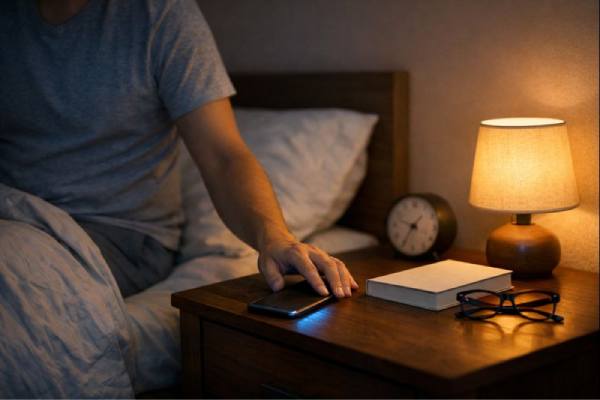
Sleep is one of the few health levers you can pull every day, and modern technology can either support it—or quietly sabotage it. Screens extend our daylight, invite endless novelty, and keep social and work demands within arm’s reach. That convenience comes with trade-offs: later bedtimes, lighter sleep, and a mind that stays “on” long after you want it to switch off. The good news is that you rarely need extreme rules to see meaningful change. Small adjustments to light, timing, content, and boundaries can improve sleep onset, reduce night awakenings, and make mornings feel less like recovery. This guide focuses on what matters most: how blue-enriched light shifts your internal clock, why doomscrolling fuels alertness, and which practical settings and routines reliably help—without turning evenings into a joyless checklist.
Essential Insights
- Reducing bright, blue-enriched light in the last 1–2 hours before bed can make falling asleep easier and protect circadian timing.
- Lowering cognitive and emotional stimulation at night often matters as much as screen light.
- “Night mode” helps, but it cannot fully offset a bright screen held close to your eyes.
- If insomnia lasts 3+ months or you have loud snoring and daytime sleepiness, prioritize clinical evaluation alongside habit changes.
- A realistic goal is a 60-minute “screen step-down” routine: dim lights and screens, silence notifications, and switch to calmer content.
Table of Contents
- Blue light and your sleep clock
- Doomscrolling and the alertness trap
- Tuning screens without perfectionism
- Notifications, noise, and bedroom boundaries
- A wind-down routine that actually sticks
- Special cases: teens, shift work, and insomnia
Blue light and your sleep clock
Your brain tracks time partly through light. In the evening, dimmer, warmer light signals that night has arrived, helping your body begin its “biological dusk.” Screens and bright indoor lighting can interrupt that message—especially because many LEDs emit a blue-enriched spectrum that strongly stimulates the retina’s light-sensitive pathway tied to circadian timing. Short-wavelength light (often discussed around the 460–480 nm range) is particularly effective at telling your brain it is still daytime, which can delay the natural rise of melatonin and shift your internal clock later.
Two mechanisms matter most, and they often stack together. First is circadian delay: if your brain keeps receiving a “daytime” light signal late at night, your preferred sleep window drifts later. Second is acute alerting: bright light—regardless of color—can make you feel temporarily more awake, reducing sleepiness right when you want it to build. This is why people can feel fine while scrolling at 11:30 p.m., then suddenly feel wired the moment they put the phone down.
Distance and intensity also matter. A small, bright screen held close to the face can deliver a surprisingly potent light dose to the eyes, even if the room itself feels dim. Meanwhile, overhead lighting can keep your environment “day-like” long after sunset, especially with cool-white LED bulbs. The practical takeaway is not to fear blue light as a toxin, but to treat evening light as a dial you can turn down.
A useful mental model is: late light equals late sleep. If you consistently want to fall asleep earlier, make your evenings darker and warmer, and make your mornings brighter. Morning light (outdoors is ideal) helps anchor your clock and makes you sleepier at an appropriate time later.
Doomscrolling and the alertness trap
“Doomscrolling” is less about the screen and more about the state of mind it creates: threat monitoring, novelty seeking, and emotional activation. Sleep requires a downshift in arousal—slower thoughts, lower muscle tension, and less emotional intensity. Doomscrolling does the opposite. It nudges the nervous system toward vigilance, which can show up as a racing mind, a faster heartbeat, shallow breathing, or a sudden urge to “just check one more thing.”
Several design features make doomscrolling uniquely sticky at bedtime:
- Infinite content removes natural stopping points. Without an end, your brain keeps searching for a cue to disengage.
- Variable reward (occasionally interesting posts mixed with mediocre ones) reinforces “just one more” behavior.
- Social comparison and outrage reliably produce strong emotions, and strong emotions are not sleep-friendly.
- Ambiguous resolution (bad news without closure) keeps the brain problem-solving instead of settling.
Time displacement is also straightforward: if you intended to be asleep at 11:00 p.m. but you start scrolling at 10:45 p.m., you are negotiating with a machine optimized to keep you awake. Even “harmless” content can be activating if it triggers planning, shopping, messaging, or identity-focused thinking.
The most effective strategy is usually not willpower—it is changing the environment so doomscrolling is harder. Consider these targeted shifts:
- Create a content boundary: after a set time, switch to content that is predictable and low-stakes (music, a familiar show, a paper book, a calm podcast).
- Shrink the decision space: remove the most activating apps from your home screen, or place them in a folder named “Tomorrow.”
- Use a stopping cue: set a timer for 10 minutes, and when it ends, physically plug the phone in across the room.
- Protect emotional tone: avoid news, conflict-heavy threads, and high-intensity group chats in the last hour before bed.
If you regularly fall into doomscrolling during stressful periods, treat it as a signal: your brain is trying to regain control. Replacing it with a brief “worry dump” (two minutes of writing what’s on your mind and one next step for tomorrow) can provide the closure your brain is searching for.
Tuning screens without perfectionism
You do not need to ban screens to sleep better, but you do need to make them less biologically and psychologically loud. The goal is a softer landing: lower brightness, warmer color, fewer surprises, and less temptation to keep interacting.
Start with brightness, because it is often more impactful than people realize. A “night shift” or “blue light filter” can help, but if the screen is still bright, your eyes are still receiving a strong alerting signal. A practical target is: in the last hour before bed, set your device to the lowest comfortable brightness you can tolerate without squinting. If you notice yourself holding the phone closer because it is dim, increase font size instead of increasing brightness.
Next, adjust color temperature. Warmer settings reduce short-wavelength emission and often feel less stimulating. Use your device’s built-in night mode, and schedule it to turn on automatically 2–3 hours before your intended bedtime so you are not making decisions while tired. If you use multiple devices, match the schedule across them to avoid one “bright link” in the chain.
Then address interaction intensity:
- Turn off autoplay where possible.
- Switch to grayscale in the evening if you are prone to compulsive checking.
- Choose “read-only” activities at night: reading an e-book, watching a calm show, or listening to audio tends to be less activating than commenting, gaming, or messaging.
- If you must work late, do a hard stop with a ritual: save, write the first step for tomorrow, close the laptop, and physically change rooms if possible.
Consider blue-light blocking glasses as a situational tool rather than a cure. They may offer modest benefits for some people, but results vary. If you try them, treat it like an experiment: wear them consistently for 1–2 weeks during the last 2 hours before bed, keep other habits stable, and track sleep onset and next-day alertness. If you see no change, do not force it—focus on brightness, timing, and content instead.
Finally, do not ignore the room’s lighting. If your ceiling lights are cool-white and bright, your brain is still receiving a “daytime” message even if your screen is dim. In the last 2 hours before bed, aim for low, warm lamps rather than bright overhead lighting.
Notifications, noise, and bedroom boundaries
Sleep is fragile in two predictable ways: it is easy to delay, and it is easy to interrupt. Technology contributes to both. Even if you fall asleep quickly, a buzz, a banner, or a glowing screen can fragment sleep and reduce how restored you feel the next day.
Think in layers—prevent stimulation, prevent interruption, prevent escalation.
Prevent stimulation:
Notifications are not neutral. They invite evaluation (“Is this urgent?”), emotion (“Why did they say that?”), and action (“I should reply now”). Use these defaults:
- Schedule Do Not Disturb to begin at least 60 minutes before bedtime and last until your wake time.
- Allow exceptions only for true emergencies (for example, repeated calls from specific contacts).
- Silence nonessential alerts entirely; most apps do not need permission to interrupt your nervous system.
Prevent interruption:
Keep the phone out of reach. “Out of reach” is more important than “on silent” because it blocks the reflexive check. If you use your phone as an alarm, place it across the room. Better yet, use a dedicated alarm clock and charge your phone outside the bedroom.
Control other sleep disruptors that travel with tech:
- Audio: if you sleep with sound, choose a steady source rather than content with unpredictable volume changes.
- Light: remove or cover bright LEDs from chargers, routers, and devices; even small points of light can become attention magnets at 3 a.m.
- Temperature: laptops and gaming devices add heat; a warmer room can reduce sleep depth for many people.
Prevent escalation:
If you wake at night, technology can turn a brief wake-up into a full reset of alertness. A reliable rule is: if you are awake long enough to feel frustrated (often around 15–20 minutes), get out of bed and do something dim and boring until sleepy again. Avoid checking the time and avoid checking the phone—both escalate arousal.
Bedroom boundaries are not moral rules; they are cues. When the bed becomes a place for scrolling, working, arguing, or planning, the brain learns that bed equals “thinking zone.” Protecting the bed as a cue for sleep and intimacy is one of the simplest ways to improve sleep consistency.
A wind-down routine that actually sticks
A good wind-down routine is less about “perfect relaxation” and more about building a predictable glide path from stimulation to sleep. The best routines are short, repeatable, and matched to real life. If your plan requires heroic discipline every night, it will fail on the nights you need it most.
Use a three-phase structure that takes 30–60 minutes total:
- Close loops (5–10 minutes):
Write down what your brain is trying to remember. Keep it simple:
- Three bullet tasks for tomorrow
- One worry and one next step (even if the next step is “ask for help”)
- One “done today” win to reduce the feeling of unfinished business
This reduces the urge to re-open email or scroll for answers.
- Lower input (10–20 minutes):
Shift from interactive to passive. Options include a warm shower, stretching, light reading, or calm audio. Keep lighting low and warm. If you still use a screen, make it a single-purpose choice—one episode, one chapter, one playlist—rather than an endless feed. - Cue sleep (5–10 minutes):
Do the same small sequence nightly: brush teeth, set alarm, dim lights further, and get into bed. Repetition is powerful; it teaches your nervous system what comes next.
Two practical upgrades make routines more durable:
- Pre-commit your environment: set up charging, water, and anything you need for the morning before you start winding down. The fewer reasons you have to “just check” your phone, the better.
- Use friction wisely: log out of the most activating apps at night, or require an extra step to open them. A single extra barrier can be enough when you are tired.
If you have a partner or family, negotiate “shared quiet.” A household-wide cue—lights down, quieter voices, reduced notifications—often helps everyone without requiring perfection from any one person.
Special cases: teens, shift work, and insomnia
Some people can make small tech tweaks and sleep better in a week. Others need a more tailored approach because biology, schedule, or sleep disorder risk changes the rules.
Teens and young adults:
Adolescents naturally drift toward later sleep timing, and early school schedules can create chronic sleep debt. Evening screen use can amplify that drift through both light and stimulation, and social pressure makes “just turning it off” unrealistic. Focus on leverage points:
- A consistent wake time on school days and weekends (avoid big swings).
- Bright morning light exposure (outdoors if possible) to anchor timing.
- A device “parking spot” outside the bedroom, even if screens are allowed earlier in the evening.
Shift workers and night schedules:
For night shifts, blue-enriched light can be helpful during the work window and unhelpful when you need daytime sleep. Treat light as a tool:
- Use brighter light during the first half of your shift to stay alert.
- Reduce light exposure on the commute home (sunglasses can help).
- Make your sleep space dark, cool, and quiet; aim for blackout conditions.
- Set strict notification boundaries during your sleep block, even if it happens at noon.
Chronic insomnia:
If sleep difficulty persists at least three nights per week for three months or more, habits still matter, but the core issue is often learned arousal: the bed becomes linked with wakefulness and worry. In that case, structured behavioral treatment (often CBT-I) is typically more effective than adding more “sleep hygiene” rules. Use tech changes to support treatment goals:
- A hard boundary on time-in-bed matching actual sleep (rather than lying awake for hours).
- No clock-watching and no phone-checking during awakenings.
- A consistent morning rise time, even after a bad night.
Wearables and sleep tracking:
Sleep trackers can motivate healthy routines, but they can also increase anxiety (“My score is terrible, so tomorrow will be terrible”). If tracking makes you more tense, scale back:
- Check trends weekly, not nightly.
- Focus on one metric you can influence (wake time consistency, bedtime range).
- Remember that consumer devices estimate sleep stages imperfectly; how you feel and function matters.
The main point: technology is rarely the only cause of poor sleep, but it is often the most adjustable part of the system. Make it easier for your brain to power down, and harder for your environment to pull you back into alert mode.
References
- Efficacy of blue-light blocking glasses on actigraphic sleep outcomes: a systematic review and meta-analysis of randomized controlled crossover trials 2025 (Systematic Review and Meta-Analysis)
- Electronic Media Use and Sleep Quality: Updated Systematic Review and Meta-Analysis 2024 (Systematic Review and Meta-Analysis)
- The influence of blue light on sleep, performance and wellbeing in young adults: A systematic review 2022 (Systematic Review)
- Effect of evening blue light blocking glasses on subjective and objective sleep in healthy adults: A randomized control trial 2021 (RCT)
- Behavioral and psychological treatments for chronic insomnia disorder in adults: an American Academy of Sleep Medicine clinical practice guideline 2021 (Guideline)
Disclaimer
This article is for educational purposes and does not provide medical advice, diagnosis, or treatment. Sleep problems can have many causes, including insomnia disorder, sleep apnea, restless legs syndrome, medication effects, mood disorders, and shift-work related circadian disruption. If you have persistent insomnia (for example, symptoms at least three nights per week for three months or more), loud snoring with daytime sleepiness, witnessed breathing pauses, or safety concerns such as drowsy driving, seek evaluation from a qualified clinician.
If you found this guide useful, please share it on Facebook, X (formerly Twitter), or any platform you prefer so others can benefit.