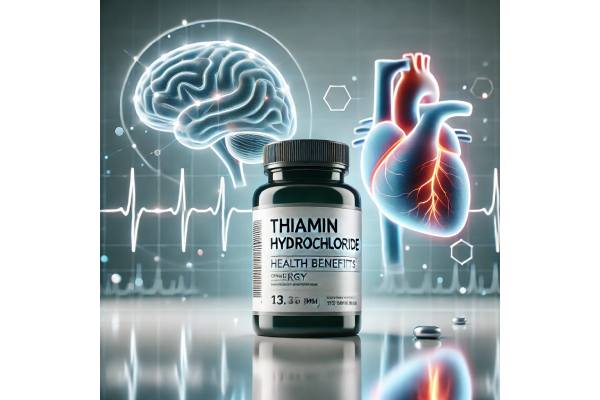
Thiamine hydrochloride is the most common supplemental form of vitamin B1, a water-soluble vitamin that helps your cells turn carbohydrates into usable energy. It plays a critical role in nerve conduction, brain function, and the proper work of the heart and muscles. Because the body stores only small amounts of thiamine, even short periods of low intake or increased losses can lead to deficiency.
You will find thiamine hydrochloride in multivitamins, B-complex products, and stand-alone tablets or injections used to treat or prevent deficiency. It is especially important in people with high carbohydrate intake, heavy alcohol use, certain digestive disorders, bariatric surgery, or long-term use of diuretics. In medical settings, higher doses of thiamine are used to treat serious conditions linked to deficiency, such as beriberi or Wernicke encephalopathy.
This guide explains what thiamine hydrochloride is, how it supports the brain and body, who may benefit from supplementation, practical dosage ranges, potential side effects, and how to discuss its use safely with a healthcare professional.
Quick Summary for Thiamine Hydrochloride
- Thiamine hydrochloride is a stable form of vitamin B1 that supports energy metabolism, nerve function, and heart health.
- It is especially useful for preventing or correcting deficiency in people with alcohol misuse, malabsorption, bariatric surgery, or very limited diets.
- Typical supplemental intakes range from about 1–2 mg per day in multivitamins up to 50–100 mg per day for deficiency, under medical supervision.
- High-dose or injectable thiamine should be used cautiously because rare allergic reactions and injection-site problems can occur.
- People with a history of severe allergy to vitamin supplements or who are acutely unwell should not self-treat with high-dose thiamine and should seek medical care instead.
Table of Contents
- What is thiamine hydrochloride?
- Key benefits for brain and body
- How to use thiamine hydrochloride in daily life
- Thiamine hydrochloride dosage guide
- Side effects and safety of thiamine hydrochloride
- What the evidence shows and practical takeaways
What is thiamine hydrochloride?
Thiamine hydrochloride is a synthetic, water-soluble salt form of thiamine (vitamin B1). It is used because it is stable, dissolves easily in water, and can be reliably manufactured in precise doses. Once absorbed, thiamine hydrochloride is converted into active coenzyme forms, mainly thiamine diphosphate (also called thiamine pyrophosphate), which drive many of the body’s core energy reactions.
Vitamin B1 is essential for several enzyme complexes that sit at key junction points in metabolism, including the conversion of pyruvate to acetyl-CoA and the function of the pentose phosphate pathway. These processes help cells make ATP, protect against oxidative stress, and synthesize neurotransmitters and nucleic acids. Organs with high energy demands—such as the brain, heart, and skeletal muscles—are particularly sensitive to marginal thiamine status.
Dietary thiamine occurs naturally in foods such as whole grains, legumes, pork, and seeds, and is added to many fortified flours and cereals. In supplements, two forms dominate: thiamine mononitrate and thiamine hydrochloride. Both are highly bioavailable when taken orally. Thiamine hydrochloride is also used in many injectable and intravenous preparations, especially in hospital settings.
The body’s total thiamine store is small, often estimated at roughly 25–30 mg, and turnover is rapid. Without regular intake, stores can be depleted within a few weeks. Factors such as high carbohydrate intake, heavy alcohol consumption, long-term diuretic use, and certain medical conditions increase requirements or losses, making deficiency more likely even in high-income settings.
Because thiamine is water-soluble and excess is excreted in urine, toxicity from oral intake is rare. However, deficiency can cause a wide spectrum of problems, from vague fatigue and irritability to serious conditions such as beriberi, Wernicke encephalopathy, and heart failure related to thiamine deficiency. Thiamine hydrochloride supplements exist to bridge the gap between dietary intake and physiological need, especially in at-risk groups.
Key benefits for brain and body
Because thiamine sits at the heart of cellular energy production, its benefits extend well beyond “just another vitamin.” Adequate thiamine hydrochloride intake supports several major systems.
1. Energy metabolism and fatigue reduction
Thiamine-dependent enzymes help break down glucose and branched-chain amino acids, allowing your cells to generate ATP efficiently. When thiamine is low, pyruvate and lactate accumulate, mitochondrial function suffers, and people may feel tired, weak, or “foggy” even if their calorie intake is adequate. Supplementation in deficient or marginally deficient individuals often improves energy levels, exercise tolerance, and general sense of vitality.
2. Nervous system and cognitive function
The brain relies heavily on glucose metabolism and thiamine-dependent pathways. Thiamine deficiency can lead to peripheral neuropathy, impaired reflexes, numbness, and burning sensations in the feet and legs. In more severe cases, it contributes to neurologic syndromes such as dry beriberi and Wernicke–Korsakoff syndrome, with confusion, ataxia, eye movement abnormalities, and memory problems. Correcting deficiency with appropriate thiamine hydrochloride regimens can rapidly improve many early neurologic signs and may prevent progression to irreversible damage in severe cases.
3. Cardiovascular health and fluid balance
Inadequate thiamine can affect the heart’s ability to pump effectively, contributing to tachycardia, enlarged heart, and fluid accumulation in “wet” beriberi. In people with heart failure, low thiamine status is common, particularly when loop diuretics are used, because these medications increase urinary thiamine loss. Restoring thiamine levels may improve symptoms, exercise capacity, and certain cardiac measurements in deficient patients, although it is not a stand-alone treatment for heart disease.
4. Glucose regulation and metabolic health
Research in diabetes and metabolic syndrome suggests that thiamine supplementation may help support endothelial function, reduce certain markers of oxidative stress, and improve some measures of glucose handling. Effects vary between studies and appear most pronounced in people with established deficiency or high cardiovascular risk, but the emerging data support ensuring adequate thiamine intake in individuals with high carbohydrate exposure or insulin resistance.
5. Digestive function and appetite
Thiamine is involved in nerve signalling and muscle tone throughout the gastrointestinal tract. Deficiency has been linked to nausea, abdominal discomfort, poor appetite, and constipation or dysmotility. In clinical practice, correcting low thiamine sometimes improves appetite and digestive comfort, particularly in malnourished or chronically ill patients.
Overall, thiamine hydrochloride’s primary benefit is ensuring that this essential vitamin is available in sufficient amounts. In well-nourished, low-risk individuals, extra thiamine may offer little beyond a safety margin. In at-risk groups, however, it can be the difference between normal cellular function and multi-system illness.
How to use thiamine hydrochloride in daily life
Using thiamine hydrochloride effectively starts with recognising your personal risk level and understanding the roles of both food and supplements.
1. Prioritise food sources first
For most healthy adults, recommended intakes (around 1.1 mg per day for women and 1.2 mg per day for men) can be met through diet. Good food sources include:
- Whole and enriched grains (brown rice, whole-wheat bread, fortified cereals)
- Legumes (lentils, beans, peas)
- Pork and other lean meats
- Seeds and nuts (sunflower seeds, flaxseeds)
- Some fish and dairy products
If your diet regularly includes these foods and you have no risk factors, a separate thiamine hydrochloride supplement is often unnecessary beyond what is present in a standard multivitamin.
2. Understand supplement formats
Thiamine hydrochloride appears in several product types:
- Multivitamin and multimineral formulas usually provide about 1–2 mg of thiamine.
- B-complex supplements often contain 10–50 mg of thiamine alongside other B vitamins.
- Single-ingredient thiamine hydrochloride tablets or capsules can range from 25 mg up to 250 mg or more per unit.
- Injectable or intravenous preparations are used in hospitals for acute deficiency or when oral intake is not possible.
When choosing a product, think about what you need: a nutritional “top-up,” or a targeted treatment for deficiency under medical care. For everyday support, lower-dose options are generally sufficient.
3. Identify if you might be at higher risk
Groups that often benefit from targeted thiamine hydrochloride supplementation include:
- People with heavy or long-term alcohol use
- Individuals after bariatric surgery or with chronic malabsorption
- Patients on long-term high-dose diuretics, especially loop diuretics
- Older adults with frail nutrition or institutionalised care
- People with very restricted diets (for example, highly refined carbohydrates with little whole food variety)
In these situations, clinicians often recommend a daily supplement, sometimes at doses higher than the dietary reference intake, to create a buffer against deficiency.
4. Combine with broader lifestyle strategies
Thiamine works best as part of a larger plan:
- Improving overall diet quality and protein intake
- Addressing alcohol misuse or dependence
- Managing underlying conditions such as heart failure or gastrointestinal disease
- Ensuring adequate intake of other related nutrients such as magnesium, which is needed for thiamine activation
Thiamine hydrochloride is not a cure-all, but it is a low-cost, generally safe tool that can support the effectiveness of other medical and nutritional interventions when used appropriately.
Thiamine hydrochloride dosage guide
There is a wide range between the usual recommended intake for healthy adults and the doses used to treat deficiency or serious illness. Understanding this range is crucial for safe use.
1. Daily requirement and typical supplement amounts
- Most healthy adults need about 1.1–1.2 mg of thiamine per day from all sources.
- Multivitamins commonly provide around 1.5 mg of thiamine hydrochloride, enough to comfortably cover average needs.
- B-complex products and stand-alone supplements often contain between 10 and 100 mg per tablet, far above the requirement but still considered safe in most people.
For general nutritional support, doses in the 1–10 mg per day range are usually sufficient when diet is reasonably balanced.
2. Doses used for mild deficiency or at-risk states
For individuals with suspected low stores but without severe symptoms—such as older adults with poor intake, people on chronic diuretics, or those recovering from illness—clinicians may recommend:
- Oral thiamine hydrochloride 25–100 mg once daily, or
- A B-complex supplement providing a similar amount of thiamine along with other B vitamins.
These doses build a margin above basic requirements and help restore tissue stores over several weeks. Duration typically spans at least one to three months, guided by symptom improvement and clinical judgement.
3. Doses for confirmed deficiency and serious conditions
In more pronounced deficiency, such as clinical beriberi, Wernicke encephalopathy, or thiamine-responsive lactic acidosis, much higher doses are used, usually in hospital settings. Regimens can include:
- Intravenous or intramuscular thiamine 100 mg or more daily for several days, then
- Transition to oral dosing of 50–100 mg per day once the patient can absorb nutrients reliably.
Some protocols use 200–500 mg per dose intravenously for short periods in severe neurologic or critical care situations. These intensive regimens are not appropriate for self-treatment and require monitoring for response and rare adverse reactions.
4. Upper intake considerations
No formal upper tolerable intake level has been set for thiamine because toxicity from oral doses is extremely rare. Excess thiamine is excreted in urine, and decades of clinical use show a broad safety margin for oral intake, even at 50–100 mg per day or more in deficiency states.
However, this does not mean that arbitrary high doses are helpful. Very large doses add cost, may interact with other medications, and are unnecessary for most people. Injectable thiamine carries a small but real risk of allergic reactions, so higher parenteral doses are reserved for clearly indicated cases.
5. Practical dosing approach
For most people considering thiamine hydrochloride:
- Use a regular multivitamin or modest B-complex for general coverage.
- Reserve higher doses (25–100 mg per day) for periods of increased need or confirmed deficiency, under the guidance of a healthcare professional.
- Avoid high-dose or injectable regimens unless they are specifically prescribed and supervised.
Side effects and safety of thiamine hydrochloride
Compared with many medications and even other vitamins, thiamine hydrochloride has a strong safety record, particularly when taken by mouth. Still, it is important to understand potential side effects and rare risks.
1. Oral thiamine side effects
Most people tolerate oral thiamine hydrochloride well, even at doses far above the daily requirement. When side effects do occur, they are usually mild and may include:
- Nausea or mild stomach discomfort
- Headache
- A feeling of warmth or flushing
- Itching or mild rash in sensitive individuals
These symptoms often resolve when the dose is lowered or the supplement is taken with food. If symptoms are persistent or severe, medical advice is warranted.
2. Allergic reactions
Allergic reactions to thiamine are uncommon but have been reported, especially with injectable preparations. Reactions range from local injection-site irritation to generalized rash, itching, or very rarely anaphylaxis.
Warning signs that need urgent care include:
- Difficulty breathing or swallowing
- Swelling of the face, lips, tongue, or throat
- Rapid heartbeat, dizziness, or faintness
- Widespread hives or severe itching
Anyone who has experienced a serious reaction to thiamine or other vitamin injections should inform all healthcare providers and avoid future exposures unless a specialist judges the benefit to outweigh the risk.
3. Safety of high-dose and intravenous use
High-dose intravenous thiamine is widely used in emergency and hospital medicine to treat Wernicke encephalopathy, severe deficiency, and some critical illness scenarios. Studies of doses up to 500 mg per injection are reassuring overall, with very low rates of serious reactions, especially when given slowly and with appropriate monitoring.
However, because intravenous administration bypasses normal protective barriers and introduces thiamine directly into the bloodstream, it should only be performed by trained professionals in environments where resuscitation equipment is available.
4. Interactions and special populations
Several factors can influence thiamine status and how thiamine hydrochloride behaves in the body:
- Long-term, high-dose diuretics can increase urinary thiamine loss.
- Certain medications may interfere with thiamine transport or activation.
- Chronic heavy alcohol use reduces thiamine absorption and storage and increases requirements.
- In severe kidney disease, accumulation of excipients from some injectable products may be a concern.
Although thiamine itself has no well-defined long-term toxicity, people with complex medical conditions, polypharmacy, or pregnancy should discuss dosing with a clinician rather than self-prescribing high doses.
5. Overall safety profile
For the average person using standard oral doses found in multivitamins or modest stand-alone supplements, thiamine hydrochloride is considered very safe. The main safety issues arise in the context of injections, extremely high therapeutic doses, or when supplementation is used as a substitute for addressing underlying alcohol dependence, malnutrition, or other serious conditions.
What the evidence shows and practical takeaways
Modern research has deepened our understanding of thiamine’s role far beyond preventing classic beriberi. It supports a more nuanced approach to thiamine hydrochloride use in both clinical care and everyday health.
1. Deficiency remains under-recognised
Surveys and clinical reports suggest that thiamine deficiency is more common than previously assumed, even in high-income countries. At-risk groups include people with alcohol use disorders, older adults, patients with chronic heart failure or kidney disease, and individuals with gastrointestinal surgery or chronic vomiting. In these populations, routine or targeted supplementation can prevent serious neurological and cardiac complications.
2. Broad systemic effects
Deficiency syndromes can affect the nervous, cardiovascular, musculoskeletal, gastrointestinal, and immune systems. Symptoms are often non-specific—fatigue, irritability, poor appetite, and vague pain—so they may be misattributed to other conditions. In such cases, a low threshold for considering thiamine status is reasonable, especially when risk factors are present.
3. Therapeutic potential beyond deficiency
Recent reviews and trials have explored higher-dose thiamine in several contexts:
- Supporting endothelial function and metabolic health in diabetes and prediabetes
- Modulating inflammatory and oxidative pathways in critical illness and sepsis
- Improving certain cardiac parameters in heart failure associated with low thiamine levels
- Addressing gastrointestinal dysmotility and unexplained lactic acidosis linked to thiamine deficiency
Results are encouraging in some subgroups but not uniformly positive. Overall, the strongest evidence still relates to preventing and treating deficiency, while the role of high-dose thiamine as a broader therapeutic agent remains an active research area.
4. Limited downside when used appropriately
Because oral thiamine hydrochloride is inexpensive and generally safe, its risk–benefit balance is favourable in many at-risk scenarios. For example, providing routine thiamine supplements to patients with chronic alcohol misuse, those starting parenteral nutrition, or individuals after bariatric surgery is a widely accepted and low-risk preventive strategy.
However, this should not lead to casual, unsupervised use of very high doses or reliance on thiamine as a substitute for comprehensive medical evaluation. Supplements are most effective when guided by a clear understanding of the underlying condition.
5. Practical summary
- Aim to meet basic needs through a varied diet rich in whole and fortified grains, lean proteins, and legumes.
- Consider a standard multivitamin or modest-dose B-complex if your diet is limited, you are older, or you have risk factors that increase thiamine needs.
- Reserve higher-dose thiamine hydrochloride (25–100 mg per day or more) for periods of increased risk or documented deficiency, under professional guidance.
- Seek urgent medical care if you or someone else shows signs of severe deficiency, such as confusion, difficulty walking, or rapid eye movements, especially in the context of malnutrition or alcohol misuse.
Thiamine hydrochloride is not a trendy wellness additive; it is a fundamental nutrient that, when overlooked, can lead to serious disease—but when used thoughtfully, helps safeguard brain function, heart health, and metabolic stability.
References
- Thiamin – Health Professional Fact Sheet 2023 (Fact Sheet)
- Vitamin B1 (Thiamine) – StatPearls – NCBI Bookshelf 2024 (Review)
- Thiamine (Vitamin B1)—An Essential Health Regulator 2025 (Review)
- Thiamine deficiency disorders: a clinical perspective 2021 (Review)
- A Systematic Review of Thiamine Supplementation in Improving Diabetes and Its Related Cardiovascular Dysfunction 2025 (Systematic Review)
Disclaimer
This article is intended for general educational purposes and does not replace medical advice, diagnosis, or treatment from a qualified healthcare professional. Thiamine hydrochloride is usually safe when taken in typical supplemental doses, but dosing decisions should consider your overall health, other medications, and specific risk factors. High-dose oral or parenteral thiamine used to treat deficiency, Wernicke encephalopathy, heart failure, or critical illness must be prescribed and monitored by a clinician familiar with current guidelines.
If you have symptoms such as confusion, difficulty walking, rapid eye movements, severe weakness, chest pain, or shortness of breath, especially in the setting of poor nutrition or heavy alcohol use, seek urgent medical care rather than self-treating with supplements. Always consult your doctor or pharmacist before starting, stopping, or changing any vitamin, mineral, or herbal product.
If you found this guide helpful, please consider sharing it on Facebook, X (formerly Twitter), or any platform you prefer, and follow our work on social media. Your support in sharing our content helps our team continue to research, write, and update high-quality, evidence-informed articles for readers around the world.