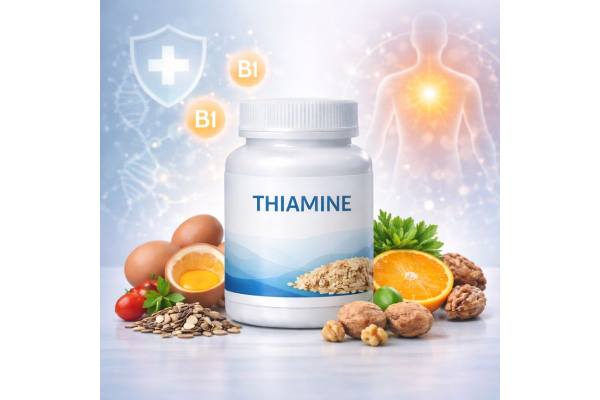
Thiamine, also called vitamin B1, is a small water-soluble vitamin with a surprisingly large impact. It sits at the gateway of how your body turns carbohydrates into usable energy, supports nerve conduction, and helps the brain handle stress. Because the body stores only a few weeks’ worth of thiamine, even mild gaps in intake can show up as fatigue, brain fog, irritability, or rapid heartbeat long before full deficiency appears.
Modern diets heavy in refined grains, alcohol use, certain medications, surgery, and chronic illness can all quietly drain thiamine status. Many people meet the basic recommended intake, yet do not reach levels associated with optimal metabolic and cardiovascular health. This guide explains what thiamine does, who is most likely to benefit from supplements, how doses differ between general wellness and medical treatment, and what is known so far about safety and side effects so you can have an informed discussion with your clinician.
Key Facts About Thiamine
- Supports energy production, nerve function, and heart health, especially when carbohydrate intake is high.
- Typical supplemental wellness doses range from about 10–100 mg per day, far above the 1.1–1.2 mg dietary requirement.
- High doses used medically (100–500 mg, often by injection) should only be given under professional supervision.
- People with chronic heavy alcohol use, severe weight loss, or recent bariatric surgery are at higher risk of deficiency and should be assessed.
Table of Contents
- What is thiamine (vitamin B1)?
- Evidence based benefits of thiamine
- How to use thiamine supplements day to day
- Thiamine dosage ranges for different needs
- Side effects, safety, and who should avoid thiamine
- Practical tips for getting enough thiamine
What is thiamine (vitamin B1)?
Thiamine is one of the eight B-complex vitamins and is essential for life. Your body cannot make it, and it stores only about 20–30 mg at any time, mainly in the heart, brain, liver, and muscles. Because stores are small and turnover is rapid, a poor intake for even a few weeks can lead to low levels.
Biochemically, thiamine is converted into thiamine pyrophosphate, a coenzyme that sits inside mitochondria and helps several key enzyme complexes work. These enzymes are responsible for breaking down glucose, branched-chain amino acids, and certain fats to generate ATP. Thiamine is also involved in the pentose phosphate pathway, which supports antioxidant defenses and DNA synthesis. When thiamine is low, cells shift toward less efficient energy production and generate more lactate, which partly explains the fatigue and lactic acidosis seen in severe deficiency.
Food sources include pork, organ meats, sunflower seeds, legumes, nuts, whole grains, and fortified breads and breakfast cereals. Polishing rice and refining flour removes most of the natural thiamine, which is why many countries enrich staple grains. Thiamine is water soluble and heat sensitive, so prolonged boiling, discarding cooking water, and food storage can reduce content.
Deficiency presents on a spectrum. Early signs may be subtle: low energy, irritability, poor concentration, and tingling in the extremities. More severe depletion causes beriberi. “Dry” beriberi affects peripheral nerves, leading to neuropathy and weakness, while “wet” beriberi stresses the heart, causing high-output heart failure and swelling. In the brain, pronounced deficiency can cause Wernicke encephalopathy and, if untreated, Korsakoff syndrome, a serious memory disorder.
Even in high-income settings, low thiamine is relatively common in people with chronic alcohol use, prolonged vomiting, restrictive dieting, bariatric surgery, heart failure treated with diuretics, and some gastrointestinal or kidney diseases. In these groups, clinicians often use supplements pre-emptively to avoid complications.
Evidence based benefits of thiamine
Because thiamine is fundamental to energy metabolism, its benefits appear wherever high energy demand and oxidative stress meet: in the brain, heart, and peripheral nerves. Research has shifted from simply preventing frank deficiency toward understanding how higher-than-minimal intakes may support metabolic and cardiovascular health.
For the nervous system, thiamine helps neurons produce ATP efficiently and maintain healthy myelin. Inadequate levels can manifest as numbness, burning feet, and impaired reflexes. Clinical experience shows that correcting deficiency often improves neuropathic symptoms within days to weeks. In alcohol-related brain disease, timely high-dose thiamine is critical to prevent or treat Wernicke encephalopathy and reduce the risk of lasting cognitive damage.
Cardiovascular benefits are increasingly studied. Observational data suggest that low thiamine status is more common in people with heart failure, especially those using loop diuretics, which increase urinary vitamin losses. Small trials of thiamine supplementation in heart failure have reported modest improvements in left-ventricular ejection fraction and symptoms in some studies, while others show neutral results. Larger analyses suggest that thiamine’s main role is to correct deficiency rather than to act as a stand-alone heart failure therapy, but ensuring adequacy appears reasonable in at-risk patients.
Thiamine also intersects with glucose regulation. It is required for enzymes that process carbohydrate load, and low status has been associated with insulin resistance and impaired glucose tolerance. Trials using higher oral doses (for example, 100–300 mg per day) in people with diabetes or pre-diabetes have reported improvements in certain vascular and metabolic markers, although results are not uniform, and this remains an adjunctive rather than primary therapy.
Other proposed benefits include supporting cognitive performance, mood, and physical energy in people with marginal deficiency; helping prevent complications in refeeding syndrome; and possibly modulating immune responses. In most of these areas, evidence is strongest when clear deficiency or high risk is present. For generally healthy adults with balanced diets, the main benefit of a modest supplement is likely “insurance” against low intake or increased demand during stress, illness, or high carbohydrate intake.
How to use thiamine supplements day to day
Over-the-counter thiamine is widely available and inexpensive. It appears either as stand-alone tablets or capsules, as part of B-complex formulas, or inside multivitamins. For daily use in otherwise healthy adults, most products supply between 10 mg and 100 mg per dose, which is many times the basic requirement of about 1.1–1.2 mg per day for adults.
Thiamine is water soluble, so timing is flexible. Many people take it with breakfast, especially if their morning meal is rich in carbohydrates, to match intake with metabolic demand. It can be taken with or without food, although taking it with meals may reduce the chance of mild stomach upset in sensitive individuals. Because it does not build up in large stores, consistent daily use matters more than the exact time of day.
Choosing a form is mostly a matter of preference. Plain thiamine hydrochloride is the standard, well-studied option. Some supplements use benfotiamine or other lipid-soluble derivatives that may enhance tissue uptake, especially for nerve health; however, they are usually more expensive, and evidence for clear superiority is still evolving. For most general wellness purposes, standard thiamine works well.
Many people prefer a B-complex supplement that combines thiamine with other B-vitamins that share roles in energy production (such as riboflavin, niacin, and vitamin B6). This approach can be useful when fatigue, stress, or poor diet are concerns, since multiple B-vitamins may be low together. However, high-dose “mega-B” formulas can easily exceed needs for some components, so labels should be checked carefully.
Magnesium deserves a special mention. Several thiamine-dependent enzymes also require magnesium as a cofactor. If magnesium intake is low, thiamine-dependent reactions may still lag despite supplementation. Ensuring adequate magnesium from food or supplements may therefore improve the functional response to thiamine in some people.
People at higher risk of deficiency—such as those with chronic heavy alcohol use, recent significant weight loss, prolonged vomiting, or bariatric surgery—should not rely on self-supplementation alone. In these situations, clinicians may recommend higher doses, parenteral (injection) routes, or combined protocols to prevent serious complications. Self-treating severe symptoms like confusion, severe weakness, chest pain, or breathlessness with vitamins alone is unsafe; urgent medical assessment is essential.
Thiamine dosage ranges for different needs
Thiamine dosing varies widely depending on the goal: maintaining general health, correcting mild deficiency, or treating serious neurological or cardiac complications. The figures below are typical ranges seen in clinical practice and research, not personalized prescriptions.
For healthy adults, dietary reference values sit around 1.1 mg per day for women and 1.2 mg per day for men, with slightly higher targets in pregnancy and lactation. Many multivitamins contain about 1.5 mg, designed to cover these needs. Because thiamine content in processed foods can be unpredictable, a small supplement of 5–10 mg per day can offer a margin of safety when diets are restricted.
For wellness-oriented supplementation, common oral doses are 10–50 mg once daily, sometimes 100 mg in short courses. These levels are far above the minimum requirement but still well within the range that has been studied for months or years with few adverse effects. They are often used for people with higher carbohydrate intake, increased physical activity, or mild unexplained fatigue where deficiency is a possibility.
When deficiency is suspected or confirmed, oral doses increase. Regimens such as 50–100 mg, two or three times per day, are often used for several weeks, then tapered to a maintenance level. In hospital settings or in people with vomiting, malabsorption, or very high risk (for example, chronic heavy alcohol use with poor nutrition, refeeding after prolonged starvation, or certain intensive-care scenarios), thiamine is frequently given by injection. Protocols in these cases may use 100 mg or more given intravenously or intramuscularly, sometimes repeated once or several times daily for a short period, followed by oral dosing.
The highest doses are reserved for emergency treatment of Wernicke encephalopathy or fulminant “shoshin” beriberi, where delayed therapy can result in permanent brain damage or death. In these situations, specialist guidelines may recommend several hundred milligrams per day intravenously over a few days, with ongoing review and step-down dosing. Such regimens must be supervised in hospital, as they are part of broader critical care.
For children, pregnancy, older adults, and people with kidney or liver disease, dosing must be individualized. While thiamine itself does not usually accumulate or cause toxicity, coexisting illnesses, other medications, and the underlying reason for deficiency alter how aggressively it should be replaced. Because there is no universally agreed upper safe limit and because high doses are sometimes used to treat serious disease, dosing decisions should be made with a clinician familiar with the person’s full medical picture.
Side effects, safety, and who should avoid thiamine
Compared with many drugs, thiamine has a very favorable safety profile. At nutritional and low-supplemental doses, side effects are uncommon. When they do occur, they are usually mild and may include nausea, stomach discomfort, or a feeling of warmth after ingestion or injection. These reactions often fade as the body adjusts or with dose reduction.
Serious adverse events are rare but important. The main concern is allergic or anaphylactic reactions, particularly with intravenous or intramuscular injections. These reactions can include rash, itching, wheezing, or sudden drop in blood pressure, and they require immediate medical treatment. They are extremely uncommon with oral tablets and capsules, but anyone with a history of allergy to vitamin injections or to excipients in a specific product should discuss risks before use.
Because thiamine is water soluble and excess is excreted in urine, toxicity from high oral intakes appears to be very limited. Clinical trials have used doses from 300 mg to more than 1000 mg per day for months without identifying clear toxic effects. However, the absence of documented toxicity is not the same as proof that extremely high doses are always safe for everyone, especially in the context of complex illness or polypharmacy. Very high doses offer diminishing returns for most people once deficiency is corrected.
Certain groups should be cautious and seek medical advice before starting supplements beyond a basic multivitamin:
- Individuals with chronic kidney disease, especially those on dialysis, because vitamin handling and fluid balance are altered.
- People with complex cardiac conditions, severe liver disease, or active cancer, where thiamine replacement may need to be coordinated with other treatments.
- Anyone with a past severe allergic reaction to thiamine or injectable vitamin preparations.
- People who are pregnant, breastfeeding, or planning pregnancy and considering high-dose regimens above standard prenatal formulations.
Children should not receive high-dose thiamine except under pediatric supervision, since dosing depends on body weight and clinical situation. Finally, thiamine can interact indirectly with other aspects of care; for example, it is often given before intravenous glucose in high-risk patients to avoid precipitating or worsening neurological injury. This timing is something clinicians manage, not something to attempt at home.
Practical tips for getting enough thiamine
A practical plan for thiamine starts with diet. Incorporate one or more thiamine-rich foods daily: whole grain breads and cereals, oats, brown rice, beans and lentils, peas, sunflower seeds, nuts, and lean pork are all good choices. Aim to spread intake across meals rather than relying on a single food source. When possible, choose minimally processed grains instead of highly refined products.
Cooking and storage practices matter. Because thiamine dissolves in water and breaks down with prolonged heat, try to cook vegetables and legumes in minimal water, or use the cooking liquid in soups and sauces. Steaming, microwaving, or pressure cooking for shorter times generally preserve more of the vitamin than slow boiling and discarding the water. Storing cooked foods for long periods and frequent reheating can gradually reduce thiamine content.
Lifestyle factors are just as important. Chronic heavy alcohol intake is one of the most common drivers of deficiency, both by reducing dietary intake and by impairing absorption and utilization. If alcohol consumption is high, reducing intake and seeking support can dramatically improve overall nutrient status. Long-term use of certain medications, such as high-dose diuretics for heart failure, some chemotherapy agents, or prolonged intravenous feeding without vitamin supplementation, can also increase risk; these situations require proactive monitoring by healthcare teams.
If you choose to use supplements, match the dose to your situation. For general insurance, a multivitamin or modest B-complex providing perhaps 5–20 mg of thiamine is often enough. People with restricted diets, recent weight-loss surgery, or chronic illnesses that affect nutrition may benefit from somewhat higher doses, but these decisions are best made with a dietitian or physician who can review lab results and other medications.
Pay attention to symptoms that might suggest low thiamine, especially if you have risk factors. These include persistent fatigue disproportionate to your schedule, new numbness or burning in the feet, unexplained muscle weakness, irritability, and shortness of breath on mild exertion. None of these signs prove deficiency, but they should prompt medical evaluation rather than long-term self-treatment.
Finally, do not overlook the bigger picture. Thiamine works alongside many other nutrients, particularly magnesium, other B-vitamins, and adequate protein. A balanced eating pattern, limited ultra-processed foods, moderated alcohol intake, regular activity, and sleep are still the foundation. Thiamine supplements are a tool to fill gaps and manage specific risks, not a substitute for general health habits.
References
- Vitamin B1 (Thiamine) – StatPearls – NCBI Bookshelf 2024 (Review)
- Thiamine (Vitamin B1)—An Essential Health Regulator 2025 (Review)
- Protocols of Thiamine Supplementation: Clinically Driven Rationality vs. Biological Commonsense 2025 (Systematic Review)
- Guidance on thiamine replacement in patients at risk of Refeeding Syndrome 2024 (Guideline)
Disclaimer
This guide is for general educational purposes and does not replace personalized medical advice, diagnosis, or treatment. Thiamine dosing, especially at high levels or by injection, must be tailored by a qualified healthcare professional who understands your full medical history, medications, and laboratory results. Never delay seeking medical care because of information you have read online, and do not attempt to treat serious symptoms such as confusion, chest pain, severe breathlessness, or rapid neurological changes with supplements alone.
If you found this article useful, please consider sharing it on Facebook, X (formerly Twitter), or any platform you prefer, and follow our work on social media. Your support by sharing helps our team continue creating carefully researched, high-quality health content.