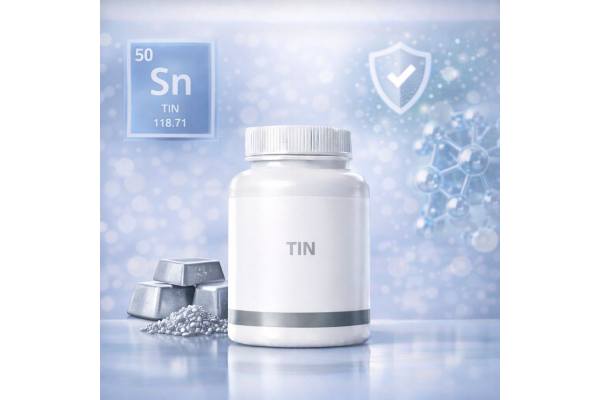
Tin is best known as the silvery metal that lines food cans, yet it also appears in some niche nutritional products and hair or “trace mineral” formulas. That can be confusing: is tin actually a nutrient, or just a contaminant that you need to keep low?
Current evidence shows that tin is not an essential trace element for humans. You already ingest tiny amounts every day from food, water, and food packaging, usually without any noticeable effect. Problems arise mainly when levels in canned foods are very high, or when people are exposed to certain industrial organotin compounds.
This guide walks you through what tin is, how your body encounters it, which effects are backed by science, and where the real risks lie. You will see why reputable authorities do not recommend routine tin supplementation, what “safe exposure” looks like in practice, and how to focus instead on proven essential minerals for long term health.
Quick Overview of Tin in Nutrition
- Tin is present in small amounts in most diets and is not currently recognized as an essential nutrient for humans.
- Typical food intake ranges from about 1–14 mg tin per day, mainly from canned foods and beverages, with no proven health benefit from higher intakes.
- High tin levels in canned foods (roughly above 150–250 mg per kg of food) can trigger acute stomach irritation, nausea, or vomiting.
- There is no evidence based supplemental dose for tin; regulatory limits suggest keeping total intake below about 14 mg per kg body weight per week.
- Children, pregnant or breastfeeding people, and anyone with kidney or liver disease should avoid non prescribed tin supplements and unnecessary high tin exposure.
Table of Contents
- What is tin in human nutrition?
- Are there real benefits of tin?
- How are we exposed to tin?
- Is tin supplementation ever appropriate?
- Side effects and toxicity risks of tin
- Practical safety tips and safer alternatives
What is tin in human nutrition?
Tin is a soft, silvery white metal (chemical symbol Sn) that occurs naturally in soil and rocks. It does not rust easily and solders well, which is why it has been widely used to line steel food cans, in alloys like bronze, and in some industrial chemicals. From a nutrition perspective, tin behaves very differently from classic essential trace elements like zinc or selenium.
When you eat foods that contain tin, only a small fraction is absorbed through the gut. Most inorganic tin passes through the digestive tract and is excreted in the stool, with a smaller amount eliminated in urine. This poor absorption means that, at normal dietary levels, tin does not accumulate rapidly in the body. Tiny residues can remain in tissues like bone for longer, but they are usually very low.
Importantly, major expert reviews conclude that there is no evidence tin is an essential element for humans. In other words, there is no clearly defined deficiency syndrome in people, no specific tin dependent enzyme that fails without it, and no agreed daily requirement. Some older animal experiments hinted that very low tin diets might affect growth or bone structure in certain species, but these findings have not translated into a recognized human need.
In modern diets, most people ingest a few milligrams of tin per day, largely from canned foods where tin from the can surface dissolves into the contents. Fresh, frozen, and glass packaged foods tend to contain very little tin, usually well under 2 parts per million by weight. Because tin is not essential, the focus of public health agencies is on limiting excessive exposure, not preventing deficiency.
For practical purposes, you can think of tin as an environmental and food contact metal that your body can tolerate in small amounts, rather than as a nutrient you need to chase in supplement form.
Are there real benefits of tin?
If you have seen tin listed inside a “trace mineral complex”, it is usually presented alongside truly essential minerals like zinc and copper. Marketing copy may hint at benefits for mood, energy, or hair quality. However, when you look for solid human data, almost none of these claims hold up.
There are a few reasons tin has occasionally been framed as helpful:
- Early animal data: Decades old studies in animals suggested that extremely low tin diets might modestly affect growth or bone structure under tightly controlled conditions. These experiments were never replicated convincingly in humans.
- Trace presence in tissues: Very small amounts of tin can be detected in human tissues and fluids. That is also true for many non essential elements and does not prove biological necessity.
- Association with other nutrients: Some multi mineral products include tin simply because it is one of many trace elements found in soil or in traditional mineral salt mixtures, not because it has an established function.
Modern, high quality reviews of trace elements classify tin as non essential or potentially toxic rather than beneficial. Unlike zinc or iron, there is no recognized tin deficiency disease, no recommended dietary allowance, and no measurable improvement in clinical outcomes when tin intake increases within the typical dietary range.
You may encounter anecdotal reports that tin improves hair texture, sleep, or mood. These are not supported by controlled trials and are difficult to separate from placebo effects or the impact of other nutrients in a supplement blend. Given that most people already receive several milligrams of tin per day from food packaging, any additional contribution from a supplement is unlikely to be the key driver of noticeable changes.
Because the known, well established benefits of essential trace elements already come from minerals like zinc, iodine, selenium, and copper, there is little rationale to add tin for “balance.” Until robust human evidence shows a clear advantage at specific doses with acceptable safety, tin is better viewed as a contaminant to manage than a nutrient to optimize.
How are we exposed to tin?
Even if you never touch a tin labeled supplement, you encounter small amounts of tin every day through your diet and environment. Understanding these exposure routes makes it easier to see where genuine risk lies and where concern is unnecessary.
Dietary exposure
For most people, food is the main source of tin. Key points include:
- Canned foods and drinks: In cans made from tinplate steel, a thin layer of metallic tin protects the can from corrosion. Over time, some tin can dissolve into the food, especially if the contents are acidic (for example, tomato products or fruit juices) or the can interior is not fully lacquered. Typical levels in properly manufactured, lacquered cans are low, often under 25 milligrams of tin per kilogram of food. In unlacquered or poorly stored cans, levels can be much higher.
- Fresh and unpackaged foods: Vegetables, fruits, grains, dairy, meat, and beverages that are not stored in metal cans usually contain very little tin, generally less than 2 parts per million by weight. These background levels come from soil and water.
- Special products: Some toothpastes include stannous fluoride (a tin containing compound) for cavity protection. When used as directed, systemic tin exposure from toothpaste is minimal because it is not swallowed in large quantities.
Across different diets, estimated average adult tin intake from food typically ranges from about 1 to 14 mg per day, with higher values in people who consume many canned foods and lower values in those who rely mainly on fresh or frozen items.
Environmental and occupational exposure
Beyond food, tin can enter the air, water, and soil near mining, smelting, and industrial plants that use tin or organotin compounds. Possible exposure settings include:
- Workplaces that produce or handle tin, solders, or organotin chemicals used in plastics, paints, and wood preservatives.
- Local environments near certain industrial facilities or contaminated sites, where dust, soil, or water may contain elevated tin levels.
- Seafood and coastal waters, where organotin compounds once used in anti fouling paints on ships may persist in sediments and enter marine food chains.
For the general population, airborne and drinking water tin levels are usually far below those associated with health effects. Occupational situations and specific polluted sites are the main contexts where inhalation or dermal exposure becomes important.
Overall, the average person’s tin exposure is modest and dominated by diet, especially canned foods. The primary goal is avoiding occasional very high intakes from badly manufactured or damaged cans, rather than eliminating all tin.
Is tin supplementation ever appropriate?
Because tin is not recognized as an essential nutrient, there is no official recommended dietary allowance, no agreed “optimal” blood level, and no medically endorsed indication for tin supplementation. When tin appears in a supplement formula, it is almost always for historical or marketing reasons instead of clear clinical need.
Several considerations clarify why routine tin supplementation is not advisable:
- Lack of proven benefit No well designed human trials have shown that adding tin to the diet improves energy, mood, hair, skin, bone health, or immune function. In contrast, robust evidence supports the benefits of addressing deficiencies in iron, zinc, iodine, or vitamin D. In a context where attention and money are limited, prioritizing nutrients with demonstrated impact is more sensible.
- Existing background intake Most adults already consume a few milligrams of tin daily from food and beverages, especially canned items. Regulatory assessments estimate chronic average intakes in the range of roughly 1–14 mg per day depending on diet and region. That level has not been linked to deficiency or specific health problems in the general population.
- Safety benchmarks focus on upper limits International bodies have derived a provisional tolerable weekly intake for tin of about 14 mg per kilogram of body weight. This benchmark is meant to protect consumers from adverse effects over a lifetime. It is not a target to reach but rather a ceiling you should stay below. Supplements that add extra tin only move you closer to that ceiling without a clear upside.
- Dosage questions Because there is no recognized beneficial dose, any suggested tin amount on a supplement label is essentially arbitrary. Some products provide microgram quantities that are nutritionally negligible. Others offer milligram doses that could meaningfully increase total intake without clear justification, especially if combined with a canned food heavy diet.
- Higher risk groups People with impaired kidney or liver function, children, and pregnant or breastfeeding individuals are often more vulnerable to metal accumulation or toxicity. For them, taking non essential metals without strong benefit evidence is particularly hard to justify.
In practical terms, tin supplementation should be considered only within controlled research settings or in very specific industrial hygiene situations under expert supervision, not as a general wellness strategy. If you see it on a label, it is reasonable to ask whether that product reflects current nutritional science.
Side effects and toxicity risks of tin
While small dietary intakes of inorganic tin are usually well tolerated, higher exposures can cause clear adverse effects, particularly in the digestive system. Organotin compounds used in certain industrial applications can be significantly more toxic than simple inorganic tin salts or metallic tin.
Acute effects from high intake
When large amounts of inorganic tin leach into canned foods or beverages, people may experience:
- Sudden nausea and vomiting
- Abdominal pain or cramping
- Diarrhea
- Headache or general malaise
Careful evaluations of outbreak reports suggest that acute gastric irritation can appear when tin concentrations in canned beverages exceed roughly 150 mg per kilogram and in canned foods exceed roughly 200–250 mg per kilogram. At these levels, symptoms usually occur shortly after eating or drinking and resolve once exposure stops.
Short term and chronic toxicity
In controlled human studies where volunteers ingested high single doses of inorganic tin salts, very large bolus doses caused stomach upset and, at still higher levels, signs of anemia and potential liver or kidney stress. Fortunately, because tin is poorly absorbed and mostly excreted in feces, lower everyday intakes from food rarely reach those extremes.
Long term toxicology studies in animals have explored whether sustained high tin exposure can cause cancer, reproductive harm, or genetic damage. For inorganic tin, findings so far do not show strong carcinogenic or mutagenic effects at doses relevant to human dietary exposure. However, that does not mean high exposures are benign: persistent gastrointestinal irritation, weight changes, and organ effects have been observed at higher experimental doses.
Organotin compounds
A different risk category involves organotin compounds, where tin is bound to carbon containing groups. These chemicals have been used in:
- Marine anti fouling paints
- Certain plastics and PVC stabilizers
- Pesticides and wood preservatives
Organotins can be far more toxic than simple inorganic tin salts. Depending on the specific compound, reported human effects include skin and eye irritation, respiratory symptoms, neurological complaints, immune suppression, and endocrine disruption. Regulations have significantly restricted the most hazardous organotins in many regions, but legacy contamination may persist in some marine environments and industrial sites.
Vulnerable populations
Children, pregnant people, individuals with pre existing gastrointestinal disease, and those with impaired kidney or liver function may be more sensitive to both inorganic tin and organotin exposures. For them, avoiding questionable canned products and occupational or environmental exposures is especially important.
The bottom line is that tin is not among the most dangerous metals at normal dietary levels, but clear toxicity appears at higher doses, and certain organotin compounds are hazardous even at relatively low exposures. That profile supports a cautious approach rather than enthusiastic supplementation.
Practical safety tips and safer alternatives
If tin is not an essential nutrient and high exposures can be irritating or harmful, what should you actually do in daily life? Fortunately, a few straightforward habits can keep your tin intake in a comfortable range while you focus on nutrients that truly matter.
Smart choices with canned foods
You do not need to avoid canned foods entirely, but these steps reduce the chance of a high tin dose:
- Prefer reputable brands that follow modern canning standards, including well applied internal lacquers on cans.
- Avoid canned foods that taste metallic, fizz unexpectedly when opened (if not carbonated), or show obvious can damage such as severe dents, corrosion, or swelling.
- Transfer leftover canned foods to glass or plastic containers rather than storing them in an opened can in the refrigerator. This limits further leaching of tin into the food.
- Rotate canned items with fresh, frozen, or glass packaged alternatives to diversify both your diet and your potential exposure.
At work and in the environment
If you work with tin solder, organotin containing materials, or in smelting and metal processing environments:
- Follow occupational safety guidance for ventilation, protective equipment, and hygiene (for example, hand washing before meals and avoiding bringing contaminated clothing home).
- Participate in workplace health monitoring if it is offered, especially if exposure levels may be significant.
- Report any symptoms like persistent cough, skin irritation, or neurological changes to your occupational health provider.
For people living near industrial sites or known contaminated areas, local health and environmental agencies are the best source of site specific advice on water testing, soil safety, and seafood consumption.
Focusing on proven essential minerals
Instead of paying extra for supplements that include non essential metals like tin, consider confirming that you are meeting needs for:
- Iron (especially in menstruating individuals and during pregnancy)
- Iodine (for thyroid function)
- Zinc (for immune and skin health)
- Selenium (for antioxidant and thyroid systems)
- Calcium, magnesium, and vitamin D (for bone and muscle function)
These nutrients have well defined deficiency states, established intake recommendations, and substantial evidence for benefit when corrected.
When to seek medical advice
You should talk with a health professional if:
- You suspect you have consumed food from a can with an unusually metallic taste and now have acute vomiting, abdominal pain, or diarrhea.
- You work with organotin compounds and notice new neurological or respiratory symptoms.
- You have chronic kidney, liver, or gastrointestinal disease and are concerned about cumulative exposure to metals, including tin, from your diet or environment.
In all of these situations, a clinician can evaluate your specific risk, advise on appropriate testing if needed, and help you prioritize which exposures are most important to address.
References
- Trace Elements in Human Nutrition (II) – An Update 2020 (Systematic Review)
- TIN 2006 (Expert Committee Evaluation)
- Toxicological Profile for Tin and Tin Compounds 2005 (Guideline)
- Re-evaluation of stannous chloride (E 512) as food additive 2018 (Risk Assessment)
Disclaimer
The information in this article is intended for general educational purposes and does not replace personalized medical advice, diagnosis, or treatment. Individual health decisions about diet, supplements, and environmental exposures should always be made in consultation with a qualified healthcare professional who can consider your medical history, medications, and laboratory data. Tin is not currently recognized as an essential nutrient, and no supplement containing tin should be started, stopped, or adjusted solely on the basis of this article.
If you have symptoms that you think may be related to metal exposure, or if you work with tin or organotin compounds, discuss your situation with your doctor or an occupational health specialist. In an emergency or if you feel seriously unwell, seek in person medical care without delay.
If you found this guide useful, please consider sharing it on Facebook, X (formerly Twitter), or any platform you prefer, and follow our work on social media. Your support in sharing our articles helps our team continue producing careful, evidence based health content.