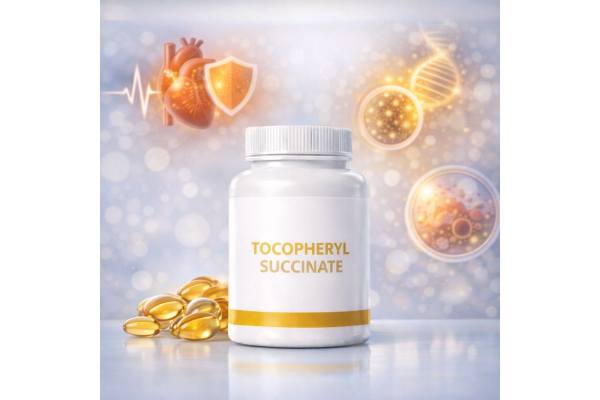
Tocopheryl succinate, often called vitamin E succinate or α-tocopheryl succinate, is an ester form of vitamin E that has attracted attention far beyond its role as a simple antioxidant. In this form, vitamin E is bound to succinic acid, which changes how it behaves in cells and how it is used in supplements, skincare, and experimental therapies. Preclinical research suggests that tocopheryl succinate may influence oxidative stress, mitochondrial function, and cell death pathways, especially in fast-dividing cells. At the same time, water-soluble derivatives such as tocopheryl polyethylene glycol succinate (TPGS) are already used clinically to correct vitamin E deficiency and to enhance drug delivery. This guide walks you through what tocopheryl succinate is, how it differs from other vitamin E forms, its potential benefits and uses, typical dosage ranges in available products, and the side effects and safety considerations you should understand before using it.
Key Insights for Tocopheryl Succinate
- Tocopheryl succinate is an esterified form of vitamin E that can influence antioxidant defenses and mitochondrial function.
- Most proposed anticancer and immune-modulating benefits are based on cell and animal studies rather than large human clinical trials.
- Water-soluble vitamin E succinate derivatives such as TPGS have been used to treat severe vitamin E deficiency under medical supervision.
- High doses of vitamin E forms may increase the risk of gastrointestinal upset, bleeding in susceptible people, or interactions with chemotherapy and anticoagulant drugs.
- People with bleeding disorders, advanced liver disease, severe kidney disease, or those on blood thinners or active cancer treatment should use tocopheryl succinate only under specialist guidance.
Table of Contents
- What is tocopheryl succinate?
- What are the main benefits of tocopheryl succinate?
- How to use tocopheryl succinate in supplements and skincare
- What is an appropriate tocopheryl succinate dosage?
- Side effects, interactions, and who should avoid tocopheryl succinate
- What does the research say about tocopheryl succinate?
What is tocopheryl succinate?
Tocopheryl succinate is a modified form of vitamin E in which α-tocopherol (the main dietary vitamin E isoform) is chemically linked to succinic acid. This bond creates an ester that is more stable to oxidation and somewhat less lipophilic than free α-tocopherol. In supplements and topical products you will often see the names “α-tocopheryl succinate,” “vitamin E succinate,” or “D-α-tocopheryl succinate.”
Unlike plain α-tocopherol, which primarily acts as a chain-breaking antioxidant in lipid membranes, tocopheryl succinate appears to interact differently with cell membranes and mitochondria. Laboratory studies suggest that it can accumulate in mitochondrial membranes and interfere with the function of complex II of the respiratory chain, especially at the ubiquinone-binding site. This mitochondrial targeting is thought to increase reactive oxygen species in stressed or rapidly dividing cells and trigger programmed cell death (apoptosis).
In commercial products, tocopheryl succinate rarely appears as a stand-alone nutrient in multivitamins because standard vitamin E activity is usually measured in α-tocopherol equivalents. However, you may find it in:
- Specialty antioxidant or “mitochondrial support” supplements
- Some oncology-adjacent nutraceutical formulations
- Topical skincare, especially serums and creams aimed at barrier support and photoprotection
A closely related derivative, d-α-tocopheryl polyethylene glycol 1000 succinate (TPGS), is a water-soluble version in which the succinate is further linked to a polyethylene glycol chain. TPGS is used medically to treat vitamin E deficiency in patients with fat-malabsorption and as a pharmaceutical excipient to improve drug solubility and absorption, which differs from the more experimental role of simple tocopheryl succinate in disease-modifying strategies.
Understanding these structural differences matters because they influence absorption, distribution, and how strongly each form affects mitochondrial function, oxidative stress, and cell signaling.
What are the main benefits of tocopheryl succinate?
Most of the proposed benefits of tocopheryl succinate come from preclinical work in cell cultures and animal models, not from large, well-controlled human trials. With that caveat, several potential advantages have emerged.
1. Antioxidant and membrane-stabilizing actions
Like other vitamin E forms, tocopheryl succinate can help protect cell membranes from lipid peroxidation, especially in environments with high oxidative stress. The succinate moiety does not remove its antioxidant properties; instead, it may change where and how the molecule partitions into membranes and intracellular compartments. This could be relevant in tissues exposed to chronic inflammation or oxidative injury, such as the liver, skin, or cardiovascular system.
2. Pro-apoptotic effects in cancer cells (preclinical)
One of the most distinctive features of tocopheryl succinate is its ability to trigger apoptosis selectively in many cancer cell lines while having far less effect on matched normal cells in vitro. Research indicates that α-tocopheryl succinate can:
- Disrupt mitochondrial complex II and increase mitochondrial reactive oxygen species
- Activate pro-apoptotic proteins such as Bak and Bax
- Promote release of cytochrome c and downstream caspase activation
These effects are sometimes grouped under the term “mitocan” (mitochondria-targeting anticancer agents). At least in models, tocopheryl succinate can slow tumor growth, sensitize tumors to chemotherapy, or overcome multidrug resistance when formulated appropriately.
3. Immune-modulating and anti-inflammatory potential
Vitamin E as a family of molecules plays an important role in immune cell function. More recent work suggests that certain analogues, including α-tocopheryl succinate, may enhance dendritic cell activity or modify the tumor microenvironment when used as adjuvants in cancer immunotherapy models. These findings hint at a possible role supporting T-cell mediated responses and reducing immunosuppressive cell populations in tumours, although this remains early-stage research without clear clinical protocols.
4. Skin barrier and photoprotection support
In topical products, tocopheryl succinate is used for its antioxidant ability and perceived stability compared with free tocopherol. Formulators include it to help:
- Reduce oxidative damage induced by UV exposure
- Support the skin barrier and reduce transepidermal water loss when combined with emollients
- Complement other actives such as vitamin C or niacinamide
Most of these benefits mirror what is known for topical vitamin E in general, with the succinate form chosen mainly for formulation reasons (stability and compatibility with emulsions).
Because most of the striking anticancer data are preclinical, clinicians currently view tocopheryl succinate as a promising research molecule rather than a proven therapy. For everyday users, its realistic advantages lie more in antioxidant support and topical skin care than in direct disease treatment.
How to use tocopheryl succinate in supplements and skincare
How you use tocopheryl succinate depends on whether your focus is oral supplementation, targeted medical use under supervision, or topical skincare.
Oral supplements
In over-the-counter products, tocopheryl succinate may appear as:
- A listed source of vitamin E in capsules or tablets
- Part of “mitochondrial” or “cell protection” complexes
- Included in combination with vitamin C, CoQ10, selenium, or plant polyphenols
For general antioxidant support, most manufacturers use tocopheryl succinate at doses equivalent to typical vitamin E amounts (for example, 100–400 IU per day of vitamin E equivalents, or roughly 67–268 mg of α-tocopherol equivalents). This level is often within or slightly above the range of usual dietary supplements but below the high doses used in some older vitamin E trials.
Clinical and specialized uses (TPGS)
In clinical practice, the best-documented use of a succinate form of vitamin E is TPGS (d-α-tocopheryl polyethylene glycol 1000 succinate) rather than plain tocopheryl succinate. TPGS is:
- A water-soluble vitamin E derivative
- Used to correct severe vitamin E deficiency in children with chronic cholestasis and fat-malabsorption who do not respond to large doses of standard vitamin E
- Also used widely in pharmaceuticals to improve solubility and absorption of poorly soluble drugs
In these contexts, dosing and monitoring are handled by specialists, and TPGS is treated as a prescription-strength formulation rather than a casual supplement.
Topical skincare
Tocopheryl succinate is more common in creams and serums than in stand-alone oral products. You might see it in:
- Moisturizers marketed for barrier repair or after-sun care
- Antioxidant serums combined with vitamins C and A
- Eye creams or face creams aimed at reducing the visible effects of oxidative stress
Practical tips for topical use:
- Look for leave-on products (serums, creams, oils) rather than cleansers, so the ingredient has contact time with the skin.
- Use once or twice daily, often after cleansing and before or mixed with your moisturizer.
- Pair with daily broad-spectrum sunscreen; antioxidants support but do not replace UV protection.
Stacking with other supplements
If you already take a multivitamin with vitamin E, adding additional tocopheryl succinate can increase your total vitamin E intake. It is sensible to:
- Tally total vitamin E from all sources (multivitamin, separate vitamin E, tocopheryl succinate products, functional foods).
- Keep long-term intake at or below commonly recommended upper limits unless under medical care.
Because tocopheryl succinate may have stronger mitochondrial effects than basic α-tocopherol, people with complex health conditions, especially cancer, should coordinate any high-dose use with their oncology or specialist team.
What is an appropriate tocopheryl succinate dosage?
There is no universally accepted “standard dose” of tocopheryl succinate for the general population. Guidance is usually inferred from:
- Typical vitamin E supplement doses
- Clinical experience with TPGS in deficiency states
- Safety data from trials and long-term vitamin E supplementation in other contexts
General supplement ranges
In non-prescription products, tocopheryl succinate is usually dosed to provide between 50 and 400 IU of vitamin E per day (approximately 33–268 mg α-tocopherol equivalents). This is similar to standard vitamin E capsules, just in a different chemical form. For many adults with no major health issues, staying closer to the lower–middle part of that range (for example, 100–200 IU/day) is a conservative approach when diet already contains some vitamin E from nuts, seeds, and vegetable oils.
Medically supervised dosing (TPGS)
When used to correct severe vitamin E deficiency in patients with cholestasis, TPGS has been administered orally in body-weight–based doses under specialist supervision. These doses are not intended for self-supplementation and highlight why medical oversight is essential when high doses are used in vulnerable populations.
Topical product strengths
In skincare, the concentration of tocopheryl succinate typically ranges from about 0.1% to several percent of the formula:
- Lower concentrations (0.1–0.5%) often appear in combination antioxidant products.
- Higher concentrations (1–5%) may be marketed for intensive barrier support or anti-aging effects.
Because absorption through intact skin is limited and localized, topical use generally raises fewer systemic safety concerns than oral supplementation, assuming the user has no allergy or sensitivity.
Choosing a practical dosage strategy
For a generally healthy adult considering tocopheryl succinate:
- If your multivitamin already provides 100–200 IU of vitamin E, adding another 100 IU from tocopheryl succinate likely keeps you within a moderate intake range, provided you do not use separate high-dose vitamin E as well.
- Those with clotting disorders, on anticoagulant therapy, or with significant liver disease should avoid high doses of any vitamin E form unless directed by a clinician, because of potential bleeding risk and impaired metabolism.
Children, pregnant or breastfeeding individuals, and people with chronic diseases should avoid self-directed doses above basic dietary replacement and should instead obtain individualized advice based on lab values and clinical goals.
Side effects, interactions, and who should avoid tocopheryl succinate
Although vitamin E is often perceived as a gentle nutrient, concentrated tocopheryl succinate and related high-dose vitamin E formulations can cause problems in some situations.
Common and mild side effects
At typical supplement doses, side effects are usually mild and may include:
- Nausea, stomach discomfort, or loose stools
- Headache or fatigue in sensitive individuals
- Skin irritation, redness, or breakouts when used topically, especially in very sensitive or acne-prone skin
These effects often improve when the dose is reduced or the product is used less frequently.
Bleeding risk and clotting concerns
Vitamin E can influence platelet aggregation and vitamin K–dependent clotting pathways. High intake, especially above several hundred IU per day from combined sources, has been associated in some research with an increased tendency to bleed, particularly in people who:
- Take anticoagulants (warfarin, direct oral anticoagulants) or antiplatelet agents (aspirin, clopidogrel)
- Have bleeding disorders or very low platelet counts
- Are scheduled for surgery or invasive procedures
Because tocopheryl succinate is a vitamin E source, this risk consideration applies to it as well. Anyone on blood-thinning medication should discuss total vitamin E intake with their prescriber.
Interactions with cancer therapies
A key concern in oncology is whether strong antioxidants might blunt the intended oxidative damage caused by some chemotherapies and radiotherapy. Tocopheryl succinate occupies a complex position here: in models, it can both produce pro-oxidant effects selectively in cancer cells and protect normal tissues, depending on context, dose, and timing.
Because robust human data are lacking, many oncologists advise caution with high-dose vitamin E or experimental analogues during active chemotherapy or radiotherapy unless part of a controlled clinical protocol. Patients interested in tocopheryl succinate should therefore involve their oncology team before starting or stopping any such supplements.
Who should avoid or be especially cautious?
Extra caution or avoidance is advisable if you:
- Have a known allergy to vitamin E derivatives or previous reactions to vitamin E–containing products
- Have a history of severe bleeding, hemorrhagic stroke, or are on strong blood thinners
- Have advanced liver failure or severe kidney disease
- Are pregnant, breastfeeding, or planning pregnancy and considering doses above basic prenatal vitamin levels
- Are undergoing active cancer treatment, unless your oncology team explicitly approves a defined protocol
In all of these cases, it is safer to rely on dietary sources of vitamin E and standard, clinician-recommended formulations rather than self-experimentation with high-dose tocopheryl succinate.
What does the research say about tocopheryl succinate?
Research on tocopheryl succinate stretches back several decades and spans biochemistry, oncology, immunology, and pharmaceutical sciences. The key themes can be grouped as follows.
1. Mitochondrial targeting and apoptosis
Mechanistic studies show that α-tocopheryl succinate interacts with mitochondrial complex II (succinate–ubiquinone reductase). By binding near the ubiquinone site, it can partially disrupt electron transport, increase mitochondrial reactive oxygen species, and trigger mitochondrial outer membrane permeabilization. This cascade leads to cytochrome c release and caspase-dependent apoptosis in many cancer cell lines.
A notable feature is relative selectivity: transformed or rapidly dividing cells tend to be more sensitive than healthy, non-proliferating cells, possibly because of differences in mitochondrial membrane potential, redox state, or antioxidant defenses. That selectivity underlies the interest in tocopheryl succinate as a prototype mitochondria-targeted agent.
2. Anticancer effects in preclinical models
Beyond isolated cells, α-tocopheryl succinate has inhibited tumor growth in various animal models when administered alone or in combination with chemotherapy. Reported effects include:
- Reduced tumor volume and delayed progression
- Enhanced sensitivity to standard chemotherapeutic drugs
- Possible effects on angiogenesis and metastasis in some models
However, translating doses and delivery systems from animals to humans is non-trivial. Many experiments use formulations (such as nano-carriers or targeted delivery systems) and dose levels that may not be practical or safe for routine human use.
3. Immunomodulation and combination with immunotherapy
Recent reviews on vitamin E and its analogues, including α-tocopheryl succinate, have highlighted possible roles in shaping anti-tumor immunity. Proposed mechanisms include:
- Enhancing dendritic cell maturation and antigen presentation
- Increasing effector T-cell activity
- Reducing immunosuppressive cell types within the tumor microenvironment
Some preclinical studies have explored tocopheryl succinate as an adjuvant to cancer vaccines or in combination with checkpoint inhibitors, but this field is still emerging and remains far from clinical guidelines.
4. Clinical data and gaps
For tocopheryl succinate itself (not TPGS), human clinical data are sparse and fragmented. Small early-phase trials and pilot studies have been conducted, but there are no large randomized controlled trials clearly establishing:
- Proven survival benefits in cancer
- Clear cardiovascular or metabolic outcomes
- Standard dosing regimens for chronic disease modification
In contrast, TPGS has robust clinical use for correcting vitamin E deficiency in cholestatic children and is extensively characterized as a safe drug-delivery excipient. That means clinicians are more comfortable using TPGS for its vitamin E and formulation role than prescribing plain tocopheryl succinate as a disease-modifying therapy.
5. Overall evidence balance
Taken together:
- The mechanistic and preclinical evidence that tocopheryl succinate can act as a mitochondria-targeted anticancer agent is strong and internally consistent.
- Evidence that it improves meaningful clinical outcomes in humans is currently limited.
- Safety at moderate doses appears acceptable in most people, but high-dose, long-term use around serious illness (such as active cancer) remains an area for controlled research, not self-experimentation.
For now, tocopheryl succinate is best viewed as a promising research molecule, a useful component of certain drug formulations, and a helpful antioxidant in topical skincare—rather than a proven standalone therapy for serious disease.
References
- Vitamin E succinate with multiple functions: A versatile agent in nanomedicine-based cancer therapy and its delivery strategies 2021 (Systematic Review).
- α-Tocopheryl succinate induces apoptosis by targeting ubiquinone-binding sites in mitochondrial respiratory complex II 2008 (Mechanistic Study).
- Treatment of vitamin E deficiency during chronic childhood cholestasis with oral d-alpha-tocopheryl polyethylene glycol-1000 succinate 1987 (Clinical Trial).
- Delineating the Immunotherapeutic Potential of Vitamin E and Its Analogues in Cancer: A Comprehensive Narrative Review 2024 (Narrative Review).
Disclaimer
The information in this article is intended for general educational purposes only and does not replace personalized medical advice, diagnosis, or treatment from a qualified healthcare professional. Tocopheryl succinate and related vitamin E derivatives can interact with medications and underlying health conditions, especially in the context of bleeding risk, liver disease, and cancer therapy. Never start, stop, or change any supplement or medication regimen based solely on online content. Always discuss your plans, laboratory results, and health goals with your physician, pharmacist, or specialist, particularly if you are pregnant, breastfeeding, managing a chronic illness, or receiving chemotherapy or anticoagulant therapy.
If you found this guide helpful, please consider sharing it on Facebook, X (formerly Twitter), or any platform you prefer, and follow us on social media. Your support in sharing our articles helps our team continue researching and producing clear, practical, evidence-informed content for readers like you.