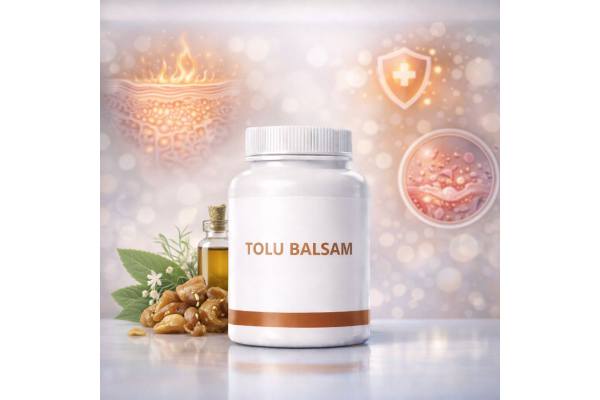
Tolu balsam is a fragrant plant resin that has travelled from South American forests into cough syrups, topical medicines, and perfumes around the world. Traditionally obtained from the trunk of Myroxylon balsamum trees, this thick, honey-like exudate has long been valued as a soothing remedy for irritated airways and minor skin problems, and as a natural fixative in fragrances. Modern pharmacopoeias now mainly treat Tolu balsam as a flavouring and fragrance ingredient, yet interest in its medicinal potential persists.
It contains aromatic acids and esters that may provide mild antiseptic, expectorant, and skin-protective actions, but it is also a recognised fragrance allergen with a real risk of contact dermatitis. This guide walks you through what Tolu balsam is, how it has been used, what we actually know from research, how to think about dosage in a modern context, and which side effects and allergy issues deserve particular attention so that you can make informed, cautious decisions with your healthcare professional.
Quick Overview for Tolu balsam
- Tolu balsam is an aromatic tree resin traditionally used as an expectorant for coughs and as a soothing ingredient in topical preparations.
- It is now used mainly as a flavouring and fragrance component in cough syrups, lozenges, ointments, and cosmetics.
- Traditional adult oral doses have typically fallen around 0.3–1 g Tolu balsam per day for short-term respiratory support, usually in syrups or pills.
- People with fragrance allergy, balsam of Peru allergy, or chronic eczema should be especially cautious and may need to avoid Tolu balsam-containing products.
Table of Contents
- What is Tolu balsam?
- Tolu balsam benefits and traditional uses
- How to use Tolu balsam in practice
- Tolu balsam dosage guidelines
- Side effects and who should avoid Tolu balsam
- What the research says about Tolu balsam
What is Tolu balsam?
Tolu balsam is a natural resin obtained from Myroxylon balsamum (often the variety balsamum), a leguminous tree native to northern South America, especially Colombia and neighbouring regions. The resin is collected by making shallow incisions in the bark and allowing the exudate to thicken into a sticky, aromatic mass that is later purified. It has a warm, sweet scent often described as vanilla-like with notes of cinnamon and honey.
Chemically, Tolu balsam is composed mainly of esters and free forms of benzoic acid and cinnamic acid, along with benzyl benzoate, benzyl cinnamate, and trace components such as vanillin and other phenolic compounds. These molecules underpin both its fragrance and its traditional medicinal roles: benzoic and cinnamic acid derivatives can show mild antiseptic, anti-inflammatory, and preservative properties in laboratory settings.
Tolu balsam is related to, but distinct from, balsam of Peru, which is obtained from Myroxylon balsamum var. pereirae. Both resins share many constituents and are often grouped together under fragrance and flavour regulations. In practice, this means that a sensitivity to one often implies a sensitivity to the other, a key concern for people with fragrance allergies.
In modern industry, Tolu balsam is used in:
- Flavouring for cough syrups and lozenges
- Fragrances and perfumes (as a base note and fixative)
- Soaps and cosmetic creams
- Certain pharmaceutical preparations, often in small concentrations
Despite its long history in traditional medicine, Tolu balsam today is more commonly classified as a flavour and fragrance ingredient than as a stand-alone therapeutic drug in conventional guidelines. It remains, however, an ingredient of interest in phytotherapy and natural product research.
Tolu balsam benefits and traditional uses
For centuries, healers in South America and later in Europe described Tolu balsam as a warming, soothing remedy for the chest and throat. It was incorporated into syrups and lozenges meant to ease coughs, lessen throat irritation, and support expectoration of thick mucus. Pharmacognosy texts classify it as a mild expectorant and demulcent, meaning it may help stimulate respiratory secretions while coating irritated mucous membranes.
Several mechanisms have been proposed. Volatile aromatic compounds in Tolu balsam may have a reflex action on the airway mucosa when inhaled or ingested, gently increasing mucus fluidity and promoting clearance. The resinous fraction can create a thin protective film over sore tissues in the throat, similar to other plant resins and gums used for coughs. None of these actions has been rigorously quantified in large, modern clinical trials, but they are consistent with how other resinous expectorants are thought to work.
Traditional uses have extended beyond the respiratory system:
- Topical antiseptic and protective agent – Ointments and plasters containing Tolu balsam have been used on minor wounds, ulcers, and cracked skin, aiming to reduce microbial load and support healing.
- Mild analgesic and anti-inflammatory effect – The warm, aromatic nature of the resin has made it a component in rubs and liniments for muscular aches or joint discomfort, generally alongside other active ingredients such as menthol or camphor.
- Oral care and flavouring – Its sweet, vanilla-like aroma has led to its inclusion in some mouthwashes, tooth powders, and lozenges, where it contributes both taste and a mild soothing effect.
In modern products, Tolu balsam is often not the primary therapeutic agent. Instead, it appears in combination with more extensively studied active ingredients (for example, dextromethorphan, guaifenesin, or herbal extracts such as thyme). In those formulas, it may contribute modest soothing, antiseptic, or flavouring effects rather than acting as the main driver of clinical benefit.
Overall, any benefits are best considered as supportive and symptomatic, not disease-modifying. There is insufficient high-quality evidence to treat Tolu balsam as a stand-alone treatment for respiratory or skin conditions, but it may play a helpful supporting role in well-designed, balanced formulations.
How to use Tolu balsam in practice
Today, most people encounter Tolu balsam as a hidden ingredient rather than as a bottle of pure resin. It appears on labels under names such as “Tolu balsam,” “Balsamum tolutanum,” or occasionally under broader fragrance designations. Reading ingredient lists carefully is the first step if you want either to use it intentionally or avoid it because of allergy risk.
Common ways Tolu balsam is used include:
- Cough syrups and lozenges – Here, Tolu balsam is typically present in small amounts alongside standard cough medicines, serving as a flavouring and soothing additive. It may be listed as a “co-adjuvant” or flavour.
- Topical ointments and pastes – Some older-style wound products, haemorrhoid preparations, and protective skin ointments contain Tolu balsam for its mild antiseptic and protective properties.
- Plasters and tinctures – Related balsamic resins (including Tolu) appear in compound tinctures used historically on the chest, or in adhesive plasters for their stickiness and aroma.
- Cosmetics and fragrances – Perfumes, scented soaps, and creams may use Tolu balsam as a fixative to hold lighter fragrances and to impart a warm, sweet base note.
If you are considering Tolu balsam for its traditional benefits, practical steps include:
- Prefer combination products with clear labelling
Rather than buying raw resin, most people are better served by licensed cough syrups, lozenges, or ointments that include Tolu balsam in small, controlled amounts, accompanied by clear usage instructions and safety information. - Be cautious if you have allergy concerns
If you have never used balsamic resins or have a history of fragrance sensitivity, applying any product containing Tolu balsam to a small skin area first (for example, the inner forearm) can help identify irritation early. Those with known fragrance allergy or balsam of Peru allergy should seek specialist advice before any exposure. - Use products as directed
Because robust dose–response data are lacking, exceeding recommended use adds risk without proven extra benefit. Treat Tolu balsam-containing products as medicines or specialised cosmetics, not as everyday “natural” substances that can be used freely. - Separate internal and external use
Preparations intended for the skin should not be ingested. If you are using a Tolu balsam-containing cough syrup or lozenge, treat it as a medicinal product and follow labelled dosing instructions. - Inform your healthcare team
Tell your doctor, pharmacist, or dermatologist about any Tolu balsam-containing products you are using, particularly if you have chronic skin disease, asthma, or multiple allergies, so they can interpret symptoms and test results accurately.
Used thoughtfully and in modern, regulated formulations, Tolu balsam can be a pleasant, supportive ingredient. The key is to respect its allergenic potential and to see it as one part of a broader treatment plan, not a cure-all.
Tolu balsam dosage guidelines
Unlike vitamins or well-studied pharmaceuticals, Tolu balsam does not have universally accepted, evidence-based dosage ranges for specific diseases. Modern pharmacopoeias and herbal monographs mainly quote traditional oral quantities and typical concentrations in finished products rather than outcomes-driven dosing schemes.
Historically, adult internal doses have been in the range of several hundred milligrams per day, usually divided into multiple doses and always as part of a syrup, elixir, or pill rather than as pure resin. Some monographs have cited daily amounts around 0.3–1 g of Tolu balsam for short-term use in respiratory complaints, commonly blended with other expectorants. These figures reflect older pharmacopoeial practice rather than modern clinical trials.
For topical use, concentrations tend to be low:
- Soaps and cosmetic products may contain around 0.1% Tolu balsam or related resins.
- Perfumes and fragranced creams can range higher, but the actual amount of resin in a single application remains small.
Given the current evidence base, sensible dosage principles are:
- Follow product-specific labels – If you are using a licensed cough syrup, lozenge, or ointment that lists Tolu balsam, follow the manufacturer’s instructions diligently and do not exceed the stated maximum daily dose.
- Short-term internal use only – Where Tolu balsam is taken orally, it is generally intended for short-term relief of minor, self-limiting conditions (such as a simple cough or sore throat), not for long-term continuous use.
- Avoid high-dose self-experimentation – Taking large, unmeasured amounts of pure resin is not advisable. Safety data are limited, and resins can irritate the gastrointestinal tract at higher doses.
Certain groups warrant extra caution:
- Children – Paediatric dosing of Tolu balsam has not been well defined. Many modern paediatric cough formulations have moved away from balsamic resins in favour of better-studied agents or non-pharmacological measures such as honey (in children over one year).
- Pregnancy and breastfeeding – There is insufficient data to support routine oral use during pregnancy or lactation. Occasional skin exposure via cosmetics may be acceptable for those without allergies, but medical advice is prudent.
- Older adults and those on multiple medicines – Polypharmacy increases the chance of interactions and unpredictable reactions; any regular use of Tolu balsam-containing medicinal products should be coordinated with a clinician.
In regulatory toxicology, related balsamic materials such as balsam of Peru have had permitted daily exposure values estimated, highlighting that systemic exposure needs careful calculation in specialised settings. For everyday users, the practical takeaway is simple: stay within conservative, product-labelled ranges and limit use to the shortest necessary duration.
Side effects and who should avoid Tolu balsam
The main safety concern with Tolu balsam is allergy, especially allergic contact dermatitis. Because its chemical composition overlaps with balsam of Peru and other fragrance ingredients, Tolu balsam can trigger or amplify reactions in individuals sensitised to fragrance mixes.
Typical adverse effects include:
- Allergic contact dermatitis – Red, itchy, sometimes blistering rashes at sites where a Tolu balsam-containing product touches the skin (for example, under a perfumed watch strap, behind the ears, or around the mouth).
- Eczematous flares in people with existing dermatitis – Individuals with atopic dermatitis or chronic hand eczema can see worsening if they use scented products that include Tolu balsam or related resins.
- Perioral or perianal dermatitis – In some cases, consumption of foods or medicines containing balsamic flavourings can aggravate eczema around the mouth or in the anal region due to systemic contact allergy.
Less commonly reported but plausible reactions include:
- Irritant effects on the gastrointestinal tract with large or concentrated oral doses, potentially causing nausea, abdominal discomfort, or diarrhoea.
- Respiratory irritation – Strong balsamic vapours may aggravate asthma or fragrance sensitivity in some susceptible individuals.
You should avoid Tolu balsam or use it only under specialist guidance if:
- You have a confirmed patch-test allergy to balsam of Peru, fragrance mix I or II, or related fragrance markers.
- You have a history of strong reactions to perfumes, scented cosmetics, or “vanilla–cinnamon” type fragrances.
- You have chronic, difficult-to-control eczema, especially involving the face, hands, or anogenital area, where fragrance exposure is a known trigger.
- You are pregnant, breastfeeding, or considering oral use in children and have not discussed the product with a healthcare professional.
Practical ways to reduce risk:
- Prefer fragrance-free or “for sensitive skin” products if you have eczema or a strong atopic background.
- When starting a new topical product that contains Tolu balsam, test a small area of skin for several days before wider use.
- If a rash appears where you apply or where you might be systemically exposed to Tolu balsam (for example, around the lips with certain syrups or lozenges), stop the product and seek medical advice.
Dermatology patch-test series consistently show that balsam of Peru and related fragrance allergens are among the more common positive reactions in tested patients, which supports taking Tolu balsam seriously as a potential trigger rather than treating it as a harmless natural ingredient.
What the research says about Tolu balsam
Compared with popular supplements that have numerous randomised controlled trials, modern evidence for Tolu balsam as a therapeutic agent is limited. Most information comes from historical medical texts, pharmacopoeias, phytochemical studies, case reports, and allergy and toxicology research on related resins.
Phytochemical and pharmacognosy research confirms that Tolu balsam contains significant amounts of benzoic and cinnamic acid derivatives, as well as complex resinous and essential oil fractions. These constituents exhibit antiseptic and antioxidant actions in laboratory settings. However, translating such in vitro effects into proven clinical outcomes (such as faster cough resolution or better wound healing) requires controlled human studies that are largely lacking.
On the safety side, dermatological literature on balsam of Peru allergy, combined with case reports, strongly supports an association between these resins and allergic contact dermatitis, systemic contact dermatitis, and fragrance-related eczema flares. Because Tolu balsam shares many of the same sensitising compounds, it is generally treated similarly in allergy guidance and patch-testing practice.
Regulatory toxicology work has begun to quantify acceptable daily exposures for balsam of Peru using conservative risk-assessment methods. These analyses integrate animal studies, human experience, and uncertainty factors to derive daily thresholds for systemic exposure considered unlikely to pose significant risk. Although these calculations are not specific to Tolu balsam, they inform how regulators view related resins in medicines and cosmetics.
Broad reviews of medicinal resins emphasise their long traditional use as expectorants, antiseptics, and topical protectants, but also highlight a recurring pattern: strong cultural and historical support with only modest, modern clinical validation. Tolu balsam fits this pattern well.
Taken together:
- Potential benefits are mainly soothing, flavouring, and mildly antiseptic or expectorant, especially as part of multi-ingredient cough and topical preparations.
- The strongest, best-documented evidence relates to allergy and contact-dermatitis risk.
- Robust, controlled trials demonstrating clear therapeutic advantages at defined doses compared with placebo or standard care are still missing.
For now, the most balanced view is that Tolu balsam is best considered as a supporting excipient with pleasant sensory and mild pharmacological properties, used at low levels in regulated products, rather than as a primary, high-dose supplement.
References
- Tolu Balsam Uses, Benefits & Dosage 2025 (Monograph)
- Resins Covering Medicinally Activated Plants and Their Significance in Medicinal cum Pharmaceutical Areas: An Overview 2024 (Systematic Overview)
- The estimation of permitted daily exposure (PDE) values for Myroxylon balsamum (L.) Harms var. pereirae (Royle) Harms, balsamum (balsam of Peru) for regulatory toxicology purposes: application of various toxicological strategies 2023 (Regulatory Toxicology Study)
- Balsam of Peru allergy 2019 (Clinical Allergy Overview)
- Balsam of Peru | Allergy UK | National Charity 2021 (Patient Guideline)
Disclaimer
The information in this article is for general educational purposes only and does not replace personalised medical advice, diagnosis, or treatment from a qualified healthcare professional. Tolu balsam is a biologically active substance with real potential for allergy and other adverse effects, especially in sensitive individuals or when used inappropriately. Never start, stop, or change any medication, supplement, or treatment plan based solely on online information. Always discuss questions about dosage, product choice, and suitability in pregnancy, breastfeeding, childhood, or chronic illness with your doctor, pharmacist, or another licensed health professional. If you suspect an allergic reaction or experience troubling symptoms after using a product that may contain Tolu balsam, seek medical attention promptly.
If you found this guide helpful, please consider sharing it on Facebook, X (formerly Twitter), or any platform you prefer, and follow us on social media. Your support through sharing helps our team continue to research, write, and update high-quality health content for readers around the world.