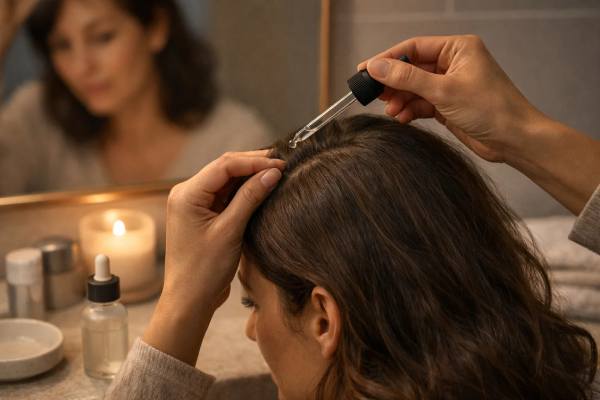
Topical melatonin sits in an unusual place in hair care. It is familiar as a sleep hormone, yet on the scalp it is discussed for a very different reason: possible support for hair growth and reduced shedding. That contrast is part of why interest has grown so quickly. People want options that feel lighter than prescription pills, gentler than some high-strength actives, and more targeted than another supplement bottle.
The evidence is promising, but it is not simple. Topical melatonin is not a universal solution for every kind of alopecia, and it does not have the same depth of evidence as minoxidil. Still, several human studies suggest it may help some people with early pattern thinning or diffuse hair loss, especially when used consistently over months rather than judged after a few weeks. The most useful way to approach it is not as a miracle product, but as a treatment with a narrow evidence base, practical strengths, and clear limits.
Quick Facts
- Topical melatonin may help reduce shedding and modestly improve density in some cases of early pattern thinning and diffuse hair loss.
- The best-supported strengths are 0.0033% and 0.1%, usually applied once daily for about 3 to 6 months.
- The evidence is still smaller and less rigorous than the evidence for minoxidil, so it is better viewed as a promising option than a proven first-line standard.
- Consistency matters more than frequent product switching; most people need at least 90 days before judging whether it is helping.
- Sudden heavy shedding, patchy loss, scalp inflammation, or ongoing thinning despite treatment should prompt medical evaluation rather than more self-testing.
Table of Contents
- What topical melatonin is and why it is used
- What the evidence actually shows
- Best-supported strengths and who may try it
- How to use topical melatonin well
- How it compares with minoxidil
- Safety, limits, and when to move on
What topical melatonin is and why it is used
Topical melatonin is a scalp-applied formulation of melatonin, usually sold as a solution or serum rather than a pill. In hair care, it is used not for sleep but for its proposed effects on the follicle environment. Researchers have been interested in it for years because melatonin is active in the skin and hair follicle, and because it appears to have antioxidant and hair-cycle effects that could matter in pattern thinning.
That idea sounds attractive, especially in early hair loss. Many people want something between doing nothing and starting a better-known drug. Topical melatonin often enters that conversation because it seems low-commitment, is generally framed as well tolerated, and has been studied in both men and women. The appeal is strongest in people with mild or early androgenetic alopecia, sometimes called male pattern or female pattern hair loss, and in people with diffuse thinning who want a topical option with a lighter feel.
But there is an important distinction here: plausible is not the same as proven. Hair loss treatments often begin with a credible mechanism and only later reveal whether the real-world effect is large, consistent, and durable enough to matter. Topical melatonin has reached the stage where there is human data worth taking seriously, yet the data remain limited in scale and quality. That means it should be discussed with realistic expectations.
It also helps to separate “hair loss” into categories before deciding whether melatonin even belongs in the routine. Most of the useful human literature centers on early androgenetic alopecia and some forms of diffuse alopecia. That is not the same thing as scarring alopecia, patchy autoimmune hair loss, or severe shedding triggered by illness, thyroid disease, or major nutrient deficiency. Those conditions need a different workup and often a different treatment plan.
A practical way to think about topical melatonin is this: it is a follicle-support option with a moderate amount of encouraging evidence, not a universal regrowth therapy. It seems most relevant where follicles are still active but underperforming, which is also why the timing of use matters. It is more likely to fit a person with early thinning than someone with advanced loss and long-standing miniaturization. If you want that framework to make more sense, it helps to understand the hair growth cycle first, because treatments like this work by influencing cycling over time rather than producing immediate visible change.
What the evidence actually shows
The evidence for topical melatonin is better than many “natural” hair products, but it is still modest. That balance matters. Some human studies report reduced shedding, improved hair density, a higher proportion of hairs in growth phase, or better hair texture after several months of once-daily use. Reviews of the human literature generally conclude that the signal is positive. At the same time, they also point out the limits: many studies are small, open-label, uncontrolled, or use formulations that make it harder to isolate melatonin’s true effect.
That is why the strongest honest summary is not that topical melatonin “works” in a blanket sense. It is that topical melatonin appears promising in selected forms of hair loss, especially early androgenetic alopecia, but the evidence base is not yet strong enough to treat it like a first-rank standard.
The most consistent positive outcomes in the literature fall into three buckets:
- less active shedding,
- modest improvement in density or hair counts,
- better support of growth-phase hairs over time.
Those outcomes are meaningful, but they are not the same as dramatic regrowth. A person with mild thinning may notice a little less hair on the brush, less see-through scalp under bright light, or better styling coverage after a few months. Someone hoping for a dense, obvious reversal of more advanced hair loss may be disappointed if melatonin is used alone.
Another important detail is who was studied. Much of the literature is focused on androgenetic alopecia and general diffuse hair loss rather than all-cause shedding. That means the evidence does not automatically carry over to every common scenario, such as sudden telogen effluvium after illness, postpartum shedding, iron deficiency, or inflammatory scalp disease. In those settings, melatonin may still be used by some people, but the evidence is thinner and the root cause matters more.
A second limit is study design. One of the more careful modern reviews notes that most topical melatonin trials outside a small number of better-designed studies do not clearly prove efficacy because of design weaknesses or because melatonin is mixed with other active ingredients. That is a crucial point for readers comparing products. A formula can look impressive on paper while telling you very little about melatonin itself.
So what should a reader take from the evidence? Two things. First, topical melatonin is not empty hype. There is a real clinical signal. Second, that signal is still smaller and less settled than the evidence for more established therapies used for pattern loss. If your shedding pattern is not clearly patterned and is dragging on for months, it is often smarter to first understand whether you are dealing with ongoing diffuse shedding such as chronic telogen effluvium rather than assuming any growth serum will solve it.
Best-supported strengths and who may try it
When people ask for the “best” melatonin strength, what they usually want is the concentration with the strongest human support. That is a better question than which number sounds strongest on a label. Based on the current literature, the best-supported topical strengths are 0.0033% and 0.1%, usually used once daily for about 90 to 180 days.
Of those two, 0.0033% is the most established in the older clinical literature and is the concentration many readers will see referenced most often. It has been used in once-daily studies showing reduced hair loss and improved density over time. The 0.1% concentration also appears in review-level summaries as an evidence-backed option, but current data do not justify saying it is clearly superior. There is no strong head-to-head human evidence showing that 0.1% reliably outperforms 0.0033% on the scalp.
That is why “best-supported” is more accurate than “strongest.” With topical melatonin, higher is not automatically better. In fact, when a treatment’s evidence base is still developing, chasing the highest concentration can add cost, irritation risk, or confusion without improving the odds of success.
The more practical choice is to look for a scalp formula that does four things well:
- clearly states the melatonin concentration,
- is intended for scalp use rather than general skin use,
- has a vehicle you can tolerate,
- gives straightforward once-daily directions.
Who is the most reasonable candidate? Usually someone with mild early pattern thinning, a widening part, increased miniaturized hairs, or general early density loss who wants a lower-intensity topical option. It may also fit someone who wants an adjunct rather than a replacement for a standard treatment. In contrast, it is a weaker match for someone with sudden severe shedding, scarring alopecia, sharply patchy loss, or rapidly progressive thinning that needs a fuller medical evaluation.
It also helps to be honest about stage. Topical melatonin seems best positioned for follicles that are still active enough to respond. That usually means earlier loss. Once miniaturization has been present for years, the ceiling tends to be lower for any gentle topical agent.
For women, it may be particularly attractive when the picture is subtle and diffuse rather than advanced. For men, it may fit earlier recession or crown thinning, but expectations should stay modest. People with clear patterned thinning who are comparing options should still understand where it sits relative to better-established therapies for male pattern baldness treatment options or female pattern thinning. The strongest reason to try topical melatonin is not that it is the most powerful choice. It is that it may offer a gentler, evidence-informed option for the right stage and the right goals.
How to use topical melatonin well
Most people do not fail a hair treatment because the idea was wrong. They fail because the routine becomes inconsistent, the product is judged too early, or too many actives are started at once. Topical melatonin is especially vulnerable to this problem because its effect, when it works, is usually gradual and subtle at first.
The human studies most often use once-daily application, commonly in the evening, for about 3 to 6 months. That makes nightly use the most evidence-aligned starting point. The point is not to flood the scalp. It is to place the product where thinning is present and use it with enough consistency for the follicles to experience steady exposure over time.
A practical way to use it looks like this:
- Apply it once daily, usually at night, to the affected scalp rather than the hair lengths.
- Part the hair so the product reaches the skin, not just the strands.
- Follow the product’s amount instructions rather than improvising extra volume.
- Keep using it for at least 90 days before deciding it failed.
- Judge progress monthly with photos, not day to day in the mirror.
For many people, the first meaningful sign is reduced shedding rather than instant new density. That may show up as fewer hairs in the sink, on the pillow, or in the brush. Cosmetic regrowth usually takes longer because new hair needs time to become visible and then long enough to improve coverage.
Another useful rule is to introduce it into a stable routine. If you change shampoo, add supplements, start a scalp scrub, and begin melatonin all in the same week, you lose the ability to tell what is helping and what is irritating. A clean routine is easier to assess and easier to stick with.
Texture and vehicle also matter more than people expect. A good product is one you will actually use nightly. Some solutions dry quickly and disappear into the scalp. Others feel tacky or leave hair flatter the next morning. That may sound cosmetic, but adherence is part of efficacy. An elegant vehicle often beats a theoretically perfect formula that gets abandoned after 10 days. If you are sorting through leave-on growth products more broadly, a guide to scalp serum ingredients can help you judge which labels are evidence-aware and which are mostly marketing.
Finally, do not expect topical melatonin to rescue a scalp problem it was never designed to fix. If itching, scale, burning, or visible inflammation are part of the picture, those need attention too. A calmer scalp often improves the odds that any hair treatment will be tolerated well enough to be used consistently.
How it compares with minoxidil
This is the comparison most readers care about, and the answer is straightforward: minoxidil remains the stronger, better-supported topical treatment for pattern hair loss. Topical melatonin may help, but it does not currently match minoxidil’s evidence depth or expected regrowth power.
That does not make melatonin irrelevant. It just defines its lane more clearly. Minoxidil has a longer track record, larger trials, better clinical recognition, and more predictable use patterns. Topical melatonin, by contrast, occupies a more “promising adjunct or alternative” role. It may be appealing for early thinning, for people who want to start with a gentler-feeling option, or for those who do not tolerate standard treatments well. But when visible regrowth is the priority, minoxidil usually remains the more evidence-based first move.
There are a few practical differences worth noting.
Where melatonin may appeal
- once-daily use is simpler than twice-daily regimens,
- available data suggest good tolerability,
- some users prefer its positioning as a lower-intensity topical,
- it may fit mild early loss or supportive maintenance goals.
Where minoxidil still leads
- stronger evidence for regrowth,
- clearer expectations around response timelines,
- broader clinician familiarity,
- better support for moderate patterned thinning.
The key mistake is turning this into an all-or-nothing decision. Some people use melatonin as an adjunct. Some try it first because their hair loss is mild and they want a gentler entry point. Others start with minoxidil because they want the treatment with the strongest hair-growth record and only consider melatonin later. The best choice depends on stage, goals, and tolerance.
What melatonin should not do is create false confidence in a situation that needs more decisive treatment. If a person has ongoing progression, obvious miniaturization, or a family pattern that is advancing steadily, delaying effective care for many months can narrow later options. In those cases, it helps to understand the routine demands and tradeoffs of starting minoxidil well rather than assuming a softer option will be enough.
In practical terms, topical melatonin is best framed as a potentially useful but less proven topical. It may reduce shedding and support density in the right person. Minoxidil is still the benchmark for topical regrowth. Most frustration begins when readers expect those two categories to perform the same way.
Safety, limits, and when to move on
Topical melatonin appears to have a favorable safety profile in the available clinical literature, and one of the earlier pharmacodynamic studies did not find a meaningful effect on endogenous serum melatonin levels after once-daily topical use. That is reassuring, but it should not be overstated. Reassuring is not the same as exhaustively studied.
The most likely real-world issue is local tolerance. A product may sting, itch, dry the scalp, or leave residue because of the vehicle rather than the melatonin itself. Alcohol-based or fragranced formulas can be less forgiving on a sensitive scalp. That is one reason it helps to start with one leave-on treatment at a time and keep the rest of the routine stable for a few weeks.
There are also evidence limits that users should know before spending months on it. Topical melatonin is not well supported for:
- scarring alopecias,
- abruptly patchy hair loss,
- severe inflammatory scalp disease,
- heavy shedding driven by untreated medical triggers,
- advanced long-standing pattern loss where follicles may be harder to revive.
Pregnancy and breastfeeding are another area where caution makes sense. Even though topical exposure is different from oral use, published hair-specific safety data are not strong enough to treat it casually in those settings without clinician input. The same goes for people who have multiple scalp therapies in play, active dermatitis, or a history of reacting to leave-on products.
The bigger question is when to stop waiting for it to work. A fair trial is usually 3 months for early changes and closer to 6 months for a more meaningful verdict. At that point, ask a few practical questions:
- Has shedding clearly decreased?
- Do monthly photos show less scalp show-through?
- Is the routine easy enough to sustain?
- Has thinning stabilized, or is it still progressing?
If the answer is no across the board after a consistent trial, it may be time to rethink the diagnosis or move toward a treatment with stronger evidence. Hair loss often becomes expensive when people keep extending a weak trial because the product feels gentle or hopeful.
Faster evaluation is warranted if loss becomes sudden, patchy, inflamed, painful, or associated with eyebrow loss, illness, thyroid symptoms, or major diet change. In those cases, the priority is not better product selection. It is getting the diagnosis right. If that sounds closer to your situation, a guide to sudden hair shedding and when to see a doctor is a better next step than adding another serum.
References
- Clinical Studies Using Topical Melatonin – PMC 2024 (Review)
- Melatonin and the Human Hair Follicle – PubMed 2023 (Review)
- Comparative Effect of Conventional and Non-Conventional Over-the-Counter Treatments for Male Androgenetic Alopecia: A Systematic Review and Network Meta-Analysis – PMC 2025 (Systematic Review and Network Meta-Analysis)
- Topical Melatonin for Treatment of Androgenetic Alopecia – PMC 2012 (Clinical Review)
Disclaimer
This article is for educational purposes only and is not medical advice, diagnosis, or treatment. Hair loss has many causes, including androgenetic alopecia, telogen effluvium, thyroid disease, iron deficiency, inflammatory scalp disorders, medication effects, and autoimmune conditions. Topical melatonin may be reasonable in some cases of early thinning, but it is not a substitute for medical evaluation when hair loss is sudden, patchy, painful, rapidly progressive, or tied to other health symptoms.
If this article helped, please share it on Facebook, X, or another platform you prefer.