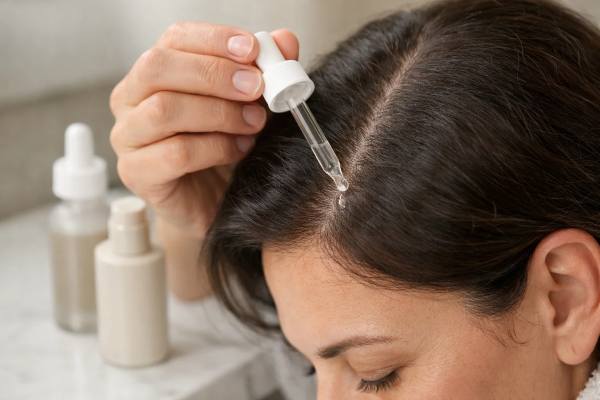
Minoxidil has a frustrating reputation: it helps many people, but not equally, and not always as quickly as they hope. That is why topical tretinoin keeps appearing in hair-loss conversations. The idea is appealing. If tretinoin can increase minoxidil activity or help the scalp absorb it better, perhaps the combination can turn a partial response into a better one. But the evidence is more nuanced than the internet usually suggests.
Topical tretinoin with minoxidil is not a standard first step for most people with thinning hair. It is better understood as a selective add-on: potentially useful in some cases, unnecessary in others, and clearly too irritating for certain scalps. The real question is not whether the pairing sounds clever. It is whether the likely benefit outweighs the very real risk of redness, burning, scaling, and treatment dropout. To answer that well, you need more than marketing language. You need the actual evidence, the likely mechanism, and a clear sense of who should not try it.
Core Points
- Topical tretinoin may improve minoxidil response in some people, especially those who appear to be weaker responders, but it is not a proven universal upgrade.
- The evidence is promising but limited, with small studies and more mechanistic support than large modern clinical trials.
- Scalp irritation is the main trade-off, and barrier damage can make treatment harder to continue.
- People with sensitive, inflamed, flaky, or eczema-prone scalps are often poor candidates for this combination.
- If the combination is used, it is safest to start with clinician guidance, low-strength formulations, and slow introduction rather than home mixing.
Table of Contents
- Why People Pair Tretinoin With Minoxidil
- What the Evidence Actually Shows
- How Tretinoin Might Increase Response
- Who Might Benefit Most
- Who Should Skip It
- How to Use It More Safely
Why People Pair Tretinoin With Minoxidil
The appeal of combining topical tretinoin with minoxidil comes from a simple problem: minoxidil does not work equally well for everyone. Some people see thicker density and steadier coverage within months. Others get only mild improvement, heavy early shedding without enough recovery, or almost no visible change despite correct use. That uneven response has pushed clinicians and patients to look for ways to make topical minoxidil more effective without moving immediately to oral medications or more aggressive treatment plans.
Tretinoin entered that conversation because it already had a long dermatology history and a known effect on skin turnover, epidermal behavior, and topical drug handling. Older hair-loss studies suggested that adding tretinoin to minoxidil might improve outcomes or make once-daily treatment perform similarly to twice-daily minoxidil alone. More recent work added another reason for interest: tretinoin may increase follicular sulfotransferase activity, which matters because minoxidil has to be converted into an active sulfate form inside the follicle before it can work well.
That sounds compelling, but it is important to keep the clinical context straight. The combination is not considered a standard first-line move for routine hair loss. It is better described as a targeted adjunct that some clinicians consider when topical minoxidil alone seems underpowered, especially in androgenetic alopecia. It is not the right lens for every patient with shedding, and it should not distract from the more basic questions of diagnosis, adherence, and scalp tolerance.
Before anyone adds tretinoin, a few simpler explanations deserve attention:
- The person may not actually have pattern hair loss.
- The scalp may be inflamed or too irritated to tolerate treatment well.
- Application may be inconsistent or incorrect.
- The chosen vehicle may be the real problem.
- The hair cycle may not have had enough time to respond.
That last point matters because hair treatment timelines are slow. A product can feel ineffective at eight weeks and still become useful at six months. Understanding the broader hair growth cycle helps explain why early judgments are often wrong.
Another reason this pairing gets attention is convenience. In one of the better-known clinical studies, the combination was explored as a once-daily option rather than a clearly stronger one. That distinction is easy to miss. Many people hear “tretinoin boosts minoxidil” and assume a dramatic jump in regrowth. The published evidence is more cautious. At best, the combination may help a subset of patients and may allow more efficient use in certain formulations. At worst, it adds just enough irritation to make a previously manageable routine unsustainable.
So the right starting attitude is neither enthusiasm nor dismissal. It is selectivity. The pairing is biologically plausible and sometimes clinically useful, but it is not a universal hack that every minoxidil user should rush to try.
What the Evidence Actually Shows
The evidence for topical tretinoin with minoxidil is interesting, but it is not deep. That matters because this combination is often discussed online as though its benefit were already settled. It is not. The case for using it rests on a handful of studies, a plausible mechanism, and recent reviews that treat it as promising rather than proven.
The oldest frequently cited study suggested that topical tretinoin alone had some hair-growth activity and that the combination of tretinoin with low-strength minoxidil produced visible regrowth in a meaningful portion of participants after prolonged use. That early signal is one reason the pairing never disappeared from dermatology discussion. But it was a small older study, not the kind of modern trial that settles a treatment question by itself.
A more relevant clinical trial came later and compared two real-world approaches in men with androgenetic alopecia: 5% minoxidil used twice daily versus a combined 5% minoxidil and 0.01% tretinoin formulation used once daily. The key result was not that the combination clearly outperformed standard treatment. It was that the two approaches appeared roughly equivalent in measured hair variables. That is an important nuance. The trial supports the idea that tretinoin may help make once-daily minoxidil more viable in some settings. It does not prove that every patient will grow more hair by adding tretinoin.
More recent evidence has been mechanistic and selective. A small prospective study found that topical tretinoin increased follicular sulfotransferase expression in a group of patients initially predicted to be nonresponders to minoxidil, converting 43% of them into predicted responders after a short course of tretinoin application. That finding is clinically intriguing, but it is not the same as a large long-term trial showing superior visible regrowth in a broad patient population. It suggests who might benefit, not that everyone will.
Taken together, the evidence supports a few measured conclusions:
- The combination is biologically plausible.
- It may be most useful in selected low-responders to topical minoxidil.
- It has not been shown in modern large trials to be a universal upgrade over well-used minoxidil alone.
- Irritation remains the main practical barrier to success.
Recent reviews and consensus-style articles generally treat topical tretinoin as an adjunct rather than a mainstream default. That is the right frame. The science is strong enough to justify clinician interest, but not strong enough to justify casual enthusiasm.
This is also why the combination should not be used to rescue the wrong diagnosis. If a person has diffuse shedding from stress, iron deficiency, thyroid disease, or another trigger, adding tretinoin to minoxidil may create scalp irritation without solving the real cause. That is especially relevant when the hair-loss picture includes symptoms that point toward another workup, such as the patterns discussed in hair-loss blood tests and medical triggers.
The honest answer to “Does it boost results?” is therefore a qualified one. It may boost results for some people, especially a subset of weaker responders. But the present evidence does not support presenting it as a broadly established performance enhancer for every minoxidil user.
How Tretinoin Might Increase Response
The best current explanation for why tretinoin may help minoxidil involves follicular sulfotransferase enzymes. Topical minoxidil is not fully active in the bottle. It needs to be converted into minoxidil sulfate within the follicle to exert its hair-growth effect efficiently. Some people have lower follicular sulfotransferase activity, and this appears to be one reason they respond poorly to topical minoxidil.
Tretinoin may change that. In a small but influential study, topical tretinoin increased expression of follicular sulfotransferase enzymes in a group of predicted minoxidil nonresponders. That result gave the combination a more specific rationale than the older idea that tretinoin simply made the scalp “absorb better.” Today, the more sophisticated version of the theory is that tretinoin may help some follicles activate minoxidil more effectively, not just let more of it pass through the skin.
There may still be a penetration effect as well, but that part cuts both ways. A treatment that increases delivery can also increase irritation. Tretinoin alters epidermal behavior and can weaken comfort at the skin barrier level, especially during the first weeks of use. On a scalp that is already dry, inflamed, or reactive, that may mean more burning, scaling, and redness without enough extra growth benefit to justify continuing.
That tension explains why this is not a simple “more absorption is better” story. A good scalp treatment does not just need potency. It needs tolerability. A formulation that looks elegant on paper but creates enough dermatitis to reduce adherence is not a clinical win.
A few factors probably influence whether the mechanism translates into visible benefit:
- Baseline sulfotransferase activity in the hair follicle.
- The diagnosis, especially whether androgenetic alopecia is truly present.
- The concentration and vehicle of tretinoin.
- Baseline scalp barrier quality.
- Whether minoxidil use has been consistent enough to judge response fairly.
This is one reason the combination is more interesting for partial responders than for complete nonusers. If someone has never given standard minoxidil an honest trial, it is hard to know whether the issue is biology, diagnosis, adherence, or impatience. If someone has used it correctly for months and still seems under-responsive, the mechanistic rationale for a carefully supervised add-on becomes more meaningful.
It also helps to remember that hair growth happens in a follicular environment, not in isolation. The scalp barrier, inflammation status, and local tolerance all influence whether a treatment can actually be sustained long enough to matter. That broader context is why the idea of the follicle environment and scalp health matters so much here. A theoretically stronger regimen can still fail if the scalp becomes too irritated to maintain it.
So yes, tretinoin may increase response, but the mechanism is selective, not magical. It likely helps a subset of patients by improving local activation of minoxidil. It does not transform minoxidil into a different drug, and it does not erase the need for a healthy enough scalp to tolerate ongoing treatment.
Who Might Benefit Most
The people most likely to benefit from topical tretinoin with minoxidil are not everyone with thinning hair. They are usually a narrower group: patients with a reasonably clear diagnosis of androgenetic alopecia, some tolerance for topical treatment, and a suspicion that standard topical minoxidil is underperforming despite correct use.
One potentially strong use case is the partial or predicted low-responder to topical minoxidil. This is the group most directly supported by the sulfotransferase data. If the issue is weak follicular activation rather than poor adherence or the wrong diagnosis, tretinoin has a plausible chance of improving response. The benefit may be especially relevant when someone has plateaued with topical minoxidil or never achieved the expected density improvement after a fair trial.
Another possible use case is the person who wants a clinician-designed once-daily regimen rather than conventional twice-daily topical minoxidil. The older randomized trial suggested that a once-daily combined formulation could perform similarly to twice-daily minoxidil in male pattern hair loss. That does not make it better, but convenience can matter. A slightly simpler routine that a patient actually follows may outperform a theoretically superior routine that gets skipped.
The combination may also make sense in people who:
- Have a stable scalp without chronic irritation.
- Are not already reacting to alcohol-based topical treatments.
- Can follow slow introduction and monitoring.
- Understand that this is an adjunct, not a guaranteed rescue strategy.
- Are working with a clinician who can assess whether the diagnosis and vehicle make sense.
What usually does not justify adding tretinoin is simple impatience. Minoxidil is already a long game. Adding an irritating adjunct after only a few weeks of use often creates more confusion than value. The same is true if the hair loss pattern is still unclear. Tretinoin does not fix telogen effluvium, traction alopecia, active scalp disease, or patchy autoimmune hair loss just because minoxidil happens to be in the routine too.
There is also a lifestyle factor. People who can apply precisely, monitor the scalp, and step back early if irritation begins tend to do better with this kind of add-on than people who already struggle to keep a simple topical routine going. Tretinoin is not forgiving when used casually.
A final point is that some people may benefit more from changing the overall treatment path than from intensifying a topical one. If a patient is failing topical minoxidil because of poor tolerance, clinician-guided alternatives may be more practical than adding another irritant. The same goes for people whose hair loss is already clearly progressive and likely to need a broader long-term strategy, such as those reviewing general causes and treatment options for hair loss in men or comparable approaches in women.
The best candidate, then, is not simply “someone who wants better results.” It is someone with the right diagnosis, the right scalp, and a believable reason to think topical minoxidil needs help rather than time.
Who Should Skip It
This is the most important section for many readers, because topical tretinoin with minoxidil is often easier to misuse than to use well. The people who should skip it are not rare exceptions. They include many of the people most tempted to try it.
The clearest group is anyone with a sensitive, inflamed, or barrier-damaged scalp. If your scalp already burns, stings, flakes heavily, reacts to fragranced products, or becomes tight after routine washing, tretinoin is more likely to push it toward dermatitis than toward better hair density. This matters because irritation can reduce adherence, increase shedding from inflammation, and make it impossible to tell whether the treatment or the scalp disease is driving the problem.
People with active eczema, seborrheic dermatitis, psoriasis, contact dermatitis, recent sunburn, or healing scalp injury are also poor candidates until those issues are controlled. Retinoids are not gentle on an already compromised surface. If your scalp is currently behaving like the patterns described in scalp eczema and related irritation, adding tretinoin is usually the wrong priority.
Another group that should think twice includes people who are already responding well to minoxidil alone. If the current regimen is working and tolerable, there is often little reason to complicate it. Adding tretinoin just because it sounds more advanced can turn a stable routine into a reactive one.
Pregnancy and pregnancy planning also deserve caution. Topical tretinoin is generally avoided during pregnancy, and hair-loss regimens involving prescription retinoids should not be improvised during this period. This is an area for clinician guidance, not experimentation.
You should also likely skip the combination if you:
- Are using strong exfoliating acids or other scalp actives already.
- Recently colored, bleached, or chemically straightened your hair and your scalp feels tender.
- Have severe dandruff or uncontrolled folliculitis.
- Are confusing breakage with hair loss.
- Have thinning caused mainly by traction, autoimmune patchy loss, or medical shedding rather than androgenetic alopecia.
- Already struggle with adherence to a simpler regimen.
One especially important caution is irritation from minoxidil itself. If you are already reacting to topical minoxidil, it is risky to assume tretinoin will somehow improve the situation. In many cases, the problem is the vehicle, such as propylene glycol, alcohol, fragrance, or general scalp sensitivity. Layering tretinoin onto that can make the reaction worse. Sometimes what needs fixing is not response but tolerability. A guide to product allergy versus irritation can help frame that distinction.
Finally, skip the do-it-yourself version. Home-mixing tretinoin cream into minoxidil solution is not a smart substitute for a properly designed formulation. It creates too many unknowns in concentration, stability, spread, and irritation.
In short, the people who should skip this combination are not just the unusually fragile. They are anyone whose scalp is sending clear warning signs, anyone whose diagnosis is still uncertain, and anyone whose current routine is already delivering acceptable results without extra risk.
How to Use It More Safely
If topical tretinoin with minoxidil is being considered, safety comes down to restraint. This is not a routine that rewards enthusiasm. It rewards careful formulation, slow introduction, and a low threshold for backing off if the scalp starts to object.
The first principle is do not self-compound at home. Even though some studies used specific concentrations of tretinoin with minoxidil, those are not recipes to imitate in the bathroom. The concentration, vehicle, contact pattern, and stability matter. A clinician-supervised product or clearly directed regimen is safer than improvisation.
The second principle is start with the gentlest reasonable setup. The scalp usually does better when a retinoid is introduced slowly rather than nightly from the beginning. Many people tolerate a cautious ramp better than an aggressive launch. If irritation develops early, pushing through often backfires.
A safer approach usually includes:
- Confirm the diagnosis first.
This combination is best reserved for a pattern-hair-loss setting, not unexplained shedding. - Stabilize the scalp before starting.
Treat dandruff, dermatitis, and obvious inflammation first. - Introduce one change at a time.
Do not add tretinoin, a new acid exfoliant, and a medicated shampoo in the same week. - Apply to a dry, calm scalp.
Wet, freshly abraded, or sunburned skin is more likely to sting and overreact. - Watch the barrier, not just the hairline.
Persistent redness, burning, tenderness, and scaling are not signs that it is “working harder.”
One of the easiest mistakes is misreading irritation as a normal initiation phase that should simply be pushed through. Mild adaptation can happen. Persistent dermatitis is different. Once the scalp becomes chronically reactive, people often start washing less, scratching more, or skipping treatment unpredictably. The result is worse tolerance and worse adherence, not better hair.
You should stop or step back if you notice:
- Ongoing burning rather than brief tingling.
- Worsening flaking that feels raw rather than dry.
- New scalp pain or tenderness.
- Rapid worsening of dermatitis symptoms.
- Increasing difficulty applying or continuing treatment.
At that point, the question is no longer whether tretinoin might help. It is whether the scalp can sustain the plan. Sometimes the right decision is to return to simpler minoxidil use. Sometimes it is to address inflammation first. Sometimes it is to reassess the whole diagnosis.
Medical guidance becomes more important if you have patchy loss, intense inflammation, pregnancy concerns, uncertain diagnosis, or repeated treatment failure. Readers who are already near that threshold should treat the decision to see a dermatologist as part of the treatment plan, not as a last resort.
The safest conclusion is a practical one: topical tretinoin with minoxidil is a selective tool. Used carefully, it may help some low-responders. Used casually, it often creates exactly the problem hair treatments cannot afford—an irritated scalp that can no longer tolerate the routine needed to preserve results.
References
- An Updated Review of Topical Tretinoin in Dermatology: From Acne and Photoaging to Skin Cancer 2025 (Review)
- Consensus Recommendations for the Management of Androgenetic Alopecia in Egypt: A Modified Delphi Study 2025 (Consensus Statement)
- Treatment of Androgenetic Alopecia: Current Guidance and Unmet Needs 2023 (Review)
- Tretinoin enhances minoxidil response in androgenetic alopecia patients by upregulating follicular sulfotransferase enzymes 2019 (Prospective Study)
- Efficacy of 5% minoxidil versus combined 5% minoxidil and 0.01% tretinoin for male pattern hair loss: a randomized, double-blind, comparative clinical trial 2007 (Randomized Clinical Trial)
Disclaimer
This article is for educational purposes only and is not a substitute for medical advice, diagnosis, or treatment. Topical tretinoin with minoxidil can irritate the scalp and is not appropriate for everyone, especially people with scalp inflammation, pregnancy-related concerns, or uncertain hair-loss diagnoses. A qualified clinician can help determine whether this combination is suitable, whether another cause of hair loss is being missed, and whether a safer alternative would make more sense.
If this article helped you, please share it on Facebook, X, or another platform you trust so others can make more informed hair-treatment decisions.