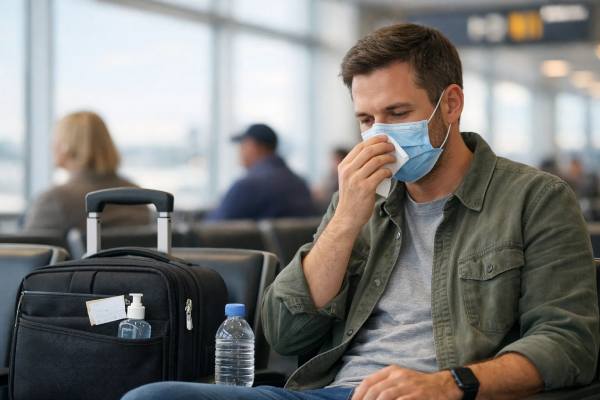
Getting sick right before a trip creates a difficult choice: protect your plans, or protect the people around you. Respiratory viruses spread most easily in the exact environments travel requires—crowded lines, enclosed cabins, shared air, and repeated close contact. The good news is that risk is not all-or-nothing. With a few high-impact habits, you can meaningfully reduce how much virus you release, how long others are exposed, and how likely you are to worsen your own symptoms mid-journey.
This article walks you through a practical, ethics-forward approach: how to decide whether you should travel at all, what makes flying and public transport risky (and what makes them safer than many people assume), and the specific steps that matter most. You will also learn when “push through it” becomes unsafe—both for you and for vulnerable travelers who did not choose the exposure.
Quick Overview for More Responsible Travel
- Delaying travel until symptoms are improving and you are fever-free for 24 hours reduces risk to others and usually makes the trip easier on your body.
- A well-fitting high-filtration mask worn consistently is one of the most effective ways to reduce spread in crowded and enclosed transit.
- Ventilation choices matter: more fresh air, open vents, and less time in dense crowds can significantly lower exposure.
- Do not travel if you have severe symptoms, significant shortness of breath, chest pain, confusion, or vomiting that prevents hydration.
- If travel is unavoidable, use a layered plan: mask, minimize time in crowds, avoid eating and drinking around others, and isolate or mask more carefully after arrival.
Table of Contents
- Decide if you should travel
- How viruses spread during travel
- Flying while sick
- Public transport when you are ill
- A layered plan to reduce spread
- Recovery, red flags, and special situations
Decide if you should travel
The most effective way to prevent spread during travel is also the simplest: do not travel while you are actively sick. That is not always possible, but it is still the best starting point—especially if you are early in symptoms, coughing frequently, or feel feverish. Beyond protecting others, postponing often protects you. Travel stress, dehydration, poor sleep, and dry cabin air can make a mild illness feel much worse, and complications are harder to manage away from home.
A decision checklist that keeps you honest
Use this as a practical filter before you focus on masks and hand sanitizer:
- Are your symptoms improving overall, or are they still ramping up? Early illness is usually the highest-risk phase for spread.
- Have you been fever-free for 24 hours without fever-reducing medication? If not, delaying travel is the safer and more considerate choice.
- Can you go through the trip without removing a mask for long stretches? If you cannot (long meals, frequent drinks, severe congestion), your ability to reduce spread drops.
- Will you be around high-risk people soon after arrival (older adults, pregnant people, immunocompromised individuals, people with chronic lung or heart disease)? If yes, postponing or changing plans protects them.
- Are you likely to need urgent care during travel (worsening breathing, dehydration, severe weakness)? If yes, traveling adds avoidable risk.
Two common scenarios where postponing is usually best
- You are sick enough that you cannot function normally: significant fatigue, nonstop coughing, dizziness, or severe body aches. Even if you could physically board, you may struggle to navigate delays, walk long terminals, or stay hydrated.
- You have symptoms that are hard to contain: uncontrolled cough, frequent sneezing, repeated nose wiping, or heavy mucus. These make consistent source control difficult in public settings.
If you must travel, choose the least harmful version
If a delay is impossible, you can still reduce harm by reshaping the trip: pick off-peak times, choose fewer connections, avoid long layovers, and plan for minimal time in crowded indoor spaces. Ethically, think in “exposure minutes.” Your goal is to shorten them, not to pretend the risk is zero.
How viruses spread during travel
Respiratory viruses spread mainly through virus-containing particles you breathe out. These range from larger droplets that fall quickly to smaller aerosols that can linger, especially in poorly ventilated spaces. Travel environments amplify the core ingredients for transmission: people close together, limited personal space, lots of talking, and repeated contacts over time. Importantly, the highest-risk moments are often not the ride itself, but the surrounding crowd choreography—ticket lines, security queues, boarding gates, packed platforms, and tight stairwells.
Three risk drivers you can actually control
You cannot control who is next to you, but you can control the factors that matter most:
- Duration: longer time in shared air increases the chance that enough virus accumulates to infect someone.
- Density: shoulder-to-shoulder crowds raise exposure, even for short periods.
- Ventilation and airflow: more clean air dilutes particles; stagnant air concentrates them.
When you are sick, you are the source. The question becomes: how do you reduce what leaves your face and how long others are near it?
Why surfaces matter less than they used to in most cases
People still worry about “catching a cold from a seatback tray,” and basic hygiene remains valuable. But for many respiratory viruses, inhalation risk in crowded indoor settings is usually more important than touching a surface once. That means a clean, focused strategy beats a frantic one: practice good hand hygiene, avoid touching your face, and do not rely on wiping every surface as your main defense if you are actively coughing.
Travel has a hidden multiplier: behavior changes
Illness changes how people behave in ways that increase spread:
- You may breathe through your mouth because your nose is blocked, which can increase particle release.
- You may remove a mask to sip water, manage congestion, or talk to staff.
- You may speak louder in noisy stations and airports, which increases exhaled particles.
- You may sleep with your mouth open or snore on long rides, releasing particles continuously.
This is why “I will just be careful” fails without a plan. You need a set of repeatable behaviors that work even when you are tired, delayed, and uncomfortable.
Flying while sick
Flying is often misunderstood. On many aircraft, cabin air is exchanged frequently and filtered, which can reduce background risk once you are seated and the ventilation system is running at full strength. The higher-risk parts tend to be the human bottlenecks: check-in counters, security, crowded gates, jet bridges, and boarding lines. If you are sick and must fly, treat the airport as the main transmission zone and the plane as a place where consistency matters most.
Before you leave for the airport
Start by reducing symptoms that force you to unmask. Pack tissues, a sealable bag for used tissues, hand sanitizer, and the most protective mask you can wear comfortably for hours. Bring water so you are not forced to buy drinks and remove your mask repeatedly. If congestion is severe, consider strategies that help you equalize pressure during ascent and descent (swallowing, gentle jaw movement), because ear pain can make you restless and more likely to remove your mask.
At the airport: reduce crowd time and close contact
- Use digital check-in and carry-on only when possible to shorten lines.
- Stand slightly to the side of dense clusters rather than directly in the middle.
- Keep conversations brief and quiet; talking projects more particles.
- If you need to cough or sneeze, do it into a tissue or your sleeve while staying masked, then sanitize your hands.
If you feel you are becoming too ill to travel—feverish, lightheaded, or short of breath—pause and reassess before boarding. A delay is frustrating, but mid-flight deterioration is harder for everyone.
On the plane: consistency beats perfection
Once seated, do the small things that add up:
- Keep your mask on continuously, adjusting fit only when necessary.
- Turn on the overhead air vent and aim it toward your upper chest or face area; a steady airflow can help dilute exhaled particles around you.
- Avoid eating on the flight if you can. If you must drink, do it quickly and intentionally, then re-mask.
- Limit unnecessary movement in the aisle. The goal is fewer close encounters with many strangers.
If you become significantly worse during the flight, notify the crew. They can help you access water, manage symptoms, or seek assistance on arrival.
Public transport when you are ill
Buses, trains, subways, and rideshares vary widely in ventilation, crowding, and trip length. The same principles apply, but you often have fewer ways to create distance and fewer opportunities to step away. If you are sick and must use public transport, prioritize routes and times that give you space and fresh air, and use your mask as a “default setting,” not an optional tool.
Pick the least risky trip, not the fastest one
When you are infectious, the best route is often the one with fewer crowded transfers. A slightly longer direct ride can be safer than two tight connections through packed stations. When feasible, choose:
- Off-peak travel times
- Less crowded stations or entrances
- Cars or sections that appear emptier
- Seats near open windows on vehicles that allow them
If the vehicle is packed, consider waiting for the next one if you can. Ten extra minutes may reduce dozens of close-contact exposures.
Rideshares and taxis: ventilation is your best lever
Small vehicles trap air quickly. If you are riding with a driver, treat it like sharing a small room. Practical steps:
- Open windows, even slightly, to create fresh-air exchange.
- Sit in the rear seat on the opposite side from the driver when possible.
- Keep conversation minimal and stay masked throughout.
- Pay electronically to reduce handoffs.
If coughing is frequent or you feel feverish, reconsider whether you should be in a small car with another person at all.
On trains and subways: manage the high-risk moments
The most crowded points—platform edges, doors, stairwells—often carry the highest exposure density. Try to:
- Stand back from door clusters until boarding flow slows.
- Choose a spot with space rather than aiming for the first available seat.
- Avoid eating and drinking inside the vehicle when others are nearby.
- Keep your hands clean after holding rails, pushing door buttons, or touching shared surfaces.
A small but powerful habit is to treat your mask as “always on,” and your hands as “not for face-touching.” That simple consistency prevents the spiraling chain of adjustments that spreads germs.
A layered plan to reduce spread
If you have to travel while sick, do not rely on a single measure. The most dependable approach is layered: each layer reduces risk a bit, and together they can reduce it a lot. Think of it as source control (what leaves you), exposure control (how close others get), and recovery support (so you do not worsen and become more infectious mid-trip).
Before travel: set yourself up to succeed
- Choose the most protective mask you can tolerate for long periods, and test the fit at home. If it slides or gaps when you speak, it will fail when you are rushing.
- Pack a “containment kit”: masks, tissues, sanitizer, a small trash bag, water, and a simple pain or fever plan.
- Plan food around travel rather than on travel. Eating before you leave reduces the temptation to unmask in crowded areas.
- If you are staying with others after arrival, arrange a separate sleeping area if possible.
During travel: a simple operating script
Use a repeatable script you can follow even when tired:
- Mask stays on in indoor public spaces, especially when within arm’s length of others.
- Minimize time in crowds by moving with purpose and stepping aside from bottlenecks.
- Ventilation first when you have a choice: open vents, open windows, choose less packed areas.
- Hands clean, face untouched: sanitize after coughing, sneezing, wiping your nose, or touching shared surfaces.
- Keep interactions short: less talking, less particle output, fewer opportunities for close-range exposure.
If your symptoms require frequent nose care, consider stepping away from others briefly, handling it quickly, and sanitizing your hands immediately afterward.
After arrival: do not “declare victory” too early
The post-travel period is when people relax precautions, yet you may still be contagious. If you will be around others:
- Prefer a day or two of extra distance if symptoms are still active.
- Mask in shared indoor spaces if you cannot fully separate.
- Focus on rest and hydration to shorten the illness window.
A key mindset: travel compresses many exposures into a short time. Your best courtesy is to reduce the number of additional exposures you create after you arrive.
Recovery, red flags, and special situations
Traveling while sick is not only about transmission; it is also about your safety. Mild colds are unpleasant but manageable. More serious respiratory infections can worsen quickly, and travel can hide warning signs until you are far from help. Build in a low threshold to stop and seek care if your symptoms change.
Red flags that should change your plan
Do not push through travel if you develop:
- New or worsening shortness of breath at rest
- Chest pain or pressure
- Confusion, fainting, or severe weakness
- Dehydration you cannot correct (very low urine output, inability to keep fluids down)
- A rapidly worsening fever pattern or feeling acutely worse rather than slowly better
If you are already en route and these appear, seek medical help rather than trying to “finish the trip.”
High-risk travelers need a stricter standard
If you are older, pregnant, immunocompromised, or living with chronic lung, heart, or kidney disease, treat illness before travel as a stronger signal to postpone. The cost of complications is higher, and the margin for error is smaller. The same is true if you are traveling with an infant or a child who cannot mask reliably or communicate worsening symptoms clearly.
International and group travel adds complexity
When travel involves events, tours, conferences, or family gatherings, the social pressure to show up can override judgment. A helpful boundary is to separate “attendance” from “exposure.” If you must arrive, consider skipping the first high-contact activities, attending virtually when possible, or meeting outdoors where air is moving. Your goal is to participate without turning the trip into a transmission event.
Protect your recovery to shorten the contagious window
Your behavior affects how long you stay sick. Prioritize sleep, fluids, simple nutrition, and symptom control that lets you breathe comfortably and rest. If you are coughing heavily, schedule breaks to reduce strain. If congestion causes ear or sinus pain on flights, manage it early, because pain increases stress and can lead to more face-touching and mask removal.
A final rule that keeps you grounded: if you would not want the person next to you to travel with your symptoms, delay if you can. When you cannot, use layers, consistency, and courtesy to reduce harm.
References
- Preventing Spread of Respiratory Viruses When You’re Sick | Respiratory Illnesses | CDC 2025 (Guidance)
- Masks and Respiratory Viruses Prevention | Respiratory Illnesses | CDC 2025 (Guidance)
- Flu Prevention: Information for Travelers | Influenza (Flu) | CDC 2025 (Guidance)
- Physical interventions to interrupt or reduce the spread of respiratory viruses – PubMed 2023 (Systematic Review)
- Comprehensive Analysis of Pathogen Transmission and Mitigation Strategies in Aircraft Cabins: Airflow, Surfaces, and Disinfection 2025 (Technical Review)
Disclaimer
This article is for general educational purposes and does not provide medical advice, diagnosis, or treatment. Respiratory symptoms can come from many causes, and individual risk varies based on age, pregnancy status, immune function, chronic health conditions, and symptom severity. If you have trouble breathing, chest pain, confusion, signs of dehydration, rapidly worsening symptoms, or any other concerning changes—seek urgent medical care. For personal guidance on whether you should travel, consult a licensed clinician, especially if you are at higher risk of complications or will be around vulnerable people after arrival.
If you found this article helpful, please consider sharing it on Facebook, X (formerly Twitter), or any platform you prefer.