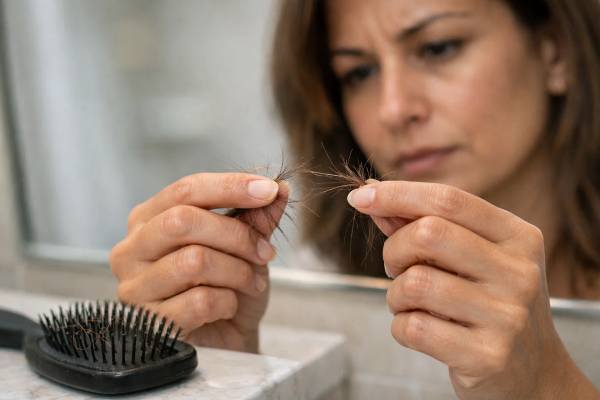
When hair seems to stop at one stubborn length, feels rough no matter what you use, and shows tiny white specks that snap into frayed ends, the problem is often not shedding from the root. It is breakage along the shaft. Trichorrhexis nodosa is one of the clearest examples. In this disorder, weak points form in the hair fiber, and those weak points split and fracture under everyday stress.
For many people, the condition is acquired rather than inherited. Heat, chemical processing, friction, rough detangling, and repeated styling can gradually erode the cuticle until the cortex starts to split like the end of a rope. In other cases, especially when it begins early in life, trichorrhexis nodosa can signal an underlying metabolic, genetic, or structural hair problem.
That is why good care starts with recognition. Once you know what you are looking at, the goal changes from chasing “growth” to protecting fragile fibers, reducing new fractures, and giving healthier hair a chance to stay intact.
Key Insights
- Trichorrhexis nodosa causes hair shaft breakage, not true follicle loss, so the main goal is retention of new growth.
- Acquired cases often improve when heat, chemical stress, friction, and aggressive grooming are reduced consistently.
- The damaged segment usually does not fully rebuild, so smoother care works better than intensive product layering alone.
- Onset at birth, early childhood, or with body-hair involvement can point to an underlying disorder that needs medical evaluation.
- A practical routine is to cleanse gently, condition every wash, detangle with slip, and pause high-risk styling for at least several growth cycles.
Table of Contents
- What trichorrhexis nodosa looks like
- Why hair shafts start fraying
- Congenital and acquired forms
- How diagnosis is confirmed
- Best care routine for breakage
- Recovery timeline and when to seek help
What trichorrhexis nodosa looks like
Trichorrhexis nodosa is a structural hair-shaft disorder marked by weak points, or “nodes,” that make the fiber easy to snap. Those nodes are not healthy thick spots. They are fracture sites. Under magnification, the broken ends look like two worn paintbrushes pushed into each other. In daily life, that microscopic pattern shows up in a far more familiar way: brittle hair, uneven lengths, white dots on strands, and a constant sense that the hair is not retaining length even when the scalp is producing new growth.
The condition often announces itself through a cluster of signs rather than one dramatic symptom:
- Hair feels dry, rough, or dull.
- Individual strands show tiny pale nodules or specks.
- Ends split, fray, and snap with light handling.
- The overall style looks thinner because strands keep breaking shorter.
- Hair may grow from the scalp normally but cannot stay intact long enough to look longer.
This is why trichorrhexis nodosa is often confused with “hair loss.” What many people are seeing is not a shedding disorder at all. The follicle may be working, but the visible fiber fails before it can accumulate length. That distinction matters because treatment for breakage is very different from treatment for true shedding or patterned thinning. If the main problem is shaft fracture, the most useful framework is breakage versus root-level loss, not simply “how to regrow hair.”
The look can vary by hair type and by where the fracture happens. Some people see diffuse short broken hairs around the crown or nape. Others notice a patch of hair that seems stuck at a few centimeters, especially where heat, rubbing, or combing is concentrated. In tightly curled or coily hair, the damage may feel like a general collapse in length retention rather than a neatly defined patch.
Another clue is the mismatch between scalp health and shaft health. The scalp may look quite normal. There may be no major shedding in the shower and no obvious widening of the part. Yet the hair itself looks fragile, fuzzy, or cottony, with many short pieces projecting from the surface. Trichorrhexis nodosa can also affect eyebrows, beard hair, and body hair, though scalp hair is the most common concern.
One practical point helps set expectations early: trichorrhexis nodosa is a problem of fiber integrity. The goal is not to “switch on growth” as much as to reduce new break points. That is why people often feel better once the condition is named. It explains why expensive growth products may disappoint when the real issue is not slow growth, but repeated shaft failure.
Why hair shafts start fraying
Healthy hair shafts depend on a protective cuticle. When that outer layer is worn down, the inner cortex becomes exposed, and the strand starts to split under forces it used to tolerate. Trichorrhexis nodosa develops when enough of that protective structure is lost. The result is a weak segment that buckles, frays, and breaks.
In acquired cases, the process is usually cumulative. It is rarely one shampoo or one rough combing session. More often, it is repeated stress over weeks or months. The most common contributors include:
- High heat from flat irons, hot combs, blow-dryers, and frequent hot brushing.
- Chemical processing such as bleaching, relaxing, straightening, perming, or repeated coloring.
- Mechanical trauma from aggressive combing, brushing, teasing, backcombing, or tight manipulation.
- Friction from rubbing, scratching, headgear, rough towels, or persistent scalp itch.
- Weathering of older hair that has been exposed to years of washing, sun, water, and grooming.
The closer damage occurs to the scalp, the more dramatic the breakage usually looks. This is why proximal trichorrhexis nodosa can create obvious short, uneven hair and areas that seem unable to gain length. Distal breakage, by contrast, often blends into classic split ends and weathered tips. Localized trichorrhexis nodosa can happen in a small patch where rubbing or scratching is concentrated.
Hair texture and styling patterns matter too. Curly, coily, and tightly curled fibers often have more bends along the shaft, which means more points where stress can concentrate. That does not mean textured hair is inherently diseased. It means the fiber may be less forgiving when heat, chemical straightening, or repeated manipulation are layered on top. In the real world, this is why acquired trichorrhexis nodosa is seen so often in people dealing with both natural fragility and intensive grooming demands.
Chemical exposure deserves special attention because people often underestimate how much invisible injury it can create. Strong straighteners, bleaches, and certain smoothing treatments can weaken the cuticle before the hair feels damaged. By the time the strand looks rough, nodular fracture points may already be present. This is one reason recurring breakage after processing should raise suspicion for more than ordinary dryness, especially after harsh relaxers or other high-risk chemical treatments.
There is also a behavioral side to the disorder. Some cases are driven by rubbing, twisting, or habitual grooming rather than salon damage alone. An itchy scalp, anxiety-linked hair handling, or a very specific combing pattern can create a localized zone of repeated trauma. That is why a detailed hair history matters so much. The answer is often not hidden in a rare lab value. It is hidden in the daily routine.
A useful way to think about the condition is this: trichorrhexis nodosa is the visible record of repeated strain written into the hair shaft. Once enough layers of protection are gone, the strand stops behaving like resilient fiber and starts behaving like worn fabric.
Congenital and acquired forms
Trichorrhexis nodosa is not one single pathway to breakage. It has two broad clinical contexts: congenital and acquired. Understanding that distinction helps determine how far the evaluation should go and how much of the plan should focus on routine alone.
Acquired trichorrhexis nodosa is by far the more common form. It develops after the hair shaft has been repeatedly stressed by grooming, heat, chemicals, friction, or chronic rubbing. In these cases, the history often makes sense once you slow down and map the habits. The person may be bleaching every six weeks, flat-ironing several times a week, brushing dry curls, scratching an itchy patch at the crown, or using a routine that requires frequent tension and manipulation. The damage is real, but it is not mysterious.
Congenital trichorrhexis nodosa is different. It appears at birth, in infancy, or early childhood, and it may be linked to metabolic, genetic, or syndromic conditions that make the shaft inherently fragile. In these cases, the disorder is less about weathering alone and more about the hair being built with reduced structural resilience from the start.
Features that make an underlying disorder more likely include:
- Onset at birth or within the first months of life.
- Very short, brittle hair despite gentle care.
- Eyebrow, eyelash, or body-hair involvement.
- Poor growth, feeding issues, neurologic symptoms, or developmental concerns.
- Other skin, nail, or ectodermal abnormalities.
- A family history of unusually fragile hair.
Certain inherited or metabolic conditions have been associated with trichorrhexis nodosa, including disorders of amino acid metabolism, sulfur-poor hair syndromes, Menkes disease, Netherton-related fragility patterns, and other syndromic hair disorders. That does not mean every child with breakage has a rare disease. It means early onset changes the threshold for deeper workup.
There is also a middle ground. Some people may have a mild inherent shaft weakness that only becomes obvious when grooming stress is added. This is one reason two people can follow the same hair routine and only one develops severe breakage. The issue is not always purely external or purely genetic. Sometimes it is an interaction between baseline fragility and daily wear.
That distinction shapes treatment expectations. Acquired disease often improves clearly when trauma is reduced. Congenital forms may improve with very careful handling, but the fragility can persist because the basic shaft structure remains vulnerable. In selected metabolic disorders, targeted treatment of the underlying condition can help, but there is no universal “repair” method that normalizes every congenital case.
For adults, the practical question is usually whether the pattern looks disproportionate to the routine. If a person has obvious heat or chemical stress, acquired disease is the leading explanation. If breakage seems severe despite gentle care, has been present since childhood, or involves multiple hair-bearing sites, the evaluation should widen. Trichorrhexis nodosa may be the diagnosis on the strand, but not the whole diagnosis in the person.
How diagnosis is confirmed
The diagnosis often starts with a good clinical suspicion. A person says their hair will not grow, but closer questioning shows that it grows and then snaps. They describe white dots along the shaft, uneven short pieces, or breakage in one repeatedly handled area. The exam reveals dull, brittle fibers with variable lengths rather than a true decrease in follicle density.
From there, clinicians usually confirm the picture by examining the shaft itself. The most helpful tools are:
- History and physical examination, including onset, styling habits, chemical exposure, friction, and family history.
- Trichoscopy or dermoscopy, which can show white nodes, shaft irregularities, and broken fibers in the office.
- Light microscopy, which remains the clearest confirmatory method because it shows the classic splayed “paintbrush” fracture pattern.
This is one of the most important distinctions in the article: trichorrhexis nodosa is diagnosed from the hair shaft, not mainly from blood work. In straightforward acquired cases, a microscope tells the story far more directly than a broad hormone panel. That is why scalp biopsy is usually not the first or best test. The follicle is often not the main problem.
A careful history can also help classify the type. Proximal damage points toward more severe near-scalp injury, often from heat or chemical processes. Distal damage suggests weathering and cumulative grooming injury. A sharply localized patch raises the possibility of rubbing, scratching, or a repetitive handling habit. In children or lifelong cases, the question becomes whether the fragility is part of a broader inherited hair disorder.
Additional tests become more useful when the presentation is unusual. A clinician may order laboratory or genetic workup when:
- The fragility began in infancy or early childhood.
- There are developmental, metabolic, or neurologic clues.
- Eyebrows, lashes, or body hair are involved.
- The hair appears abnormally fragile despite a very gentle routine.
- Another diagnosis, such as nutritional deficiency or inflammatory scalp disease, seems likely at the same time.
It is also important to distinguish trichorrhexis nodosa from conditions that look similar. Monilethrix has a beaded appearance with regular constrictions. Trichorrhexis invaginata has a “bamboo hair” pattern. Bubble hair is linked to heat damage. Trichotillomania produces irregular broken lengths from pulling. Ordinary split ends can coexist with trichorrhexis nodosa, but they do not always mean the same thing. The shaft pattern under magnification helps separate these disorders.
In day-to-day practice, the most useful mental model is simple: if the scalp is growing hair but the fiber is failing, inspect the fiber. That keeps the workup efficient and prevents the common mistake of treating a shaft fracture problem as though it were exclusively a shedding disorder from the root.
Best care routine for breakage
The best care routine for trichorrhexis nodosa is protective, not aggressive. The damaged segment usually cannot be restored to fully normal strength, so the aim is to prevent fresh nodes from forming while healthier hair grows in. That means fewer high-risk inputs and more consistent low-friction care.
A practical routine usually looks like this:
- Stop the major triggers first.
Put bleaching, relaxing, smoothing treatments, and frequent high-heat styling on hold. If the routine caused the damage, no serum can outperform continued exposure. This pause often matters more than adding a new product. - Wash the scalp gently and on a reasonable schedule.
Clean hair is easier to detangle and less likely to mat or snag. Choose a mild shampoo that fits your scalp type, not one that leaves the shaft stripped and squeaky. - Condition every wash.
Conditioner reduces friction between fibers. In trichorrhexis nodosa, that matters because friction is part of the problem. Apply enough slip to help the strands separate with less force. - Detangle with support, not speed.
Work in sections. Use fingers first when possible, then a wide-tooth comb on conditioned, slip-coated hair. Repeated dry forcing is a common way to turn fragility into visible breakage. A gentler technique is especially important in textured hair, where the choice between rough pulling and controlled sectioning can define the difference between retention and fracture. Many people improve simply by changing their detangling approach. - Reduce heat and tension.
If heat cannot be avoided completely, use it sparingly and keep it off the most damaged areas. Limit repeated passes, tight brushing under tension, and styles that require strong pulling from the roots through the ends. - Protect the older ends.
The oldest hair has the most weathering. Soft handling during sleep, exercise, and wash day lowers the number of daily micro-injuries. For some people, that means looser styles, less brushing, and smoother fabrics during sleep. - Trim strategically.
Regular small trims can remove heavily frayed segments that keep splitting upward. Trimming is not the cure, but it prevents the most damaged fiber from continuing to shred.
There are also important limitations to know. Deep conditioners, oils, silicones, and bond-focused formulas may improve feel, slip, and combability, which can be genuinely helpful. But they do not erase a structurally broken node. Their value is mostly preventive and supportive. They make future handling safer; they do not fully rebuild a strand that is already split apart.
A good routine also treats the cause behind the routine. If rubbing and scratching are driving localized breakage, the itch source needs attention. If a smoothing regimen caused the damage, the answer is not a stronger post-treatment mask. It is a change in exposure. Trichorrhexis nodosa improves when care becomes quieter, simpler, and more consistent.
Recovery timeline and when to seek help
Recovery from trichorrhexis nodosa usually means less new breakage first, then better length retention later. That order matters. Many people become discouraged because they expect the already damaged hair to look normal again within days. In reality, the earliest sign of progress is often more subtle: fewer snapped hairs on wash day, less fuzz along the top layer, and a smoother feel during detangling.
A reasonable timeline looks like this:
- In the first few weeks, the goal is stabilization. The hair should feel less stressed if the main triggers have been removed.
- By about 6 to 8 weeks, many people notice fewer fresh fracture points and a more predictable routine.
- Over the next few months, healthier new growth has a better chance of surviving, so retained length starts to improve.
- Full cosmetic recovery takes longer if large portions of the existing length are already weathered.
That timeline is why patience matters. Hair shafts do not “heal” the way skin does. Improvement depends on growing better-preserved hair and not destroying it on the way down the shaft. The more severe the old damage, the more visible the recovery depends on time, trims, and consistency.
Medical evaluation becomes more important when the story does not fit a straightforward acquired case. You should seek professional assessment if:
- Breakage begins in infancy, childhood, or has been lifelong.
- Eyebrows, eyelashes, or body hair are also fragile.
- The hair looks unusually brittle despite very gentle care.
- There are scalp symptoms such as major redness, scale, pain, or inflammation.
- A localized patch suggests chronic rubbing, scratching, or another underlying scalp disorder.
- There are signs of nutritional, metabolic, endocrine, or genetic disease.
- The hair is snapping and shedding at the same time, making the picture mixed.
Adults should also get help when breakage is severe enough to create obvious thinning, when the cause is unclear, or when a simplified routine has not improved things after a few months. A dermatologist can confirm the diagnosis with shaft examination, decide whether testing is needed, and separate pure breakage from overlapping disorders. That is especially useful when the problem is being mistaken for patterned thinning or chronic shedding. In those situations, broader guidance on when specialist hair-loss care makes sense can prevent a long cycle of trial and error.
The most encouraging part of trichorrhexis nodosa is that acquired cases often respond well once the source of damage is recognized. The hair may not need more stimulation. It may simply need less injury. That shift in perspective is often the turning point from constant breakage to steady retention.
References
- A Clinical Review of Trichorrhexis Nodosa 2025 (Review)
- Updates on disorders in curly hair 2024 (Review)
- Hair Shaft Disorders in Children – An Update 2023 (Review)
- Breaking the cycle of hair breakage: pearls for the management of acquired trichorrhexis nodosa 2017 (Review)
Disclaimer
This article is for educational purposes only and does not replace medical diagnosis or treatment. Hair breakage can overlap with inflammatory scalp disease, nutritional deficiency, inherited hair-shaft disorders, and other causes of apparent thinning. Persistent fragility, childhood onset, or breakage with other symptoms should be evaluated by a qualified clinician.
If this article helped you, please share it on Facebook, X, or another platform you use so more people can recognize the difference between hair that is shedding and hair that is breaking.