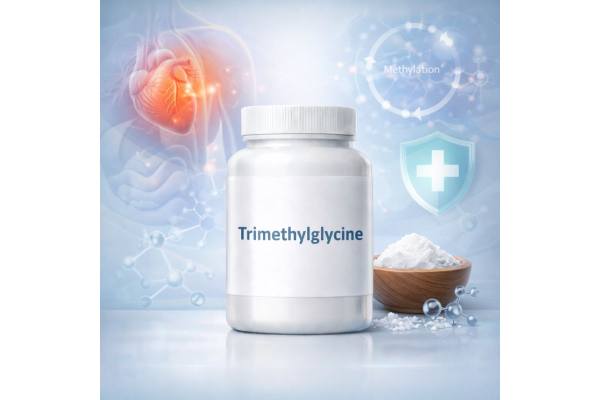
Trimethylglycine (TMG), also called betaine or betaine anhydrous, is a naturally occurring compound found in foods like beets, spinach, and whole grains. It has two “jobs” that explain most of its popularity: it helps the body recycle homocysteine into methionine (a methylation-related pathway), and it acts as an osmolyte, helping cells manage fluid balance under stress. In supplement form, people most often use TMG to support healthy homocysteine levels, strengthen methyl donor status when diet is limited, and—especially in sports nutrition—potentially support training output and recovery.
TMG is not a stimulant, and it is not a hormone. The most important thing is using it for the right goal, at a realistic dose, while watching for a few predictable downsides like stomach upset or changes in blood lipids in some people.
Essential Insights
- TMG can support healthy homocysteine metabolism, especially when folate and vitamin B12 status is not optimal.
- Athletic use is most often tied to cell hydration and training performance, with effects that vary by person and protocol.
- Typical supplemental dosing is about 1,500–6,000 mg/day, often split into 2 doses.
- Higher doses may cause gastrointestinal discomfort and may raise LDL cholesterol in some individuals.
- Avoid or use only with clinician guidance if you have kidney disease, significant lipid disorders, or are pregnant or breastfeeding.
Table of Contents
- What is trimethylglycine and how does it work?
- Does TMG lower homocysteine?
- Can TMG improve exercise performance?
- Is TMG good for liver health?
- How to choose a TMG supplement
- How much TMG should you take?
- Side effects, interactions, and who should avoid TMG
What is trimethylglycine and how does it work?
Trimethylglycine (TMG) is a small molecule derived from glycine with three methyl groups attached. In the supplement world, you will usually see it labeled as betaine or betaine anhydrous. Your body also makes betaine from choline, and you get it directly from foods—beets are the famous example, but leafy greens, wheat bran, quinoa, and seafood contribute too.
TMG matters because it supports two core physiological functions:
- Methyl donation (homocysteine recycling): TMG donates a methyl group in a pathway that helps convert homocysteine back into methionine. Methionine can then be used to form S-adenosylmethionine (SAMe), a major methyl donor involved in hundreds of reactions (including neurotransmitter metabolism, creatine synthesis, and DNA methylation patterns). This does not mean “more TMG equals better methylation” for everyone—it means TMG can be helpful when methyl donor intake or related nutrients are limited, or when homocysteine runs high.
- Osmolyte function (cell hydration control): TMG helps cells regulate fluid balance under stress (heat, dehydration, intense exercise). This is one reason betaine appears in sports supplements: better cellular hydration can influence perceived effort, muscular endurance, and heat tolerance in some contexts.
A common confusion: betaine HCl is not the same product as betaine anhydrous. Betaine HCl is betaine bound to hydrochloride and is usually marketed for stomach acidity support; it is not typically used at the same gram-level doses as TMG for homocysteine or performance goals. If your goal is methylation or exercise performance, you generally want betaine anhydrous (TMG).
Finally, TMG is not a thyroid hormone, not creatine, and not a stimulant. Its effects tend to be subtle, goal-specific, and easiest to notice when you track the right outcomes (lab markers for homocysteine, or consistent performance testing in training).
Does TMG lower homocysteine?
For many people, the strongest “medical-style” reason to consider TMG is support for healthy homocysteine metabolism. Homocysteine is a sulfur-containing amino acid intermediate. Your body constantly produces it and clears it through two main routes: remethylation (turning it back into methionine) and transsulfuration (moving it toward cysteine production). TMG supports the remethylation side.
If your homocysteine is mildly elevated, TMG may help—but it works best when you also cover the fundamentals:
- Folate and vitamin B12 status: These nutrients support another major homocysteine pathway (the folate-dependent remethylation route). If folate or B12 is low, simply adding TMG may not fully solve the problem. Many clinicians prioritize correcting B12 and folate first, then layering TMG if needed.
- Riboflavin (B2) and vitamin B6: These can matter depending on your metabolism, diet pattern, and genetics. You do not need to assume a genetic issue to benefit from a better B-vitamin baseline, but you also do not need megadoses.
- Diet and lifestyle: High alcohol intake, low produce intake, and low protein quality can nudge homocysteine upward. So can hypothyroidism and certain medications. If you only supplement and ignore the driver, results often plateau.
In practical terms, people usually use TMG in two ways:
- Lab-marker strategy: You test fasting homocysteine, take TMG consistently for 8–12 weeks (often alongside a targeted B-vitamin plan), then re-test. This is the cleanest way to know whether it is worth continuing.
- Diet-gap strategy: If your diet is low in choline-rich foods (eggs, fish) and leafy greens, or you are under high training stress, TMG can serve as a simple methyl donor “backstop.”
One caution: lowering homocysteine is not automatically the same thing as lowering cardiovascular risk for everyone. Homocysteine is a useful marker, but outcomes depend on the full clinical picture. That is why TMG fits best as part of a plan: nutrient repletion, sleep, training load management, and appropriate medical oversight when homocysteine is significantly elevated.
Can TMG improve exercise performance?
TMG’s reputation in sports nutrition comes from its osmolyte role and its potential to influence muscle function under stress. In real-world terms, people hope for one of three outcomes: a small boost in training volume (more reps at a given load), better repeated sprint capacity, or a slight edge in endurance performance.
What tends to be most realistic:
- Muscular endurance and training output: Some protocols show improved repetitions to fatigue or better maintenance of power across sets. This can be meaningful over months if it helps you accumulate more quality work without increasing perceived strain.
- Endurance performance (sometimes): The endurance story is mixed. When benefits appear, they often look like modest improvements in time trial performance or economy, not dramatic leaps. Hydration status, heat, and training level likely influence who responds.
- Body composition: Some people use TMG expecting fat loss or lean mass gains. The more defensible expectation is indirect: if training quality improves and recovery holds steady, body composition may move in a favorable direction over time. TMG is not a shortcut that replaces training, protein intake, or energy balance.
How to make a fair test of whether it works for you:
- Pick one measurable marker (for example, total reps across 3 work sets at a fixed weight, a 2,000 m row time, or a repeat-sprint protocol you can reproduce).
- Keep everything else stable for 3–6 weeks: training plan, sleep targets, caffeine timing, and hydration habits.
- Use a consistent dose (many sports protocols cluster around 2,500 mg twice daily, but lower doses are also used).
- Evaluate trend, not one session. A single great workout proves little; a consistent 2–4% improvement over multiple tests is more convincing.
A subtle but important point: some “response” may actually be improved tolerance to training stress (less drop-off late in a session) rather than a higher one-rep max. If your sport is repeated effort—field sports, CrossFit-style mixed modal work, rowing, combat sports conditioning—that pattern can matter.
If you are already doing the basics extremely well (training periodization, creatine, protein timing, sleep), TMG’s effect may be small. If your recovery is messy or hydration is inconsistent, TMG is less likely to save the day. It works best as a “fine-tuning” tool, not the foundation.
Is TMG good for liver health?
TMG is closely tied to liver metabolism because the liver is a major hub for methylation, fat processing, and homocysteine handling. This is why betaine has a long research history in fatty liver contexts, including nonalcoholic fatty liver disease (NAFLD) and broader “metabolic liver stress.”
Why it might help, in plain language:
- Methyl support for fat handling: The liver uses methylation pathways to package and export fats. When methyl donors are limited (or when metabolic stress is high), fat can accumulate more easily in the liver. TMG can support methyl availability through the homocysteine-to-methionine route.
- Osmolyte protection: Liver cells also deal with osmotic stress. As an osmolyte, TMG may help cells stay resilient when metabolic inflammation and oxidative stress are present.
- Gut-liver axis signaling: Emerging work discusses betaine’s influence on gut-derived signals that affect liver inflammation and fat metabolism. This does not mean it “fixes the microbiome,” but it can be part of a broader dietary approach that includes fiber, protein adequacy, and reduced ultra-processed intake.
What to expect realistically:
- If you have NAFLD, the biggest levers are still weight management (if needed), resistance training, aerobic activity, and reducing excess added sugars and alcohol. Supplements can support but rarely outperform lifestyle changes.
- TMG may be more likely to help markers (certain lab values) than it is to produce an obvious “feel it” effect. Many people with fatty liver feel normal until disease is advanced.
- Results vary by dose and by baseline status. Some studies use very high doses that are not comfortable for everyday supplementation.
Practical guidance if liver health is your main goal:
- Treat TMG as a supportive adjunct alongside nutrition changes (adequate protein, higher fiber, fewer sugary beverages) and a training plan.
- If you track labs, consider monitoring ALT, AST, GGT, fasting triglycerides, and fasting glucose, plus imaging-based measures if your clinician recommends them.
- Be cautious with “more is better.” Higher doses can create gastrointestinal side effects, and liver-focused protocols should be clinician-guided—especially if you have other conditions or take medications.
If you have confirmed liver disease, do not self-diagnose or self-treat with supplements alone. TMG can belong in the conversation, but it should not replace a medical plan.
How to choose a TMG supplement
Choosing a TMG product is mostly about avoiding label confusion and getting a dose you can use consistently.
Start with the ingredient name:
- Look for trimethylglycine, betaine, or betaine anhydrous.
- Avoid mixing it up with betaine HCl. Betaine HCl is typically used in much smaller amounts and is intended for stomach acidity support, not methylation or performance goals. If a product emphasizes “HCl,” it is a different use case.
Next, check the form and serving size:
- Effective daily amounts often land in the 1,500–6,000 mg/day range depending on goal. Many capsules provide 500–1,000 mg each, which can turn into a “pill burden.” Powders make higher doses easier and cheaper.
- If you are sensitive to taste or texture, capsules may be easier—but calculate how many capsules you will actually take daily before committing.
Then look at formulation choices that affect tolerance:
- Single-ingredient TMG is easiest to evaluate because you can attribute effects (or side effects) to one thing.
- If combined with other methyl donors (methylfolate, methylcobalamin, SAMe), the stack may feel “stronger,” but it can also create more variables if you get headaches, sleep disruption, or anxiety-like symptoms. More is not always better.
Quality and testing considerations:
- Prefer brands that provide third-party testing or transparent quality documentation. With powders, consistency and purity matter.
- Watch for “proprietary blends” that hide the exact TMG dose. If you cannot see milligrams clearly, it is harder to use responsibly.
Finally, match the product to your goal:
- For homocysteine support, many people prefer a straightforward TMG plus an appropriate B-vitamin strategy (often guided by labs).
- For performance, a powder that allows consistent dosing (and easy split dosing) can be the most practical.
- For liver-health support, consider whether you are willing to pair it with the lifestyle moves that actually drive outcomes—if not, save your money.
How much TMG should you take?
TMG dosing depends heavily on your intent and how you tolerate it. Most people do best starting low, then adjusting based on response and any side effects.
Common daily dosing ranges (typical supplemental use):
- General wellness and methyl donor support: 1,500–3,000 mg/day, often split into 2 doses.
- Homocysteine-focused use: commonly 3,000–6,000 mg/day for a defined period (often 8–12 weeks), frequently combined with folate and vitamin B12 support.
- Performance protocols: often 2,500 mg twice daily (total 5,000 mg/day) for several weeks, though lower daily totals are also used.
How to take it:
- Split dosing (morning and early afternoon) often improves tolerance, especially above 3,000 mg/day.
- With food is a good default if you get stomach upset. Some athletes prefer taking one dose pre-workout; if that bothers your stomach, move it earlier and take it with a meal.
- Hydration matters. Because TMG relates to cellular fluid balance, inconsistent fluid and electrolyte intake can muddy your results.
How long until you notice anything:
- Homocysteine labs: plan on 8–12 weeks before re-testing.
- Training outcomes: some notice changes within 2–4 weeks, but it is easiest to judge after 4–6 weeks of consistent training and supplementation.
Smart starting plan (simple and realistic):
- Days 1–7: 1,000–1,500 mg/day
- Weeks 2–3: 2,000–3,000 mg/day
- Weeks 4–8: adjust within 3,000–5,000 mg/day if needed for your goal and tolerance
When not to push the dose:
- If you develop consistent nausea, loose stools, reflux symptoms, or headaches, reduce the daily total or split into smaller doses.
- If you have lipid concerns, consider checking cholesterol after a few months of higher-dose use, especially if you have a family history of elevated LDL cholesterol.
TMG works best when you treat it like a targeted tool: choose one goal, choose one dose strategy, run it consistently, and assess with the right measurement.
Side effects, interactions, and who should avoid TMG
TMG is generally well tolerated, but it is still biologically active. Side effects are usually dose-related and often improve when you split doses or reduce the total.
Common side effects (most often at higher doses):
- Gastrointestinal upset: nausea, stomach cramps, diarrhea, or a “heavy” feeling after dosing.
- Body odor changes: a fishy odor can occur in susceptible individuals due to trimethylamine-related metabolism (this is uncommon but memorable).
- Sleep disruption or feeling “wired” (less common): usually happens when TMG is combined with other methyl donors or taken late in the day in sensitive people.
Potential lab and health considerations:
- Blood lipids: some people see increases in LDL cholesterol with betaine use, particularly at higher doses or with long-term use. If you have known lipid issues, it is reasonable to monitor labs.
- TMAO discussion: betaine can influence trimethylamine-related pathways. The health relevance of this varies and is still debated; it is a “watch the whole risk profile” issue, not a reason for panic.
Interactions and caution zones:
- Diabetes medications: TMG may influence metabolic markers in some people. If you use glucose-lowering medications, monitor blood sugar and discuss changes with a clinician.
- Methylation stacks: combining TMG with high-dose methylfolate, methylcobalamin, SAMe, or similar products can be too activating for some people. If you feel anxious, overstimulated, or develop headaches, simplify your stack.
Who should avoid TMG or use it only with clinician guidance:
- Pregnant or breastfeeding individuals (insufficient supplement safety data for routine use).
- Children and adolescents unless specifically supervised (some studies exist, but routine self-supplementation is not the default choice).
- Kidney disease or significant medical complexity where osmolyte and methylation shifts could be clinically relevant.
- People with uncontrolled lipid disorders or a strong history of elevated LDL cholesterol (monitoring is important if you still choose to use it).
- Anyone treated for a serious liver condition should coordinate supplement use with their care team.
If you want the most evidence-based way to use TMG, treat it like a trial: choose a target (homocysteine lab value, training output metric), pick a dose, run it for a defined period, and decide based on results—not hype.
References
- Betaine Dietary Supplementation: Healthy Aspects in Human and Animal Nutrition 2025 (Review)
- Betaine as a Functional Ingredient: Metabolism, Health-Promoting Attributes, Food Sources, Applications and Analysis Methods 2023 (Review)
- Effects of chronic betaine supplementation on exercise performance: Systematic review and meta-analysis 2024 (Systematic Review and Meta-Analysis)
- Betaine regulates the gut-liver axis: a therapeutic approach for chronic liver diseases 2025 (Review)
- Effects of low-dose B vitamins plus betaine supplementation on lowering homocysteine concentrations among Chinese adults with hyperhomocysteinemia: a randomized, double-blind, controlled preliminary clinical trial 2023 (RCT)
Disclaimer
This article is for educational purposes only and does not provide medical advice, diagnosis, or treatment. Supplements like trimethylglycine (TMG) can affect lab markers and may interact with medical conditions and medications. If you are pregnant or breastfeeding, have kidney or liver disease, have a history of lipid disorders, or take prescription medications (including diabetes therapies), consult a licensed clinician before using TMG. Seek medical care promptly for persistent side effects, chest pain, severe abdominal pain, fainting, or any concerning symptoms.
If you found this guide helpful, please share it on Facebook, X (formerly Twitter), or any platform you prefer, and follow us on social media. Your support through sharing helps our team keep producing high-quality, practical health content.