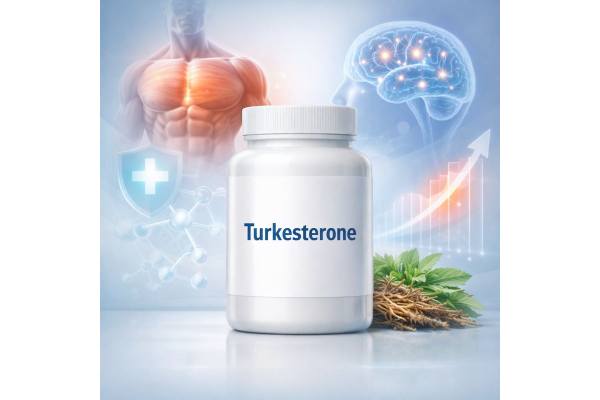
Turkesterone is a plant-derived compound that has become popular in fitness circles for one main reason: it is marketed as a “muscle-building” supplement without the hormonal risks associated with anabolic steroids. It belongs to a group called ecdysteroids, natural molecules plants use for defense and signaling. Most turkesterone supplements are sourced from Ajuga turkestanica and sold as capsules, tablets, or powders with varying potency and purity.
The reality is more nuanced. Early research on ecdysteroids is interesting, but human evidence on turkesterone specifically is limited, and product quality varies widely. This guide breaks down what turkesterone is, what benefits are plausible, how to use it alongside training and nutrition, what dosing ranges are commonly used, and the side effects and safety cautions you should take seriously—especially if you compete in tested sports.
Quick Facts for Turkesterone
- May support training performance and recovery when paired with adequate protein and progressive lifting.
- Expect subtle changes at best; dramatic “steroid-like” results are not realistic for most people.
- Typical supplemental intake is 250–1,000 mg per day, depending on extract strength and tolerance.
- Avoid if pregnant or breastfeeding, or if you have unexplained liver issues or use multiple performance supplements.
- Choose third-party tested products to reduce the risk of contamination and mislabeling.
Table of Contents
- What is turkesterone?
- Does turkesterone actually work?
- How turkesterone may work
- How to use turkesterone
- Turkesterone dosage and timing
- Side effects and who should avoid it
- Evidence quality and smart alternatives
What is turkesterone?
Turkesterone is an ecdysteroid, a class of naturally occurring compounds found in certain plants (and also in insects, where related molecules help regulate molting). In supplements, “turkesterone” usually means a specific ecdysteroid molecule extracted from plants, most famously Ajuga turkestanica, a species associated with Central Asia. You may also see the term phytoecdysteroids, which simply means “plant ecdysteroids.”
A common point of confusion is the relationship between turkesterone and ecdysterone (also called 20-hydroxyecdysone). They are related but not identical molecules. Many human studies on performance talk about ecdysterone, not turkesterone. That distinction matters because people often assume the entire category behaves the same in the body. Similar does not always mean interchangeable.
Why it is marketed as “non-hormonal”
Turkesterone is not an anabolic steroid like testosterone derivatives used in medical and non-medical settings. It does not act as a direct replacement for testosterone, and it is not typically described as binding strongly to human androgen receptors in the way anabolic steroids do. That is why marketing often frames it as “anabolic without suppression.”
Still, “non-hormonal” is not the same as “no biological effects.” Many plant compounds influence signaling pathways indirectly—through inflammation, stress responses, protein synthesis signals, appetite, or training capacity. The right mental model is: turkesterone is not a steroid hormone, but it may influence cellular pathways linked to performance or recovery.
What you can realistically expect from a supplement label
Most turkesterone products list:
- total extract weight (for example, 500 mg)
- an estimated standardization percentage (for example, 10 percent turkesterone)
- capsule count and serving size
The catch is that “500 mg extract” does not automatically mean “500 mg turkesterone.” If an extract is 10 percent, you would expect 50 mg of the target compound per capsule—assuming the label is accurate.
If you are evaluating turkesterone, the most important early questions are not “Is it natural?” but:
- Is the product standardized to a known amount of active compound?
- Is it third-party tested for identity and contaminants?
- Does the brand provide a certificate of analysis?
These details often predict real-world outcomes better than hype claims.
Does turkesterone actually work?
This is the question most people care about: will turkesterone noticeably improve muscle, strength, or physique? The honest answer is: it might help some people a little, but the average person should expect modest, hard-to-measure effects unless training, sleep, calories, and protein are already in a strong place.
Where it could help
If turkesterone has real performance value, it is most likely to show up in one of these “adjacent” benefits rather than instant muscle gain:
- Training capacity: slightly better ability to handle volume (more quality sets per week)
- Recovery feel: less soreness or faster readiness to train again
- Consistency: subtle improvement in energy or motivation that keeps training regular
- Body composition support: small shifts over time when paired with progressive resistance training and adequate protein
These are the kinds of effects that matter in the gym, but they are also easy to confuse with placebo, better programming, or better nutrition.
Where marketing often exaggerates
Be skeptical of claims that imply:
- rapid lean mass increases within 1–2 weeks
- “steroid-like” transformations
- dramatic strength jumps without changes to training
- guaranteed results for everyone
Supplements that truly move the needle strongly tend to have clearer, repeatable effects across many studies and populations. Turkesterone does not have that level of consensus.
What makes results vary so much
Turkesterone experiences are inconsistent for several reasons:
- Baseline matters: If you are sleeping 5 hours, under-eating protein, and training randomly, turkesterone is unlikely to rescue results.
- Product quality varies: Many products may be under-dosed, mislabeled, or not truly standardized.
- Response biology differs: Digestion, absorption, and metabolism can change how much of a compound reaches tissues.
- Expectations shape perception: When someone expects a dramatic change, normal training fluctuations can feel like a “result.”
A practical “success metric” that makes sense
If you want to judge turkesterone fairly, track outcomes that reflect training performance rather than vibes:
- total weekly training volume (sets that are close to failure)
- rep performance at a fixed load (for example, how many reps at 80 kg on squat)
- body weight trend and waist measurement (weekly averages)
- recovery markers (sleep hours, resting heart rate, perceived soreness score)
If nothing moves after a solid 6–8 week training block, it is reasonable to conclude that turkesterone is not providing meaningful value for you—or that the product is not potent enough to matter.
How turkesterone may work
Turkesterone is popular because it is often described as “anabolic,” but its proposed mechanisms are not the same as anabolic steroids. Think of it more like a compound that may influence cell signaling related to growth and recovery rather than directly turning on androgen receptors.
Protein synthesis signaling and muscle adaptation
Muscle growth requires two things: training that creates a stimulus, and enough recovery resources (protein, calories, sleep) to rebuild. Some ecdysteroids are proposed to influence protein synthesis pathways and muscle cell signaling. The most realistic interpretation is that, if an effect exists, it likely nudges the system rather than overriding it.
In practice, that means turkesterone is unlikely to build muscle without:
- consistent progressive overload
- adequate protein (often a range like 1.6–2.2 g per kg per day for many lifters)
- enough total calories to support training goals
Stress response and recovery support
One reason plant compounds can appear “performance enhancing” is that they may influence stress-related biology—sleep quality, inflammation signaling, and perceived fatigue. If you recover slightly better, you can train more effectively. For many lifters, recovery is the bottleneck.
This is why people sometimes report:
- better readiness to train
- smoother soreness patterns
- improved training consistency
These are plausible, but they are not guaranteed, and they do not prove direct muscle-building action.
Absorption and the “bioavailability problem”
A major open question for many ecdysteroids is how well they are absorbed and how they are transformed in the gut and liver. If absorption is low or metabolism is rapid, you may need higher doses to see any systemic effect—yet higher doses can also increase side effects and cost.
This is one reason “more mg” is not always better. A higher dose of a low-quality product may still deliver very little active compound, while a lower dose of a verified, standardized extract could be more meaningful.
Why it may feel different from stimulants
Turkesterone is not a stimulant like caffeine. If it helps, the effect is usually described as:
- “steady” rather than “wired”
- gradual rather than immediate
- more about training tolerance than acute focus
If you take it expecting the noticeable punch of a pre-workout, you may be disappointed even if it is helping slightly in the background.
The bottom line: the “how” is still being clarified. Use turkesterone as a structured experiment, not as a shortcut, and tie it to measurable training outcomes.
How to use turkesterone
Turkesterone makes the most sense when you use it as part of a coherent training and recovery plan. It is not a substitute for programming, protein, or sleep. If you treat it like a controlled add-on to a solid routine, you will get clearer answers about whether it helps you.
Pick the right use case
Turkesterone is usually tried for one of these goals:
- Lean mass support during a structured hypertrophy block
- Strength progression support during a peaking or intensification phase
- Recovery support during high-volume training
- Consistency support for people who feel run down during training cycles
If your goal is fat loss with minimal strength loss, turkesterone is less proven than basics like protein, resistance training, and an appropriate calorie deficit. It could still be used, but expectations should be conservative.
How long to run a fair trial
A reasonable trial length is 6–8 weeks, because:
- training adaptations accumulate over time
- body composition changes are slow
- placebo effects often fade when tracking is consistent
Shorter trials (1–2 weeks) are rarely useful unless you are testing tolerance.
How to stack it without confusing results
If you add turkesterone while also changing five other variables (new pre-workout, new program, new creatine, new protein intake), you will never know what did what. A clean approach:
- Keep training plan steady for the full trial.
- Keep calories and protein consistent.
- Add turkesterone alone for 2–3 weeks.
- Only then consider adding another supplement if needed.
If you want a “minimal but effective” stack, many athletes prioritize:
- creatine monohydrate (daily consistency)
- protein intake targets
- caffeine only when needed
- turkesterone as an optional add-on
Timing and daily habits that make it work better
Even if timing is not everything, routines improve compliance:
- Take turkesterone at the same time daily (morning and evening if split).
- Pair it with meals if it upsets your stomach.
- Keep hydration and fiber adequate to reduce GI variability.
Also, set a clear plan for training progression:
- 10–20 hard sets per muscle group per week (depending on experience and recovery)
- progressive overload (more reps, more load, or more sets over time)
- deloads when performance stalls
Turkesterone is most likely to show value when it supports the ability to do the work consistently. Without that foundation, it becomes an expensive guess.
Turkesterone dosage and timing
Turkesterone dosing is one of the most confusing parts of using it because products differ in purity and standardization, and human research is not as robust as people assume. The goal is to choose a practical dose range, tolerate it well, and avoid getting trapped in “more is better” thinking.
Common supplemental dose ranges
In typical consumer use, you will see these patterns:
- 250–500 mg per day as a conservative starting range (often split into 1–2 doses)
- 500–1,000 mg per day as a common “full” range in fitness circles
- Sometimes higher daily totals, especially when product standardization is unclear
Important: if the label lists “extract mg” rather than “turkesterone mg,” the true dose of active compound may be much lower. For example, a 500 mg capsule of a 10 percent extract would theoretically provide 50 mg of the target compound—if accurately standardized.
Split dosing and timing
Many people split turkesterone into morning and evening doses for steadier intake and better stomach tolerance. Practical timing options:
- Once daily with a meal (simplest, best for compliance)
- Twice daily with meals (often better tolerated at higher totals)
- Pre-workout timing is optional; it is unlikely to behave like an acute performance booster
A sensible “start low” protocol
If you are new to it, this structure reduces guesswork:
- Days 1–7: 250 mg per day with a meal
- Weeks 2–8: increase to 500 mg per day if tolerated and still relevant
- Optional: move toward 750–1,000 mg per day only if you have a strong reason, good tolerance, and a verified product
If you notice stomach upset, reduce dose or take only with food. If there is no meaningful benefit after 6–8 weeks with consistent training, it is reasonable to stop.
Product quality and standardization checks
Because turkesterone is a high-hype supplement, quality issues can be common. Look for:
- Third-party testing for identity and contaminants
- Clear standardization information (percent or mg of active compound)
- Batch-specific documentation (a certificate of analysis is ideal)
- Avoid “proprietary blend” labeling when it obscures actual dosages
If you compete in tested sports, quality matters even more. The biggest real-world risk is not turkesterone itself—it is contamination or adulteration with prohibited substances in poorly controlled manufacturing.
The practical takeaway: dose conservatively, prioritize product verification, and judge results with training data—not wishful thinking.
Side effects and who should avoid it
Turkesterone is often described as “well tolerated,” but the safety picture is incomplete, especially for long-term high-dose use and for special populations. Most side effects reported by users are mild and digestive, but the bigger safety issue is uncertainty: many products are not standardized well enough to predict what you are really taking.
Possible side effects
Commonly reported issues include:
- stomach discomfort, nausea, or reflux
- loose stools (more likely at higher doses)
- headaches (often hard to prove as supplement-related)
- sleep changes (some feel calmer, others feel restless)
If side effects occur, the first fix is usually to reduce the dose and take it with food. If symptoms persist, stop and reassess rather than pushing through.
Who should avoid turkesterone
Avoid or use only with clinician guidance if you are:
- pregnant or breastfeeding
- under 18
- managing unexplained liver enzyme elevations or known significant liver disease
- dealing with severe kidney disease where supplement clearance concerns matter
- using multiple performance supplements and cannot confidently track reactions
Turkesterone is not essential, and if your situation increases risk, the best move is often to skip it.
Medication and condition interactions
No interaction list is perfect, but consider caution if you use:
- blood thinners or antiplatelet medications (general supplement caution, especially with herbal extracts)
- diabetes medications (any supplement that affects training tolerance, appetite, or metabolism can indirectly affect glucose control)
- immunosuppressants or complex endocrine medications (individualized risk is higher)
If you are under medical care for a chronic condition, bring the exact product label to your clinician rather than describing it from memory.
Tested sport considerations
Even if a compound is not explicitly banned, athletes can still fail a drug test from:
- contaminated supplements
- mislabeled ingredients
- poor manufacturing controls
If you compete under anti-doping rules, choose products with strong third-party certification and keep records of lot numbers and receipts. If your sport has strict liability rules, the safest option is often to avoid high-risk, high-hype categories entirely.
The bottom line: turkesterone is not a “free lunch.” Treat it like a serious supplement choice, not a casual add-on.
Evidence quality and smart alternatives
Turkesterone sits in a tricky evidence category: high public interest, plausible mechanisms, and limited high-quality human data. The smartest way to use the evidence is to decide how much uncertainty you are comfortable with—and whether your goals could be met more reliably with simpler tools.
What research can and cannot tell you right now
- Ecdysteroids as a category have been studied more than turkesterone alone. Some human work suggests potential effects on strength or body composition in certain contexts, but results are not universally consistent and may depend on dosing, training status, and product purity.
- Turkesterone-specific human evidence is much thinner in public literature than marketing implies. That does not mean it does nothing; it means your expectations should be conservative.
- Product variability makes interpretation harder. Even a well-designed study cannot help if the market product you buy does not match its label.
A practical reading: there is enough signal to justify cautious experimentation for some people, but not enough certainty to treat turkesterone as a cornerstone supplement.
How to decide if it is worth trying
Turkesterone may be worth a trial if:
- you already train consistently (3–5 days per week)
- your protein intake is strong and stable
- you are not expecting rapid, steroid-like change
- you can afford a verified product and track outcomes
It is probably not worth it if:
- your training is inconsistent
- you are still building basic habits (sleep, calories, progressive overload)
- you are in a high-risk tested-sport environment with strict liability
- you want predictable, well-established results
Smarter alternatives with clearer evidence
If your goal is muscle and strength, these usually deliver more reliable returns:
- Creatine monohydrate: supports strength and high-intensity performance for many people when taken daily.
- Protein targets: consistent daily protein intake often outperforms niche supplements.
- Progressive resistance training: structured programming is the main driver of results.
- Sleep and recovery: small improvements in sleep can have outsized effects on training quality.
- Caffeine (strategic): useful for performance when timed well and not overused.
If you still want to try turkesterone after you have the basics covered, that can be reasonable. Just keep the experiment clean, time-limited, and measured. The biggest win is not “finding a magic pill”—it is building a system where you can tell what actually works for your body.
References
- Ecdysterone as a potential anabolic compound in humans: A systematic review 2020 (Systematic Review)
- Ecdysteroids: A novel class of anabolic agents? 2019 (Review)
- Phytoecdysteroids: Distribution, biological activity and therapeutic potential 2022 (Review)
- Ajuga turkestanica (Lamiaceae): A review of phytochemistry and pharmacology 2022 (Review)
- Dietary supplement contamination and adulteration: Implications for athletes 2020 (Review)
Disclaimer
This article is for general educational purposes and does not provide medical advice, diagnosis, or treatment. Turkesterone and related plant extracts may vary in purity and potency, and supplements can interact with medications or underlying health conditions. If you are pregnant, breastfeeding, under 18, managing a chronic condition, have abnormal liver or kidney tests, or take prescription medications, consult a qualified healthcare professional before using turkesterone. If you compete in tested sports, understand that supplement contamination can lead to positive drug tests; consider third-party certified products and consult your sport’s anti-doping guidance.
If you found this guide useful, please share it on Facebook, X (formerly Twitter), or any platform you prefer, and follow us on social media. Your support through sharing helps our team continue producing high-quality, practical health and supplement content.