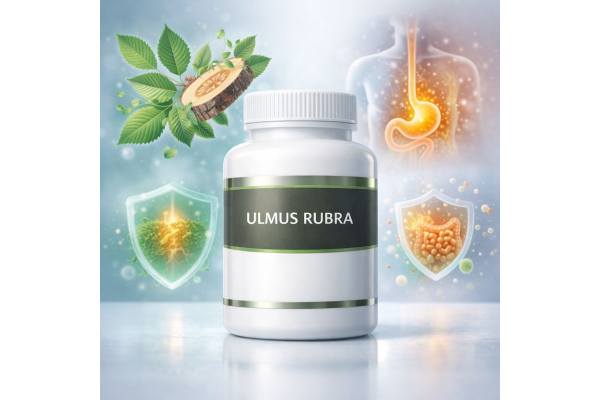
Ulmus rubra—better known as slippery elm—is a North American tree whose inner bark has a long history of use for throat and digestive comfort. The reason it’s still discussed today is practical: when mixed with water, the bark’s mucilage forms a thick, soothing gel that can coat irritated tissues. People most often reach for it when they want support during heartburn or reflux flare-ups, a scratchy throat, or a sensitive stomach that feels “raw.”
That said, slippery elm is not a quick fix for every symptom, and the strength of evidence varies by use. Quality and preparation matter, and timing can matter even more because the mucilage may interfere with how your body absorbs medications. This guide breaks down what Ulmus rubra is, how it may work, realistic benefits, practical ways to use it, dosing considerations, and safety—so you can decide if it fits your goals.
Core Points for Ulmus rubra
- May soothe irritated throat and upper digestive lining by forming a protective mucilage layer.
- Often used for occasional heartburn, reflux discomfort, and “scratchy” throat episodes.
- Separate from oral medications by at least 2 hours to reduce absorption issues.
- Common capsule strength is 400 mg; some adult labels list 2 capsules taken 3 times daily (2,400 mg/day).
- Avoid if you have trouble swallowing or an esophageal obstruction, or if advised to avoid slowed gut movement.
Table of Contents
- What is Ulmus rubra and what is it used for
- What makes slippery elm soothing
- Which benefits are most realistic
- How do you take it for the stomach and throat
- How much slippery elm should you take
- Side effects, interactions, and who should avoid it
- What the research actually shows
What is Ulmus rubra and what is it used for
Ulmus rubra is the botanical name for slippery elm, a deciduous tree native to parts of the United States and Canada. In supplements and traditional preparations, the part used is the inner bark (sometimes labeled “inner bark powder” or “bark”). When the inner bark is mixed with water, it produces a slippery, gel-like texture—hence the common name.
Most people use slippery elm for a simple reason: it’s a demulcent, meaning it can form a soothing coating over irritated tissues. That “coating” sensation is why it’s commonly taken for:
- Occasional throat irritation (dryness, scratchy feeling, or transient hoarseness)
- Upper digestive discomfort, such as occasional heartburn or reflux irritation
- Sensitive stomach feelings, especially when the lining feels “inflamed” or easily bothered
- Bowel comfort in some traditional-use contexts, where fiber and mucilage may influence stool form and transit
It also appears in some multi-ingredient gastrointestinal formulas, where slippery elm is paired with other soothing or gut-supportive ingredients (for example, aloe, peppermint oil, or specific fibers). In these blends, it’s hard to know how much of the effect comes from slippery elm alone, but its role is often “comfort and coating.”
Common names and label clues
When shopping, you may see these names used interchangeably:
- Slippery elm
- Red elm
- Moose elm
- Ulmus rubra (or older naming like Ulmus fulva)
A useful label clue is the phrase “inner bark” and a clear form such as capsule, powder, or lozenge. If a label does not clearly identify the plant part, it can be harder to judge whether you’re getting the traditional preparation that produces the mucilage effect.
What makes slippery elm soothing
Slippery elm’s signature property is its mucilage—a mix of plant polysaccharides that swells in water to form a viscous gel. This matters because many common discomforts (throat irritation, reflux “burn,” a tender stomach) are not only about acid or infection. They can also involve irritated surfaces that feel better when protected from friction, dryness, and repeated exposure to triggers.
The “coating” mechanism in plain language
When prepared with liquid, slippery elm can:
- Cling to mucous membranes in the mouth and throat, which may reduce the sensation of scratchiness
- Provide a temporary barrier in the upper digestive tract, which may feel calming during mild reflux irritation
- Hold water and add bulk, which can influence stool consistency in some people—especially if their diet is low in soothing fibers
This doesn’t mean it “blocks acid” the way an alginate raft or certain medications might. Think of slippery elm more like a comfort layer: it may reduce how harsh irritation feels, even if it doesn’t remove the underlying trigger.
Why timing and preparation change the experience
People sometimes try slippery elm and feel nothing. Often the reason is practical:
- Too little water (mucilage can’t gel properly)
- Wrong form for the goal (capsules can work, but lozenges or mixed powder may better coat the throat)
- Taking it too late (for reflux discomfort, earlier—before a known trigger meal or at the start of symptoms—may be more noticeable)
Another important reality: the same gel that can coat tissues may also coat other things—including medications and nutrients—reducing or delaying absorption. That’s why separation from other oral products is a key part of “using it correctly,” not just a minor detail.
Which benefits are most realistic
Slippery elm is often marketed with long lists of benefits. A realistic approach is to focus on the uses that match its most plausible actions: surface soothing, comfort, and gentle fiber-like effects.
Most plausible, commonly reported benefits
- Throat comfort during dryness or irritation: Lozenges, teas, and syrups that keep mucilage in contact with the throat may reduce the “sandpaper” feeling that comes with dryness, post-nasal drip irritation, or transient voice strain.
- Occasional heartburn or reflux discomfort: Some people describe less burning or fewer “raw” sensations, especially when slippery elm is used alongside lifestyle steps (meal timing, trigger reduction, head-of-bed elevation).
- Stomach “tenderness” and mild gastritis-like discomfort: The coating effect may feel calming when the stomach lining is easily irritated, though this is not a substitute for evaluation if symptoms persist.
- Bowel habit support in some contexts: As a mucilaginous fiber, slippery elm may help stool consistency for certain people—though effects can be variable, and hydration matters.
Benefits that are often overstated
- “Cures ulcers” or “heals GERD”: Soothing does not equal curing. If you have frequent reflux, trouble swallowing, unexplained weight loss, vomiting blood, black stools, or symptoms lasting more than a couple of weeks, you need medical evaluation.
- “Detox” and sweeping anti-inflammatory claims: Laboratory findings don’t automatically translate to meaningful whole-body results in real life. Slippery elm’s most defensible role is localized comfort.
Who may notice benefits most
You’re more likely to feel a difference if you:
- Get episodic symptoms (rather than severe daily symptoms)
- Can identify triggers (spicy meals, late eating, coffee, dehydration, seasonal throat irritation)
- Use slippery elm as part of a plan—not as the only strategy
If you are trying to reduce reflux discomfort, consider thinking in “layers”: meal habits, trigger control, physical positioning, and then targeted soothing tools like slippery elm. That approach usually leads to clearer results than taking random doses without a pattern.
How do you take it for the stomach and throat
Choosing the right form is half the battle. Slippery elm is sold as powder, capsules, lozenges, and occasionally as part of combined GI formulas.
Powder mixed with liquid
Powder is the most “traditional-feeling” option because it can create a noticeable gel.
Practical tips:
- Mix with enough liquid so it can thicken without becoming a paste.
- Let it sit briefly after mixing; the gel can thicken more after a minute or two.
- For throat comfort, sip slowly rather than chugging.
Best for:
- Throat coating
- Stomach “rawness” sensations
- People who want to feel the mucilage effect directly
Trade-offs:
- Texture is not for everyone
- It can be harder to take on the go
Capsules
Capsules are convenient and consistent, but the coating effect can be subtler because the mucilage forms after the capsule dissolves.
Best for:
- Routine use
- People who dislike thick textures
- Travel and workdays
Trade-offs:
- You may need more water and patience to notice “soothing”
- Effects can feel less immediate than lozenges or mixed powder
Lozenges and throat-focused products
If your main goal is throat comfort, lozenges often make the most sense because they keep slippery elm in contact with the throat longer.
Best for:
- Dry, scratchy throat
- Voice strain days
- Seasonal irritation
Trade-offs:
- Sugar alcohols or flavoring agents can bother sensitive stomachs in some people
How to avoid common mistakes
- Don’t take it dry and hope for the best—water activates the mucilage.
- Don’t stack it right on top of medications—separate by time.
- Don’t use it to “push through” red-flag symptoms that deserve evaluation.
How much slippery elm should you take
There is no single universally “correct” dose of slippery elm for every goal because products vary in form and concentration. The most responsible approach is to treat dosing as label-guided, goal-specific, and adjustable—starting with the smallest amount that produces the effect you want.
A practical way to think about dosing
Instead of asking “What is the perfect dose?” try these questions:
- Am I using it for throat comfort, reflux discomfort, or general digestive soothing?
- Am I using a form that can actually deliver the effect (lozenge for throat, gel for coating)?
- Can I take it with enough water and with correct timing away from medications?
Example label dosing from a regulated listing
One example of a licensed capsule product lists:
- Ulmus rubra 400 mg per capsule
- Adults: 2 capsules taken 3 times daily (a total of 2,400 mg/day)
- Traditional use as a demulcent for irritation of the gastrointestinal tract
This gives you a realistic reference point for what some labels consider a typical adult regimen. In real life, many people experiment below that level first, especially if they are sensitive to fiber-like supplements.
Timing guidelines for common goals
- For reflux or heartburn discomfort: many people time soothing agents before trigger meals or at the first sign of irritation, rather than waiting until symptoms build.
- For throat comfort: use when the throat feels dry or scratchy, and consider forms that stay in contact longer (lozenges or slow sipping a prepared mixture).
- For bowel comfort: effects are often more noticeable with steady hydration and consistent timing.
Medication spacing rule of thumb
Because mucilage can slow or reduce absorption of oral medications and supplements, a conservative strategy is:
- Take slippery elm at least 2 hours before or after oral medications (or follow your clinician’s advice if you have complex prescriptions).
If you take a medication where steady blood levels matter, treat spacing as essential, not optional.
Side effects, interactions, and who should avoid it
Slippery elm is often described as gentle, and serious adverse effects appear uncommon. Still, “gentle” does not mean “risk-free,” especially when you factor in swallowing problems, bowel motility issues, allergies, and medication interactions.
Potential side effects
Some people may experience:
- Bloating or changes in stool (more likely if you increase dose quickly or don’t drink enough water)
- Nausea or fullness from the thick texture (powder preparations)
- Allergic reactions, typically uncommon, but possible with any botanical
If you notice itching, hives, swelling, wheezing, or throat tightness, stop use and seek urgent care.
Medication and supplement interactions
The main concern is absorption interference. The same gel that can coat the throat and stomach may:
- Bind to medications or nutrients
- Slow their movement through the gut
- Reduce how much gets absorbed or delay onset
This matters most for:
- Thyroid medications
- Certain heart rhythm and blood pressure drugs
- Antiseizure medications
- Blood thinners
- Any drug where small changes in absorption can change outcomes
Spacing slippery elm away from medications is the simplest risk-reduction step.
Who should avoid slippery elm or get medical advice first
Avoid or use only with clinician guidance if you:
- Have difficulty swallowing, a history of choking, or known esophageal obstruction
- Have significant bowel motility problems or are advised to avoid products that could slow gut movement
- Are pregnant or breastfeeding (use only with professional guidance)
- Have persistent reflux symptoms that could indicate complications (trouble swallowing, chest pain, unexplained weight loss, vomiting blood, black stools)
Quality and contamination considerations
Botanical products can vary widely. To reduce risk:
- Choose brands with clear labeling of Ulmus rubra and plant part (inner bark)
- Prefer products with third-party quality testing where possible
- Avoid vague blends that hide amounts in “proprietary” totals if you need predictable dosing
What the research actually shows
The best way to set expectations is to separate three things: (1) what slippery elm plausibly does based on its properties, (2) what people commonly report, and (3) what clinical studies can confidently prove.
Where evidence is strongest
- Safety signals: Large-scale signals of severe toxicity are not prominent in the literature, and slippery elm is generally treated as low risk when used appropriately. Reports of liver injury linked specifically to slippery elm are notably rare.
- Mechanism fit: The mucilage demulcent action matches the most common uses—localized soothing in the throat and upper GI tract—so the “why people use it” story is coherent.
Where evidence is limited or indirect
- Reflux and GERD: Some reviews of natural products discuss slippery elm as a soothing option, but high-quality, slippery-elm-only trials in GERD are limited. Many real-world protocols combine slippery elm with other tools, which makes it hard to isolate its contribution.
- IBS and bowel habits: Small studies and formulas that include slippery elm suggest possible symptom improvements, but these are typically multi-ingredient interventions. Improvements could come from several components, placebo effects, dietary changes, or the combination itself.
- Throat and cough: Traditional use is common, and the mechanism is plausible, but robust modern trials for specific throat conditions are limited.
How to interpret slippery elm studies responsibly
If you see a study where slippery elm appears in a blend, ask:
- Was slippery elm the main active ingredient or one of many?
- Were participants also advised to change diet or medications?
- Were outcomes subjective (symptom scores) or objective?
- Was the study large enough and well-controlled?
Multi-ingredient GI trials can still be useful for real-life decision-making, but they don’t prove that slippery elm alone will produce the same effect.
What a fair “trial run” looks like
A practical self-test (with medical guidance if needed) is:
- Pick one goal (throat comfort or reflux discomfort).
- Use one consistent form (lozenge or prepared mixture for throat; capsule or mixture for GI comfort).
- Keep timing consistent for 7–14 days, including medication spacing.
- Track a few simple outcomes (frequency of symptoms, severity 0–10, and key triggers).
If you see no change after a consistent trial, it may not be the right tool for your physiology—or the underlying cause may require a different approach.
References
- Slippery Elm – LiverTox – NCBI Bookshelf 2024 (Safety Monograph)
- Slippery Elm | Memorial Sloan Kettering Cancer Center 2022 (Clinical Monograph)
- Natural Products in the Management of Gastroesophageal Reflux Disease: Mechanisms, Efficacy, and Future Directions 2025 (Review)
- Product information 2021 (Regulatory Listing)
Disclaimer
This article is for educational purposes only and does not replace medical advice, diagnosis, or treatment. Ulmus rubra (slippery elm) may affect how your body absorbs oral medications and supplements, and it may be inappropriate for people with swallowing difficulties, obstructions, or certain gastrointestinal conditions. If you are pregnant, breastfeeding, managing a chronic illness, taking prescription drugs, or have persistent or worsening symptoms (such as trouble swallowing, unexplained weight loss, chest pain, vomiting blood, or black stools), speak with a licensed healthcare professional before using slippery elm.
If you found this guide helpful, please consider sharing it on Facebook, X (formerly Twitter), or any platform you prefer, and follow us on social media. Your support through sharing helps our team continue producing high-quality, trustworthy health content.