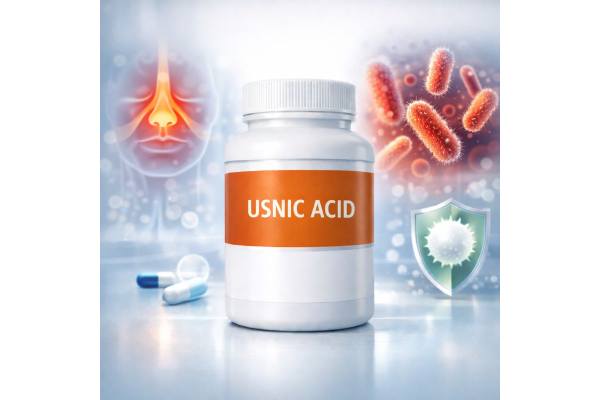
Usnic acid is a naturally occurring compound made by lichens—organisms formed by a partnership between fungi and algae. It shows strong activity against certain microbes in lab studies, which is why it has been used in some topical products like creams, wound-care ideas, and hygiene formulas. You’ll also see it discussed online for weight loss, but that’s where the story changes: oral usnic acid has been linked to severe liver injury, including cases serious enough to require hospitalization and, in rare situations, transplant-level care.
That combination—interesting topical potential and major oral safety concerns—makes it a supplement topic that deserves a clear, practical guide. Below, you’ll learn what usnic acid is, what benefits are realistic, how it works, why oral use is risky, how topical use is typically approached, and the red-flag symptoms and interactions that matter most.
Key Takeaways for Usnic Acid Safety
- Best-supported use is topical antimicrobial support, not oral “fat loss.”
- Oral use has been associated with acute liver injury and is a high-risk choice.
- Typical topical formulas are often in the 0.1% to 1% range (w/w), following product directions.
- Stop immediately if you develop jaundice, dark urine, severe fatigue, or persistent nausea after exposure.
- Avoid oral use if you are pregnant, breastfeeding, have liver disease, or use multiple hepatotoxic medications.
Table of Contents
- What is usnic acid and where does it come from?
- What benefits and uses are realistic today?
- How does usnic acid work in microbes and cells?
- Oral usnic acid and weight loss: why it is risky
- How to use usnic acid topically and typical ranges
- Side effects, interactions, and who should avoid it
- What the evidence and regulation suggest
What is usnic acid and where does it come from?
Usnic acid is a secondary metabolite produced by several lichen species. Lichens are not a single organism; they are a stable partnership between a fungus and a photosynthetic partner (an alga or cyanobacterium). In nature, usnic acid helps lichens defend themselves—think of it as part of their chemical “shield” against bacteria, fungi, UV exposure, and environmental stress.
In consumer products, you may encounter usnic acid in a few forms:
- Purified usnic acid (a defined ingredient in a formulation).
- Lichen extracts (for example, extracts from Usnea species) that may contain usnic acid among other lichen compounds.
- Usnate salts (forms designed to improve solubility for certain formulations).
This matters because “lichen extract” does not automatically equal “usnic acid,” and two lichen extracts can vary widely in potency, safety profile, and irritancy. If a label does not specify the active ingredient amount or the type of extract, it’s hard to know what you are using.
You will also see usnic acid discussed as two mirror-image forms (enantiomers), often written as (+) and (-). These forms can behave differently in lab models, which is one reason researchers sometimes report conflicting results. For everyday users, the practical takeaway is simpler: usnic acid is a potent bioactive compound, and potency cuts both ways. It can be useful in targeted topical contexts, but it also has a well-documented risk profile when taken orally.
Finally, usnic acid is sometimes marketed in the broader category of “natural antibiotics” or “lichen medicine.” That framing can be misleading. Usnic acid is not an antibiotic in the clinical sense, and it has not earned a standard role as an oral treatment for infections. Its most defensible place in consumer use is topical, controlled, and conservative—especially given the safety history tied to oral products.
What benefits and uses are realistic today?
When people search for usnic acid benefits, they often see a long list: antimicrobial, anti-inflammatory, antioxidant, anticancer, and weight loss. The more helpful question is: which uses are realistic for consumers today, and which are mostly research concepts?
Most realistic: topical antimicrobial and hygiene uses
The strongest and most consistent theme in usnic acid research is activity against certain Gram-positive bacteria in laboratory settings. That’s why it has shown up in topical ideas such as:
- Skin and foot products marketed for odor control or antimicrobial support
- Cosmetic and personal-care formulas (for example, deodorant-type products that rely on antimicrobial ingredients to reduce odor-causing bacteria)
- Experimental wound-care and dressing concepts where antimicrobial activity is valuable
If you are considering a product in this category, set your expectations properly. Topical usnic acid is not a guaranteed cure for skin infections, and it should not replace appropriate medical treatment for spreading redness, fever, pus, or severe pain. The realistic goal is support: reducing odor, supporting a clean wound-care routine when used appropriately, or complementing standard hygiene.
Possible but uncertain: inflammation-related skin and comfort claims
Usnic acid has anti-inflammatory signals in preclinical models. This can translate to marketing language about “calming” the skin or supporting barrier comfort. In the real world, these claims are difficult to prove because topical products contain many ingredients, and irritation risk can cancel out any theoretical soothing effect. For many people, a gentle, fragrance-free base formula matters more than the presence of an aggressive active.
Commonly advertised but not recommended: oral weight loss
Usnic acid became notorious because it was used in some weight-loss products. The weight-loss angle usually centers on energy metabolism and thermogenesis (heat production). The problem is that the same mechanism that sounds appealing on paper is linked to toxicity in humans. Because of the liver injury history, oral usnic acid is best approached as a high-risk, low-reward idea rather than a legitimate fat-loss tool.
Anticancer and antiviral: research-stage concepts
You may see claims that usnic acid fights cancer cells or viruses. Those statements often come from cell-based experiments where the compound is applied directly to cells at concentrations that are not realistic or safe for human oral use. These findings are scientifically interesting, but they do not translate into a responsible self-treatment strategy.
A useful way to summarize: topical antimicrobial and hygiene uses are the most defensible consumer-facing applications, while oral and systemic claims remain limited by safety and by a lack of strong human clinical data.
How does usnic acid work in microbes and cells?
Understanding how usnic acid works helps explain both its appeal and its risks. It is a biologically active compound that interacts with fundamental cellular processes, especially energy handling.
Antimicrobial activity: why Gram-positive bacteria are a frequent target
In lab models, usnic acid shows stronger activity against Gram-positive bacteria than many Gram-negative bacteria. A practical interpretation is that certain bacterial cell structures make Gram-positive organisms more susceptible. Researchers have described effects such as:
- interference with bacterial growth and replication
- disruption of membrane function and cellular integrity
- shifts in bacterial stress responses
This antimicrobial profile is one reason usnic acid has been explored in topical and material-based applications. It may also explain why it appears in deodorant-type concepts: odor is often driven by bacterial metabolism on skin, so antimicrobial ingredients can reduce odor intensity.
Energy metabolism: the mechanism tied to both “fat loss” marketing and toxicity
Usnic acid is widely discussed as an uncoupler of oxidative phosphorylation in mitochondria. In plain language, mitochondria are the cell’s energy factories. “Uncoupling” means energy production becomes inefficient: the cell burns fuel but produces less usable energy (ATP), often releasing more heat.
This concept was attractive to weight-loss marketers because inefficiency can raise energy expenditure. But in living organisms, disrupting mitochondrial energy production can also cause cellular stress, especially in metabolically active organs like the liver. The same core mechanism that can increase thermogenesis can also increase the risk of cellular injury.
Why dose and exposure route matter so much
Route changes risk:
- Topical use usually aims for local effect and minimal systemic absorption. That does not guarantee safety, but it generally reduces whole-body exposure.
- Oral use increases systemic exposure and places the liver at the center of metabolism and detoxification demands, which is where severe adverse events have been reported.
Why formulation and purity matter
Usnic acid is poorly water soluble, and products may use different solvents, carriers, or salts. These choices can alter absorption and tissue exposure. Two products with the same “mg” on a label can behave differently depending on formulation, co-ingredients, and how the body processes the compound.
Mechanism is useful, but the actionable takeaway is straightforward: usnic acid is not a gentle botanical. It’s a potent bioactive compound that can influence core energy processes, which is exactly why oral use carries a level of risk that most supplements never approach.
Oral usnic acid and weight loss: why it is risky
If you have seen usnic acid marketed for weight loss, the marketing usually focuses on “thermogenic” effects and metabolic acceleration. The problem is that real-world safety history matters more than theoretical fat-loss mechanisms.
No established safe oral dose
Unlike nutrients with recommended daily intakes, usnic acid does not have a broadly accepted safe oral intake level for general supplementation. What exists instead are reports and analyses linking oral exposure to acute liver injury, sometimes severe. That makes “how much should I take?” the wrong starting question. The better question is: “Is oral use worth the risk?” For most people, the responsible answer is no.
Why liver injury is the central concern
The liver is the main organ that processes many compounds absorbed from the gut. If a substance disrupts mitochondrial energy handling, the liver can be especially vulnerable. Reports of injury have described patterns consistent with acute hepatitis-like illness. In practice, that can look like:
- fatigue that feels unusual and persistent
- nausea, poor appetite, and abdominal discomfort
- dark urine and pale stools
- jaundice (yellowing of skin or eyes)
The risk is not limited to people with known liver disease. Even healthy individuals have developed severe symptoms after using products containing usnic acid, particularly in weight-loss contexts.
Multi-ingredient “fat burner” blends raise the stakes
Usnic acid has often appeared in formulas combined with stimulants or thyroid-like ingredients. These blends introduce extra risk for three reasons:
- Side effects overlap and multiply (nausea, palpitations, anxiety, insomnia).
- It becomes harder to identify the ingredient responsible for symptoms.
- Some co-ingredients can increase metabolic strain, dehydration risk, or appetite suppression, which can mask early warning signs.
Weight loss benefit is not reliably demonstrated in humans
Even if usnic acid can increase thermogenesis in theory, that does not automatically create safe, sustained fat loss in real life. Weight loss depends on behavior, appetite, sleep, training, and metabolic health. A high-risk mitochondrial uncoupler is not a responsible substitute for proven strategies.
If someone insists on experimenting with oral usnic acid, the safest guidance is to not do it. If a clinician is involved for a medical reason, that is different from self-supplementation, but it is not the typical consumer situation. For general readers, oral usnic acid is better viewed as a cautionary tale: “natural” can be dangerously powerful.
How to use usnic acid topically and typical ranges
Topical use is where usnic acid is most commonly positioned as a consumer ingredient. Even here, “safe” means “safer than oral,” not risk-free. Your goals should be modest, your exposure should be limited, and your skin response should guide the plan.
Common topical goals
People typically use topical usnic acid products for:
- odor control (deodorant-type use)
- antimicrobial support for minor skin issues
- cosmetic formulas that highlight lichen-derived “purifying” ingredients
If you have signs of infection (spreading redness, warmth, pus, fever, worsening pain), do not treat that as a cosmetic problem. Seek medical care.
Typical topical concentration range
Many topical concepts use low concentrations. A practical range you may encounter in leave-on or controlled topical formulations is roughly 0.1% to 1% (w/w), though products vary. Higher concentrations are not automatically better and can increase irritation risk. Because labeling differs by region and product type, the most reliable rule is: follow the manufacturer’s directions and avoid improvising your own high-strength mixture.
How to start safely
A cautious rollout reduces the chance of a messy reaction:
- Patch test first: Apply a tiny amount to a small area (inner forearm) once daily for 2–3 days.
- Watch for delayed reactions: Itching, burning, redness, swelling, or a rash can appear after repeated exposure.
- Use the smallest effective amount: More product increases exposure without guaranteeing better results.
- Limit surface area at the beginning: Start with one region rather than full-body application.
How long to use before judging
- For odor control, you may notice an effect within days.
- For cosmetic “clarifying” outcomes, give it 2–4 weeks, but stop sooner if irritation appears.
Where topical use can still be risky
Be careful if you:
- apply to broken skin over large areas
- use occlusive dressings that increase absorption
- combine with other strong actives (retinoids, strong acids, benzoyl peroxide) without guidance
- have eczema-prone or highly reactive skin
Topical use is the most reasonable context for usnic acid, but conservative dosing, careful monitoring, and a low threshold to stop are essential—especially given the compound’s potency.
Side effects, interactions, and who should avoid it
Usnic acid is one of the clearest examples of a supplement ingredient where safety should lead the conversation. The risk profile depends heavily on route (topical vs oral), but caution is appropriate either way.
Common side effects
Topical exposure may cause:
- irritation (burning, stinging, redness)
- dryness or peeling
- allergic contact dermatitis (itchy rash that can spread beyond the application area)
Oral exposure has been associated with:
- nausea, abdominal discomfort, loss of appetite
- profound fatigue
- symptoms consistent with liver injury (see warning signs below)
Liver injury warning signs you should not ignore
If you have taken an oral product that may contain usnic acid, stop immediately and seek medical evaluation if you develop:
- yellowing of skin or eyes
- dark urine or pale stools
- persistent nausea or vomiting
- right-upper abdominal pain or tenderness
- unusual fatigue that feels “heavy” and out of proportion
- itching without an obvious skin cause
These symptoms warrant prompt attention because early stopping and evaluation can make a major difference.
Medication and supplement interactions to consider
Avoid combining oral usnic acid with anything that increases liver strain or complicates diagnosis. Higher-risk combinations can include:
- frequent alcohol use
- acetaminophen overuse
- anabolic agents and some bodybuilding supplements
- multiple “fat burner” products
- prescription drugs with known hepatotoxic potential (your pharmacist can help identify these)
Even topical use deserves caution if you have a history of severe fragrance allergy or contact dermatitis, because lichen-derived ingredients can be sensitizers in some people.
Who should avoid usnic acid
Avoid oral use entirely, and treat topical use as clinician-guided, if you are:
- pregnant or breastfeeding
- living with liver disease or elevated liver enzymes
- recovering from hepatitis or unexplained prior jaundice
- taking multiple medications processed by the liver
- under 18
Also avoid “self-formulating” usnic acid powders or extracts at home. Uncontrolled concentration is a common path to unnecessary harm.
The most important safety advantage you can give yourself is simple: do not treat usnic acid like a routine wellness supplement. If you choose to use it at all, topical and conservative is the only defensible direction for most consumers.
What the evidence and regulation suggest
Usnic acid sits in an unusual category: it has genuine bioactivity that makes researchers interested, but it also has a safety record that limits responsible consumer use—especially orally. That tension shows up clearly when you look at the evidence landscape.
What we know with higher confidence
- Topical antimicrobial potential is plausible. Laboratory and formulation research consistently shows activity against certain microbes, particularly Gram-positive bacteria, which supports its appearance in topical and hygiene-focused ideas.
- Oral hepatotoxicity risk is real. Multiple analyses and safety-focused reviews describe clinically apparent liver injury linked to oral exposure in supplement contexts. This is not a theoretical concern; it is an observed adverse outcome.
What remains uncertain or research-stage
- Many benefits (anti-inflammatory, anticancer, neuroprotective) are supported primarily by cell-based and animal models. These are valuable for drug discovery, but they are not enough to justify self-treatment.
- Optimal topical dosing and long-term topical safety are still not fully standardized across product types. A “natural” label does not substitute for careful formulation and quality control.
How to interpret product claims
If a product claims usnic acid will “burn fat,” “detox the liver,” or “replace antibiotics,” treat that as a red flag. Claims that contradict known safety signals deserve extra skepticism. More trustworthy claims tend to be modest and topical: odor control support, cosmetic hygiene, or antimicrobial adjunct use, paired with clear instructions and warnings.
Safer alternatives for common goals
If your goal is weight loss, safer approaches include:
- structured nutrition and protein targets
- resistance training and daily movement
- clinician-guided options when appropriate (especially if you have metabolic disease)
If your goal is topical antimicrobial support, alternatives include:
- well-studied topical antiseptics used appropriately
- clinician-directed topical antibiotics when infection is present
- barrier-supportive skincare and targeted acne ingredients when relevant
Usnic acid remains scientifically interesting, and it may contribute to future topical or engineered formulations that reduce toxicity risk. For now, the best evidence-informed posture is conservative: avoid oral exposure, use topical products cautiously if you choose them, and treat any systemic symptoms as urgent signals to stop and seek care.
References
- Hepatotoxicity of usnic acid and underlying mechanisms 2025 (Review)
- Toxicity of Usnic Acid: A Narrative Review 2022 (Narrative Review)
- Advances in Research on Bioactivity, Toxicity, Metabolism, and Pharmacokinetics of Usnic Acid In Vitro and In Vivo 2022 (Review)
- Critical Assessment of the Anti-Inflammatory Potential of Usnic Acid and Its Derivatives—A Review 2023 (Review)
- Usnic Acid – LiverTox – NCBI Bookshelf 2018 (Safety Monograph)
Disclaimer
This article is for educational purposes only and does not provide medical advice, diagnosis, or treatment. Usnic acid has been associated with clinically significant liver injury when taken orally, and it may also cause skin irritation or allergic reactions when used topically. If you are pregnant or breastfeeding, have liver disease, have unexplained past jaundice, take prescription medications with liver risk, or are considering any oral product that may contain usnic acid, consult a qualified healthcare professional before use. Stop use and seek medical care urgently if you develop jaundice, dark urine, persistent vomiting, severe fatigue, or other symptoms suggestive of liver injury.
If you found this guide helpful, please consider sharing it on Facebook, X (formerly Twitter), or any platform you prefer, and follow us on social media. Your support by sharing helps our team continue producing high-quality, trustworthy content.