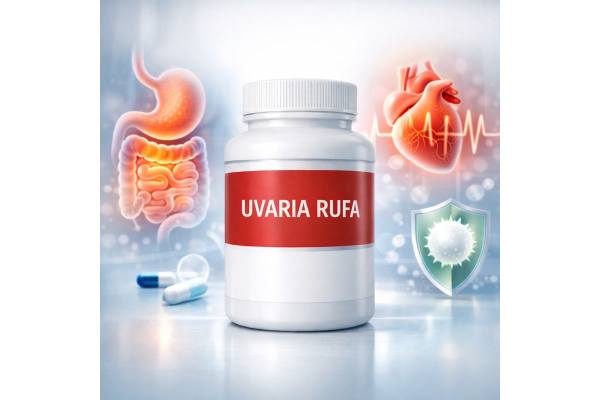
Uvaria rufa is a climbing shrub in the Annonaceae family with a long history of traditional use across parts of Southeast Asia. Today, interest in Uvaria rufa is growing for one main reason: the plant contains unusually potent natural compounds—especially Annonaceous acetogenins and flavonoids—that show measurable activity in lab and animal research. The most talked-about applications include prostate support (based on preclinical benign prostatic hyperplasia findings), antioxidant and anti-inflammatory effects, and metabolic enzyme inhibition linked to post-meal blood sugar control.
At the same time, Uvaria rufa is not a “casual” wellness herb. Most evidence is not from large human trials, and the same compounds that make it promising can also make it easier to misuse. This guide helps you understand what Uvaria rufa is, what it may help with, how it is typically used, how to think about dosage, and what side effects and interactions matter most.
Core Points for Uvaria rufa
- May support prostate health in preclinical research, but human evidence is limited.
- Shows lab evidence for anti-inflammatory and metabolic enzyme effects, not yet confirmed in large trials.
- Avoid combining with hormone-related therapies unless a clinician approves.
- A cautious human-equivalent range from animal research is about 100–250 mg/day of concentrated extract, short term.
- Avoid if pregnant, breastfeeding, or managing significant liver or kidney disease without medical guidance.
Table of Contents
- What is Uvaria rufa and what part is used?
- What benefits are realistic and evidence-based?
- What compounds give it activity?
- How do you use it and how much should you take?
- Side effects and who should avoid it
- How strong is the evidence and what is missing?
What is Uvaria rufa and what part is used?
Uvaria rufa (often written with the author name as Uvaria rufa (Dunal) Blume) is a woody climber in the custard-apple family (Annonaceae). If you have seen the term “carabao teats” or “susong kalabaw,” that nickname is commonly associated with Uvaria rufa in the Philippines and refers to the plant’s distinctive fruit shape in local tradition. In Indonesia, you may see it referred to by regional names such as “lelak.” The key point for supplement users is that Uvaria rufa is not a single standardized ingredient—different products may use different plant parts, and those parts can have very different chemistry.
Which plant parts show up in supplements?
Most modern research and many traditional preparations focus on the stem, leaves, twigs, or bark rather than the fruit. In practice, you may encounter:
- Stem or stem bark extracts (often discussed in prostate-related research contexts).
- Leaves or aerial parts (more common in antioxidant and general “herbal tonic” positioning).
- Twigs (sometimes grouped with leaves in phytochemical studies).
- Fruit extracts (more often positioned for skin-related antioxidant or cosmetic-adjacent uses).
Because Uvaria rufa contains multiple compound classes, the “same” herb can behave differently depending on what is extracted and how. A water infusion may emphasize more polar compounds (some flavonoids and glycosides), while alcohol or ethyl acetate extraction can pull out more lipophilic constituents, including acetogenins and phytosterols.
Traditional use versus supplement marketing
Traditional use is often broad—fever, skin discomfort, digestive complaints, and reproductive or prostate-related concerns are commonly mentioned in ethnobotanical contexts. Supplement marketing may spotlight one angle (such as prostate support) because it is easy to understand and aligns with consumer search intent. A helpful mindset is to treat Uvaria rufa like a “toolbox plant” rather than a single-purpose supplement: it may offer multiple biological activities, but that also means you need to be clear about your goal and selective about the form you choose.
What benefits are realistic and evidence-based?
Uvaria rufa is most interesting when you focus on benefits that have a plausible mechanism and at least some experimental support. The most credible benefits today are best described as preclinical—meaning cell studies, enzyme assays, and animal models—rather than proven clinical outcomes.
Prostate support and urinary comfort
The strongest “headline” claim tied to Uvaria rufa comes from research using extracts in a benign prostatic hyperplasia (BPH) model. In that context, Uvaria rufa is discussed for two linked actions: 5-alpha reductase inhibition (an enzyme involved in converting testosterone to dihydrotestosterone) and antioxidant support in prostate tissue. For consumers, this translates to a realistic expectation of potential support for prostate biology, not a promise of symptom resolution. If you are already using prescription therapy for urinary symptoms or prostate enlargement, Uvaria rufa should be treated as a clinician-guided add-on, not a replacement.
Anti-inflammatory and immune-modulating signals
Several Uvaria rufa constituents have been evaluated for inflammatory signaling in lab systems. One common marker in these studies is nitric oxide production in immune cells after an inflammatory trigger. When certain isolated compounds reduce that response, it suggests anti-inflammatory potential. A practical, honest way to interpret this is: Uvaria rufa contains compounds that may influence inflammatory pathways, but we do not yet know the right dose or the real-world impact in humans.
Metabolic enzyme inhibition for post-meal glucose
Uvaria rufa has also been studied for compounds that inhibit alpha-glucosidase and alpha-amylase, two enzymes involved in breaking down carbohydrates into absorbable sugars. This category of activity is relevant to post-meal blood sugar peaks. Importantly, enzyme inhibition in a lab does not automatically translate into a safe or meaningful effect in people. Still, it is a rational reason researchers explore Uvaria rufa for metabolic support.
Antimicrobial and antitubercular signals
Some isolated constituents show activity against microbes in laboratory testing, including moderate signals in antitubercular screening for at least one compound class. This is not the same as being an antibiotic substitute. If you are exploring Uvaria rufa for “immune support,” keep the expectation grounded: it is research interest, not a clinically validated infection treatment.
What compounds give it activity?
Uvaria rufa’s value—and its caution flags—come from its chemistry. Rather than relying on one famous molecule, the plant contains several compound families that can push biological systems in different directions. Understanding these categories helps you read labels, interpret studies, and avoid mismatched expectations.
Annonaceous acetogenins: potent, bioactive, and dose-sensitive
The most distinctive compounds discussed in Uvaria rufa research are Annonaceous acetogenins. These are long-chain polyketide-derived molecules often associated with cytotoxic (cell-growth inhibiting) activity in lab testing. In research contexts, this is explored for anticancer potential and for chemical discovery. For supplement users, the take-home message is not “this cures cancer.” It is that acetogenins can be powerful—and powerful compounds tend to be dose-sensitive.
That matters because extraction method influences acetogenin content. Products made from more lipophilic fractions or certain plant parts may concentrate acetogenins more than a simple tea would. If you see marketing that implies “stronger is better,” treat that as a red flag unless the product has clear standardization and safety rationale.
Flavonoids and related phenolics: antioxidant and signaling support
Uvaria rufa also contains flavonoids (including flavones and flavanones) and other phenolic compounds. These are often linked to antioxidant capacity and to modulation of inflammatory signaling. In enzyme assays, some flavonoid-like structures can also influence carbohydrate-digesting enzymes. In practical terms, this category is more aligned with what people expect from “plant antioxidants,” but the exact mix varies widely by part used and extraction style.
Phytosterols and triterpenes: possible links to prostate biology
Some research points toward phytosterols (such as beta-sitosterol) and other lipophilic constituents in certain extracts. Phytosterols are frequently discussed in prostate-health contexts across multiple plants, though the overall evidence base for supplements is mixed and depends on the specific condition and formulation. In Uvaria rufa, the presence of these compounds may partially explain why particular extracts show activity in prostate models.
Why this complexity matters for buyers
Two Uvaria rufa products can share the same plant name and still be chemically different. When choosing a product, prioritize:
- Clear identification of plant part (stem, leaf, bark, fruit).
- Transparent extraction method (water, ethanol, ethyl acetate, or multi-step extraction).
- Any standardization markers (even if imperfect), plus contaminant testing.
This is one of the situations where a vague label (“Uvaria rufa extract”) is not enough to judge quality or fit.
How do you use it and how much should you take?
There is no universally established clinical dosing standard for Uvaria rufa. Most human-facing guidance must be built from traditional preparation patterns, product-label conventions, and careful interpretation of preclinical dosing. That means your safest approach is conservative: choose a clearly labeled product, start low, and treat it as a short-term experiment unless a clinician guides otherwise.
Common forms you might see
Uvaria rufa typically appears as:
- Capsules or tablets containing dried extract (often the easiest to dose consistently).
- Powdered plant material (less consistent potency, more variable absorption).
- Tinctures (dose depends on concentration and extraction strength).
- Tea or decoction (traditional style, but dosing is imprecise and chemistry depends on simmer time and plant part).
If your goal is prostate-related support, research discussions most often involve stem-derived extracts rather than casual leaf tea. If your goal is general antioxidant support, leaf-based preparations may be more common in traditional practice.
A cautious dosing range based on human-equivalent logic
One practical way to estimate a cautious range is to translate animal dosing into a human-equivalent dose (HED) using body-surface-area scaling. In a BPH rat model, oral dosing of a Uvaria rufa extract at 10–20 mg/kg for a multi-week period is reported in the research context. When scaled to a 70 kg adult using standard conversion factors, that is roughly:
- About 110–225 mg/day of a concentrated extract as a human-equivalent range.
This is not a “recommended dose,” but it is a rational anchor for caution when no clinical standard exists. If you choose to try Uvaria rufa, a conservative pattern some clinicians prefer for non-standardized botanicals is:
- Start near the low end (for example, ~100 mg/day of concentrated extract).
- Monitor for tolerance for 3–7 days (sleep, stomach, dizziness, skin, mood).
- If well tolerated and still appropriate, consider moving toward ~200–250 mg/day.
- Keep the trial time-limited (often 2–6 weeks), then reassess.
Practical tips to reduce risk
- Take it with food unless a product label indicates otherwise.
- Avoid stacking multiple “bioactive” herbs aimed at the same pathway (for example, multiple prostate-support blends) without guidance.
- Do not combine with alcohol-heavy routines if you are using concentrated extracts.
- If you feel unwell, stop early; do not “push through” side effects.
When in doubt, the safest dosing instruction is still the simplest one: do not exceed the product label, and avoid long-term daily use unless your clinician has a clear plan.
Side effects and who should avoid it
Because Uvaria rufa contains potent compound families, side effects and interactions deserve as much attention as benefits. Even if you tolerate many herbs well, assume Uvaria rufa is more pharmacologically “active” than a basic culinary botanical.
Possible side effects
Side effects depend on the extract type and dose, but users should be alert for:
- Stomach upset (nausea, cramps, loose stool), especially with higher doses or concentrated extracts.
- Headache or lightheadedness, which can occur when a botanical alters inflammatory or metabolic signaling in sensitive people.
- Skin reactions (itching or rash), particularly in those prone to plant sensitivities.
- Fatigue or unusual weakness, which should be treated as a stop signal rather than something to ignore.
If a product is rich in acetogenins or other strong lipophilic compounds, tolerance may be less predictable, and side effects may appear earlier.
Who should avoid Uvaria rufa unless medically supervised?
Avoid self-experimentation if you are in any of these groups:
- Pregnant or breastfeeding (traditional uses can include reproductive contexts, and safety is not established).
- Trying to conceive without clinician guidance, especially if using higher-strength extracts.
- Using hormone-related therapies, including 5-alpha reductase inhibitors or other androgen-modulating treatments, unless a clinician confirms compatibility.
- Living with significant liver or kidney disease, because concentrated plant extracts can add metabolic workload and safety data is limited.
- Managing complex chronic illness with multiple medications, where interaction risk is higher.
Medication and supplement interactions to think about
Uvaria rufa is most likely to create problems when it overlaps with medications that already target similar outcomes:
- Prostate and hormone pathway medications (risk of unpredictable combined effects).
- Glucose-lowering medications if you are experimenting for metabolic support (risk of unwanted lowering, especially if diet changes occur at the same time).
- Anti-inflammatory and anticoagulant regimens (not because Uvaria rufa is proven to thin blood, but because multi-pathway botanicals can complicate monitoring).
A safe rule: if a supplement has a plausible enzyme-level effect, treat it like it could change how other therapies behave—until proven otherwise.
How strong is the evidence and what is missing?
Uvaria rufa sits in an “early but intriguing” evidence category. The chemistry is compelling and several studies show measurable biological activity, but the gap between promising lab data and real-world clinical outcomes remains large.
What we know with reasonable confidence
- Uvaria rufa contains multiple bioactive compound families, including acetogenins and flavonoids.
- Isolated compounds can show strong activity in assays, including enzyme inhibition and inflammation-related signaling changes.
- Certain extracts demonstrate meaningful effects in animal models, including prostate-related outcomes in BPH research settings.
These are legitimate signals. They justify research interest and cautious, informed exploration by professionals.
What we do not know yet
The missing pieces are the ones that matter most for everyday supplement decisions:
- Human dosing standards: the safe and effective dose range is not established across populations.
- Long-term safety: multi-month or multi-year daily use has not been well characterized.
- Product consistency: commercial extracts can vary dramatically in active compound concentration.
- Best-fit use cases: prostate support, metabolic support, and anti-inflammatory aims may require different extracts, not a one-size product.
How to interpret “promising” without overreaching
If you are choosing Uvaria rufa, frame your intent in measurable terms. Instead of “better health,” choose an outcome you can track, such as urinary comfort changes, sleep disruption, GI tolerance, or specific metabolic markers your clinician already monitors. Then keep your trial structured:
- One change at a time.
- Clear dose and schedule.
- Short, defined trial period.
- Stop rules you respect.
The bottom line
Uvaria rufa is best viewed as a research-forward botanical with potential, not a proven staple supplement. If you treat it with the same seriousness you would treat a strong, targeted herbal extract—rather than a casual daily vitamin—you will make safer decisions and get clearer feedback about whether it helps you.
References
- Feature-based molecular networking and MS2LDA analysis for the dereplication of adjacent bis-tetrahydrofuran Annonaceous acetogenins – PubMed 2025
- Acetogenins from the Stem of Uvaria rufa and Their Cytotoxic Activity – PubMed 2024
- Polyoxygenated cyclohexene derivatives and other constituents of Uvaria rufa stem – PMC 2023
- α-Glucosidase inhibitory and α-amylase inhibitory activities of compounds isolated from Uvaria rufa Blume – PubMed 2022
- Uvaria rufa Blume attenuates benign prostatic hyperplasia via inhibiting 5α-reductase and enhancing antioxidant status – PubMed 2016
Disclaimer
This article is for educational purposes only and does not provide medical advice, diagnosis, or treatment. Uvaria rufa is a biologically active botanical with limited human clinical research, and product composition can vary widely by plant part and extraction method. If you are pregnant, breastfeeding, managing a chronic condition, or taking prescription medications—especially hormone-related or glucose-lowering therapies—talk with a qualified healthcare professional before using Uvaria rufa. Stop use and seek medical advice if you develop concerning symptoms such as persistent gastrointestinal distress, rash, dizziness, or unusual fatigue.
If you found this guide helpful, please share it on Facebook, X (formerly Twitter), or any platform you prefer, and follow us on social media. Your support through sharing helps our team continue producing high-quality, research-informed content.