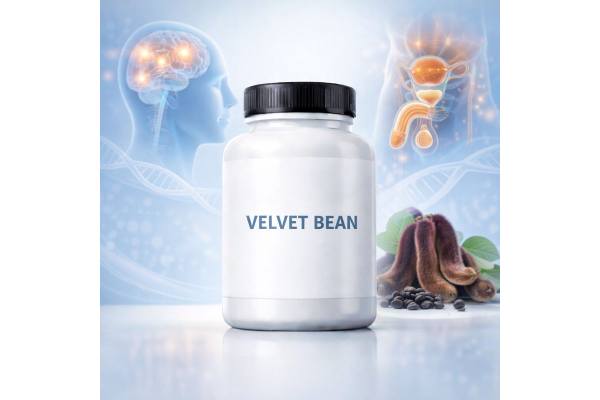
Velvet bean—also called Mucuna pruriens—is one of the few supplements whose “active ingredient” is also a prescription-class drug in another form. Its seeds naturally contain L-dopa (levodopa), a direct precursor to dopamine. That single fact explains both the excitement around velvet bean and the need for extra caution: dopamine pathways influence movement, motivation, mood, blood pressure, and nausea reflexes, so benefits and side effects can arrive together.
People most often explore velvet bean for dopamine support, occasional low mood or stress resilience, libido and fertility goals, and (most notably) Parkinson-related interest. But the quality of products varies widely, and labels do not always predict how much levodopa you’re actually getting. Used thoughtfully, velvet bean can be a focused tool; used casually, it can be unpredictable.
Essential Insights for Velvet Bean Users
- Choose products that state levodopa (L-dopa) content, since real-world amounts can vary widely between brands.
- Start low and assess tolerance; common beginner ranges are 25–50 mg L-dopa per day, with higher intakes requiring medical guidance.
- Avoid raw or unprocessed seeds; they can trigger severe gastrointestinal and neuropsychiatric symptoms in some cases.
- Avoid if pregnant or breastfeeding, or if you have a history of psychosis, bipolar mania, or uncontrolled heart rhythm issues.
Table of Contents
- What is velvet bean, and what is in it?
- What benefits have the best evidence?
- How do you choose a safe product?
- How much should you take, and when?
- What are the side effects and who should avoid it?
- What the research and quality issues really mean
What is velvet bean, and what is in it?
Velvet bean is a tropical legume whose seeds have been used in traditional systems of medicine for centuries. In modern supplement form, it’s usually sold as seed powder, seed extract, or “standardized” extract. The plant is also known by names like cowhage (often referring to the itchy hairs on the pods) and Mucuna pruriens.
The standout compound is levodopa (L-dopa). Your body converts L-dopa into dopamine, a neurotransmitter involved in movement control, motivation and reward, attention, and several hormone signals. If you’ve heard velvet bean described as “dopamine support,” this is the practical reason. Unlike many herbs that influence dopamine indirectly, velvet bean can supply the direct building block.
But velvet bean is not “just L-dopa.” Depending on the preparation, it may contain other bioactive constituents such as:
- Plant antioxidants that may influence oxidative stress markers
- Alkaloids and polyphenols that may modulate inflammation pathways
- Proteins and amino acids in less refined powders
- Trace minerals from the seed matrix
This complexity is sometimes framed as an advantage—some people speculate that the natural matrix could change the feel or timing compared with isolated levodopa. The tradeoff is predictability: the more “whole” the product, the less certain the dose.
A key practical detail: the fine hairs on velvet bean pods can cause intense itching and irritation on contact. That’s not the supplement you’re swallowing, but it matters if you handle whole pods or raw seeds. For safety, the supplement conversation should focus on processed products with transparent dosing information, not home-prepared raw seeds.
What benefits have the best evidence?
Velvet bean is marketed for everything from mood to muscle, but the strength of evidence varies sharply by goal. If you want a grounded view, it helps to sort benefits into “best supported,” “plausible but early,” and “mostly theoretical.”
Most supported: Parkinson-related interest (movement symptoms).
Because velvet bean contains levodopa, it’s been studied as a botanical source of the same core compound used in conventional Parkinson therapy. Clinical trials and reviews suggest it may improve motor symptoms and may have differences in onset time or duration compared with standard formulations in some settings. However, the evidence base is still limited in size and quality, and the biggest open question is consistency: Parkinson management depends on tight dose control, while supplement products can be variable.
Plausible but early: motivation, mild low mood, and stress resilience.
Dopamine is involved in drive and reward, so it’s reasonable that some people feel more “lift” or “get-up-and-go.” Preclinical research supports antidepressant-like signals in animal models, but we do not yet have strong clinical trial evidence for velvet bean as a depression treatment. If you’re considering it for mood, the most responsible framing is “may support energy and motivation in some people,” not “treats depression.”
Plausible but mixed: libido, fertility, and hormonal support.
Velvet bean has a reputation for supporting male reproductive health. Some small human studies and animal research suggest improvements in sperm parameters or hormone markers, but results depend heavily on population (fertility challenges vs. healthy adults), product type, and dose. If your goal is fertility, it’s better viewed as an adjunct to fundamentals (sleep, alcohol reduction, micronutrient adequacy, heat exposure avoidance) rather than a stand-alone fix.
Mostly theoretical: athletic performance and cognition.
Dopamine can influence perceived effort, focus, and movement initiation, so there’s a plausible pathway. But “plausible” is not “proven,” and performance claims often ignore side effects like nausea or jitteriness that can erase any upside.
A useful way to decide: if your goal requires precise dopamine manipulation (Parkinson symptoms, significant apathy, medication-level effects), velvet bean belongs in a clinician-guided plan. If your goal is general wellness, keep expectations modest and prioritize product transparency and tolerability.
How do you choose a safe product?
Velvet bean is one of those supplements where “quality” is not a vague concept—it directly determines your experience and risk. The most important selection principle is simple: you want to know how much levodopa you’re taking.
Here’s a practical, buyer-friendly checklist.
1) Prefer products that disclose levodopa (L-dopa) per serving.
Many labels list only “Mucuna pruriens extract” in milligrams. That number is not the active dose unless the levodopa percentage is stated. Two products with the same extract weight can deliver very different levodopa amounts.
2) Be cautious with “high potency” claims.
Some extracts are standardized to higher levodopa percentages. That can be useful for dosing accuracy, but it also raises the stakes for side effects and interactions. High-potency products are not automatically better; they just make it easier to take a lot without realizing it.
3) Look for evidence of third-party testing.
Because this category is prone to label ambiguity, independent verification matters. A credible Certificate of Analysis (COA) is ideal, but even a reputable third-party certification mark is a meaningful step up from “trust us.”
4) Avoid raw seeds and DIY preparations.
Home preparation is where dosing becomes most unpredictable, and it also increases the chance of gastrointestinal distress. There are documented cases of severe symptoms after eating raw seeds. If you’re seeking levodopa exposure, the “natural” route is not safer by default.
5) Watch multi-ingredient blends.
Blends that stack velvet bean with other “dopamine boosters” (tyrosine, stimulants, yohimbine-like herbs, high caffeine, or MAOI-like botanicals) can increase nausea, anxiety, insomnia, blood pressure swings, or agitation. If you’re evaluating velvet bean, start with a single-ingredient product so you can attribute effects accurately.
6) Consider your protein timing.
Large, high-protein meals can compete with amino-acid transport and may change how L-dopa is absorbed or experienced. For some people, taking velvet bean matters less than when they take it relative to protein intake.
The bottom line: velvet bean is not a casual “sprinkle it in a smoothie” supplement. The safest approach starts with transparent labeling, conservative dosing, and a plan to stop if side effects show up.
How much should you take, and when?
Because velvet bean products vary widely, the most meaningful dosage unit is milligrams of levodopa (L-dopa) rather than “milligrams of extract.” If your label does not disclose L-dopa content (or a clear standardization percentage), you cannot dose reliably.
A conservative, general wellness approach (adults):
- Start: 25 mg L-dopa once daily for 3–7 days
- Typical range: 25–50 mg L-dopa per day
- Upper cautious range: 100 mg L-dopa per day only if you tolerate lower doses well and have a clear reason
If your product lists a standardization percentage, you can estimate:
- Example: 500 mg extract standardized to 15% L-dopa ≈ 75 mg L-dopa
If you can’t estimate, treat the product as un-doseable and consider switching brands.
Timing guidelines (to reduce side effects and improve consistency):
- First dose earlier in the day. Dopamine-active supplements can disrupt sleep in some people.
- Consider taking away from very high-protein meals. Many people do better with a light meal or a lower-protein window.
- Avoid “stacking” with stimulants at first. Caffeine plus velvet bean can feel edgy or nauseating for some users.
- Use a trial structure. Try the same dose for at least several days before adjusting, and change only one variable at a time.
How long does it take to feel?
Some people notice effects within 30–90 minutes, especially with higher-potency extracts. Others feel nothing noticeable but still experience side effects (nausea, vivid dreams, restlessness). That mismatch is a clue that subjective “feel” is not a reliable dosing guide.
Cycling and breaks:
If you use velvet bean for general wellness (not Parkinson-related care), many people choose shorter blocks (for example, 2–4 weeks) with breaks. This is a practical strategy to reassess whether benefits persist and to reduce the chance of drifting into higher and higher dosing.
Important medical boundary:
If you have Parkinson’s disease—or you take levodopa, dopamine agonists, MAO inhibitors, antipsychotics, or blood pressure medications—do not self-prescribe velvet bean. The same “dopamine lever” that creates potential benefit can create real complications without careful monitoring.
What are the side effects and who should avoid it?
Velvet bean’s side effects largely mirror what you’d expect from a dopamine precursor. Some are mild and predictable; others can be serious, especially at higher doses or in susceptible people.
Common side effects (often dose-related):
- Nausea or stomach upset
- Headache
- Dizziness or lightheadedness (especially when standing)
- Vivid dreams or insomnia
- Restlessness, jitteriness, or “wired” feeling
Less common but more serious concerns:
- Confusion, agitation, or hallucinations (risk rises with higher dopaminergic exposure)
- Significant blood pressure changes or palpitations
- Worsening anxiety or triggering a manic-like state in vulnerable individuals
- Dyskinesia-like involuntary movements in people prone to them (especially with Parkinson-related dopamine sensitivity)
Who should avoid velvet bean unless a clinician specifically recommends it:
- Pregnant or breastfeeding individuals (safety data is not adequate)
- Anyone with a history of psychosis, schizophrenia-spectrum conditions, or bipolar mania
- People with uncontrolled arrhythmias or unstable cardiovascular disease
- Those with a history of severe migraines triggered by dopaminergic agents
- Children and adolescents, unless medically supervised
Medication interaction risk zones (talk to a clinician first):
- Parkinson medications (levodopa/carbidopa and dopamine agonists): risk of “too much dopamine,” timing conflicts, and symptom fluctuations
- MAO inhibitors (especially non-selective or high-dose combinations): blood pressure and neuropsychiatric risk
- Antipsychotics: pharmacologic tug-of-war that can destabilize symptoms
- Blood pressure drugs: additive dizziness or hypotension
- Stimulants: greater risk of anxiety, insomnia, and palpitations
A special caution about raw seeds:
Eating raw or unprepared velvet bean seeds is not the same as taking a standardized supplement. There are documented cases of severe digestive symptoms and neuropsychiatric symptoms after ingesting raw seeds. If you see advice online promoting raw seed use, treat it as a red flag.
When to stop immediately and seek medical help:
If you experience hallucinations, severe confusion, chest pain, fainting, persistent vomiting, or sudden uncontrolled movements, stop the supplement and seek urgent care—especially if you also take prescription medications that affect dopamine.
What the research and quality issues really mean
Velvet bean sits in a rare category: it’s sold as a supplement, but it can deliver a compound that functions like a medication. That mismatch explains why the research story is both promising and frustrating.
1) The clinical “signal” is strongest where the mechanism is direct.
In Parkinson-related studies, the rationale is straightforward: levodopa is a central therapy, and velvet bean contains it. Reviews of clinical trials suggest improvements in motor symptoms and therapy-related complications in some settings. The limitation is scale: trials are small, product types differ, and the dosing strategies aren’t uniform. In other words, the signal is real enough to study seriously, but not solid enough to generalize casually.
2) The biggest practical risk is dose unpredictability.
Supplement labels don’t always tell you the actual levodopa content you’re swallowing. Analyses of marketed products show that levodopa amounts can vary dramatically between brands and may not match what consumers expect from the label. This is not a theoretical concern: it affects side effects, interactions, and the chance of accidental high exposure.
3) “Natural” does not automatically mean “gentler.”
Some people assume a plant source will be milder than an isolated compound. In reality, a plant extract can deliver a medication-level dose—sometimes without the consumer realizing it—especially when products are standardized to high percentages or labeled ambiguously.
4) The safety conversation is not only about toxicity—it’s about suitability.
Many adults could take a low dose and feel only mild effects. But for someone with a psychiatric vulnerability, complex medication regimen, or Parkinson symptom fluctuations, the same supplement can destabilize sleep, mood, or movement control.
5) The best use case is the most disciplined one.
Velvet bean makes the most sense when you can answer three questions clearly:
- What is my target outcome (and how will I measure it)?
- How much L-dopa am I actually taking?
- What is my stop rule if side effects show up?
If you can’t answer those, the safest “research-based” choice is to pass—or to involve a clinician who can help you turn a risky experiment into a monitored plan.
References
- Mucuna pruriens Treatment for Parkinson Disease: A Systematic Review of Clinical Trials – PubMed 2025 (Systematic Review)
- Levodopa Content of Mucuna pruriens Supplements in the NIH Dietary Supplement Label Database – PubMed 2022 (Analytical Study)
- Quality assessment of “naturally occurring” high-percentage L-dopa commercial products proposed as dietary supplements on the Internet: from labeling to analytical findings – PubMed 2025 (Quality Assessment)
- Poisoning After Ingestion of Mucuna pruriens Seeds on Reunion Island – PubMed 2022 (Case Report)
Disclaimer
This article is for educational purposes only and does not provide medical advice, diagnosis, or treatment. Velvet bean (Mucuna pruriens) can deliver pharmacologically active levels of levodopa (L-dopa) and may cause side effects or interact with medications, especially treatments that affect dopamine, blood pressure, or mental health. If you are pregnant or breastfeeding, have Parkinson’s disease, have a psychiatric condition, or take prescription medications, consult a qualified healthcare professional before using velvet bean. Stop use and seek medical care promptly if you develop severe symptoms such as confusion, hallucinations, fainting, chest pain, or persistent vomiting.
If you found this guide helpful, please consider sharing it on Facebook, X (formerly Twitter), or any platform you prefer, and follow us on social media. Your support through sharing helps our team continue producing high-quality, practical health content.