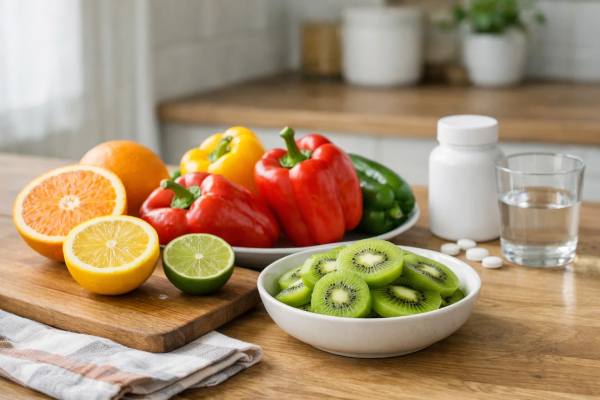
Vitamin C sits at a practical crossroads: it is both a true essential nutrient and one of the most common “immune support” add-ons people reach for during cold season. Getting enough matters for everyday tissue repair, antioxidant balance, and normal immune signaling. The more interesting question is how to get it—through food, supplements, or a smart mix—and whether the form changes what your body actually absorbs. Citrus is famous, but kiwi and bell peppers can deliver surprisingly large amounts in a small serving. Supplements add convenience, yet higher doses are not automatically better because absorption saturates and excess is excreted. This guide compares food sources and supplement options in real terms—portion sizes, timing, and tolerability—so you can build a vitamin C routine that supports respiratory health without chasing megadoses or marketing claims.
Quick Overview
- Vitamin C from food reliably covers daily needs while also delivering fiber and plant compounds that support overall recovery and resilience.
- Supplements can help when intake is inconsistent, appetite is low, or you need a predictable dose during travel or high exposure periods.
- Very high supplemental doses commonly cause diarrhea and may be inappropriate for people with kidney stone history or iron overload conditions.
- A practical baseline is 75–90 mg/day from food, with optional short-term supplemental dosing in the 200–500 mg/day range when needed.
Table of Contents
- Citrus, kiwi, and peppers compared
- How vitamin C is absorbed
- Food versus supplements in real life
- Smart dosing for everyday immunity
- Using supplements during a cold
- Safety limits and special situations
Citrus, kiwi, and peppers compared
Vitamin C “counts” the same chemically whether it comes from an orange or a tablet. The meaningful difference is how easy it is to reach an effective intake day after day—and how many other helpful nutrients arrive in the same bite.
What counts as “enough” in daily life
Most adults do well when they consistently hit roughly 75–90 mg per day (a common target range used in nutrient recommendations), and many food patterns can meet this without any special planning. If you like numbers, one easy mental model is: one strong vitamin C food serving per day often gets you close, and two servings makes it effortless.
Citrus: dependable, portable, and familiar
Citrus earns its reputation because it is consistent and accessible:
- A medium orange is often in the neighborhood of 50–80 mg.
- Half a grapefruit commonly lands around 40–60 mg.
- A standard glass of orange juice can be a large contributor, though amounts vary widely by brand and serving size.
Citrus also offers hydration and potassium, which can be useful when you are under the weather. The main limitation is practicality: if you rely on juice, it is easy to overshoot calories or added sugars (in sweetened products). Whole fruit is generally the simplest default.
Kiwi: small fruit, big return
Kiwi is one of the most efficient “volume-to-vitamin C” foods:
- One kiwi is often 60–90 mg, and two can comfortably exceed typical daily targets.
A bonus is how easy it is to eat when appetite is low: it is soft, tart-sweet, and does not require cooking. If you are trying to increase vitamin C without feeling like you are constantly snacking, kiwi is a strong pick.
Bell peppers: the quiet leader
If you are only thinking “fruit,” you may miss the highest-impact option. Red bell peppers can deliver very high vitamin C per serving, often exceeding citrus on a per-weight basis. A cup of chopped raw red pepper can provide more than a day’s worth for many adults. Yellow peppers are often strong too; green peppers typically contain less.
Practical trick: slice peppers at the start of the week and keep them ready to grab. They are one of the fastest ways to raise vitamin C without changing your whole diet.
Cooking and storage matter more than people realize
Vitamin C is sensitive to heat and prolonged storage. You do not need to fear cooking, but you do want to be intentional:
- Short cooking (quick sauté, microwaving, light steaming) tends to preserve more than long boiling.
- Cut and stored produce gradually loses potency, so fresh and lightly handled is best when feasible.
The bottom line: if you want the simplest “food-first” strategy, rotate one citrus + one kiwi or pepper serving across most days, and you will usually cover your bases without thinking about milligrams.
How vitamin C is absorbed
Understanding absorption prevents the two most common mistakes people make: assuming more is always better, and assuming supplements automatically “hit harder” than food.
Absorption saturates, so megadoses do not scale
Vitamin C absorption is efficient at modest intakes and becomes less efficient as doses rise. Once your transport systems and tissues are well supplied, extra vitamin C is increasingly excreted in urine. Practically, this means:
- Small-to-moderate intakes have a high return.
- Large single doses often have diminishing returns and a higher chance of gastrointestinal upset.
This is why a person can take gram-level doses and still not achieve proportionally higher tissue levels. For most people, the body’s handling of vitamin C favors steady adequacy, not heroic spikes.
Food spreads intake naturally
Food often delivers vitamin C in smaller “packets” across the day—breakfast fruit, lunch vegetables, dinner sides. This spacing matters because it aligns with how absorption works. Even if the total daily milligrams are similar, food-based intake often functions like built-in dose-splitting.
There is also a second advantage: vitamin C from food shows up with other compounds that support overall recovery and immune resilience, such as:
- Flavonoids and carotenoids
- Fiber (supporting gut microbial balance)
- Potassium and folate
- Water content, especially in fruit
These are not “vitamin C boosters” in a magical sense; they are co-benefits that help explain why food-first approaches are so reliable for long-term health.
Supplement form matters less than dose and timing
Most vitamin C pills contain ascorbic acid or mineral ascorbates (such as sodium ascorbate or calcium ascorbate). For the majority of people:
- The body uses vitamin C similarly across common forms.
- The major difference is tolerability (some people find buffered forms gentler) and additives (sweeteners, flavorings, large tablets).
“Liposomal” vitamin C is sometimes marketed as superior. Some people tolerate it well, but the real-world value usually comes down to whether it helps you take a consistent dose without stomach upset—not whether it turns vitamin C into a different nutrient.
Timing with meals and iron
Vitamin C can increase absorption of non-heme iron (the type found in plant foods). This is helpful for people who struggle to maintain iron status, but it can be problematic for those with iron overload conditions. A practical interpretation:
- If you are taking iron supplements, pairing them with vitamin C can improve absorption.
- If you have iron overload risk, avoid high-dose vitamin C unless your clinician advises otherwise.
In short: the “best absorbed” approach is rarely the fanciest product. It is a reasonable dose, split when needed, that fits your day.
Food versus supplements in real life
The best choice is usually not “food only” or “supplements only.” It is choosing the tool that matches your constraints—appetite, schedule, budget, and how often you actually eat produce.
When food is the smarter default
Food wins when you can do it consistently because it solves multiple problems at once. A food-first plan helps you:
- Meet vitamin C needs while improving overall micronutrient intake
- Add fluids and fiber that support recovery
- Avoid the digestive ceiling that shows up with high-dose pills
Food also scales well. If you have a week of restaurant meals or travel, you can compensate with targeted choices that do not feel like a “diet”:
- Add bell peppers or broccoli to one meal
- Choose fruit at breakfast
- Keep kiwi or mandarins on hand
For many people, this is the most sustainable approach because it builds vitamin C into routines that already exist.
When supplements are genuinely useful
Supplements shine when reliability matters more than culinary perfection. Common scenarios include:
- You rarely eat fruits and vegetables, even when trying
- You are traveling, working long shifts, or frequently skipping meals
- Appetite is low during illness and chewing fresh foods is unappealing
- You want a consistent dose during a time-limited, high-exposure period
In these cases, a moderate supplement can be a practical bridge. The goal is not to “supercharge” immunity; it is to reduce the chance that low intake becomes one more stressor during cold season.
The hidden tradeoffs people forget
Convenience vs consistency: A supplement is convenient, but only if you actually take it. If you dislike large tablets or forget doses, a food habit may be more reliable.
Cost vs value: Many premium vitamin C products cost far more than their benefit justifies. If you use supplements, the simplest option that you tolerate well is often the best.
Precision vs flexibility: Supplements offer precise milligrams. Food offers flexibility and co-nutrition. If your overall diet is already strong, precision is rarely necessary. If your diet is chaotic, precision can help.
A hybrid approach that works for most people
If you want a realistic plan that balances both worlds:
- Use food as your baseline most days.
- Keep a moderate-dose supplement available for “gap days” (travel, poor appetite, hectic weeks).
- Avoid turning supplements into a daily megadose habit unless a clinician has a specific reason for it.
This hybrid strategy tends to be both effective and low-maintenance—exactly what you want when cold season is already demanding.
Smart dosing for everyday immunity
“Smart dosing” means matching dose to goal, and goal to evidence. For vitamin C, the most defensible targets are adequacy, consistency, and tolerability.
Start with a simple baseline target
For most adults, aiming for 75–90 mg/day from food is a practical benchmark. Many people can meet this with one of the following patterns:
- 1 kiwi daily
- 1 orange daily plus a vegetable serving
- 1 cup raw bell pepper slices a few times per week plus regular fruit
If you do this most days, your vitamin C status is usually well supported without any complicated tracking.
When a daily supplement dose makes sense
If your intake is inconsistent, a moderate supplement can help you stay above “bare minimum” without pushing into the range where side effects become likely. Common everyday supplemental ranges that many people tolerate well include:
- 100–200 mg/day for basic coverage
- 200–500 mg/day during higher-risk months or high-stress weeks
This is also the range where “diminishing returns” have not yet dominated the picture for most people.
Split dosing is an underrated tactic
If you choose to use higher supplemental amounts, splitting often improves both absorption efficiency and comfort:
- 200–250 mg twice daily is typically easier on the stomach than 500 mg once
- If you are using 500 mg/day, consider 250 mg morning + 250 mg evening
This small change can be the difference between “I gave up after two days” and “I can actually do this.”
Special considerations that change the target
Some situations justify a slightly higher, more deliberate approach:
- Smokers: needs can be higher because oxidative stress and turnover increase.
- Restricted diets or low produce intake: moderate supplementation may be more valuable.
- High physical stress blocks: people who train intensely or work in harsh conditions may benefit more from consistent adequacy.
The key is that these are context-driven adjustments, not a reason to permanently megadose.
A simple, no-drama plan
If you want one plan that fits most adults:
- Build a food baseline (fruit or pepper/vegetable daily).
- Add 200 mg/day supplement only if you frequently miss that baseline.
- Increase to 500 mg/day only during time-limited periods when sleep, stress, or exposure risk is unusually high.
This keeps dosing aligned with physiology: steady support without unnecessary extremes.
Using supplements during a cold
When symptoms hit, people often shift from “daily nutrition” thinking to “rescue” thinking. Vitamin C is not a cure for a cold, but some evidence suggests regular intake can modestly reduce symptom burden for certain people. The practical question becomes: if you want to try vitamin C during a cold, how do you do it without upsetting your stomach or wasting effort?
Food first when appetite allows
During illness, hydration and simple carbohydrates often become more appealing than raw vegetables. You can still use foods strategically:
- Citrus or kiwi as a snack you can tolerate
- Bell pepper slices if you can handle crunch
- Lightly cooked broccoli added to soup near the end so it is not overcooked
- Frozen fruit blended into a smoothie when chewing feels hard
A small but useful detail: vitamin C pairs well with the “sick day basics” (fluids, warm foods, easy-to-digest meals). You do not need a perfect menu—just repeat a few foods you can actually eat.
If you supplement, focus on timing and comfort
Starting supplements late—after symptoms are in full swing—often disappoints people. If you choose to trial vitamin C as part of your cold routine, it is most reasonable to start early and keep doses tolerable.
A conservative, adult-oriented trial approach:
- Begin the same day symptoms start.
- Use split dosing to reduce stomach upset.
- Keep total daily intake at or below commonly recommended upper boundaries.
Example trial plan for a healthy adult:
- 250–500 mg in the morning
- 250–500 mg mid-day
- 250–500 mg in the evening
This totals 750–1,500 mg/day and is often tolerated better than one large dose.
If loose stools begin, reduce the dose or stop. Diarrhea is a sign you have pushed beyond what your gut wants to handle, and continuing rarely adds benefit.
What to expect if it helps
Vitamin C, when helpful, tends to show up as:
- Slightly fewer “hard” symptom days
- A milder peak of congestion or fatigue
- A modestly shorter overall course for some people
If you try it, evaluate it honestly. If you used it for two days and felt no difference, that is useful information. Not every body responds the same way, and that is exactly why conservative, time-limited trials make sense.
Do not let vitamin C replace the basics
Cold recovery is still mostly driven by rest, fluids, and symptom support. If you are choosing between sleep and a supplement routine, choose sleep.
Safety limits and special situations
Vitamin C is widely safe at nutritional doses. Problems are most likely when people take gram-level amounts routinely, or when they have underlying conditions that change risk.
The most common side effect is simple and immediate
High-dose vitamin C frequently causes:
- Diarrhea
- Abdominal cramping
- Nausea or reflux in sensitive stomachs
This is not a subtle reaction. For many people it is the built-in “stop sign” that prevents sustained megadosing. If you hit that threshold, lower the dose or switch to a split-dose schedule rather than forcing it.
Upper limits are a safety boundary, not a goal
For adults, an often-cited tolerable upper intake level is 2,000 mg/day from all sources. Children and teens have lower upper limits that vary by age, so adult-style dosing is not appropriate for younger kids.
A practical way to use the upper limit:
- Treat it as a ceiling for short trials, not a daily target.
- If you routinely feel the need to take near-ceiling doses, it is worth reassessing the plan.
Kidney stones and kidney disease
People with a history of kidney stones, kidney disease, or high oxalate risk should be cautious with high-dose vitamin C. If this applies to you, keep supplementation conservative and discuss dosing with a clinician—especially before repeated gram-level use.
Iron overload and hemochromatosis
Vitamin C can increase absorption of non-heme iron. For most people this is harmless or even helpful, but it can be risky for those with iron overload conditions. If you have hemochromatosis or elevated iron stores, avoid high-dose vitamin C unless specifically advised by your clinician.
Pregnancy, breastfeeding, and children
In pregnancy and breastfeeding, the goal is steady adequacy, not aggressive supplementation. For children, the biggest safety issues are accidental high intake from flavored chewables and gummies and inappropriate adult dosing. If you use pediatric supplements:
- Choose age-appropriate doses.
- Store them like medicine, not candy.
Medication interactions and lab testing
Vitamin C can interact with certain medications and can interfere with some lab tests. If you take prescriptions that require careful monitoring, or if you are preparing for labs, ask a pharmacist or clinician whether high-dose vitamin C is appropriate.
The safest summary is straightforward: food-first is low-risk and high-value, and supplements work best at moderate doses chosen for consistency, not intensity.
References
- Vitamin C – Health Professional Fact Sheet 2025 (Guideline and Evidence Summary)
- Vitamin C reduces the severity of common colds: a meta-analysis – PMC 2023 (Systematic Review and Meta-analysis)
- Dietary reference intakes tables: Reference values for vitamins – Canada.ca 2025 (Guideline Table)
- Vitamin C – Consumer 2021 (Guideline and Safety Summary)
Disclaimer
This article is for educational purposes and does not provide medical advice. Vitamin C supplements are not appropriate for everyone, and high doses can cause gastrointestinal side effects and may increase risk in people with kidney disease, a history of kidney stones, or iron overload conditions. If you are pregnant, breastfeeding, managing a chronic condition, taking prescription medications, or considering high-dose vitamin C, consult a qualified healthcare professional for individualized guidance. Seek medical care promptly for severe or worsening symptoms, breathing difficulty, chest pain, dehydration, persistent high fever, or if you are immunocompromised.
If you found this article useful, please consider sharing it on Facebook, X (formerly Twitter), or any platform you prefer.