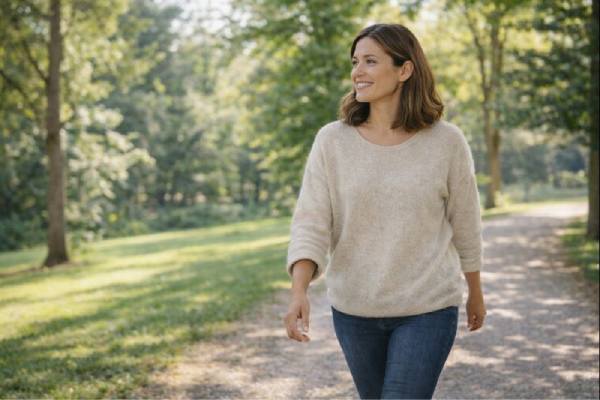
Anxiety is not only a feeling—it is a full-body state. Heart rate climbs, breathing becomes shallow, muscles brace, and attention locks onto potential threats. When that system is “on,” thinking your way out can feel impossible. Walking works differently: it meets anxiety where it lives—inside the nervous system—and gently shifts the body toward safety. That shift can happen faster than many people expect, especially with a steady pace and a predictable rhythm.
Walking is also unusually flexible. It can be a quick reset between meetings, a structured routine you build over weeks, or a low-pressure way to re-enter daily life when worry has narrowed your world. This article explains how much walking tends to help, what “the right intensity” really means, and why the effects are more than distraction—while keeping expectations realistic and safety in view.
Key Insights
- A brief 10–20 minute walk can reduce “in-the-moment” anxiety and make emotions feel more manageable.
- Consistency matters more than perfection; most benefits build with 3–5 days per week.
- Moderate intensity (where you can talk in short sentences) is often a sweet spot for calming effects.
- If walking triggers panic-like sensations, slower starts and gradual pacing can prevent setbacks.
- Pair walking with a simple plan (time, place, cue) to make it reliable on anxious days.
Table of Contents
- What walking changes in anxious moments
- The dose that helps most people
- Intensity and pace without guesswork
- Why walking works in the brain and body
- Making it stick on hard days
- Safety, special situations, and next steps
What walking changes in anxious moments
Anxiety has a body signature
When anxiety spikes, the body often behaves as if danger is present: adrenaline rises, breathing speeds up, the gut tightens, and attention narrows. This is not a character flaw—it is a protective system that is simply overactive or misdirected. The practical problem is that anxiety can make stillness feel unsafe. Sitting and “calming down” may increase awareness of racing thoughts, sensations, and uncertainty.
Walking gives the anxious system something it understands: purposeful movement. It also introduces predictable sensory input—footsteps, arm swing, a steady horizon—that can reduce internal “noise.” Many people notice that within minutes, their breathing begins to deepen and their thoughts become less sticky. The goal is not to erase worry on demand, but to lower the intensity enough that you regain choices.
Why walking can calm faster than you expect
A short walk often helps in three immediate ways:
- Breathing shifts naturally. Even a gentle pace encourages slightly deeper breaths, which supports a calmer autonomic state.
- Muscle tension has an outlet. Anxiety energizes the body; walking uses that energy in a controlled, non-alarming way.
- Attention widens. Moving through space recruits orientation—your brain tracks surroundings, distance, and rhythm—making it easier to step out of rumination.
If you want a simple “acute anxiety” protocol, try this: walk for 12 minutes at an easy-to-moderate pace, and every 2 minutes check one concrete cue—jaw unclenched, shoulders down, hands relaxed, longer exhale. That keeps the walk from turning into a frantic “escape” and teaches the body that movement can be steady and safe.
A key expectation to set: walking may not feel pleasant at first. If you are highly keyed up, the first 3–5 minutes can feel restless. Many people improve after that initial ramp-up, especially if they keep the pace steady instead of speeding up to outrun the feeling.
The dose that helps most people
“Best dose” depends on your starting point, your symptoms, and your schedule. But across many studies of walking and broader physical activity, a few patterns show up consistently: small bouts can help quickly, and bigger improvements usually come from doing something reliably over weeks.
The minimum that is still meaningful
If you are starting from zero or you feel overwhelmed, aim for 10 minutes per walk, 3 days per week. That can be enough to create a noticeable shift in stress reactivity and sleep quality within a couple of weeks. For some people, the biggest early benefit is simply proof: “I can influence my state.”
If anxiety is intense, shorter and more frequent walks may work better than rare long walks. Think two 10-minute walks instead of one 20-minute walk, especially if your day has predictable anxiety windows (for example, mid-morning or late afternoon).
A practical target for ongoing anxiety support
A widely used benchmark for general health is 150 minutes per week of moderate-intensity activity, often framed as 30 minutes on 5 days. For anxiety, this target is useful because it is high enough to build physiological resilience without demanding athletic training. If 30 minutes sounds unrealistic, scale it:
- 15 minutes, twice a day, 5 days a week
- 25 minutes, 4 days a week
- 10 minutes after each meal (breakfast, lunch, dinner) for most days
The best schedule is the one you can repeat when you are not feeling brave.
How long until you notice a difference?
Many people feel some relief the same day—especially reduced “edge” or improved sleep that night. More stable changes often show up after 2–6 weeks of consistent walking. If you track anything, track something simple: a 0–10 anxiety rating before and after, once a day for two weeks. Patterns matter more than any single day.
One limitation worth naming: walking is not a switch you flip. If your anxiety is driven by ongoing stressors, trauma, or a clinical anxiety disorder, walking may reduce symptoms and improve coping, but it may not resolve the underlying condition on its own. Treat it as a supportive intervention that makes other strategies easier.
Intensity and pace without guesswork
For anxiety, “how hard” you walk can matter as much as “how long.” Too easy may feel like it does nothing; too intense may mimic anxiety sensations (pounding heart, breathlessness) and backfire—especially for panic-prone people. The sweet spot is usually moderate intensity.
The talk test is your best tool
Forget perfect heart-rate formulas at first. Use the talk test:
- Easy: you can sing or speak full paragraphs comfortably.
- Moderate: you can talk in short sentences, but you would not want to give a speech.
- Vigorous: you can only say a few words before needing a breath.
For most people using walking for anxiety, moderate intensity is ideal. It raises body temperature and circulation enough to create a calming after-effect, without pushing you into “alarm-like” sensations.
Rate of perceived exertion in plain language
If you like numbers, use a 0–10 effort scale:
- 2–3/10: easy stroll
- 4–6/10: purposeful, brisk walk
- 7+/10: hard effort
A good anxiety-supporting walk is often 4–6/10. If you are new, start at 3–4/10 and build gradually.
What about hills, intervals, and speed walking?
These can be helpful—but timing matters.
- If you have general worry and feel sluggish, adding hills or brief faster intervals can improve mood and confidence.
- If you have panic attacks or strong fear of bodily sensations, keep the first 2–3 weeks steady and moderate. Then add intensity slowly, so your body learns, “This sensation is exercise, not danger.”
A simple progression that avoids guesswork:
- Week 1–2: 10–20 minutes, steady pace, 3–5 days/week
- Week 3–4: add 5 minutes to two walks each week
- Week 5+: add 3–5 short “pick-ups” (30–60 seconds slightly faster) once or twice per week
Finally, remember that “more” is not always “better” for anxiety. If you finish a walk feeling wired or irritable, you may be pushing too hard or too late in the day. Try a slightly slower pace, a flatter route, or earlier timing.
Why walking works in the brain and body
Walking is simple, but its effects are layered. Some mechanisms are chemical, some are nervous-system training, and some are psychological learning. Together, they create a calmer baseline and a faster recovery from stress.
Autonomic balance and the “recovery signal”
Anxiety is often tied to a dominance of sympathetic arousal (the mobilizing system). Walking—especially rhythmic, moderate walking—can increase your capacity to shift into parasympathetic recovery after a stress spike. In everyday terms, you may still get anxious, but you spend less time stuck there.
A useful mental model: walking is practice in “activation with control.” Your heart rate rises on purpose, then returns to baseline. Repeating that cycle teaches the body that activation is not automatically a threat.
Brain chemistry that supports steadier mood
Movement influences neurotransmitters involved in mood and focus, including those linked to calm attention and emotional regulation. Walking also increases blood flow and supports factors associated with brain plasticity—your brain’s ability to adapt. Over time, this can make anxious patterns less rigid.
Importantly, walking tends to help without demanding intense willpower. You do not have to “think positive” to benefit. You just have to move.
Interoceptive exposure: a gentle way to reduce fear of sensations
Many anxiety symptoms are frightening because they feel mysterious: a fast heartbeat, lightheadedness, a tight chest. Walking creates mild versions of those sensations in a safe context. With repetition, your brain learns new associations: “My heart can beat faster and I am still okay.” This is especially relevant for panic and health anxiety, where fear of sensations becomes part of the problem.
The key is dosing: enough sensation to teach safety, not so much that you trigger a full panic spiral.
Attention, environment, and the “widening” effect
Anxiety narrows focus. Walking widens it. Even in the same neighborhood, moving changes perspective: new sights, small navigational choices, a steady forward direction. Many people benefit from “soft focus” walking—eyes up, scanning gently, noticing color and distance. It is a practical form of cognitive flexibility training.
You can also shape the effect with context. Nature, daylight, and social walking can add extra benefits, but they are not required. A plain indoor corridor walk still counts.
Making it stick on hard days
The hardest part of walking for anxiety is not the physiology—it is follow-through. Anxiety can bring fatigue, avoidance, and a “why bother” feeling. The solution is not motivation. It is design: make walking easy to start and hard to skip.
Lower the start threshold
On anxious days, aim for a “minimum viable walk” that feels almost too small to refuse:
- Put on shoes and walk 5 minutes.
- If you want to stop at 5, you can. If you continue, that is a bonus.
This approach prevents all-or-nothing thinking and builds identity: you are someone who keeps a promise to yourself, even in a small way.
Use a cue that already exists
Attach walking to something stable:
- after morning coffee
- after lunch
- immediately after work
- after you drop someone off
If anxiety makes mornings hard, choose the least variable part of your day, not the most idealized version.
Plan for barriers before they happen
A simple “if-then” plan reduces friction:
- If it is raining, then I do a 12-minute indoor walk (hallway, stairs, mall).
- If I feel socially anxious, then I choose a route where I can turn around easily.
- If I feel tired, then I walk easy for 8 minutes and reassess.
You are not negotiating with anxiety in real time—you are executing a plan you made when calm.
Make walking emotionally safe
For some people, silence increases rumination. For others, headphones increase agitation. Experiment with these options:
- Grounding focus: count 20 steps, then name 5 things you see. Repeat.
- Audio support: calm music, a familiar podcast, or a guided walk.
- Social buffer: walk with one trusted person or in a lightly populated area.
If you tend to rush when anxious, choose routes that encourage steadiness: a loop, a park path, or any place where you do not feel pressured to “get somewhere.”
The long game is consistency. A modest routine kept for months beats an ambitious plan kept for a week.
Safety, special situations, and next steps
Walking is generally safe, but anxiety can complicate how it feels—especially if you fear bodily sensations or if you have medical conditions that make exertion risky. Use walking as a supportive tool, and keep a few guardrails in mind.
If walking triggers panic-like sensations
If you notice that walking brings on dizziness, racing heart, or fear of “something bad happening,” try these adjustments:
- Start with 5 minutes easy, then 5 minutes moderate, then 2 minutes easy to finish.
- Walk on a flat route close to home for the first two weeks.
- Keep breathing simple: slightly longer exhale, relaxed jaw, shoulders down.
- Avoid checking your pulse repeatedly; it can reinforce alarm.
If panic is frequent, consider pairing walking with evidence-based treatment (such as cognitive behavioral therapy) so that the learning generalizes beyond the walk.
When to be cautious medically
If you have chest pain with exertion, fainting, unexplained shortness of breath, a new irregular heartbeat, or a condition where exercise limits have been recommended, get medical guidance before increasing intensity. Anxiety can mimic medical symptoms, and medical symptoms can be mistakenly dismissed as anxiety. When in doubt, get assessed.
How to combine walking with other anxiety supports
Walking works well alongside:
- psychotherapy (it can make sessions more productive by reducing baseline arousal)
- medication (it can support sleep, energy, and confidence during treatment)
- breathing or relaxation skills (walking becomes a moving practice ground)
- sleep routines (a daytime walk can strengthen circadian cues)
A practical weekly template many people tolerate well:
- 3 days: 20–30 minutes moderate
- 2 days: 10–20 minutes easy
- 1–2 days: optional social or nature walk, whatever feels restorative
Signs it is working
Progress is often subtle. Look for changes like:
- fewer “spikes” that hijack your day
- faster recovery after stress
- improved sleep depth or fewer night awakenings
- more willingness to do normal activities you were avoiding
- a sense that anxious thoughts feel less urgent
If you are not seeing any shift after 6 weeks of consistent walking, that does not mean you failed. It may mean anxiety is being maintained by factors that need additional support—stress load, trauma, medical issues, or patterns of avoidance. In that case, walking is still valuable, but it should be one part of a broader plan.
References
- The Effect of Walking on Depressive and Anxiety Symptoms: Systematic Review and Meta-Analysis – PMC 2024 (Systematic Review and Meta-Analysis)
- Effectiveness of physical activity interventions on undergraduate students’ mental health: systematic review and meta-analysis – PMC 2024 (Systematic Review and Meta-Analysis)
- Effect of physical activity for reducing anxiety symptoms in older adults: a meta-analysis of randomized controlled trials – PMC 2024 (Meta-Analysis)
- Is Exercise a Viable Therapy for Anxiety? Systematic Review of Recent Literature and Critical Analysis – PMC 2023 (Systematic Review)
- Physical activity 2024 (Guidance)
Disclaimer
This article is for educational purposes and does not provide medical advice, diagnosis, or treatment. Walking can support anxiety management, but it is not a substitute for professional care—especially if symptoms are severe, persistent, or interfering with daily life. If you have medical conditions or experience warning signs during activity (such as chest pain, fainting, or severe shortness of breath), seek medical evaluation before changing your exercise routine. If you feel at risk of harming yourself or others, contact local emergency services or a crisis resource in your area immediately.
If you found this helpful, consider sharing it on Facebook, X (formerly Twitter), or any platform you prefer so others can benefit too.