Getting sick can make your home feel suddenly “contaminated,” even if it looked perfectly normal the day before. The good news is that you don’t need to disinfect your entire life to lower the chance of passing germs to other people in your household—or to avoid getting sick again. The most protective approach is also the simplest: focus on the surfaces your hands touch often, clean the small “sick zone” where you spend time, and use disinfectants only where they add real value. That strategy reduces exposure without creating an exhausting, chemical-heavy routine that irritates airways when they’re already inflamed.
This guide breaks down what to clean first, how often to do it, and which tasks are mostly stress with little payoff—so you can spend your limited energy on rest, fluids, and recovery.
Core Points
- Prioritize high-touch surfaces and the “hands-to-face” pathway over low-contact areas like walls and ceilings.
- Clean with soap or detergent first; disinfect only in targeted spots when someone is actively sick or high-risk people are in the home.
- Use products safely: ventilate, wear gloves if needed, and never mix cleaners (especially bleach with ammonia or acids).
- A short daily routine (5–10 minutes) is usually more effective than a one-time deep clean you can’t sustain.
- Follow label directions for contact time and surface compatibility so disinfectants can actually work without damaging finishes.
Table of Contents
- Cleaning priorities when you’re sick
- High-touch surfaces to clean first
- Bathroom steps that protect housemates
- Kitchen and dish rules you can live with
- Laundry, bedding, and soft surfaces done right
- Disinfecting without obsessing or harming health
Cleaning priorities when you’re sick
When you’re ill, it helps to think in “routes,” not rooms. Germs spread most efficiently along routes where hands repeatedly pick things up and then touch the face: tissues, phones, faucet handles, doorknobs, and anything shared. That’s why cleaning priorities should follow three questions:
- Is it touched often? The more hands on it, the more it matters.
- Is it shared? If other people use it, it climbs the list.
- Does it sit near coughing, sneezing, or face-touching? Bedside items and bathroom fixtures matter more than a bookshelf across the room.
A practical way to apply this is to define a small “sick zone.” That’s the area where you spend the most time—usually the bed or couch, plus the path to the bathroom and kitchen. Keeping this zone cleaner reduces the number of times you and others re-touch the same germy surfaces.
Your baseline approach can be simple:
- Daily: Wipe the most-used high-touch points and your sick zone surfaces.
- After obvious contamination: Clean anything visibly soiled (like a nightstand hit by a sneeze spray or a counter used to prep a hot drink while coughing).
- After recovery: Do one reset pass on the sick zone and shared surfaces, then return to normal routines.
This approach also protects your lungs and energy. Over-cleaning tends to mean stronger products, more fumes, and longer exposure—exactly what you don’t need when your airways are sensitive. A five-minute, repeatable routine is often more protective than a “perfect” deep clean you only manage once.
If you live with someone at higher risk (older adults, babies, pregnancy, immune suppression, or chronic lung disease), your priorities stay the same, but your frequency increases: consider cleaning shared high-touch points twice a day during the first few days of illness, when symptoms are most active.
High-touch surfaces to clean first
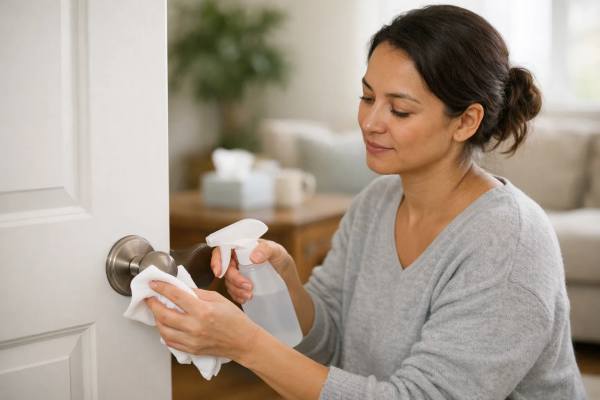
High-touch surfaces are the best return on effort because they’re where germs and people repeatedly meet. If you can only do one thing, do this: clean what hands touch, especially what hands touch before touching the face (eyes, nose, mouth) or food.
Start with a short, specific list. These tend to be the true “repeat offenders” in most homes:
- Doorknobs, handles, and locks (front door, bedroom, bathroom)
- Light switches and dimmers
- Faucet handles and sink knobs
- Toilet handle or flush button
- Phone screens, tablets, keyboards, mouse, and remote controls
- Refrigerator handle, microwave buttons, coffee machine buttons
- Bedside table surface, lamp switch, alarm clock
- Handrails, drawer pulls, cabinet handles
- Car steering wheel and gear selector (if you’ve been driving while sick)
How often? For most households, once daily while symptoms are active is a solid baseline. If you’re coughing a lot, sharing a bathroom, or frequently moving between rooms, add a second quick pass on the most shared items (bathroom and kitchen handles, remotes, and phones).
A simple method that doesn’t require fancy supplies:
- Wash or sanitize your hands first. Otherwise you’re spreading germs onto the cloth.
- Use soap/detergent and water (or a standard household cleaner) to remove grime and oils that protect germs.
- If you choose to disinfect, do it after cleaning and let the surface stay wet for the product’s stated contact time.
- Use separate cloths for bathroom and kitchen, and don’t reuse a cloth that smells musty.
Two small tips that make a big difference:
- Clean from “cleaner” to “dirtier.” Start with phones/remotes, then handles, and finish with bathroom fixtures.
- Avoid “double-dipping.” If you’re using wipes, use enough that you’re not dragging the same wipe across multiple rooms.
This is also where you can reduce household conflict: agree on shared rules like “everyone wipes their phone once a day” and “the sick person uses one designated remote.” Tiny boundaries prevent repeated re-contamination.
Bathroom steps that protect housemates
Bathrooms deserve special attention during respiratory illness because they concentrate shared touch points—faucets, towels, toilet controls—and they’re often small, poorly ventilated spaces. The goal is not a sterile bathroom. The goal is reducing hand-to-surface-to-hand transfer for anyone who uses the room.
If you share a bathroom, prioritize these areas daily:
- Sink handles and the sink rim where hands rest
- Counter area where toothbrushes, cups, and medications sit
- Toilet seat and flush handle/button
- Door handle (both sides) and light switch
- Any shared dispensers (soap pump, lotion, mouthwash bottle)
A clean routine that’s realistic when you feel awful:
- Ventilate first (fan on, crack a window if possible).
- Clean sink handles, counter edges, and toilet touch points with your usual cleaner or soapy water.
- Disinfect selectively on the highest-touch points if someone else is using the bathroom the same day.
- Finish with handwashing so you don’t carry residue or germs back to your sick zone.
Towels and personal items matter here more than floors:
- Use your own hand towel if possible, or switch to disposable paper towels during the acute phase.
- Keep toothbrushes separated so heads don’t touch, and store them so they can dry.
- Consider using a cup or bin for your own small items (thermometer, nasal spray) so they don’t sit loose on a shared counter.
What about the shower and bath? Unless you’re visibly soiling surfaces (for example, heavy mucus on fixtures), the shower is usually lower priority than sink handles and counters. If you want one quick shower-related task, wipe the faucet handle and shower door handle—the parts people touch with wet hands.
Finally, protect your breathing. Bathrooms are where strong products can feel suffocating. If you’re using disinfectants, use the minimum needed, keep the door open afterward, and step out while the room airs out.
Kitchen and dish rules you can live with
The kitchen can trigger a lot of worry because it’s where food is prepared, but you don’t need extreme measures to keep it safe. Your biggest kitchen risks when sick are straightforward: coughing near food, touching shared handles with unwashed hands, and leaving frequently touched items (like a mug or spoon) in common areas.
Focus on three categories: hands, handles, and high-traffic prep space.
Hands: Wash hands before preparing food, making tea, or grabbing shared snacks. If you’re too ill to do that reliably, reduce your kitchen footprint: keep drinks and simple foods in your sick zone, or ask someone else to prep meals for a day or two.
Handles: Clean and, if desired, disinfect the refrigerator handle, microwave buttons, kettle handle, and cabinet pulls once daily during active symptoms. These are touched constantly and often absentmindedly.
Prep space: You do not need to disinfect every inch of counter. Clean the section you actually used, especially if you were coughing or sneezing while standing there. Soap and water or a standard kitchen cleaner is usually enough, with targeted disinfecting only if you want an extra step.
Dish and utensil guidance that avoids drama:
- Normal dishwashing is typically sufficient. Hot water, detergent, and friction do a lot of work.
- A dishwasher adds heat and longer wash time, but it’s not mandatory if you hand-wash thoroughly.
- Use your own water bottle or mug if possible to reduce mix-ups.
Two items people over-focus on:
- Groceries and packages: It’s rarely worth disinfecting packaging. A better use of time is washing hands after putting groceries away and before eating.
- Sponges: A sponge can hold onto food residue and moisture. If yours smells, looks slimy, or has been used to clean up obvious mess from illness, replace it. Otherwise, let it dry fully between uses and avoid using the same sponge for bathroom tasks.
A simple “sick-day kitchen rule” that works: the sick person doesn’t handle shared snacks (chips, bread bags, cookie jars). Put single servings in a bowl or plate so you’re not repeatedly reaching into communal containers.
Laundry, bedding, and soft surfaces done right
Soft surfaces feel like they “hold germs forever,” but most households can handle them with calm, routine steps. The big priorities are bedding near your face, frequently used throw blankets, and clothing that’s been coughed into—especially in the first few days when symptoms are strongest.
Bedding: If you’re sleeping in the same bed each night, you don’t need to change everything daily. A reasonable approach is:
- Change pillowcases every 2–3 days during active symptoms (or sooner if you’re sweating heavily or coughing a lot at night).
- Change sheets once per week as usual, and do a full bedding wash after you’re feeling better.
Towels: If possible, give the sick person their own hand towel and bath towel. If you’re sharing, swap towels more often and let them dry fully between uses.
Clothes: Wash clothes normally. The most important thing is to dry them completely, because damp fabric encourages odors and microbial growth. If someone in the household is medically fragile, you can wash the sick person’s clothing separately during the acute phase, but it’s not required for most households.
Handling laundry without spreading germs everywhere:
- Carry laundry in a basket rather than hugging it against your chest.
- Avoid shaking sheets or towels (shaking can fling dust and particles into the air).
- Wash hands after loading the washer, especially before touching your face.
Soft furnishings (couches, curtains, rugs) are where obsessing often outpaces benefit. Instead of trying to “disinfect fabric,” do this:
- If you spent most of the day on one couch spot, wash the throw blanket and wipe the remote—that’s the high-impact part.
- If there are visible spills or tissues left behind, remove them promptly and clean the spot.
- Vacuuming is optional; if you do it, ventilate and go slowly to avoid stirring up dust that can irritate a sore throat or cough.
Trash deserves a mention because tissues pile up fast. Use a lined trash can in your sick zone, tie the bag when it’s full, and wash hands afterward. That’s typically enough—no special biohazard rituals needed.
Disinfecting without obsessing or harming health
Disinfecting can be useful, but only when it’s done correctly and targeted to the right places. Many people end up doing the worst of both worlds: using strong products broadly (more fumes, more effort) while wiping them off too fast to work.
A clean mental model is:
- Cleaning removes dirt and lowers germ load through friction and soap/detergent.
- Disinfecting uses chemicals to kill remaining germs on hard, nonporous surfaces.
- Sanitizing is a milder reduction in germs (more common for food-contact contexts and certain products).
When disinfecting is most worth it:
- Someone in the home is actively sick and others share the same bathroom or common areas.
- A high-risk person lives in the home and you want an extra layer on high-touch points.
- A surface was directly exposed to respiratory secretions (for example, a nightstand where you sneezed repeatedly).
How to do it without common mistakes:
- Clean first. Disinfectants work better on surfaces without greasy residue or visible grime.
- Respect contact time. Disinfectants usually need the surface to remain wet for a specified time. If it dries instantly, you likely didn’t use enough product.
- Choose the right surface. Disinfectants are mainly for hard, nonporous surfaces. For fabrics, washing and drying are usually better.
- Ventilate and protect your skin. Open a window, run a fan, and consider gloves if products irritate you.
- Never mix products. Mixing cleaners—especially bleach with ammonia or acidic products—can create dangerous gases.
If disinfectants trigger coughing, headaches, or asthma symptoms, scale back. You can often get most of the benefit by cleaning more consistently with soap/detergent and focusing on hand hygiene and airflow. If you still want a disinfecting step, limit it to a few high-touch points (bathroom fixtures, doorknobs, and the phone/remote) rather than spraying entire rooms.
Finally, set a clear end point so cleaning doesn’t take over your recovery. A good “reset” moment is when you’ve been improving and fever-free for a full day (without fever-reducing medications). At that point, do one focused pass: wash bedding, wipe high-touch points, empty sick-zone trash, and return to normal cleaning.
References
- When and How to Clean and Disinfect Your Home | Water, Sanitation, and Environmentally Related Hygiene (WASH) | CDC 2025 (Guidance)
- Cleaning and Disinfecting with Bleach | Water, Sanitation, and Environmentally Related Hygiene (WASH) | CDC 2024 (Guidance)
- Viral cultures for assessing fomite transmission of SARS-CoV-2: a systematic review and meta-analysis – PubMed 2022 (Systematic Review and Meta-Analysis)
- SARS-CoV-2 and the role of fomite transmission: a systematic review – PubMed 2021 (Systematic Review)
Disclaimer
This article is for general educational purposes and is not a substitute for personal medical advice, diagnosis, or treatment. Cleaning and disinfecting recommendations may differ based on the illness involved, household risk factors, and the products and surfaces in your home; always follow product label directions and safety warnings. If you or someone in your household has severe symptoms (such as trouble breathing, persistent chest pain, confusion, bluish lips or face, dehydration, or worsening symptoms after initial improvement), seek urgent medical care. If you think you’ve been exposed to harmful fumes or chemicals from cleaning products, contact local emergency services or your regional poison control resources promptly.
If this guide helped, consider sharing it on Facebook, X (formerly Twitter), or any platform you prefer so others can clean smarter and rest sooner.