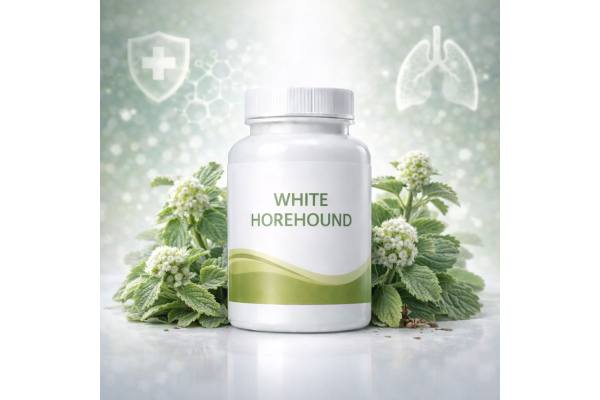
White horehound (Marrubium vulgare) is an old-fashioned bitter herb that still shows up in modern cough syrups, teas, and capsule formulas. People reach for it when a cold cough lingers, mucus feels “stuck,” or appetite and digestion feel sluggish. Its signature compound, marrubiin, helps explain why horehound tastes intensely bitter—and why it has a long history as a traditional expectorant and digestive stimulant.
What makes horehound interesting today is not hype, but practicality: it is available in simple forms (tea, syrup, tincture, standardized extracts), it can fit into short-term routines, and official herbal monographs describe traditional uses and typical dosing ranges. Still, “natural” does not mean “risk-free.” Certain conditions (especially bile-duct or liver disorders) and life stages (pregnancy and breastfeeding) call for extra caution or avoidance.
Essential Insights for White Horehound
- May soothe cough associated with a cold by supporting expectoration and throat comfort.
- Can support mild dyspeptic complaints such as bloating and flatulence in short courses.
- Typical adult dosing ranges include 3–6 g/day as tea or 4.5–12 mL/day as a liquid extract.
- Avoid during pregnancy and breastfeeding, and do not use in children under 12 years.
- Avoid if you have bile-duct obstruction, cholangitis, liver disease, or a known Lamiaceae allergy.
Table of Contents
- What is white horehound and what does “extract” mean?
- Does white horehound help cough and mucus?
- Can it help digestion, appetite, and bloating?
- How to take white horehound: tea, syrup, tincture, and capsules
- Dosage and timing guide for common goals
- Side effects, interactions, and who should avoid it
- What the evidence and regulators actually say
What is white horehound and what does “extract” mean?
White horehound is a perennial mint-family herb (Lamiaceae) traditionally used for two main themes: respiratory comfort (especially coughs with a cold) and digestive support (especially sluggish appetite, bloating, and “heavy” digestion). In supplements, you will usually see the dried aerial parts—often described as “herb” or “flowering tops.”
The word extract matters because it tells you how concentrated the product may be. A simple tea is an infusion of the herb in hot water; it is mild, but it still carries the bitter taste. A tincture is an alcohol-water extraction that pulls out a broader range of compounds and is easy to dose by milliliters. A liquid extract may list a DER (drug extract ratio), which tells you how much herb was used to make a certain amount of extract (for example, 1:1 means the liquid roughly represents 1 gram of herb per 1 mL of extract, depending on the product). A dry extract is concentrated and then dried into a powder for capsules or tablets; it may be “standardized” to a marker compound, or it may simply list a DER.
Horehound’s hallmark bitter compound is marrubiin (a labdane diterpene). Bitters often work through a mouth-to-gut reflex: when your taste receptors detect bitterness, the body may increase saliva, gastric secretions, and digestive activity. That is one reason horehound appears in both cough remedies and digestive bitters.
A practical advantage of horehound is flexibility. If you want a traditional approach, tea or syrup may be enough for a short course. If you want more convenience, a measured liquid extract or capsule can be easier to fit into a routine—especially when you are traveling or do not want multiple cups of tea per day.
Does white horehound help cough and mucus?
White horehound is best known as a traditional expectorant—meaning it is used to help the body move mucus out more effectively. In real life, that “benefit” often looks like this: coughs feel more productive, the chest feels less tight with mucus, and throat irritation calms down because the cough cycle becomes less frantic. It is not usually framed as a “stop coughing” herb; it is more often used to make coughing more effective and less bothersome.
There are two main ways horehound formulas can help during a cold cough:
- Expectorant support: Traditional use suggests it helps loosen or mobilize mucus. For people who feel congested or “stuck,” this can be the difference between a cough that goes nowhere and a cough that clears.
- Soothing delivery forms: Horehound often appears in syrups with honey or other demulcent ingredients. A syrup’s thickness can coat the throat and reduce the urge-to-cough loop, especially at night.
One advantage of horehound is that it can be paired thoughtfully. Many commercial cough formulas combine it with ivy leaf, plantain, or similar herbs, aiming to cover multiple angles (mucus support plus throat comfort). If you are making your own routine, the pairing can be simpler: horehound tea plus adequate fluids, warm showers, and nasal saline can be a surprisingly coherent plan for the “whole system” of a cold.
What to expect (and what not to expect):
- Most realistic: mild-to-moderate symptom relief during a cold, especially when used early and consistently for several days.
- Less realistic: treating serious respiratory illness, shortness of breath, fever that persists, chest pain, wheezing, or coughing up blood. Those are medical-evaluation situations, not supplement situations.
A useful self-check: if your cough is mostly dry and scratchy, a syrup form may feel better than a bitter tea. If your cough is wet and “gunky,” a tea or measured extract taken with plenty of water may fit better. Either way, treat horehound as a short-course tool—not a forever supplement.
Can it help digestion, appetite, and bloating?
Horehound’s other classic role is as a bitter digestive—used traditionally for mild dyspeptic complaints such as bloating and flatulence, and for temporary loss of appetite. If you have ever tried a true bitter herb, you know the taste is not subtle. That bitterness is part of the point: it “primes” digestion for many people.
Where it can be most helpful:
- After a stretch of low appetite: travel, stress, or a lingering cold can blunt hunger cues. A bitter taken shortly before meals may help appetite feel more normal.
- Bloating and sluggish digestion: some people describe a heavy, slow feeling after meals; bitters may support digestive secretions and motility.
- Gas and mild discomfort: traditional use focuses on mild, functional symptoms rather than severe pain.
A practical advantage is timing control. If your goal is digestive support, horehound is often taken before meals. That makes it easy to “test” in a structured way: take it for a few days, notice whether hunger signals, post-meal comfort, and bloating change, and then decide whether it is worth continuing.
However, digestive herbs are also where people accidentally overdo it. Common mistakes include taking horehound on an empty stomach when you are already prone to irritation, combining it with multiple other strong bitters at once, or using it as a substitute for addressing a trigger (very large meals, alcohol, or foods you personally do not tolerate well).
It also matters what kind of digestive issue you are dealing with. Bloating and gas can come from many causes—dietary patterns, constipation, lactose intolerance, reflux, gallbladder issues, and more. Horehound is most appropriate for mild, functional complaints. If symptoms are persistent, severe, or associated with weight loss, vomiting, black stools, or intense pain, you deserve a proper medical workup rather than a rotating cast of supplements.
Used appropriately, horehound’s digestive “advantage” is that it tends to be a focused, bitter-driven approach: simple, measurable, and usually intended for short-term use rather than indefinite daily supplementation.
How to take white horehound: tea, syrup, tincture, and capsules
Choosing the best form depends on your goal, your taste tolerance, and how precisely you want to dose. Horehound is famously bitter—some people do not mind it, others strongly prefer capsules.
1) Tea (infusion)
Tea is the most traditional form and can be a good “first trial” because it is simple and inexpensive. The tradeoff is taste and time. Tea tends to fit best for mucus support, especially when paired with hydration.
Tips to make it more usable:
- Cover the cup while steeping to keep aromatic compounds in.
- Drink it warm if cough is the goal; warmth itself can feel soothing.
- If bitterness is a barrier, consider using a smaller amount more consistently rather than one strong cup you avoid.
2) Syrup and lozenges
If your main problem is throat irritation and night coughing, syrup can be the most comfortable form. Horehound is commonly paired with honey or other soothing ingredients, and the “coating” effect can matter as much as the herb itself.
Practical use: take the last dose 30–60 minutes before bed, then avoid eating and drinking so the throat-coating effect lasts longer.
3) Tincture or liquid extract
These are best when you want easy dosing without swallowing capsules. They also work well for appetite support because the bitter taste hits quickly. If the label lists a DER (drug extract ratio) and solvent percentage, you have more transparency about what you are taking.
4) Capsules or tablets (dry extract or powdered herb)
Capsules are the most convenient and the least bitter. They are also easiest for people with sensitive taste or nausea. The downside is that some “bitters” work partly through taste receptors, so bypassing the mouth may reduce the digestive reflex effect for certain people.
Quality cues that matter across forms:
- Clear botanical name (Marrubium vulgare).
- Plant part (aerial parts or flowering tops).
- Extract details (DER, solvent, or standardization marker) when relevant.
- A realistic, specific serving size in grams, mg, or mL—rather than vague “proprietary blends.”
Dosage and timing guide for common goals
Horehound dosing is usually framed as a short course. For cold-related cough, many people use it for several days up to about a week. For digestive goals, a short trial is often one to two weeks, then reassess. If you need something indefinitely, that is a clue to look deeper for the underlying cause.
Below are common traditional adult ranges used for oral products. Use label directions when they are clear and credible, and avoid stacking multiple horehound products unless you are intentionally calculating the combined daily amount.
Tea (infusion)
- A common approach is 1–2 g of dried herb infused in 250 mL of hot water, 3 times daily.
- That works out to 3–6 g/day total dried herb.
Powdered herb (capsules or loose powder)
- Typical ranges may look like 225–450 mg per dose, 3 times daily.
- That works out to 675–1,350 mg/day total of powdered herb, depending on the product.
Expressed juice (fresh-herb juice preparations)
- Some products use an expressed juice dose of 10–20 mL, 3 times daily (total 30–60 mL/day).
Liquid extract (measured extract)
- A common range is 1.5–4 mL, 3 times daily (total 4.5–12 mL/day).
Timing tips by goal
- Cough with a cold: take doses spaced across the day, and consider a final dose in the evening for nighttime comfort. Hydration supports the overall goal.
- Bloating, flatulence, or appetite: many people take it about 30 minutes before meals to align with the bitter-driven digestive reflex.
When to stop and reassess
- If cough symptoms do not improve over about a week, or if they worsen, it is smarter to switch from self-care to medical evaluation.
- If digestive symptoms persist beyond a couple of weeks, treat that as a sign to investigate causes (diet triggers, reflux, gallbladder issues, constipation, medication side effects) rather than extending the supplement indefinitely.
Dosage precision matters more with extracts than with tea. With a concentrated extract, measure carefully in mL, and avoid “free-pouring” from a dropper unless the label provides a calibrated dropper volume.
Side effects, interactions, and who should avoid it
Most people consider horehound a short-term herb, not an everyday long-haul supplement. That framing helps reduce risk, because long-term daily use is where small issues can quietly become bigger ones.
Who should avoid white horehound
Avoid use if you have any of the following, unless a qualified clinician who knows your history advises otherwise:
- Pregnancy or breastfeeding.
- Children under 12 years.
- Bile-duct obstruction, cholangitis, or known liver disease.
- Ileus (bowel obstruction).
- Known allergy to horehound or other Lamiaceae plants (mint family).
Use caution and get advice first if you have:
- Gallstones or biliary disorders. Bitter herbs can stimulate digestive secretions, which may be uncomfortable or inappropriate in some bile-related conditions.
- Active peptic ulcer or significant reflux. Bitters can aggravate symptoms in sensitive people.
Possible side effects
Even when an herb is generally well tolerated, individual responses vary. Potential issues include:
- Stomach upset, nausea, or heartburn, especially if taken on an empty stomach by someone prone to irritation.
- Diarrhea or cramping, particularly if you combine multiple strong digestive herbs.
- Allergic reactions (rash, itching, swelling), which should be treated as a stop-now situation.
Interactions to think about
Formal interaction data is limited, but a cautious approach is appropriate if you take:
- Diabetes medications: if a product is marketed for blood sugar support or you notice unusual shakiness or sweating, monitor closely and involve your prescriber.
- Blood pressure medications: if you are prone to lightheadedness, be cautious with any new herb that could shift vascular tone or hydration routines.
- Multiple cough products at once: stacking syrups, lozenges, and decongestants can lead to unnecessary side effects even if horehound itself is not the main culprit.
When to seek medical care instead of self-treating
Get evaluated promptly for shortness of breath, wheezing, high fever, chest pain, dehydration, coughing up blood, severe abdominal pain, black stools, or rapid worsening of symptoms. Supplements are not a safe “bridge” in those scenarios.
What the evidence and regulators actually say
A clear way to think about white horehound is to separate three layers: tradition, plausibility, and modern clinical proof. Horehound has strong tradition and a plausible mechanism for certain uses, but the modern clinical evidence base is smaller than many supplement labels imply. That does not make it useless; it just tells you how to use it intelligently.
1) Traditional use is officially described for specific, modest goals
Regulatory-style monographs describe horehound as a traditional herbal product used as an expectorant in cough associated with a cold, and for mild dyspeptic complaints (bloating and flatulence) and temporary loss of appetite. The important detail is the word traditional: it signals long-standing use and plausible benefit, not the same level of proof required for a prescription medicine.
2) Clinical research exists, but often in multi-ingredient formulas
Modern studies more commonly evaluate horehound as part of a syrup blend rather than as a stand-alone herb. That mirrors how people actually use it (cough syrups are rarely single-herb), but it also means you cannot credit horehound alone for every benefit seen in a combination product. Practically, the takeaway is still useful: a horehound-containing syrup may be a reasonable short-term option for symptom relief during an uncomplicated cold, especially when it helps sleep.
3) Preclinical studies support “properties,” not guaranteed outcomes
Laboratory and animal research suggests horehound extracts can show antioxidant activity, antimicrobial effects against certain organisms, and metabolic enzyme effects that can look “antidiabetic” in models. These findings are best treated as properties—signals that the plant contains biologically active compounds—rather than a promise that a capsule will treat chronic disease.
4) Safety data is evolving, so stay conservative
Some studies explore toxicity screening and bioactivity using modern models. You do not need to fear horehound, but you should respect the usual red flags: pregnancy and breastfeeding avoidance, avoiding use in children, and avoiding use in certain liver and bile-duct conditions.
A practical, evidence-aligned way to use horehound
- Choose a goal that matches tradition (cold cough or mild digestion support).
- Use a clear, measured dose for a short period.
- Track one or two symptoms (night cough severity, mucus clearance, bloating score, appetite).
- Stop if side effects appear or if symptoms persist beyond a reasonable window.
Used this way, white horehound stays in its strongest lane: a focused, short-term herbal tool with a long history and a growing—but still limited—modern evidence base.
References
- Efficacy and tolerability of SEDIFLÙ in treating dry or productive cough in the pediatric population (SEPEDIA): A pilot, randomized, double-blind, placebo-controlled, multicenter clinical trial 2024 (RCT)
- Community herbal monograph on Marrubium vulgare L., herba 2013 (Guideline)
- Insight into biological activities of chemically characterized extract from Marrubium vulgare L. in vitro, in vivo and in silico approaches 2023
- The antiproliferative effects of Marrubium vulgare, and toxicity screening in zebrafish embryos 2024
Disclaimer
This article is for educational purposes only and does not provide medical advice, diagnosis, or treatment. Herbal supplements can cause side effects and may interact with medications or health conditions. If you are pregnant, breastfeeding, managing a chronic condition (especially liver, bile-duct, digestive, blood pressure, or blood sugar disorders), or considering use for a child, consult a qualified healthcare professional before using white horehound. Seek urgent medical care for severe or worsening symptoms such as shortness of breath, chest pain, high fever, coughing up blood, severe abdominal pain, or signs of dehydration.
If you found this guide helpful, please consider sharing it on Facebook, X (formerly Twitter), or any platform you prefer, and follow us on social media. Your support through sharing helps our team continue producing high-quality, trustworthy content.