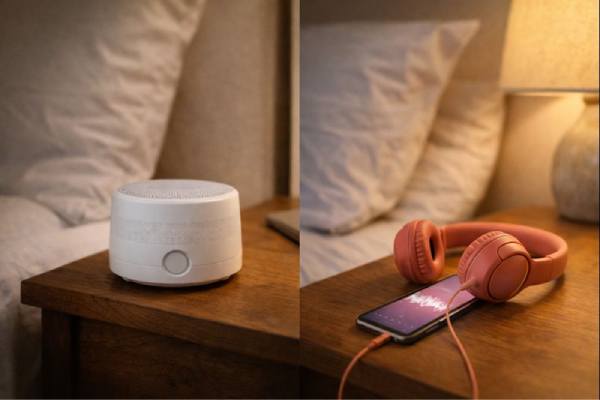
If you have ever tried a sound machine and thought, “Why does this help me settle down so quickly?” you are not imagining it. The right kind of steady background sound can make sleep feel easier and work feel smoother—mostly by reducing sudden noise disruptions and giving your brain a predictable sensory “floor.” But not all noise is the same. White noise has a brighter, hiss-like quality, while pink noise leans softer and deeper, closer to steady rainfall. Those differences matter for comfort, masking power, and how your nervous system responds over time.
This article explains what white and pink noise are, what research suggests about sleep and concentration, and how to use either one safely. You will also learn how to choose the best option for your environment, your sensitivity to sound, and your goals—sleep onset, staying asleep, or maintaining focus.
Quick Overview
- Both white noise and pink noise can improve sleep in noisy environments by masking sudden sounds and reducing micro-awakenings.
- Pink noise often feels gentler than white noise, which can make it easier to tolerate for long periods.
- Noise is not universally helpful: it may worsen sleep or focus for some people, especially at high volume or if the sound is irritating.
- Start with 30–60 minutes at a low, steady volume and adjust only until disruptive noises are less noticeable, not fully erased.
Table of Contents
- What makes white and pink noise different
- How noise supports sleep
- What the evidence says for sleep
- What the evidence says for focus
- How to use noise safely and effectively
- Troubleshooting and alternatives
What makes white and pink noise different
White noise and pink noise are both “broadband” sounds, meaning they contain many frequencies at once. The difference is how the energy is distributed across those frequencies—and that changes how they feel to your ears.
White noise: bright and evenly distributed
White noise contains all audible frequencies at equal intensity (in a technical sense, equal power per unit of frequency). To most people it resembles radio static, a steady hiss, or air rushing. Because it includes a lot of higher-frequency content, white noise can be excellent at masking sharp, high-pitched disruptions—like certain voices, squeaky doors, or clinking sounds.
That same brightness is also why some people find white noise fatiguing, especially if:
- The speaker has a harsh “hiss” or hissy distortion
- The volume is higher than necessary
- You are sensitive to higher frequencies or prone to headaches
Pink noise: softer and heavier in the low range
Pink noise also spans many frequencies, but it contains relatively more energy in lower frequencies (often described as equal power per octave). Many people experience it as smoother and less sharp, closer to steady rainfall, wind in trees, or a soft waterfall.
In practical terms, pink noise can feel easier to keep on for hours because it is less “sparkly” on the top end. The tradeoff is that it may be less effective than white noise at masking certain high-frequency sounds unless you raise the volume.
Comfort often matters more than the spectrum
If a sound is irritating, your brain will keep monitoring it. That defeats the point. The best noise color is usually the one you can tolerate effortlessly—because tolerance enables consistency, and consistency is what helps your nervous system settle.
A simple rule: if you notice the noise repeatedly, it is probably not the right tone or the right volume.
How noise supports sleep
Noise helps sleep less by “knocking you out” and more by shaping your sleep environment so your brain can stay asleep. Most benefits come from two mechanisms: masking and predictability.
Masking: reducing the impact of sudden sound changes
Your sleeping brain still reacts to novelty. Sudden changes—voices in the hallway, a car door slam, a neighbor’s music starting and stopping—can trigger brief arousals. You might not remember waking up, but these micro-arousals can fragment sleep and make you feel unrefreshed.
A steady background sound can reduce the contrast between silence and sudden noise. When the baseline is stable, your brain is less likely to treat a new sound as an alarm. This is why noise tends to be most helpful in:
- Apartments with unpredictable neighbor noise
- Urban areas with traffic bursts or sirens
- Homes with multiple sleepers on different schedules
- Light sleepers who wake easily after sleep onset
Predictability: calming the sensory system
Many people fall asleep faster when the sensory environment becomes repetitive and non-demanding. A consistent sound can act like a “do not disturb” signal for the brain: nothing new is happening here, so attention can stand down. Over time, that consistency can become a conditioned cue—similar to how a familiar bedtime routine tells your body it is time to shift gears.
Entrainment is a different category
Some products and studies use sound in a more active way: brief bursts (often pink noise) timed to specific phases of deep sleep rhythms, with the goal of strengthening slow-wave activity. That is not the same as running a continuous sound machine all night. It is a targeted intervention that may or may not translate to consumer apps, depending on timing accuracy and the person’s sleep stage.
For most people using a bedroom sound machine, the primary effect is still straightforward: fewer disruptions and a calmer baseline.
What the evidence says for sleep
When people ask whether white noise or pink noise “works,” it helps to clarify what outcome they mean. Sleep has multiple targets: falling asleep, staying asleep, and waking up feeling restored. Noise can influence each one differently.
White noise: best evidence in noisy settings, mixed results overall
Research on continuous white noise suggests the clearest benefit appears when the environment is already disruptive. In other words, noise does not create perfect sleep out of thin air—it reduces the damage from unpredictable sound. This aligns with real-world experience: a sound machine feels most effective when it is masking a problem you can actually name (traffic bursts, neighbor footsteps, hallway voices).
Across studies, results vary widely because “white noise” is not a single standardized exposure. Volume levels, speaker quality, distance from the bed, and the type of background disturbance all change the outcome. Some people also find continuous noise disruptive or annoying, which can cancel any masking benefit.
Pink noise: promising in specific contexts, not automatically better
Pink noise is often described as “more pleasant,” and comfort matters. But research also suggests an important nuance: timing and delivery matter. Targeted, carefully timed pink-noise stimulation is not the same as playing pink noise continuously.
A continuous overnight pink-noise track may help some sleepers by masking external noise, yet it can also alter sleep architecture in ways that may not support every cognitive outcome. If you notice vivid dreams, lighter sleep, or you wake feeling oddly unrested despite enough hours, the sound itself may be affecting your sleep depth or continuity.
Who is most likely to benefit
Noise tends to help sleep when your main issue is external disruption or a “hyper-alert” sensory system. You are a strong candidate if:
- You wake to small noises and struggle to fall back asleep
- Your environment has intermittent, unpredictable sounds
- You feel calmer with a steady sensory background
- You sleep well in hotels with consistent HVAC hum
If your insomnia is driven more by racing thoughts, irregular sleep schedules, late caffeine, or untreated sleep apnea, noise may be a helpful accessory—but not a primary solution.
What “better” often means in practice
For many people, the practical win is not a dramatic increase in total sleep time. It is fewer awakenings, less tossing and turning, and a smoother path back to sleep when you do wake. That can still be meaningful, especially over weeks.
What the evidence says for focus
Focus is not just willpower—it is a balance of arousal, distraction control, and task engagement. Noise can help concentration for some people, but it can also harm performance for others. The difference often comes down to baseline attention level and how easily your brain under- or over-stimulates.
Why noise can improve attention in some people
One leading explanation is “optimal arousal.” If your brain tends to drift or under-engage (common in ADHD traits, sleep deprivation, or monotonous tasks), a steady background sound can provide mild stimulation that helps stabilize attention. Some researchers also discuss “stochastic resonance,” the idea that a small amount of background noise can improve signal processing in certain systems—like giving your brain just enough texture to stay locked in.
In practical terms, noise may help with:
- Repetitive work (data entry, reading dense material, coding)
- Tasks with low novelty that trigger wandering
- Environments with intermittent speech, which is particularly distracting
Why it can backfire in others
If your baseline attention is already steady, additional noise can become a competing stimulus. Some people show slower reaction times or more errors with background noise, even if they subjectively “feel” more focused. This is especially true when the sound:
- Has noticeable fluctuations (pulsing, swooshing, periodic fades)
- Contains hiss or high-frequency harshness
- Is too loud, or played through poor speakers
- Is paired with tasks that demand verbal working memory
A key point: speech-like sounds (even muffled) tend to be more disruptive than non-speech noise. If you are using noise to focus, prioritize tracks without voices and without rhythmic elements that pull attention.
White noise vs pink noise for work sessions
- White noise can be more effective at masking intelligible speech because it covers a wide frequency range, including higher frequencies where consonants live.
- Pink noise often feels less tiring over long periods and may be easier to tolerate for a full morning of work.
If you are unsure, treat it like a short experiment:
- Choose one task type (reading, writing, problem-solving).
- Try 20–30 minutes with white noise at low volume.
- Repeat another day with pink noise at the same perceived loudness.
- Compare objective output: errors, rereads, time to completion, and mental fatigue.
Your performance data is more reliable than your first impression.
How to use noise safely and effectively
The biggest mistake with sound machines is volume creep. People raise the volume to “make sure it’s working,” and the sound becomes the new disturbance. Effective use is quieter and more intentional than most people expect.
Choose the lowest effective volume
A practical target for many adults is a steady sound in the range of about 40–50 dB near the bed (roughly comparable to a quiet room or soft rainfall), adjusted to your comfort and environment. You do not need to fully erase external noise; you want to reduce its sharpness and surprise.
Tips that prevent overdoing it:
- Place the speaker across the room, not right next to your head
- Use a track that is smooth and non-looping (loops can create subtle “jumps” your brain notices)
- If you are masking traffic peaks, try positioning the speaker between you and the noise source
Use timing strategically
If your main problem is falling asleep, you may not need the noise all night. Consider:
- A timer for 30–90 minutes, then off
- A “fade out” feature if abrupt silence wakes you
- All-night playback only when external disruption is truly unpredictable
For focus, you can treat noise like a work tool:
- Use it during deep work blocks
- Turn it off during breaks to reduce sensory fatigue
- Avoid pairing it with everything you do, so it stays effective when you need it
Special caution for earbuds and for children
Sleeping with earbuds or headphones increases risk because the sound is delivered directly to the ear canal and can be louder than you realize. If you need audio, a pillow speaker or a room speaker at low volume is generally safer than in-ear devices.
For infants and young children, be conservative:
- Keep the sound low and the device far from the sleep space
- Avoid maximum volume settings
- Consider using the sound only during sleep onset rather than continuously all night
Young ears are more vulnerable to cumulative exposure, and children cannot reliably tell you when something feels too loud.
When to avoid or rethink noise
Noise may not be a good fit if you have:
- Sound sensitivity that worsens with steady noise
- Frequent headaches triggered by high-frequency sound
- Tinnitus that becomes more noticeable after using sound
- A partner who finds the noise stressful
In these cases, pink noise at very low volume, a softer “colored” noise, or non-audio strategies may work better.
Troubleshooting and alternatives
If white noise and pink noise are not helping, it does not mean you are out of options. Often the fix is matching the tool to the real problem—or adjusting the sound so it stops competing for attention.
If the noise feels annoying or “too present”
Try these changes before giving up:
- Switch from white to pink noise (or vice versa)
- Lower the volume and move the speaker farther away
- Choose a higher-quality sound source (poor speakers add harshness)
- Use a track labeled “smooth” or “no loop” to reduce periodic artifacts
A common sign you have the wrong track: you notice the sound more at the moment you are trying to relax.
If speech still cuts through
Speech is hard to mask because the brain is tuned to it. Options:
- Try white noise at a slightly higher level than pink noise, but still comfortable
- Combine sound with physical barriers (door draft stopper, heavier curtains, soft furnishings that reduce echo)
- Move the sound source closer to the doorway or the noise source rather than closer to your head
The goal is to reduce intelligibility. If you cannot make out words, the brain tends to treat it as less meaningful.
Other “noise colors” and sound families
You may also see:
- Brown noise: deeper, heavier low frequencies; some people find it very soothing for focus, but it can feel rumbling if too loud.
- Green noise: often marketed as a mid-frequency emphasis; for some listeners it is gentler than white noise.
- Nature sounds: rain, wind, ocean, or fan sounds; these can feel more pleasant, but variability can become distracting if the track has obvious peaks and dips.
There is no universal winner. The best option is the one your nervous system treats as neutral.
When the real solution is not sound
If your sleep is consistently poor despite optimizing your environment, consider whether another driver is present:
- Irregular sleep timing and long naps
- Late caffeine or alcohol
- Chronic stress and nighttime rumination
- Restless legs symptoms or loud snoring with daytime sleepiness
In these cases, noise can be supportive, but addressing the underlying pattern is what changes your baseline.
References
- Noise as a sleep aid: A systematic review – PubMed 2021 (Systematic Review)
- Systematic review: auditory stimulation and sleep – PMC 2022 (Systematic Review)
- Overnight exposure to pink noise could jeopardize sleep-dependent insight and pattern detection – PMC 2023 (Experimental Study)
- Systematic Review and Meta-Analysis: Do White Noise and Pink Noise Help With Attention in Attention-Deficit/Hyperactivity Disorder? – PMC 2024 (Systematic Review and Meta-Analysis)
- Pink noise reduces impact of traffic noise on sleep and the blood metabolome: a cross-over pilot study – PubMed 2026 (Cross-Over Trial)
Disclaimer
This article is for informational purposes only and does not replace medical advice, diagnosis, or treatment. Sleep and attention problems can have many causes, including insomnia disorder, sleep apnea, medication effects, anxiety, depression, and other health conditions. If you have persistent sleep disruption for more than a few weeks, significant daytime sleepiness, loud snoring with breathing pauses, worsening mood, or safety concerns (for example, drowsy driving), seek guidance from a qualified healthcare professional. If you use sound for sleep or focus, keep volumes low and avoid prolonged high-volume exposure, especially for children.
If you found this article helpful, please share it on Facebook, X (formerly Twitter), or any platform you prefer.