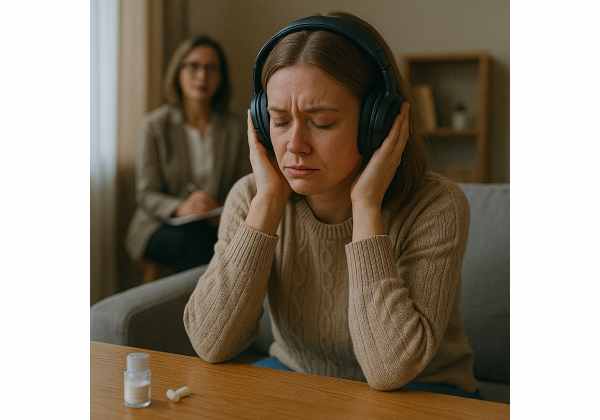
Everyday sound can feel harmless to one person and unbearable to another. For some people, certain noises feel painfully loud, emotionally triggering, threatening, distracting, or impossible to ignore even when others nearby are not bothered. This experience is often described casually as noise sensitivity disorder, but in clinical settings it may be discussed more precisely as decreased sound tolerance, hyperacusis, misophonia, phonophobia, sensory over-responsivity, or sound sensitivity related to another medical or mental health condition.
The exact meaning matters. A person who feels ear pain from normal-volume sounds may need a different evaluation from someone whose strongest reaction is anger, disgust, panic, or overload in response to specific sounds such as chewing, tapping, alarms, or background chatter. Noise sensitivity can also appear alongside migraine, tinnitus, anxiety, PTSD, autism, ADHD, concussion, hearing changes, and sleep disruption.
This article explains what the term can mean, how symptoms show up, what conditions are commonly confused with one another, and when professional evaluation becomes important.
What to know about sound sensitivity
- “Noise sensitivity disorder” is not one single diagnosis; it is an umbrella phrase for several types of reduced sound tolerance.
- Symptoms may include ear discomfort, pain, irritability, panic, disgust, anger, avoidance, trouble concentrating, or feeling overwhelmed in ordinary sound environments.
- Hyperacusis, misophonia, phonophobia, tinnitus-related distress, migraine sensitivity, and sensory overload can look similar but have different patterns.
- Sound sensitivity may involve the ear, auditory nervous system, emotional threat response, attention systems, or a combination of factors.
- Sudden, one-sided, painful, neurologic, or severely impairing symptoms should be evaluated by a qualified clinician.
Table of Contents
- What Noise Sensitivity Disorder Means
- Common Symptoms and Everyday Signs
- Hyperacusis, Misophonia, and Phonophobia
- Causes and Body-Brain Mechanisms
- Risk Factors and Associated Conditions
- Diagnostic Context and Clinical Evaluation
- Complications and Urgent Warning Signs
What Noise Sensitivity Disorder Means
Noise sensitivity disorder is best understood as a broad, non-specific phrase for sound that causes stronger distress, discomfort, pain, fear, anger, or overload than would usually be expected in that situation. It does not point to one single cause, and it is not the same thing as simply disliking loud places.
In clinical language, the broader category is often called decreased sound tolerance. This means the person’s nervous system, hearing system, emotional response system, or attention system has difficulty tolerating certain sounds. The sound may be objectively loud, like construction noise, but it may also be ordinary in volume, such as a keyboard, refrigerator hum, clock ticking, a person breathing, or dishes clinking.
The word “disorder” can be misleading because some forms of sound sensitivity are symptoms of another condition rather than stand-alone diagnoses. For example, sound sensitivity can happen during migraine attacks, after acoustic trauma, with tinnitus, after concussion, during periods of severe stress, or as part of sensory processing differences. In other cases, the main problem is persistent and specific enough that clinicians may consider terms such as hyperacusis or misophonia.
A useful first distinction is whether the problem is mainly about loudness, meaning, fear, or sensory overload:
- Loudness or pain: ordinary sounds feel too loud, sharp, physically uncomfortable, or painful.
- Specific triggers: certain sounds provoke intense anger, disgust, panic, or distress even when they are not loud.
- Anticipatory fear: the person fears sound because it may cause pain, worsen symptoms, or feel unsafe.
- Overload: complex environments with many sounds feel exhausting, disorganizing, or impossible to filter.
These patterns can overlap. A person may have both tinnitus and hyperacusis, or both misophonia and anxiety. Someone may avoid restaurants because of chewing sounds, loud music, crowd noise, and fear of being trapped in an overwhelming environment. That does not mean the symptoms are “imagined.” It means the clinical picture needs careful description rather than a one-word label.
Noise sensitivity also differs from normal preference. Many people dislike sirens, leaf blowers, alarms, or repetitive sounds. Sensitivity becomes clinically important when reactions are intense, persistent, hard to control, disproportionate to the setting, or disruptive to school, work, relationships, sleep, parenting, travel, or daily routines.
Because the term is broad, the most helpful question is not only “Do I have noise sensitivity disorder?” but “What kind of sound intolerance is this, what pattern does it follow, and what else might explain it?”
Common Symptoms and Everyday Signs
Noise sensitivity can show up as physical discomfort, emotional distress, avoidance, concentration problems, or a strong sense of threat or overload. The pattern of symptoms often gives important clues about whether the issue is closer to hyperacusis, misophonia, phonophobia, migraine-related sensitivity, tinnitus distress, or broader sensory over-responsivity.
Physical symptoms may include ear pain, pressure, burning, sharp discomfort, headaches, muscle tension, startle responses, nausea, dizziness, fatigue, or a feeling that sounds are “piercing.” Some people describe normal sounds as amplified or harsh. Others say that sound does not merely annoy them; it seems to hit the body before they have time to think.
Emotional symptoms may include irritability, disgust, anger, anxiety, panic, shame, helplessness, or dread before entering noisy places. In misophonia, the reaction is often tied to specific trigger sounds, especially repetitive human-generated sounds. Common examples include chewing, sniffing, throat clearing, breathing, pen clicking, tapping, typing, or repetitive movement sounds. Some people also react to visual cues associated with sound, such as seeing someone chew or bounce a leg.
Behavioral signs are often easier for others to notice than the internal experience. A person may leave rooms suddenly, wear ear protection often, avoid family meals, stop using public transportation, struggle in open-plan offices, request quiet classrooms, or appear irritable in environments that seem ordinary to others. Children may cover their ears, cry, hide, refuse certain places, or be described as “overreacting” when they are actually overwhelmed.
Noise sensitivity can also affect attention. Background sound may make it difficult to read, follow conversation, complete homework, or stay emotionally regulated. This can overlap with trouble concentrating, ADHD, anxiety, sleep loss, or brain fog, so the context matters.
Some signs suggest the sound reaction is becoming more impairing:
- avoiding necessary places such as school, work, medical appointments, or grocery stores
- escalating conflict with family members over ordinary sounds
- needing silence to function in more and more situations
- feeling trapped, panicky, or enraged when escape is not possible
- worsening sleep because of household or environmental sounds
- feeling embarrassed, guilty, or afraid of one’s own reactions
The severity can range from mild annoyance to disabling distress. Mild sensitivity may be manageable and situational. More severe cases can narrow a person’s life, create social isolation, and lead others to misinterpret the person as rude, controlling, dramatic, or intolerant. A careful description of the trigger, reaction, duration, and consequences is often more informative than the general label.
Hyperacusis, Misophonia, and Phonophobia
The most important distinction is whether sound feels too loud or painful, emotionally intolerable because of its specific pattern, or feared because of what it might do. Hyperacusis, misophonia, and phonophobia are related sound tolerance conditions, but they are not interchangeable.
| Term | Main sound pattern | Typical reaction | Common clue |
|---|---|---|---|
| Hyperacusis | Everyday sounds feel too loud, sharp, uncomfortable, or painful | Ear discomfort, pain, distress, avoidance | The volume level matters, even when the sound is not meaningful |
| Misophonia | Specific trigger sounds or related cues feel intolerable | Anger, disgust, anxiety, panic, physical arousal | The sound’s pattern or meaning matters more than loudness |
| Phonophobia | Sound is feared or anticipated as dangerous or harmful | Fear, dread, avoidance, hypervigilance | The fear of exposure may be as impairing as the sound itself |
| Noise sensitivity | Noisy environments feel overwhelming or intrusive | Annoyance, overload, stress, difficulty focusing | Busy soundscapes are the problem, not always one trigger |
Hyperacusis is usually described as reduced tolerance to ordinary environmental sounds. A person may find dishes, running water, traffic, alarms, children’s voices, or normal conversation painfully loud. It can occur with or without measurable hearing loss. It may also appear with tinnitus, migraine, head injury, acoustic trauma, facial nerve problems, or other ear and nervous system conditions.
Misophonia is different. The reaction is usually not based on loudness. A quiet chewing sound may feel unbearable while louder music feels fine. The trigger often has a human source, though not always. Many people with misophonia know their reaction is stronger than the situation seems to justify, but that insight does not make the reaction easy to stop. A fuller discussion of misophonia and sound triggers can help clarify why this condition is often misunderstood as simple irritation.
Phonophobia refers to fear of sound. In audiology, it may describe fear that sound will cause pain, worsen tinnitus, trigger dizziness, or lead to another feared outcome. In neurology, the word may also be used differently in migraine contexts, where sound sensitivity can be part of the migraine symptom pattern. This difference in terminology is one reason professional evaluation can be confusing unless the clinician defines exactly how they are using the term.
Broader sensory overload is another related experience. Some people are not reacting to one sound but to competing sounds, bright lights, movement, social demands, and cognitive load all at once. This is common in many people under stress and may be especially prominent in neurodevelopmental conditions. The experience can resemble sensory overload in adults, even when the person’s main complaint is noise.
These categories are useful, but real life is often mixed. A person may have hyperacusis after a noise injury, misophonia around eating sounds, and fear of social settings because past sound exposure led to distress. The goal is not to force symptoms into a neat box, but to describe the pattern accurately enough that the right type of professional assessment can happen.
Causes and Body-Brain Mechanisms
Noise sensitivity can arise from changes in hearing, sensory processing, threat detection, attention, pain perception, emotional learning, or neurologic function. In many people, more than one mechanism is involved.
One proposed mechanism in hyperacusis is increased central auditory gain. In simple terms, when the auditory system receives altered or reduced input, the brain may increase the “gain,” or internal amplification, of sound signals. This may help explain why some people experience ordinary sound as unusually intense even when standard hearing tests appear normal. It may also overlap with tinnitus, where the brain perceives sound without an external source.
Peripheral ear factors can contribute as well. Noise exposure, acoustic trauma, certain ear disorders, facial nerve problems affecting middle-ear reflexes, temporomandibular joint issues, and some vestibular conditions can be associated with sound intolerance. This is why ear pain, sudden changes, dizziness, one-sided symptoms, or hearing changes should not be assumed to be purely psychological.
Misophonia appears to involve a different pattern. The trigger sound is often tied to meaning, repetition, context, and emotional salience. The body may respond with sympathetic arousal: increased heart rate, muscle tension, heat, pressure, sweating, or an urge to escape or stop the sound. The response can feel immediate and automatic. Current research has not settled a single cause, and it is more accurate to describe misophonia as an emerging clinical field with evolving definitions and measures.
Learning and prediction may also play a role. If a sound repeatedly causes distress, the nervous system may begin scanning for it. The person may notice tiny cues earlier, react faster, and feel trapped more easily. This does not mean the reaction is chosen. It means the brain may have become highly efficient at detecting a sound it has tagged as threatening, disgusting, painful, or intolerable.
Stress can intensify sound sensitivity. When someone is sleep-deprived, burned out, anxious, grieving, overstimulated, or recovering from illness or injury, the threshold for sensory tolerance can drop. This is one reason sound sensitivity may fluctuate. A restaurant that is tolerable one month may feel impossible during a period of migraine, panic attacks, insomnia, or trauma-related hyperarousal.
Noise sensitivity can also occur as part of broader nervous system dysregulation. In PTSD, the person may be more reactive to sudden or unpredictable sounds because the body is primed for danger. In anxiety disorders, the person may monitor physical sensations and environmental cues more closely. In depression or burnout, ordinary sensory input may feel draining or abrasive. In autism and ADHD, sound sensitivity may reflect differences in sensory filtering, attention, and overload rather than fear or ear disease alone.
No single explanation fits everyone. A useful clinical picture usually includes the type of sound, the volume, the emotional reaction, physical sensations, onset, triggers, associated symptoms, and what happens afterward.
Risk Factors and Associated Conditions
Noise sensitivity is more likely when the auditory system, nervous system, or emotional stress system is already under strain. Some risk factors relate to the ear, while others relate to neurologic, developmental, psychiatric, or environmental vulnerability.
Ear and hearing-related risk factors include tinnitus, noise-induced hearing changes, acoustic shock, certain inner-ear disorders, ear surgery, and prolonged exposure to loud occupational or recreational sound. Musicians, military personnel, industrial workers, frequent concertgoers, and people exposed to sudden blasts or alarms may be at higher risk of sound tolerance problems, depending on the exposure and individual susceptibility.
Neurologic and medical associations can include migraine, concussion, traumatic brain injury, facial nerve conditions, vestibular disorders, Lyme disease, temporomandibular joint problems, and some endocrine or systemic conditions. Migraine is especially important because sound sensitivity can be part of the migraine pattern even when headache is not the only symptom. Concussion-related sound sensitivity may also occur with headaches, dizziness, visual sensitivity, fatigue, and cognitive symptoms.
Mental health and neurodevelopmental conditions can shape how sound is perceived and tolerated. Anxiety, panic disorder, PTSD, obsessive-compulsive symptoms, depression, and chronic stress may increase vigilance, irritability, avoidance, or distress around sound. Trauma-related symptoms can include heightened startle, scanning for danger, and strong reactions to sudden noises; these can overlap with broader PTSD symptoms.
Autism and ADHD are also relevant. Many autistic people experience sensory differences, including strong reactions to sound, texture, light, smell, or movement. ADHD can involve difficulty filtering background noise, shifting attention away from distractions, or regulating frustration in busy environments. When social expectations mask these struggles, symptoms may be missed until adulthood; this is one reason subtle adult autism signs and sensory history can matter during assessment.
Children may show noise sensitivity differently from adults. They may cover their ears, melt down in loud places, refuse school assemblies, avoid bathrooms with hand dryers, or become distressed during meals. Adults may internalize distress, leave situations early, work from home whenever possible, or become increasingly rigid about sound control.
Risk also rises when daily life offers little recovery time. Open-plan offices, crowded classrooms, shared housing, caregiving demands, traffic noise, poor sleep, and constant digital alerts can all reduce tolerance. These factors may not “cause” a disorder on their own, but they can amplify symptoms in someone who is already vulnerable.
It is also important to avoid over-attributing sound sensitivity to personality. People with significant symptoms are not simply fussy or intolerant. Their reactions may involve measurable distress, physical discomfort, and functional impairment, even when the trigger seems minor from the outside.
Diagnostic Context and Clinical Evaluation
Noise sensitivity is evaluated by clarifying the pattern, ruling out important medical causes, and identifying whether the symptoms fit hyperacusis, misophonia, phonophobia, migraine-related sensitivity, tinnitus distress, sensory overload, or another condition. There is no single blood test, scan, or questionnaire that can fully explain every case.
A clinician may begin with a detailed history. Important questions include when symptoms started, whether onset was sudden or gradual, which sounds trigger symptoms, whether volume matters, whether the reaction is pain, fear, anger, disgust, panic, or overload, and whether there are hearing changes, tinnitus, dizziness, headaches, neurologic symptoms, sleep problems, trauma symptoms, or medication changes.
Audiology evaluation may include hearing tests and measures of loudness discomfort, though these tests must be handled carefully because some people with severe sensitivity may find sound testing distressing. Ear examination and hearing assessment are especially relevant when symptoms involve pain, pressure, tinnitus, one-sided changes, dizziness, or a history of noise injury.
Mental health evaluation may be appropriate when sound sensitivity is linked with panic, intrusive thoughts, trauma symptoms, depression, anger outbursts, compulsive avoidance, social withdrawal, or major impairment. This does not mean the sound sensitivity is “only psychological.” It means emotional and functional effects are part of the clinical picture. General mental health assessment may overlap with what happens during a mental health evaluation, especially when symptoms affect work, school, safety, or relationships.
Misophonia assessment is still evolving. The field has a consensus definition, but diagnostic criteria and measurement tools are not as established as they are for many DSM-defined psychiatric disorders. Some clinicians use structured interviews or questionnaires to describe severity, triggers, avoidance, distress, and impairment. Results are best interpreted as part of a full clinical picture rather than as a stand-alone diagnosis.
The differential diagnosis is broad. Conditions that may need consideration include:
- hearing loss with loudness recruitment
- tinnitus with sound-related distress
- migraine or vestibular migraine
- concussion or head injury
- temporomandibular joint disorder
- anxiety, panic disorder, OCD, PTSD, or depression
- autism, ADHD, or learning-related sensory differences
- sleep deprivation or chronic stress
- medication or substance-related changes
- rare neurologic, infectious, or inflammatory conditions
Some people benefit from seeing more than one type of professional. Depending on the symptoms, evaluation may involve a primary care clinician, audiologist, ear-nose-throat specialist, neurologist, psychiatrist, psychologist, or developmental specialist. The key is matching the referral to the pattern: ear pain and hearing changes call for a different starting point than trauma-related startle or highly specific misophonic triggers.
Professional evaluation is particularly important when symptoms are new, worsening, one-sided, painful, associated with neurologic symptoms, or causing major avoidance. It is also important when a child’s sound sensitivity affects eating, schooling, social development, or family functioning.
Complications and Urgent Warning Signs
The main complications of noise sensitivity come from distress, avoidance, relationship strain, reduced participation, and missed underlying causes. Even when the sound itself is not dangerous, the effect on daily life can become serious.
Avoidance may begin as a practical response. A person leaves a noisy café, wears ear protection, or avoids a family meal. Over time, the circle of tolerable situations may shrink. The person may stop traveling, avoid friends, struggle in school, miss work opportunities, or feel unable to share space with loved ones. Avoidance can also increase anticipatory fear because the person has fewer experiences of tolerating ordinary sound environments.
Relationships may be affected when others do not understand the reaction. Family members may feel criticized for eating, breathing, moving, typing, or making normal household noise. The sensitive person may feel guilty, embarrassed, or trapped. In misophonia, anger or disgust can be especially distressing because the trigger may come from someone the person loves. The emotional reaction does not necessarily reflect the person’s values or intentions.
School and work complications are common. Open-plan offices, cafeterias, classrooms, public transit, alarms, and shared spaces can become difficult. A person may appear distracted, irritable, oppositional, or withdrawn when the underlying issue is sound intolerance. Children may be mislabeled as defiant; adults may be seen as demanding or antisocial.
Noise sensitivity can also worsen sleep and mental health. Nighttime sounds may lead to hypervigilance. Daytime overload may contribute to fatigue, irritability, headaches, or shutdown. People with severe symptoms may develop anxiety about leaving home or become demoralized by how hard ordinary life feels.
Urgent or prompt professional evaluation is important when sound sensitivity appears with warning signs such as:
- sudden hearing loss, especially in one ear
- new severe ear pain, drainage, fever, or injury
- dizziness, fainting, weakness, facial drooping, confusion, or new neurologic symptoms
- sound sensitivity after head injury, blast exposure, or acoustic trauma
- severe headache, visual changes, or migraine symptoms that are new or unusual
- hallucinations, paranoia, mania, severe agitation, or loss of contact with reality
- thoughts of self-harm, suicide, or fear of harming someone else
- a child refusing food, school, sleep, or essential daily activities because of sound
These signs do not all point to the same cause. Some suggest ear or neurologic problems; others suggest urgent mental health risk. What they share is that they should not be dismissed as ordinary sensitivity.
Noise sensitivity can be isolating because the trigger may seem small to everyone else. A careful evaluation can identify whether the symptoms are primarily auditory, neurologic, sensory, psychiatric, or mixed. That distinction matters because it helps prevent both underreaction and overreaction: symptoms should not be minimized, but they also should not be forced into a single label before the pattern is understood.
References
- Consensus Definition of Misophonia: A Delphi Study 2022 (Delphi Consensus)
- Sound Tolerance Conditions (Hyperacusis, Misophonia, Noise Sensitivity, and Phonophobia): Definitions and Clinical Management 2022 (Review)
- Hyperacusis 2025 (Clinical Reference)
- Perceptual Disturbances and Disorders in the ICD-11: An Overview and a Proposal for Systematic Classification 2025 (Review)
- Clinical characteristics, impairment, and psychiatric morbidity in 102 youth with misophonia 2023 (Observational Study)
- Understanding the misophonic experience: a mixed method study 2025 (Mixed Methods Study)
Disclaimer
This content is for general educational purposes only and is not a substitute for professional medical advice, diagnosis, or treatment. Noise sensitivity can have ear, neurologic, developmental, and mental health causes, so persistent, sudden, painful, one-sided, or severely impairing symptoms should be discussed with a qualified healthcare professional.
Thank you for taking the time to read this; sharing it may help someone else better understand distressing sound sensitivity with less shame and confusion.