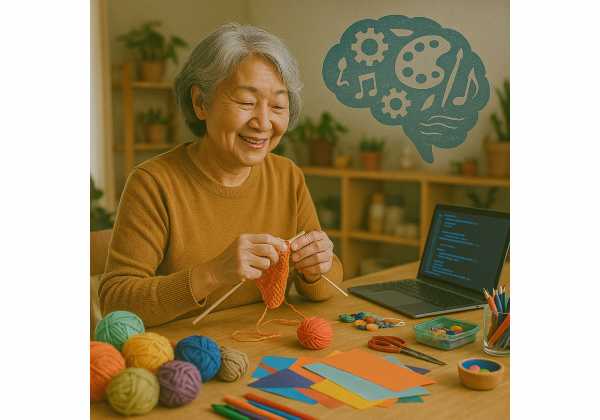
Complex hobbies give the aging brain something ordinary puzzles rarely provide: a living challenge with memory, attention, planning, problem-solving, sensory feedback, and steady progress. A person learning woodworking, quilting, coding, ceramics, chess, photography, music production, gardening design, or a new language must connect ideas, correct errors, use the hands, make choices, and adapt. That combination builds richer mental practice than repeating one familiar task.
Brain longevity is not served by “keeping busy” alone. The strongest activities stretch skill without causing chronic frustration. They ask for enough effort to wake up attention, enough repetition to build fluency, and enough variety to keep the brain from coasting. A useful hobby also fits real life: budget, space, energy, vision, hearing, joints, social support, and time. The best choice is the one a person returns to often enough to improve.
Table of Contents
- Why Complex Hobbies Support Brain Longevity
- What Makes a Hobby Brain-Building
- Craft, Code, and Create: Which Path Fits You
- How to Build a Skill Without Burning Out
- Add Social, Movement, and Sensory Challenge
- Common Mistakes That Weaken the Benefit
- Tracking Progress for Memory and Confidence
- When Memory or Mood Needs Extra Attention
Why Complex Hobbies Support Brain Longevity
Complex hobbies support brain longevity because they train several mental systems at the same time. A beginner learning to sew a jacket reads instructions, measures fabric, pictures shapes in space, remembers steps, uses fine motor control, notices mistakes, and adjusts. A beginner learning Python does something similar with logic, syntax, working memory, testing, and debugging. The materials differ, but the brain work overlaps.
This matters because healthy cognitive aging is not one skill. Memory, attention, processing speed, planning, language, emotional control, and spatial judgment change at different rates. A good hobby creates repeated practice across several of these systems instead of drilling one narrow ability. That broad practice is one reason mentally stimulating leisure activities are often discussed alongside cognitive reserve, the brain’s ability to keep functioning despite age-related change or disease burden.
Skill building also creates feedback. The scarf gets straighter. The photo composition improves. The code runs without an error message. Feedback turns abstract effort into visible progress, which strengthens motivation and helps people continue long enough to benefit.
The brain responds best to challenge that is specific, repeated, and adjustable. Too easy, and attention fades. Too hard, and the person quits. A useful hobby sits in the middle: hard enough to require full attention, but clear enough that the next step is visible. That “stretch zone” is where learning feels effortful, interesting, and possible.
Complex hobbies also protect daily identity. Retirement, caregiving, illness, and loss often shrink a person’s world. A skill gives the week a structure: a class on Tuesday, a project on the table, a notebook of ideas, a small problem to solve tomorrow. This sense of agency matters. People stick with brain-healthy habits more easily when the activity feels meaningful instead of medicinal.
Skill learning also pairs well with neuroplasticity in midlife and later life. Neuroplasticity means the nervous system changes through practice, attention, feedback, and repetition. It does not mean the brain stays young in every way. It means learning remains possible, and the quality of practice shapes the result.
What Makes a Hobby Brain-Building
A brain-building hobby has four traits: novelty, complexity, progression, and personal meaning. Novelty wakes up attention. Complexity recruits several mental and physical systems. Progression keeps the task from becoming automatic. Meaning keeps the person returning after the first burst of excitement fades.
A crossword done every morning has value, especially for language and retrieval. But if the person has used the same puzzle style for 20 years, the challenge becomes familiar. A richer version might include learning cryptic crosswords, joining a puzzle group, studying word roots, or creating puzzles for others. The upgrade matters because the brain adapts to routine.
Novelty should be real, not overwhelming
New learning works best when the first step is small enough to start today. “Learn coding” is too broad. “Make a simple calculator in Python” gives the brain a defined target. “Learn painting” is vague. “Paint 10 small studies of the same apple under different light” creates a clear practice loop.
Useful novelty includes:
- A new tool, such as a camera, loom, bread lame, soldering iron, music app, or coding editor.
- A new rule system, such as chess openings, pattern drafting, color theory, or programming logic.
- A new sensory challenge, such as hearing pitch, feeling clay texture, seeing shadow shapes, or judging wood grain.
- A new output, such as a finished object, a recipe, a short animation, a repaired chair, or a family photo archive.
The first project should be small. A 30-minute practice session teaches more than a fantasy plan that never begins.
Complexity should combine thinking and doing
The richest hobbies link the head, hands, eyes, ears, and body. That combination asks the brain to coordinate many signals at once. It also makes learning easier to remember, because the skill becomes connected to movement, emotion, and sensory cues.
A strong hobby includes at least three of these demands:
- Planning: choosing materials, steps, timing, or sequence.
- Memory: remembering patterns, commands, recipes, chords, or rules.
- Attention: noticing detail and catching errors early.
- Problem-solving: correcting mistakes and trying alternatives.
- Motor skill: using hands, posture, breath, rhythm, or balance.
- Social exchange: getting feedback, teaching, collaborating, or performing.
- Creativity: making choices instead of following every instruction passively.
A hobby does not need to be impressive to be effective. Knitting socks, writing family stories, restoring bicycles, building a simple website, and learning bird identification all create real cognitive work when practiced with progression.
Progression keeps the brain from coasting
Progression means the hobby changes as skill improves. Without progression, the person repeats what already feels easy. Repetition builds comfort, but growth needs a new edge.
Progression looks like this:
- Learn the basic move.
- Practice until it becomes smoother.
- Add one harder variable.
- Get feedback.
- Repeat with a new project.
A person learning photography might start with focus and exposure, then add composition, then low-light shooting, then editing, then a themed series. A person learning coding might start with variables, then loops, then functions, then a small app, then version control. Each layer builds on the last.
Craft, Code, and Create: Which Path Fits You
The best hobby is not the most fashionable one. The best hobby matches a person’s curiosity, constraints, and tolerance for frustration. Craft, code, and creative arts each train the brain in a different style. Many people benefit from mixing two paths: one tactile and one symbolic, or one solitary and one social.
| Path | Examples | Main brain demands | Good starter project |
|---|---|---|---|
| Craft | Woodworking, quilting, knitting, ceramics, jewelry, repair | Spatial judgment, sequencing, hand control, error correction | One small object with a clear pattern or template |
| Code | Python, website building, spreadsheets, app tools, robotics | Logic, working memory, planning, debugging, abstraction | A calculator, habit tracker, recipe sorter, or personal website |
| Create | Painting, photography, writing, music, theater, design | Attention, emotion, memory, language, pattern recognition | A 30-day small-project series with one theme |
| Strategy | Chess, bridge, go, model building, genealogy research | Planning, prediction, rule learning, mental flexibility | One beginner course plus weekly practice games or sessions |
| Nature-based | Gardening design, birding, mushroom study, map navigation | Observation, classification, memory, movement, patience | A seasonal garden map or local species journal |
Craft hobbies are especially useful for people who enjoy tangible progress. The object itself records learning. A crooked seam or uneven glaze becomes feedback without judgment. Craft also trains patience, because materials do not always obey. Wood splits. Clay dries too fast. Yarn tension changes. These small problems teach flexible thinking.
Coding offers a different kind of brain training. It forces clear instructions. A program does exactly what the person wrote, not what the person meant. That gap between intention and outcome trains attention, logic, and frustration tolerance. Coding also gives older adults a practical route into digital confidence: automating a spreadsheet, creating a photo archive, or building a simple page for a club.
Creative arts train interpretation. Painting asks the eye to see color and shadow more accurately. Writing asks memory and language to organize experience. Music joins rhythm, attention, hearing, timing, and emotion; it also fits naturally with music and the aging brain. Creative work gives the brain permission to compare, revise, and refine instead of chasing one correct answer.
Strategy hobbies sharpen prediction and flexible planning. Chess, bridge, and go require a person to hold rules in mind, imagine future moves, and learn from loss. They also create social contact when practiced in clubs or online groups. The strongest benefit comes when players review games, study patterns, and face slightly stronger opponents.
Nature-based hobbies bring cognitive work outdoors. Birding trains auditory discrimination, visual search, naming, memory, and map awareness. Gardening design teaches planning, seasonal timing, physical work, and observation. These hobbies also create a gentle reason to move, which supports brain health through circulation, sleep, mood, and metabolic fitness.
How to Build a Skill Without Burning Out
Brain-building hobbies work best as a practice rhythm, not a burst of enthusiasm followed by guilt. A reliable rhythm beats a heroic weekend. Most adults make stronger progress with 20 to 45 minutes, 3 to 5 days per week, than with one long session that causes fatigue.
Start with a project small enough to finish within two weeks. Completion teaches the brain that effort leads somewhere. A finished coaster, short poem, beginner script, repaired lamp, or 12-photo series builds confidence. After that, the next project should be slightly harder.
Use the 70 percent rule
A good practice task should feel roughly 70 percent manageable and 30 percent challenging. If everything feels easy, add a constraint: smaller stitches, fewer reference notes, a new chord, a timer, a different material, or a harder data set. If everything feels confusing, reduce the task: use a simpler pattern, watch one lesson again, copy a model, or ask for feedback.
Frustration is not failure; it is often the signal that learning is happening. Chronic frustration is different. When a session ends with dread several times in a row, the task is too hard, too long, or too poorly supported.
Practice in loops
A learning loop is simple:
- Choose one target skill.
- Practice it in a short session.
- Notice one mistake.
- Correct it.
- Record the lesson.
- Repeat the next day.
This loop keeps improvement visible. It also reduces scattered effort. A person learning guitar should not try to improve rhythm, finger strength, reading, theory, and performance in one session. A better target is “switch between G and C smoothly for 10 minutes” or “clap this rhythm before playing it.”
The same approach works for coding. Instead of trying to “learn Python,” the target becomes “write a loop that renames 20 photo files” or “fix one error message and write down what caused it.”
Use retrieval, not just review
Review feels comfortable. Retrieval builds memory. Retrieval means trying to bring information back without looking first. A painter tries to name the color mix before checking notes. A coder writes a function from memory before looking at the tutorial. A knitter recalls the pattern repeat before checking the chart.
Retrieval should be low-pressure. The point is not to prove competence. The point is to strengthen the path back to the information. Mistakes are useful because they show what needs more practice.
Schedule rest before the brain rebels
Learning uses energy. Older adults often learn better when sessions end before exhaustion. Stop while attention is still present. A good stopping point is after one clean repetition, one solved problem, or one written note about the next step.
Sleep also consolidates learning. A hobby practiced in short sessions across several days gives the brain repeated chances to strengthen the skill. Pairing skill learning with good sleep habits supports the same memory systems discussed in sleep and brain aging.
Add Social, Movement, and Sensory Challenge
A hobby becomes more powerful when it includes other people, physical movement, and sensory precision. These layers increase the number of brain systems involved and make the practice easier to sustain.
Social learning gives immediate feedback. A class, club, online group, choir, maker space, community garden, writing circle, or bridge group adds accountability and shared language. It also reduces the isolation that often creeps into later life. The social part does not need to be large. One weekly session with another learner changes the emotional tone of practice.
Teaching is especially useful. Explaining a stitch, recipe, chord, or coding concept forces the learner to organize knowledge. Teaching also reveals gaps quickly. A person who teaches a grandchild to use a camera or helps a friend fix a spreadsheet gets cognitive practice through communication, sequencing, and problem-solving.
Movement adds another layer. Many hobbies already involve posture, grip, walking, standing, bending, reaching, or rhythm. Gardening, dance, photography walks, woodworking, pottery, theater, birding, and music all include physical demands. When a hobby combines movement and thinking, it resembles the idea behind dual-tasking for brain longevity: the brain coordinates action while handling information.
The movement does not have to be intense. A 20-minute photo walk with a theme, such as “shadows” or “red objects,” trains visual attention and physical navigation. A community dance class trains rhythm, balance, memory, and social cue reading. A gardening project trains planning, seasonal memory, grip, squatting, carrying, and observation.
Sensory challenge matters too. Aging often changes hearing, vision, touch, and balance. A skill that asks for fine sensory attention keeps those systems engaged, but the environment must be safe and accessible. Good lighting, contrast, magnification, sharp tools, stable seating, and clear audio make practice more productive.
For visually demanding hobbies, strong lighting and contrast reduce strain. This is especially relevant for sewing, carving, electronics, reading music, painting, and model building. People noticing more visual difficulty during detailed work should review vision, contrast, and brain aging and consider an eye exam.
For sound-based hobbies, untreated hearing difficulty turns learning into fatigue. Music, language groups, theater, and social games all rely on hearing detail. Addressing hearing loss supports communication and reduces cognitive load; early hearing testing and hearing aids matter when conversation or instruction becomes harder to follow.
Common Mistakes That Weaken the Benefit
The main mistake is choosing a hobby that looks “good for the brain” but feels dead to the person doing it. Motivation is not decoration. It is the engine. A person who hates chess will not gain much from forcing chess. A person who loves cooking, maps, fabrics, or tools should build from that interest.
Another mistake is staying too comfortable. Repeating the same familiar pattern gives pleasure and calm, which has value, but the brain-building effect weakens when there is no learning edge. Add one new element every week or two: a new recipe technique, a harder song, a new software feature, a new joinery method, a different writing form, or a more complex plant plan.
A third mistake is taking on projects that are too large. Oversized projects create clutter, shame, and avoidance. A half-built workshop, unused subscription, expensive camera, or untouched online course becomes a reminder of failure. Start small enough that finishing is likely.
Common traps include:
- Buying too much equipment before building the habit.
- Watching tutorials without practicing.
- Practicing only when motivation feels high.
- Comparing beginner work with expert work online.
- Skipping feedback because mistakes feel embarrassing.
- Turning every hobby into a productivity task.
- Ignoring pain, eyestrain, poor sleep, or frustration.
Tutorial overload deserves special attention. Watching a lesson feels like learning, but skill grows when the person retrieves, tries, fails, and corrects. For every 10 minutes of instruction, aim for at least 20 minutes of hands-on practice.
Perfectionism also weakens learning. Early work should look imperfect. That is not a flaw; it is evidence that the task is new. A useful phrase is “make the next version better.” This keeps attention on progression instead of judgment.
Pain is another warning sign. Hand arthritis, back pain, neck strain, dizziness, or headaches should change the setup. Raise the work surface, use larger grips, take shorter sessions, improve lighting, sit with support, or switch tools. A hobby should challenge the brain, not punish the body.
Screen-heavy hobbies need boundaries. Coding, photo editing, digital art, genealogy research, and online chess all provide rich cognitive work, but long sessions without movement strain the eyes and body. Use a timer, stand between sessions, look across the room often, and stop before mental fatigue turns practice into scrolling.
Tracking Progress for Memory and Confidence
Tracking turns vague effort into visible evidence. It also supports memory. A simple log helps the learner remember what was practiced, what went wrong, and what to try next. This reduces the discouraging feeling of “starting over” every session.
A good hobby log has four lines:
- Date and time spent.
- Skill practiced.
- One thing learned.
- Next tiny step.
For example: “Tuesday, 25 minutes. Practiced buttonholes. Learned fabric needs stabilizer. Next: test two stabilizers on scrap.” Or: “Thursday, 30 minutes. Made a Python list. Learned brackets differ from parentheses. Next: sort names alphabetically.”
This kind of log trains reflection. It also gives a clinician, coach, or family member useful context if memory concerns arise. Missed sessions are not a problem; the log simply restarts.
Photos and recordings work well for creative hobbies. Take a picture of each pottery piece, sketch, meal, garden bed, repair, or woodworking joint. Record the first and fourth week of a song. Save early code files. Progress becomes easier to see when the evidence is concrete.
A monthly review keeps the hobby in the stretch zone. Ask:
- What became easier this month?
- What still causes mistakes?
- Which project felt most engaging?
- Which part felt too frustrating?
- What is the next small challenge?
This review also protects against boredom. If the hobby has become routine, add variety. If it has become stressful, simplify the next project.
Tracking should not turn the hobby into a medical test. The point is confidence and direction. A person does not need perfect streaks, scores, or wearable data to benefit. Consistency matters more than measurement.
Still, changes in thinking deserve attention. Occasional forgetfulness, slow starts, and mistakes during learning are normal, especially when tired or distracted. More concerning patterns include getting lost in familiar places, repeated difficulty managing finances or medications, major personality changes, frequent confusion with familiar tools, or trouble following ordinary conversations. These signs deserve a professional assessment.
When Memory or Mood Needs Extra Attention
Complex hobbies support brain health, but they do not replace medical care. Memory and attention are sensitive to sleep, medications, alcohol, thyroid problems, B12 status, depression, anxiety, hearing loss, vision changes, pain, infections, and blood pressure. A hobby that suddenly feels impossible might reveal a health issue rather than a lack of discipline.
A clinician should review new or worsening cognitive symptoms, especially when changes affect daily tasks. Medication review is important because some drugs increase sedation or anticholinergic burden. Mood review matters too. Depression and anxiety often reduce concentration, confidence, and motivation, and treatment helps many people think more clearly. The connection between mood and cognition is covered in more depth in depression, anxiety, and cognitive aging.
A helpful approach is to separate normal beginner mistakes from functional change. Forgetting a new knitting pattern is normal. Forgetting how to use the stove safely is not. Struggling with a coding tutorial is normal. Losing the ability to manage familiar bills is more serious. Mixing up paint colors is normal. Getting repeatedly confused in a familiar art class deserves attention.
People already diagnosed with mild cognitive impairment or early dementia still benefit from meaningful activity, but the structure should change. The activity should be familiar enough to reduce distress and supported enough to prevent unsafe errors. Good options include music, supervised cooking, guided gardening, simple woodworking with safety controls, memory books, folding and sorting tasks, art prompts, walking photography, or crafts with clear steps.
Support improves success:
- Use written steps with large print.
- Keep tools in the same place.
- Reduce background noise.
- Work at the best time of day for energy.
- Choose short sessions.
- Use safe tools and stable surfaces.
- Pair the activity with a patient partner.
- Celebrate completion, not perfection.
Hobbies also help families connect. A shared project gives people something to do together besides monitoring symptoms. Looking through old photos, planting herbs, repairing a chair, singing familiar songs, or building a simple family recipe book creates conversation and dignity.
The broad foundation still matters. Skill building works best alongside movement, sleep, blood pressure control, glucose control, hearing and vision care, social connection, and a diet pattern that supports vascular health. For readers sorting the bigger picture, cognitive aging and dementia risk provides a useful starting point.
The practical formula is simple: choose a skill that matters, make the first step small, practice often, add challenge gradually, include people when possible, and protect the body that carries the brain. Craft, code, create, repair, play, grow, write, build, and learn. A brain that keeps meeting meaningful problems has more reasons to stay engaged.
References
- Dementia prevention, intervention, and care: 2024 report of the Lancet standing Commission 2024 (Commission)
- Cognitive reserve over the life course and risk of dementia: a systematic review and meta-analysis 2024 (Systematic Review)
- Modifiable lifestyle factors and cognitive reserve: a systematic review of current evidence 2022 (Systematic Review)
- Lifestyle Enrichment in Later Life and Its Association With Dementia Risk 2023 (Cohort Study)
- The role of cognitive and social leisure activities in dementia risk: assessing longitudinal associations of modifiable and non-modifiable risk factors 2022 (Cohort Study)
Disclaimer
This article is educational and does not replace care from a qualified health professional. New or worsening memory, attention, mood, balance, vision, hearing, or safety concerns should be discussed with a clinician, especially when they interfere with daily life. People with medical conditions, pain, frailty, or cognitive impairment should adapt hobbies for safety and support.