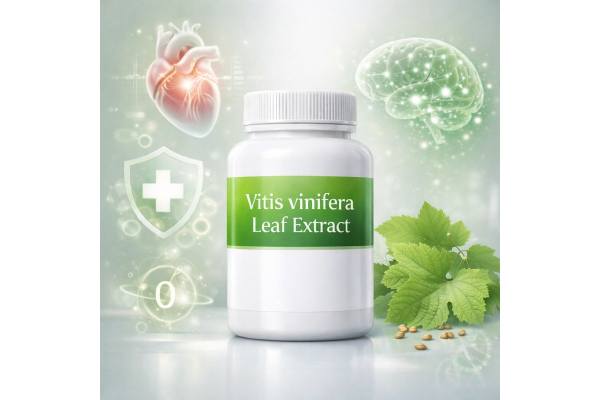
Vitis vinifera leaf extract, often called red vine leaf extract, comes from grapevine leaves that are naturally rich in polyphenols. It is best known for supporting circulation in the legs—especially when long days, heat, travel, or standing leave you with heavy, tired legs and mild swelling around the ankles. Unlike many “beauty” botanicals, this ingredient has a practical, symptom-focused reputation: it is usually taken to reduce discomfort, improve the feeling of lightness in the legs, and help manage the day-to-day nuisance of chronic venous insufficiency (CVI).
This guide explains what the extract is, what it is most commonly used for, how it may work in the body, how to take it in a realistic routine, and how to choose a product that matches the evidence. You will also find clear dosage ranges (in mg), timing expectations, and safety guidance so you can make informed, cautious decisions.
Essential Insights
- May reduce lower-leg swelling and improve heavy-leg discomfort in mild chronic venous insufficiency.
- Works best when paired with basics like walking, leg elevation, and compression when recommended.
- Typical studied intake is 360–720 mg daily of a standardized dry extract for 6–12 weeks.
- Side effects are usually mild, but stop use if rash, hives, or persistent stomach upset occurs.
- Avoid during pregnancy and breastfeeding, and use extra caution with blood thinners or bleeding disorders.
Table of Contents
- What is Vitis vinifera leaf extract?
- Does it help heavy legs and swelling?
- Benefits and best-fit uses
- How to take it in a real routine
- How much to take per day?
- Side effects, interactions, and who should avoid
- What the research says and what it does not
What is Vitis vinifera leaf extract?
Vitis vinifera is the common grapevine. When a supplement label says “Vitis vinifera leaf extract,” it refers to an extract made from grape leaves—not the fruit, and not the seeds. That difference matters because grape seed extract and grape leaf extract are used and studied for different reasons, and their polyphenol profiles do not match.
Most products marketed for leg comfort use red vine leaves (often described as “red vine leaf” or “folia vitis viniferae”). These leaves contain a mix of plant compounds called polyphenols. In standardized preparations, key compounds often include flavonoids such as quercetin derivatives (for example, quercetin glucuronides) and other phenolics that are associated with antioxidant and microcirculatory effects. In practical terms, the supplement is positioned less as a “general wellness” product and more as a targeted, symptom-oriented option for people who feel heaviness, tightness, or mild swelling in the lower legs.
You will also see different forms:
- Dry extract capsules or tablets: the most common format in clinical studies of red vine leaf extract for leg symptoms.
- Liquid extracts or tinctures: more variable in strength and harder to compare to the studied doses.
- Topical products: sometimes sold for leg comfort, but oral dosing is the best-described approach for CVI-style symptoms.
A useful way to think about this ingredient is as a “microcirculation support” botanical. It is typically used to support capillary function and fluid balance in the lower legs, especially when venous return is sluggish. Still, it is not a replacement for medical evaluation when swelling is new, one-sided, painful, or rapidly worsening.
Does it help heavy legs and swelling?
The most established use for Vitis vinifera leaf extract is symptom support in mild to moderate chronic venous insufficiency—often felt as heavy legs, ankle puffiness, tight calves, or aching that worsens after standing or sitting for long stretches. This is a common pattern: symptoms feel better in the morning, worsen by evening, and improve with leg elevation or movement.
In clinical trials of a well-known standardized red vine leaf extract (often identified by the extract code used in research), participants taking the extract showed measurable improvements in lower-leg volume and circumference compared with placebo, alongside improvements in common CVI symptoms. Doses studied in these trials commonly fall into a once-daily range that is realistic for routine use, and improvements were tracked over multiple weeks rather than days.
That said, “works” needs a practical definition. For most people, the goal is not a dramatic transformation, but a noticeable shift in daily comfort—less swelling at the end of the day, less heaviness on stairs, and fewer “my socks left deep marks” evenings. The best results tend to show up when the extract is treated as part of a plan rather than a stand-alone fix.
To set expectations, it helps to match the supplement to the right kind of swelling:
- Best fit: mild, recurring, day-dependent ankle swelling and heaviness linked to standing, sitting, warm weather, or known venous issues.
- Not a best fit: sudden swelling, one-leg swelling, swelling with chest symptoms, swelling driven by kidney, liver, or heart disease, or swelling that appears with severe shortness of breath.
If you are unsure whether your swelling is “venous-pattern” swelling, track it for one week: note morning vs. evening ankle circumference (same spot each time), activity level, salt intake, heat exposure, and whether elevation improves it within 30–60 minutes. That simple data often clarifies whether a vein-support approach makes sense.
Benefits and best-fit uses
Most interest in Vitis vinifera leaf extract centers on leg symptoms, but the benefits people actually care about are concrete and daily-life oriented. Here are the most realistic, commonly reported “wins,” along with who tends to benefit most.
Benefits that align with common use
- Reduced lower-leg swelling by day’s end: Particularly around the ankles and lower calves when swelling is mild to moderate and linked to prolonged standing or sitting.
- Less heaviness and tension in the legs: The “my legs feel full or tight” sensation that builds during the day can ease for some users.
- Improved comfort during travel and heat: Long flights, road trips, and warm weather often intensify venous symptoms; this is a frequent reason people try the extract.
- Support for people using compression: If you already use compression socks, the extract may be used as an additional comfort strategy, not a replacement.
Who it tends to fit best
- People with early-stage chronic venous insufficiency symptoms (heaviness, mild swelling, discomfort).
- Jobs that involve standing (healthcare, retail, hospitality) or sitting (drivers, desk-based work).
- People who want non-stimulant support (it is not a “pre-workout” type supplement).
- Those willing to pair it with basics: movement breaks, elevation, and compression when appropriate.
Benefits that are often overstated
You may see broad claims about heart health, blood pressure, or “detox.” While grape-derived polyphenols are widely studied in nutrition science, leaf extract products are primarily positioned—and best supported—for venous symptom relief. Treat any sweeping claims as marketing unless they are tied to the specific leaf extract form and dose you are using.
A helpful rule: if your goal is leg comfort and mild swelling support, grape leaf extract is a reasonable candidate. If your goal is general cardiometabolic improvement, other lifestyle levers and evidence-backed therapies will matter far more—and you should not rely on a leaf extract to carry that load.
How to take it in a real routine
Vitis vinifera leaf extract works best when taken consistently and paired with simple circulation habits. Think of it as a “daily maintenance” supplement rather than an as-needed rescue.
Timing and consistency
Most studied protocols use once-daily dosing, which is practical and improves adherence. You can take it:
- In the morning if your symptoms build through the day.
- With a meal if you are prone to stomach sensitivity.
- At the same time daily for at least several weeks before judging results.
What to combine it with for better outcomes
If your symptoms are truly venous-pattern symptoms, these basics amplify results more reliably than stacking more supplements:
- Movement breaks every 30–60 minutes: Even 2–3 minutes of walking or calf raises helps venous return.
- Leg elevation: 15–20 minutes with legs elevated above heart level can noticeably reduce evening puffiness for many people.
- Compression socks (when appropriate): Especially for long travel days, pregnancy-related venous symptoms (with clinician guidance), and workdays with prolonged standing.
- Hydration and salt awareness: High-salt meals can temporarily worsen fluid retention and blur whether the supplement is helping.
How to track whether it is helping
Use simple measurements so you do not rely on guesswork:
- Choose one ankle (or measure both).
- Measure circumference at the same spot (for example, just above the ankle bone).
- Track morning and evening twice per week.
- Note “heavy legs” and “tension” on a 0–10 scale.
A meaningful result is often a smaller evening jump from morning measurements and a lower symptom score on workdays that used to be uncomfortable.
When to stop experimenting and get checked
Do not “self-supplement through” warning signs. Seek medical evaluation promptly if swelling is one-sided, painful, hot/red, rapidly worsening, associated with shortness of breath or chest discomfort, or accompanied by new skin discoloration or sores.
How much to take per day?
For Vitis vinifera leaf extract, dosing matters because the best-known research uses standardized extracts with clearly stated amounts. In studies of red vine leaf extract for chronic venous insufficiency symptoms, common once-daily doses are 360 mg to 720 mg per day of a standardized dry extract. Many people choose a mid-range dose first and only consider a higher dose if they tolerate it well and symptoms remain unchanged after a reasonable trial.
A practical dosing approach
- Start: 360 mg once daily.
- Typical range: 360–720 mg daily (often once daily, depending on the product).
- Trial length: 6–12 weeks before deciding whether it is worth continuing.
If you are sensitive to supplements, start at the lower end. If you already know your symptoms are persistent and clearly venous-pattern, you may discuss a higher dose strategy with a clinician—especially if you also use compression or other therapies.
Why label details matter
Do not assume all “grape leaf” products are equivalent. Look for:
- Extract form clearly stated: “leaf dry extract” or similar wording.
- Standardization details when available: some products specify characteristic compounds or an extract ratio, which helps consistency.
- Transparent mg amount per serving: avoid blends that hide the actual dose.
Also remember that “more” is not always better. Higher doses can increase the chance of stomach upset or headaches in sensitive users, and a higher dose does not compensate for the wrong problem (for example, swelling driven by medication side effects, kidney disease, or heart failure).
Special situations
- Older adults: start low and track blood pressure, dizziness, and skin reactions.
- Multiple medications: review with a pharmacist or clinician, especially if you use blood thinners, antiplatelet drugs, or anti-inflammatory drugs frequently.
- Before travel: begin at least 1–2 weeks ahead so you can assess tolerance before relying on it during a trip.
Side effects, interactions, and who should avoid
Vitis vinifera leaf extract is generally well tolerated in studies, but “natural” does not mean risk-free. Most side effects, when they occur, are mild and resolve after stopping.
Commonly reported side effects
- Stomach upset: nausea, abdominal discomfort, or loose stools.
- Headache or light dizziness: especially if you are prone to sensitivity with polyphenol-rich extracts.
- Skin reactions: rash, itching, or hives (this is a “stop and reassess” sign).
If you develop hives, facial swelling, wheezing, or trouble breathing, treat it as a potential allergic reaction and seek urgent care.
Interactions and caution zones
Use extra caution and get professional advice if any of the following apply:
- Blood thinners or antiplatelet therapy: grape polyphenols can have mild effects on platelet function in some contexts, and combining agents that affect bleeding risk deserves supervision.
- Bleeding disorders or upcoming surgery: stop supplements in advance unless your clinician advises otherwise.
- Chronic liver or kidney disease: swelling may be a symptom of disease progression; do not self-treat without evaluation.
- Multiple venoactive products at once: stacking several “vein” supplements can make it hard to identify the cause of side effects and can increase GI issues.
Who should avoid it
- Pregnant or breastfeeding individuals: safety data is not strong enough to recommend routine use.
- Children and adolescents: avoid unless specifically recommended by a qualified clinician.
- People with known grape or plant-extract allergies: especially if you have reacted to grape-derived products before.
When swelling is not a supplement problem
If your swelling is new, one-sided, painful, or comes with shortness of breath, do not try to manage it with a leaf extract. Those patterns can signal urgent conditions that require diagnosis and targeted treatment.
What the research says and what it does not
Vitis vinifera leaf extract sits in an interesting middle ground: it has real clinical research for a focused symptom area (venous insufficiency symptoms), but the evidence is not equally strong for every claim you might see on a label.
What the research supports best
- Symptom relief in chronic venous insufficiency: Trials and reviews of standardized red vine leaf extract suggest improvements in lower-leg volume, calf/ankle circumference, and symptom scores like heaviness, tension, and pain—especially over several weeks of consistent use.
- Good overall tolerability: Adverse events are generally uncommon and usually mild in controlled settings, though real-world data reminds us that side effects still occur and vary by product and person.
Where evidence is thinner
- Severe disease and complications: Supplements are not a treatment for venous ulcers, advanced skin changes, or major varicose vein complications. These require medical care.
- Whole-body claims: Claims about broad cardiovascular outcomes, “detox,” or hormone balance are not the reason this ingredient is best known, and they are not the most responsible basis for use.
- Product-to-product equivalence: Many studies use specific standardized extracts. A random “grape leaf blend” is not automatically comparable to the studied preparations.
How to interpret results as a consumer
A reasonable, evidence-aligned way to use Vitis vinifera leaf extract is:
- Treat it as an adjunct for mild to moderate venous symptoms.
- Use a studied dose range (in mg) for 6–12 weeks.
- Track outcomes you can measure: evening swelling and symptom scores.
- Keep the foundation strong: movement, elevation, compression when recommended, and medical assessment when red flags appear.
If you do not notice any meaningful change after a full trial at an appropriate dose—and your routine basics are in place—it is fair to conclude it is not a good fit for you. In that case, your next best step is often not another supplement, but a conversation about compression, ultrasound evaluation, medication review, and targeted lifestyle changes.
References
- Red vine leaf extract (AS 195) can improve some signs and symptoms of chronic venous insufficiency, a systematic review 2020 (Systematic Review)
- Management of Lower Extremity Pain from Chronic Venous Insufficiency: A Comprehensive Review 2021 (Review)
- A nationwide study of compliance of venoactive drugs in chronic venous disease patients 2023 (Observational Study)
- Efficacy of orally administered extract of red vine leaf AS 195 (folia vitis viniferae) in chronic venous insufficiency (stages I-II). A randomized, double-blind, placebo-controlled trial 2000 (RCT)
Disclaimer
This article is for educational purposes only and does not replace medical advice, diagnosis, or treatment. Supplements can interact with medications and may not be appropriate for everyone, especially during pregnancy, breastfeeding, before surgery, or with chronic medical conditions. Seek prompt medical care for sudden or one-sided leg swelling, chest pain, shortness of breath, skin breakdown, or worsening symptoms. Always review new supplements with a qualified healthcare professional if you take prescription medicines or have ongoing health concerns.
If you found this guide useful, please share it on Facebook, X (formerly Twitter), or any platform you prefer, and follow us on social media. Your support through sharing helps our team continue producing high-quality, practical health content.