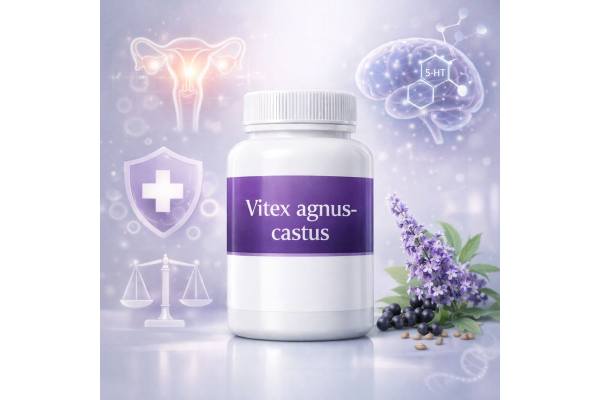
Vitex agnus-castus—often called chasteberry or chaste tree berry—is a botanical best known for supporting menstrual comfort and hormone-related symptoms. Unlike herbs that “push” estrogen or progesterone directly, vitex is typically used for its influence on upstream signaling, especially where prolactin and cycle timing play a role. That makes it a popular option for premenstrual syndrome (PMS), cyclical breast tenderness, and certain patterns of irregular cycles.
Its main advantage is that it can be tried as a structured, time-limited experiment: consistent dosing for a few cycles, symptom tracking, and clear stop rules if it does not help. Still, vitex is not a shortcut around evaluation—thyroid problems, anemia, endometriosis, fibroids, and medication effects can look like “hormone imbalance.” This guide explains what vitex is, what it may help, how to choose and take it, and how to use it safely.
Key Insights
- May reduce PMS symptoms and cyclical breast tenderness when taken consistently for 2–3 menstrual cycles.
- Works best when your symptoms fit a prolactin-sensitive pattern (breast pain, short luteal phase, premenstrual irritability).
- Typical standardized dose ranges from 20–40 mg/day (extract) or up to 300–600 mg/day (dried fruit equivalent), depending on the product.
- Avoid combining with fertility hormones or dopamine-related medications without clinician guidance.
- Avoid if pregnant, breastfeeding, or if you have hormone-sensitive conditions unless your clinician approves.
Table of Contents
- What is vitex and how does it work?
- What benefits are best supported?
- Can vitex help cycles, fertility, or menopause?
- How to choose and use vitex
- How much vitex per day?
- Common mistakes and troubleshooting
- Side effects, safety, and evidence limits
What is vitex and how does it work?
Vitex agnus-castus is the dried fruit of a Mediterranean shrub that has a long history of use for menstrual and reproductive complaints. Modern supplement products typically use the berry in one of three forms: a standardized dry extract (most common in research), a tincture, or dried fruit powder/capsules. The form matters because the active compounds vary by extraction method and because many older “success stories” used specific standardized preparations rather than generic powders.
A practical way to understand the mechanism
Vitex is often described as working through the brain–pituitary–ovarian signaling loop rather than directly acting like a hormone. In plain terms, it may help “smooth” certain hormone messages that regulate cycle timing. The best-known pathway is its relationship with prolactin, a hormone that can rise for many reasons (stress, certain medications, pituitary microadenomas, thyroid dysfunction, breastfeeding, and more). Even mildly elevated prolactin can be associated with breast tenderness, cycle disruption, and luteal phase issues in some people.
Vitex is frequently discussed for having dopaminergic activity, meaning it may influence dopamine-related signaling. Dopamine is one of the body’s natural “brakes” on prolactin release. If that brake is weak, prolactin can creep up. When prolactin is better controlled, downstream patterns—like cyclic breast pain or certain premenstrual symptoms—may improve.
What vitex is not
- It is not a rapid pain reliever. If it helps, it usually helps across cycles.
- It is not a guaranteed fix for irregular periods. Irregular cycles can come from many causes that vitex does not address.
- It is not a substitute for treatment of endocrine conditions (thyroid disease, PCOS with significant metabolic issues, hyperprolactinemia that requires medical therapy).
Who tends to respond best
People are more likely to notice benefit when symptoms cluster around a premenstrual pattern, especially:
- cyclical breast tenderness or swelling
- PMS with irritability, tension, or mood shifts that follow a predictable cycle rhythm
- suspected short luteal phase patterns (for example, spotting several days before bleeding)
If symptoms are constant (daily pelvic pain, persistent heavy bleeding, ongoing depression independent of cycle timing), vitex may be a poor match and evaluation becomes more important than supplement experimentation.
What benefits are best supported?
Most people search for vitex because they want relief from PMS, breast tenderness, or both. These are also the areas where the evidence is most consistent and where the biological logic (cycle-timed symptoms and prolactin sensitivity) makes the most sense.
PMS symptom support
PMS is not one symptom—it is a package. Vitex is typically used for a mixed cluster such as mood irritability, tension, bloating, headaches, and breast tenderness that shows up in the luteal phase (after ovulation) and resolves with menstruation. When vitex helps PMS, people often describe the shift as “less intensity” rather than “symptoms disappear.” That distinction matters for setting a reasonable goal.
A practical, measurable target is a 30–50% reduction in your top two symptoms by the end of the third cycle. For example:
- irritability drops from 8/10 to 5/10
- breast pain drops from 7/10 to 3–4/10
- bloating becomes less frequent and less disruptive
Cyclical breast tenderness and mastalgia
Cyclical mastalgia (breast pain that follows the menstrual cycle) is one of the clearest use-cases for vitex. Many protocols focus on daily dosing over approximately three cycles. People who respond often notice:
- fewer days of pain per cycle
- lower peak pain intensity
- less breast swelling or “fullness”
If breast pain is new, one-sided, associated with a lump, nipple discharge, skin changes, or does not follow a clear cycle pattern, do not self-treat—get evaluated first. Supplements are for cyclical patterns that have been assessed as benign, not for unexplained changes.
Advantages compared with “quick fixes”
Vitex’s main advantage is that it encourages a structured trial with a relatively simple routine. It also tends to be non-sedating, which is important for people who are sensitive to antihistamines or certain pain relievers. Another advantage is that it can be paired with lifestyle supports that address the same symptom terrain, such as sleep stabilization, caffeine timing, hydration, and magnesium-rich eating.
That said, vitex is not automatically superior to other options. If you have severe PMS or symptoms consistent with PMDD, evidence-based medical strategies (and professional evaluation) matter. Vitex may still be considered as part of a broader plan, but it should not delay proper care.
Can vitex help cycles, fertility, or menopause?
Vitex is often marketed for nearly every “female hormone” concern, but the real-world picture is narrower. The most defensible uses are still PMS and cyclical breast tenderness, with other uses falling into “possible, but depends on the pattern and the person.”
Irregular cycles and cycle disorders
Some people try vitex for irregular periods, long cycles, spotting, or painful periods. Here’s the key: irregular cycles are a symptom, not a diagnosis. Before you attribute irregularity to “hormone imbalance,” consider common drivers such as thyroid dysfunction, iron deficiency, chronic stress with under-eating, PCOS, high training load, perimenopause, and medication effects (including emergency contraception and some psychiatric medications).
Vitex may be reasonable when irregularity seems functional and mild—especially when paired with breast tenderness and PMS that suggests a prolactin-sensitive pattern. But if your cycles are consistently very long, absent, unusually heavy, or unpredictable, you will get more value from evaluation than from cycling through supplements.
Fertility and luteal phase support
Vitex is sometimes used in fertility contexts, particularly for luteal phase concerns and mild prolactin-related issues. This is where caution matters. If you are actively trying to conceive and you are also using ovulation induction medication, progesterone support, thyroid medication changes, or dopamine agonists, adding vitex without guidance can complicate interpretation of labs and symptoms.
If you are considering vitex for fertility:
- treat it as a clinician-supervised tool, not a DIY fix
- use objective tracking (ovulation predictor kits, basal temperature, luteal phase length, symptom log)
- stop immediately if pregnancy is confirmed unless a clinician directs otherwise
Menopause and perimenopause symptoms
Some people use vitex for perimenopausal complaints like mood swings, sleep disruption, and hot flashes. The logic is less direct here because the hormonal environment is changing in a different way than in PMS. Some people report benefits, but the response is more variable. If your main concern is hot flashes and night sweats, vitex may not be the highest-likelihood option compared with other evidence-based approaches. Still, if your symptoms are “PMS-like” and you are in early perimenopause (more mood and breast tenderness than vasomotor symptoms), vitex might be worth a careful trial.
The bottom line: vitex can be helpful outside PMS and mastalgia, but the success rate depends heavily on whether your symptom pattern fits its most plausible targets.
How to choose and use vitex
Choosing vitex is less about the brand name and more about clarity: what form is used, how it is standardized, and whether the dose is realistic. Two bottles can both say “Vitex agnus-castus” and still deliver very different amounts of active constituents.
Look for these quality signals
- Standardized extract with a stated daily amount in mg
- Single-ingredient dosing clarity (avoid proprietary blends if vitex is your main intervention)
- Batch consistency claims, ideally with a recognizable extract designation
- Clear serving size that matches the dose used in common protocols
If a label only says “chasteberry complex” without specifying how much vitex extract you get per day, it becomes difficult to run a clean trial.
Pick the form that fits your routine
- Standardized tablets/capsules: best for consistency and for comparing your results across cycles.
- Tinctures: helpful for people who prefer liquids, but dosing can be more variable and taste can be a barrier.
- Powdered fruit: often less standardized and may require higher mg amounts to match extract-based protocols.
Consistency beats perfection. The best product is the one you can take daily without missing half the doses.
How to run a “clean” trial
- Choose one vitex product and commit to it for at least two cycles.
- Keep the rest of your supplement routine stable if possible.
- Track 2–4 symptoms daily on a 0–10 scale (for example, irritability, breast pain, bloating, and headaches).
- Review your averages by cycle, not by day.
This approach turns “I think it helped” into something you can actually evaluate.
Helpful pairings that do not muddy the waters
If you want gentle support without adding too many variables:
- consistent sleep and wake time
- limiting alcohol in the premenstrual week
- reducing late-day caffeine
- adding regular walking or light strength work for stress buffering
If you add three new supplements at once, you won’t know what worked—and you may miss an interaction signal.
How much vitex per day?
Vitex dosing can look confusing because products are not standardized the same way. Some provide a small amount of concentrated extract; others provide large amounts of dried berry powder. The most useful anchor is to follow dosing that reflects common clinical use of standardized extracts.
Common dose ranges
- Standardized extract (typical research-style use): often 20–40 mg per day of a standardized fruit extract.
- Dried fruit powder equivalents: may range from 300–600 mg per day (sometimes higher), depending on how concentrated the product is.
If your product provides both “extract mg” and a “dried herb equivalent,” use the extract dose as your primary comparison point.
When to take it
Many people take vitex once daily, often in the morning. The “best” timing is the one you can do consistently. If you notice nausea, taking it with food can help. If you notice vivid dreams or sleep disruption (uncommon but reported), shifting it earlier in the day is reasonable.
How long until you know?
Vitex is typically not a one-week experiment. A realistic evaluation timeline is:
- First cycle: you may notice subtle changes (slightly less breast tenderness, less irritability)
- Second cycle: patterns become clearer
- Third cycle: best point to decide whether it’s meaningfully helping
A fair trial is usually 2–3 cycles. If there is no improvement by the end of the third cycle, continuing “just in case” is rarely productive.
When to stop or step down
Stop and reassess if:
- symptoms worsen significantly
- you develop new headaches, dizziness, rash, or menstrual changes that feel abnormal for you
- mood symptoms intensify or feel less predictable
- you become pregnant or suspect pregnancy
If vitex helps and you want to continue, consider a “maintenance” approach:
- keep the same dose for an additional 2–3 cycles
- then trial a step-down (lower dose or 5 days per week) while watching symptom return
This helps you avoid taking something indefinitely without knowing whether you still need it.
Common mistakes and troubleshooting
When vitex fails, the reason is often not that “vitex doesn’t work,” but that the trial was too messy or the symptom pattern didn’t match what vitex is most likely to influence. Troubleshooting can save months of frustration.
Mistake 1: expecting results in a week
Because vitex is usually used for cycle-timed symptoms, the feedback loop is your menstrual cycle itself. You typically need at least two cycles to see whether the luteal-phase pattern is shifting. If you stop after ten days, you haven’t really tested it.
Mistake 2: changing everything at once
If you start vitex, cut caffeine, begin a new workout plan, and add magnesium, you may feel better—but you won’t know why. If you want actionable information, change one variable at a time.
Mistake 3: using a vague “blend”
Many “hormone balance” blends underdose vitex or hide amounts in proprietary mixes. If you can’t tell how much vitex you’re taking per day, you can’t compare your results to typical dosing ranges.
Mistake 4: treating the wrong problem
These issues often need evaluation rather than supplementation:
- heavy bleeding with clots, fatigue, or dizziness
- cycles that suddenly change dramatically
- pelvic pain that is severe, one-sided, or not limited to the premenstrual window
- nipple discharge not linked to pregnancy or breastfeeding
- irregular cycles plus new acne, hair growth, or weight changes suggesting a broader endocrine shift
Vitex may still play a role later, but diagnosis should come first.
How to tell if it’s working
Use a simple “two-symptom rule”:
- pick your top two symptoms (for example, breast pain and irritability)
- track them daily for one baseline cycle if possible
- aim for a consistent, noticeable improvement by cycle three
Signs it may be a good fit:
- fewer days of breast tenderness
- lower peak PMS mood intensity
- less premenstrual swelling or headaches
- fewer days of spotting before bleeding (for some people)
Signs it may be a poor fit:
- no change after three cycles
- increased cycle irregularity
- worsening mood symptoms
- new, persistent headaches or skin reactions
Good troubleshooting isn’t about forcing vitex to work—it’s about learning quickly whether it fits your body’s pattern.
Side effects, safety, and evidence limits
Vitex is often well tolerated, but it still acts on hormone-related signaling. That means safety depends on your health context, medications, and whether you are trying to conceive.
Common side effects
Most reported side effects are mild and reversible:
- nausea or stomach upset
- headache
- dizziness
- acne flare or skin irritation
- changes in menstrual timing (earlier or later bleeding)
If you develop a rash, hives, swelling, or breathing difficulty, treat it as a possible allergy and seek urgent care.
Who should avoid vitex or use it only with clinician guidance
- Pregnant or breastfeeding individuals: stop unless a clinician specifically recommends it.
- People using fertility medications or hormonal therapy: vitex can complicate symptom interpretation and hormonal monitoring.
- Those with hormone-sensitive conditions (for example, certain cancers or conditions where hormone modulation is clinically significant): use only with specialist guidance.
- People with known hyperprolactinemia, pituitary tumors, or dopamine-related disorders: do not self-treat; coordinate care.
- Anyone with severe mood symptoms or PMDD-level impairment: use professional support; supplements should not be the only strategy.
Because vitex is often discussed for dopaminergic activity, extra caution is sensible if you take medications that strongly affect dopamine signaling.
Evidence strengths and limitations
The overall research picture is encouraging for cyclical breast pain and PMS symptom clusters, especially when standardized extracts are used consistently over multiple cycles. However, limitations are real:
- study quality varies by product and reporting detail
- different extracts are not interchangeable
- outcomes are often symptom scales, which can be influenced by expectations and cycle variability
- evidence is weaker for broad claims like “balances hormones” across all conditions
A responsible takeaway is that vitex can be a reasonable, structured trial for specific menstrual-cycle patterns, but it is not a universal hormone solution. If you use it, do so with clear goals, a clear dose, and a clear timeline—and prioritize evaluation when symptoms are severe, new, or disruptive.
References
- Vitex Agnus-Castus for the Treatment of Cyclic Mastalgia: A Systematic Review and Meta-Analysis 2020 (Systematic Review and Meta-analysis)
- Vitex agnus castus effects on hyperprolactinaemia 2023 (Review)
- Use of Vitex agnus-castus in patients with menstrual cycle disorders: a single-center retrospective longitudinal cohort study 2024 (Cohort Study)
- Effects, Mechanisms of Action and Application of Vitex agnus-castus for Improvement of Health and Female Reproduction 2025 (Review)
Disclaimer
This article is for educational purposes only and does not provide medical advice, diagnosis, or treatment. Menstrual and breast symptoms can have many causes, including conditions that require medical evaluation and prescription therapy. Vitex agnus-castus may interact with medications and may be inappropriate for people who are pregnant, breastfeeding, trying to conceive under medical treatment, or managing hormone-sensitive or pituitary-related conditions. If you have severe symptoms, sudden changes in bleeding or pain, a new breast lump, nipple discharge, fainting, or signs of anemia, seek prompt medical care.
If you found this guide helpful, please share it on Facebook, X (formerly Twitter), or any platform you prefer, and follow us on social media. Your support through sharing helps our team continue producing high-quality, trustworthy health content.