Cerebral infarction is the medical term for a part of the brain being injured because it did not get enough blood and oxygen. Most often, the cause is an ischemic stroke—an artery that feeds the brain becomes blocked, and brain cells begin to fail within minutes. What makes this condition so serious is that the brain cannot “store” oxygen the way muscles can. The clock matters, but so does the pattern: a small blockage in a deep vessel can cause major weakness, while a larger blockage can threaten speech, vision, or consciousness.
This article explains what cerebral infarction is, why it happens, how it feels, how doctors confirm it, what treatments work best in the first hours, and what long-term management looks like so you can reduce the chance of another event.
Table of Contents
- What is cerebral infarction?
- Causes and risk factors
- Symptoms and complications
- How it’s diagnosed
- Treatment: what works fastest
- Recovery, prevention, and when to seek help
What is cerebral infarction?
A cerebral infarction is an area of brain tissue that has been damaged because blood flow was reduced or stopped long enough to cause cell death. In everyday language, it is the “injury left behind” after an ischemic stroke. The size and location of the infarct determine what symptoms appear and how much recovery is possible.
How the damage unfolds
The brain depends on a steady delivery of oxygen and glucose through arteries. When a vessel is blocked:
- Seconds to minutes: neurons lose energy, and normal electrical signaling fails. This can cause sudden weakness, numbness, speech trouble, or vision loss.
- Minutes to hours: a core area becomes irreversibly damaged. Around it sits a “penumbra,” tissue that is struggling but can still be saved if blood flow returns quickly.
- Hours to days: swelling, inflammation, and chemical changes can worsen symptoms even after the blockage is treated.
This is why stroke care focuses on rapid evaluation and reperfusion—restoring blood flow—when a person meets eligibility criteria.
Is infarction the same as stroke?
They are closely related, but not identical terms. Stroke describes the clinical event (sudden neurologic symptoms due to disrupted blood flow or bleeding). Cerebral infarction describes the tissue outcome of an ischemic stroke—what is seen on imaging, and what the brain is healing from afterward. Some people have a “silent” cerebral infarction discovered incidentally on MRI, meaning there was tissue injury without obvious symptoms at the time.
Why location matters
Small infarcts can be disabling if they affect crucial pathways. Examples:
- A tiny infarct in the internal capsule can cause marked arm and leg weakness.
- An infarct in the dominant hemisphere can impair language (aphasia).
- Posterior circulation infarcts may affect balance, swallowing, double vision, or consciousness.
Understanding this anatomy helps explain why two people with similar risk factors can have very different experiences.
Causes and risk factors
Cerebral infarction occurs when blood flow to a brain region is blocked or critically reduced. The most common mechanism is a clot (thrombus or embolus) obstructing an artery. The key to prevention is matching the likely cause to the right long-term strategy.
Common causes
- Large-artery atherosclerosis: Plaque narrows a carotid or intracranial artery, and a clot forms on top of it. Sometimes plaque debris breaks off and travels downstream.
- Cardioembolism: A clot forms in the heart and travels to the brain. Atrial fibrillation is a major contributor, but recent heart attack, cardiomyopathy, valve disease, and left atrial appendage clots also matter.
- Small-vessel disease (lacunar infarcts): Chronic high blood pressure and diabetes damage tiny penetrating arteries deep in the brain. These infarcts are often small but can cause pure weakness, pure numbness, or coordination problems.
- Arterial dissection: A tear in the artery wall (often in the carotid or vertebral artery) can create a flap and clot, more common in younger adults and sometimes linked to neck trauma.
- Hypercoagulable states and inflammation: Cancer-associated clotting, antiphospholipid syndrome, severe infections, or systemic inflammatory disease can raise risk.
- Watershed (low-flow) infarction: Critically low blood pressure or severe narrowing of major arteries can reduce flow at “border zones” between arterial territories.
Risk factors you can change
The highest-yield modifiable risks usually include:
- High blood pressure (often the biggest driver of stroke risk)
- Smoking or vaping nicotine
- Diabetes or insulin resistance
- High LDL cholesterol and metabolic syndrome
- Atrial fibrillation that is untreated or undertreated
- Sleep apnea
- Sedentary lifestyle, excess alcohol, and poor diet quality
Risk factors you cannot change
Age, family history, prior stroke/TIA, and certain genetic conditions influence risk. Even when these are fixed, controlling the modifiable factors can sharply lower the chance of another event.
A practical insight: prevention works best when it is cause-specific—for example, anticoagulation for atrial fibrillation versus antiplatelet therapy for many plaque-related strokes.
Symptoms and complications
Cerebral infarction symptoms usually appear suddenly because the brain loses function the moment blood flow drops. Some people notice symptoms that come and go, which may signal a transient ischemic attack (TIA) or a fluctuating stroke—both require urgent evaluation.
Early warning signs to take seriously
Use the “FAST” concept, but think beyond it:
- Face droop or uneven smile
- Arm weakness or leg weakness on one side
- Speech problems: slurred speech, difficulty finding words, or inability to understand
- Time: symptoms starting now are an emergency
Other common stroke symptoms include:
- Sudden vision loss in one eye or one side of vision
- Sudden severe dizziness, trouble walking, or loss of coordination
- Sudden numbness on one side of the body
- Sudden confusion or altered alertness
- A sudden worst-ever headache (this raises concern for hemorrhage, but it can also occur with certain ischemic events)
Do not “wait to see if it passes.” Even if symptoms improve, the risk of a larger stroke can be high in the following hours to days.
Complications after an infarct
Complications depend on the infarct location and size, but common ones include:
- Brain swelling (edema): can worsen neurologic deficits and, in severe cases, threaten life.
- Hemorrhagic transformation: damaged brain tissue can bleed into the infarct area, especially after reperfusion or in large strokes.
- Seizures: can occur early or later, depending on the region affected.
- Aspiration pneumonia: swallowing impairment can allow food or liquid to enter the lungs.
- Deep vein thrombosis (DVT) and pulmonary embolism: immobility increases clot risk in the legs.
- Depression, anxiety, and post-stroke fatigue: common, treatable, and often underestimated.
When to treat it as an emergency
Call emergency services immediately for any sudden neurologic symptom—especially one-sided weakness, speech difficulty, new vision loss, or severe imbalance. Rapid treatment can save penumbra tissue and reduce long-term disability.
How it’s diagnosed
Diagnosis has two urgent goals: confirm stroke type (ischemic vs hemorrhagic) and identify whether the person may benefit from time-sensitive treatments. In practice, a stroke workup often begins in the emergency department within minutes of arrival.
Initial assessment
Clinicians typically focus on:
- Time last known well: the last moment the person was normal. This can differ from when symptoms were discovered.
- Neurologic exam: often summarized by a standardized scale to quantify severity.
- Vital signs and glucose: very low or very high blood sugar can mimic or worsen stroke symptoms.
- Medication and bleeding risk review: especially blood thinners.
Imaging tests that guide decisions
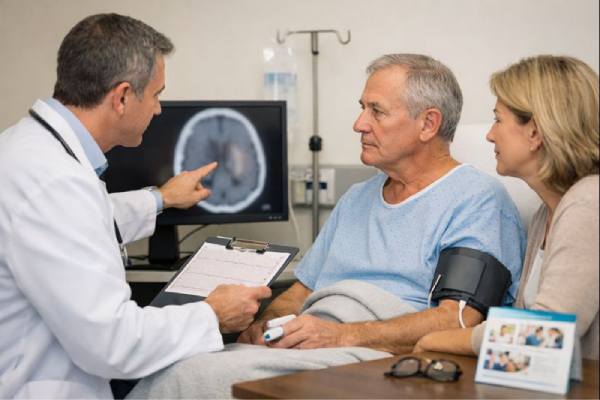
- Non-contrast CT head: fast and widely available. Its first job is to rule out bleeding. Early ischemic changes may be subtle.
- MRI brain (diffusion-weighted imaging): highly sensitive for early infarction and can show the infarct pattern (useful for identifying the likely cause).
- CT angiography (CTA) or MR angiography (MRA): identifies a large-vessel occlusion and maps arterial narrowing.
- CT perfusion or MR perfusion (in selected cases): estimates salvageable tissue and can support decisions when the onset time is unclear or beyond the classic window.
Finding the cause: the “why” workup
Cause evaluation often includes:
- ECG and heart rhythm monitoring (looking for atrial fibrillation or other arrhythmias)
- Echocardiogram (heart structure and clot sources)
- Carotid ultrasound/CTA/MRA (carotid stenosis)
- Blood tests: cholesterol, A1C, kidney function, clotting profile when indicated
- Risk-factor review: smoking, sleep apnea symptoms, migraine with aura, hormone therapy, recent infection, cancer history
A useful concept is that the infarct pattern tells a story: multiple small infarcts in different territories suggest emboli, while a single deep lacunar infarct points toward small-vessel disease.
Treatment: what works fastest
Treatment for cerebral infarction depends on how recently symptoms started, the stroke mechanism, imaging results, and individual bleeding risk. The central principle is simple: restore blood flow when safe and possible, then prevent the next event.
Emergency treatments in the first hours
- Intravenous thrombolysis (“clot-busting” medicine): may be offered to eligible patients within a time window and after imaging excludes bleeding. It can improve outcomes by dissolving clots, but it carries bleeding risk, so selection is careful.
- Mechanical thrombectomy: for certain large-vessel occlusions, specialists can remove the clot using a catheter-based procedure. This can be highly effective, especially when performed quickly and in the right patients.
- Supportive physiologic care: oxygen if needed, fever control, careful blood pressure management, and blood sugar control. These do not “open” the artery, but they protect vulnerable brain tissue.
Early secondary prevention during hospitalization
Once bleeding is excluded and the immediate plan is set, clinicians typically address:
- Antiplatelet therapy: commonly used for non-cardioembolic ischemic strokes. In selected minor strokes or high-risk TIAs, short-term dual antiplatelet therapy may be used, then de-escalated.
- Anticoagulation: used when the stroke is cardioembolic (such as atrial fibrillation). Timing depends on infarct size and bleeding risk.
- Statins and lipid management: often intensified after ischemic stroke to reduce recurrence risk.
- Carotid intervention: if significant carotid stenosis caused the event, carotid endarterectomy or stenting may be recommended in appropriate patients, often on a time-sensitive basis.
- Swallow screening and mobility: early evaluation reduces aspiration risk and clot complications.
What to expect after the acute phase
Improvement often occurs over weeks to months as swelling resolves and the brain reorganizes. The most meaningful gains usually come from a combination of:
- targeted rehab (physical, occupational, speech therapy),
- consistent risk-factor control,
- and adherence to the prevention plan matched to the stroke’s cause.
If you remember one idea: treatment is not only an emergency response. It is also a long-term strategy to prevent the next infarct.
Recovery, prevention, and when to seek help
Recovery after cerebral infarction is a structured process: stabilize, relearn, and reduce risk. Many people improve substantially, but progress is rarely linear. Setting realistic targets and tracking small functional wins—walking endurance, clearer speech, safer swallowing—helps maintain momentum.
Rehabilitation that changes outcomes
Rehab is most effective when it is specific and consistent:
- Physical therapy: strength, balance, gait training, and aerobic conditioning
- Occupational therapy: arm/hand function, daily tasks, home safety, return-to-work planning
- Speech-language therapy: speech clarity, language, cognition, and swallowing therapy
- Neuropsychology and counseling: attention, memory strategies, mood, and coping skills
A practical benchmark: many rehab programs aim for frequent practice, not occasional sessions. Short, repeated practice blocks can outperform long, sporadic ones.
Prevention that is worth your effort
Secondary prevention typically combines medication plus lifestyle:
- Blood pressure control: often the single most important lever; home BP monitoring can improve results.
- Cholesterol management: statins and, when needed, additional LDL-lowering therapies.
- Diabetes management: A1C targets and glucose stability, paired with diet and activity.
- Smoking cessation: stopping nicotine exposure meaningfully reduces vascular risk over time.
- Sleep apnea treatment: evaluation is worthwhile if snoring, witnessed apneas, or daytime sleepiness are present.
- Movement and diet: build toward regular activity you can sustain and a dietary pattern rich in vegetables, fiber, and unsaturated fats while low in ultra-processed foods and excess sodium.
- Medication adherence: missed doses are a common, preventable reason for recurrence.
When to seek urgent care again
Get emergency help immediately for any new sudden neurologic symptom, even if brief, including new weakness, speech difficulty, vision loss, or severe imbalance. Also seek urgent care for chest pain, fainting, or severe shortness of breath, which may signal heart rhythm problems or clots.
Long-term success often comes down to two habits: taking the prevention plan seriously and treating new symptoms as time-critical.
References
- 2024 Guideline for the Primary Prevention of Stroke: A Guideline From the American Heart Association/American Stroke Association 2024 (Guideline)
- 2021 Guideline for the Prevention of Stroke in Patients With Stroke and Transient Ischemic Attack: A Guideline From the American Heart Association/American Stroke Association 2021 (Guideline)
- European Stroke Organisation (ESO) expedited recommendation on intravenous thrombolysis before mechanical thrombectomy in patients with acute ischaemic stroke and large vessel occlusion 2022 (Guideline)
- A systematic review and synthesis of global stroke guidelines on behalf of the World Stroke Organization 2023 (Systematic Review)
Disclaimer
This article is for educational purposes only and does not replace individualized medical advice, diagnosis, or treatment. Cerebral infarction and stroke symptoms are medical emergencies—if you or someone else has sudden weakness, speech difficulty, vision loss, severe dizziness, or confusion, call local emergency services immediately. Treatment choices depend on timing, imaging findings, medical history, and medications, so decisions should be made with qualified clinicians.
If you found this helpful, please consider sharing it on Facebook, X (formerly Twitter), or any platform you prefer, and follow us on social media. Your support through sharing helps our team continue producing reliable, high-quality health content.