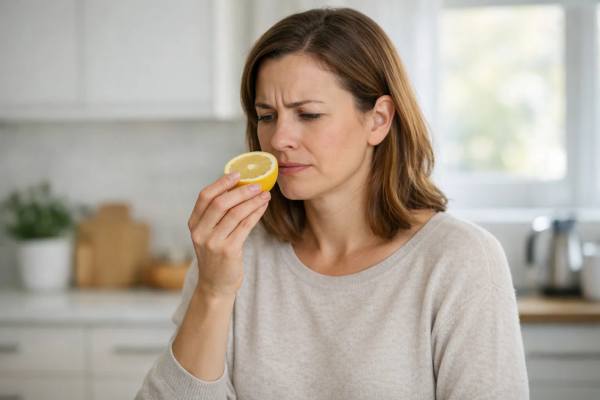
Losing your sense of smell after a cold can be unsettling, especially when food tastes flat and familiar scents disappear. In many cases, the cause is simple: swollen nasal lining and thick mucus block odor molecules from reaching the smell receptors. But sometimes the virus affects the smell-sensing tissue itself, which can make recovery slower and more unpredictable. Both patterns are common, and the right response depends on which one you’re dealing with.
The encouraging news is that many people improve over time, and there are practical steps that can support recovery and keep you safe while smell is reduced. This article explains the most likely causes, what a normal timeline looks like, why parosmia can appear during healing, and how to decide when home care is enough versus when it is time to see a clinician.
Fast Facts
- Smell loss after a cold is often caused by nasal congestion, but it can also come from post-viral injury to smell receptors.
- Many people notice improvement within days to weeks, while post-viral cases may take months and recover in waves.
- Smell training is a low-risk, evidence-supported approach for persistent post-viral smell loss when done consistently for at least 12 weeks.
- Sudden smell loss with severe headache, neurologic symptoms, facial swelling, or vision changes needs urgent medical evaluation.
- If smell remains markedly reduced beyond 2–4 weeks after other cold symptoms resolve, it is reasonable to discuss next steps with a clinician.
Table of Contents
- How smell works and fails
- Common causes after a cold
- Typical recovery timeline and milestones
- Parosmia and phantosmia explained
- What you can do at home
- Medical evaluation and treatments
- When to see a doctor urgently
How smell works and fails
Smell is more than a pleasant extra. It shapes appetite, nutrition, memory, safety, and even social connection. Understanding how smell works makes it easier to interpret what’s happening after a cold—and why recovery can look different from person to person.
Two smell pathways: orthonasal and retronasal
When you sniff coffee, odor molecules travel up the nose to a small region high in the nasal cavity called the olfactory cleft. There, specialized nerve cells in the olfactory epithelium detect those molecules and send signals through the olfactory nerve to the brain.
When you eat, much of what you call “taste” is actually smell coming from the back of the throat into the nose. This is retronasal olfaction. That is why smell loss often feels like taste loss—even if the tongue’s true tastes (sweet, salty, sour, bitter, umami) are intact.
A third player is the trigeminal system, which detects sensations like cooling (menthol), burning (chili), and sharpness (vinegar). People sometimes notice trigeminal sensations remain even when smell is reduced. That can be a clue that the issue is mainly olfactory rather than “everything is gone.”
Two main ways colds interfere with smell
After a cold, smell loss usually fits one of these patterns:
- Conductive loss (blocked access): Swelling, mucus, and nasal congestion prevent odor molecules from reaching the olfactory epithelium. The receptors may be fine, but odors cannot get to them.
- Sensorineural or epithelial injury (damaged sensing): The virus and the immune response can disrupt the olfactory epithelium and supporting cells. Even if the nose feels clear, signals may be weaker or distorted.
These patterns can overlap. A person might start with congestion-related loss, then notice lingering reduction even after the nose opens up. That is when post-viral smell dysfunction becomes more likely.
A helpful self-check is this: if you can breathe clearly through your nose but smell is still greatly reduced, blockage is less likely to be the only cause. That does not mean something dangerous is happening—it just means recovery may take longer and benefit from structured rehabilitation such as smell training, which is discussed in What you can do at home.
Common causes after a cold
“Loss of smell after a cold” sounds like one problem, but in practice it is a short list of common causes plus a few important conditions that should not be missed. The goal is not self-diagnosis; it is recognizing which pattern fits your situation and knowing what would change your next step.
Most common: congestion and inflammation
In the first days of a cold, smell loss is often straightforward. The nasal lining swells, mucus thickens, and airflow to the olfactory cleft drops. In this scenario, smell tends to improve as congestion improves. You may notice smell fluctuates during the day—better after a warm shower, worse at night, better after blowing your nose.
Post-viral olfactory dysfunction
Sometimes smell remains reduced even after the cold is “over.” This can happen after many respiratory viruses, including but not limited to SARS-CoV-2. The leading idea is that inflammation and cellular disruption in the olfactory epithelium temporarily reduce the ability to detect odors. Recovery can be gradual, and it may include a phase of distorted smells.
Clues that point toward a post-viral pattern include:
- Smell loss persists after nasal breathing feels mostly normal
- Scents return faintly, then fade again
- New distortions appear (see Parosmia and phantosmia explained)
Sinusitis and ongoing nasal disease
A cold can trigger or unmask inflammation in the sinuses and nasal passages. Smell loss may last longer if there is:
- Persistent nasal obstruction and thick discharge
- Facial pressure that worsens when bending forward
- Symptoms that improve, then worsen again (“double sickening”)
Chronic inflammation conditions—such as allergic rhinitis or chronic rhinosinusitis—can also reduce smell and slow recovery. Nasal polyps are another possibility, especially if you have long-standing congestion, reduced smell before the cold, or a history of asthma and sensitivity to certain pain relievers.
Less common but important considerations
While most cases are benign, smell loss should be evaluated sooner if it is:
- Unilateral (one-sided): One nostril consistently cannot smell while the other seems better
- After head injury: Even a mild concussion can affect smell
- Associated with neurologic symptoms: New weakness, speech trouble, severe imbalance, or confusion
- Associated with alarming nasal symptoms: Recurrent nosebleeds, severe facial pain, or clear watery drainage after trauma
If you suspect a non-cold explanation, skip ahead to When to see a doctor urgently.
Typical recovery timeline and milestones
One of the hardest parts of smell loss is the uncertainty. People often ask, “How long will this last?” The most honest answer is that recovery depends on the cause. The good news is that timeframes are often predictable once you identify the pattern.
When congestion is the main cause
If smell loss is primarily conductive (blocked access), improvement usually tracks with nasal symptoms:
- Days 1–7: Smell is reduced or absent during peak congestion.
- Week 1–2: Smell begins to return as swelling and mucus decline.
- By 2–3 weeks: Many people are close to baseline if the cold resolves normally.
In this scenario, smell may return suddenly after a strong nose-clear moment, or gradually with day-to-day variability.
When post-viral injury is the main cause
If smell receptors and their supporting tissue are disrupted, timelines tend to be longer:
- Weeks 2–6: Some people notice faint smells or partial recovery, often inconsistent.
- Months 2–3: Gradual improvement is common, sometimes with distortions.
- Months 3–6 and beyond: Continued gains can occur, especially with consistent smell training. Some people recover fully later than expected.
Recovery after post-viral smell loss often comes in waves. You might have a good day followed by a disappointing day. This pattern is frustrating, but it can be normal during healing.
Milestones that can reassure you
These changes often suggest progress, even if you are not “back to normal”:
- You detect strong odors up close (coffee, citrus peel)
- You notice odor intensity increasing week to week
- You begin to identify some smells correctly
- You develop parosmia (distorted smell) after a period of low smell
That last point deserves context: parosmia can be distressing, but it is sometimes part of recovery as the smell system recalibrates. It is discussed in detail in Parosmia and phantosmia explained.
When the timeline suggests you should check in
It is reasonable to consider medical input when:
- Smell remains significantly reduced beyond 2–4 weeks after other cold symptoms are gone
- You have persistent, severe nasal blockage or recurrent sinus symptoms
- Smell loss is unilateral or associated with new neurologic symptoms
- You have quality-of-life impact: reduced appetite, weight loss, safety concerns, or significant anxiety
A check-in does not mean something serious is likely. It means your recovery plan can be refined—often with nasal examination, targeted treatment for inflammation, and guidance on structured smell training.
Parosmia and phantosmia explained
Not all smell problems are “less smell.” Many people experience qualitative changes during recovery, and these can be more upsetting than the original loss. Naming the experience helps: it turns “something is wrong with me” into a known pattern with practical coping strategies.
What parosmia and phantosmia are
- Parosmia: Distorted smell. A familiar odor (coffee, onion, toothpaste) smells wrong—often burnt, chemical, sewage-like, or sickly sweet.
- Phantosmia: Phantom smell. You smell something that is not present (smoke, gas, rotten food).
These symptoms can appear after many viral infections, and they are commonly reported during recovery from viral smell loss.
Why distortions happen
Smell perception is a pattern-recognition process. The nose sends a “scent signature” to the brain, and the brain matches it to memory. After viral disruption, the signal can be weak or incomplete. During regeneration and rewiring, the brain may receive mismatched patterns and interpret them incorrectly.
A useful way to frame parosmia is that it can reflect a system trying to reconnect. That does not make it pleasant, but it can explain why distortions sometimes appear when smell begins to return.
How long parosmia can last
Parosmia can last weeks to months. For some, it improves gradually as intensity normalizes and the brain recalibrates. For others, it comes and goes. Progress is often nonlinear.
If parosmia is worsening steadily, causing inability to eat, or paired with severe headaches or neurologic symptoms, that is a reason to seek medical advice. Otherwise, it is often managed with a combination of trigger control and smell training.
Practical coping strategies
Parosmia can interfere with nutrition. These approaches help many people:
- Identify triggers: Common ones include coffee, fried foods, onions, garlic, eggs, and some meats.
- Choose neutral foods: Cold foods often smell less, so yogurt, smoothies, chilled grains, and simple proteins may be easier.
- Improve ventilation: Cooking smells can linger; a fan and open window can reduce exposure.
- Use texture and temperature: Crunch, creaminess, and warmth can preserve enjoyment even when smell is distorted.
- Prioritize protein and calories: If appetite drops, focus on nutrient-dense options you can tolerate.
Also consider safety: if you cannot rely on smell to detect smoke, gas, or spoiled food, take protective steps outlined in What you can do at home.
Parosmia can be emotionally heavy. If you notice low mood, avoidance of meals, or anxiety that is taking over daily life, that is a valid reason to talk with a clinician. Smell is deeply linked to wellbeing, and you deserve support.
What you can do at home
Home care has two goals: reduce ongoing nasal inflammation and actively rehabilitate smell function when it is slow to return. The most supported rehabilitation approach is smell training. It is low-risk, inexpensive, and gives you a structured way to measure progress.
Smell training: a practical protocol
Smell training is repeated, mindful exposure to a set of scents over weeks to months. A simple plan:
- Choose 4 distinct scents. A classic set is rose, lemon, clove, and eucalyptus, but any clear, recognizable odors work.
- Twice daily, smell each scent gently for about 15–20 seconds.
- While smelling, focus attention on the scent and try to recall what it “should” smell like.
- Continue for at least 12 weeks, and ideally longer if improvement is ongoing.
Many people find it helpful to track progress weekly using a short list of “test smells” (coffee, citrus peel, soap, peanut butter). The point is not perfection; it is noticing change over time.
If you have parosmia, training can still be useful. Start with less triggering scents and keep exposures brief and tolerable.
Reduce inflammation and improve nasal airflow
If congestion is still present, address the basics:
- Saline irrigation or saline spray to thin mucus and clear the nasal passages
- Warm showers or humidification to improve comfort
- Avoiding smoke exposure and heavy fragrance triggers
- Treating allergies consistently if you have sneezing, itchy eyes, or seasonal patterns
If you already use an intranasal steroid spray for allergies, consistent technique matters more than “extra sprays.” Aim the nozzle slightly outward (toward the ear) rather than straight up the middle of the nose to reduce irritation and nosebleeds.
Safety steps while smell is reduced
Smell loss is a safety issue, not just a food issue. Consider these precautions:
- Check smoke and carbon monoxide alarms and replace batteries if needed
- If you have gas appliances, consider an added gas detector
- Label leftovers with dates and rely on time and temperature, not smell, to judge safety
- Ask a trusted person to check food freshness when unsure
- Be cautious with chemical exposure (cleaners, solvents) because warning odors may be missed
Support appetite and quality of life
Because “taste” is often diminished, use other levers:
- Add texture (crunch, creaminess) and temperature contrast
- Use safe trigeminal cues: mild spice, ginger, citrus acidity, or mint can add sensation
- Prioritize protein and hydration, especially during recovery
If you are doing smell training and nasal care consistently but notice no improvement by 8–12 weeks, that is a good time to discuss evaluation and targeted treatments in Medical evaluation and treatments.
Medical evaluation and treatments
If smell loss persists, a clinician can help in two ways: identify reversible causes (ongoing inflammation, sinus disease, polyps) and guide therapies that are appropriate for your pattern. The goal is a plan that is both effective and safe.
What a clinician will usually assess
Expect questions such as:
- When smell loss started and whether it was sudden or gradual
- Whether smell loss is complete (anosmia) or partial (hyposmia)
- Whether nasal breathing is blocked or clear
- Whether symptoms are unilateral
- Whether you have facial pain, ongoing discharge, nosebleeds, or recurrent infections
- Whether you have neurologic symptoms, head trauma, or medication changes
- Whether taste is reduced and whether parosmia is present
An exam may include inspection inside the nose. Some practices use nasal endoscopy to look for swelling high in the nasal cavity, polyps, or signs of chronic sinus inflammation.
Common treatment directions
Treatment is typically guided by the suspected cause:
- Allergic rhinitis or ongoing nasal inflammation: An intranasal steroid spray and saline care may be recommended, often for several weeks, with attention to technique.
- Suspected sinusitis: Management depends on severity and duration. Some cases require only supportive care; others may need targeted treatment based on clinical findings.
- Post-viral olfactory dysfunction without major congestion: Smell training remains central, with clinician guidance on duration, expectations, and monitoring.
Some clinicians may discuss a short course of oral corticosteroids in selected cases, usually when there is significant inflammation and potential for reversible obstruction. This is not appropriate for everyone and has meaningful risks (mood changes, sleep disruption, blood sugar effects, immune effects). It should be a clinician-guided decision, not a self-directed experiment.
Tests and referrals you may encounter
If smell loss is prolonged, unilateral, or accompanied by concerning symptoms, a clinician may consider:
- Standardized smell testing (to measure severity and track change)
- Imaging when structural causes are suspected or red flags are present
- Referral to an ear, nose, and throat specialist for detailed evaluation and treatment planning
It is also common to discuss whether a recent viral illness may have been COVID-19 even if it felt like a standard cold, because symptom patterns and counseling may differ. Regardless of virus type, the practical steps—safety, smell training, and treating nasal inflammation—remain foundational.
Be cautious with unproven add-ons
People often hear about vitamin A drops, alpha-lipoic acid, omega-3s, nasal rinses with additives, or procedure-based treatments. Some have emerging evidence, but quality varies and not all are appropriate. The safest approach is to avoid stacking multiple treatments at once, especially in the nose, without clinician input. The nasal lining is sensitive, and irritation can worsen symptoms.
If you are unsure whether your case needs evaluation, use the decision points in When to see a doctor urgently as a guide.
When to see a doctor urgently
Most post-cold smell loss is not dangerous. The reason to highlight urgent scenarios is simple: a small subset of situations signals a more serious problem, and early evaluation matters. Think of these as “pattern breaks”—features that do not fit the usual post-viral story.
Urgent red flags
Seek urgent medical care if smell loss is accompanied by any of the following:
- Severe or unusual headache, especially if sudden onset or “worst headache”
- New neurologic symptoms such as weakness, facial droop, slurred speech, confusion, fainting, or severe imbalance
- Vision changes, eye swelling, or pain with eye movement
- High fever with worsening facial swelling or severe facial pain
- Stiff neck, light sensitivity, or marked drowsiness
- New chest pain or significant shortness of breath during the illness
- Clear watery nasal drainage after head trauma, especially if it is one-sided and persistent
- Significant nosebleeds, a new mass sensation, or persistent one-sided obstruction
These signs do not automatically mean something rare is happening, but they deserve prompt assessment.
Situations that warrant earlier (non-emergency) evaluation
Arrange a timely clinician visit if you notice:
- Smell loss persists beyond 2–4 weeks after cold symptoms resolve
- Smell loss is clearly one-sided
- You have recurrent sinus symptoms, ongoing thick discharge, or repeated “double sickening” patterns
- You have asthma, nasal polyps, or chronic rhinitis symptoms that are not well controlled
- Parosmia is severe enough to cause weight loss, inability to eat, or significant distress
- You work in a safety-sensitive job where smell loss increases risk (gas exposure, food safety, firefighting, lab work)
A simple “today” decision guide
If you are deciding what to do right now, use these checkpoints:
- Breathing, alertness, hydration are normal: Home care and monitoring are reasonable.
- Nose is still congested: Focus on congestion and inflammation strategies first and watch for improvement as swelling resolves.
- Nose feels clear but smell remains very low: Begin smell training and consider scheduling a check-in if there is no improvement within a few weeks.
- Relief is needed for safety and stress: Implement safety measures immediately and talk with a clinician sooner rather than later.
Smell loss can be isolating. If you feel anxious or discouraged, that reaction is understandable—and it is also treatable. A structured plan, realistic timeline expectations, and professional guidance when needed can make the experience far more manageable.
References
- Clinical Olfactory Working Group consensus statement on the treatment of postinfectious olfactory dysfunction – PubMed 2021 (Consensus Statement)
- Treatment strategies for postviral olfactory dysfunction: A systematic review – PMC 2022 (Systematic Review)
- Ask the Experts: An International Consensus on Managing Post-Infectious Olfactory Dysfunction Including COVID-19 – PubMed 2022 (Consensus)
- Position paper on olfactory dysfunction: 2023 – PubMed 2023 (Position Statement)
- The efficacy of olfactory training in improving olfactory function: a meta-analysis – PMC 2024 (Meta-analysis)
Disclaimer
This article is for general educational purposes and does not provide medical advice, diagnosis, or treatment. Loss of smell after a viral illness is common and often improves over time, but it can also signal underlying nasal disease or, rarely, a more serious condition. Seek urgent medical care if smell loss occurs with severe headache, neurologic symptoms, vision changes, facial swelling, significant shortness of breath, or after head trauma. If you are pregnant, immunocompromised, have chronic lung disease, or take medications that affect immune function, consult a licensed clinician about the safest evaluation and treatment options for your situation.
If you found this article helpful, please consider sharing it on Facebook, X (formerly Twitter), or any platform you prefer.