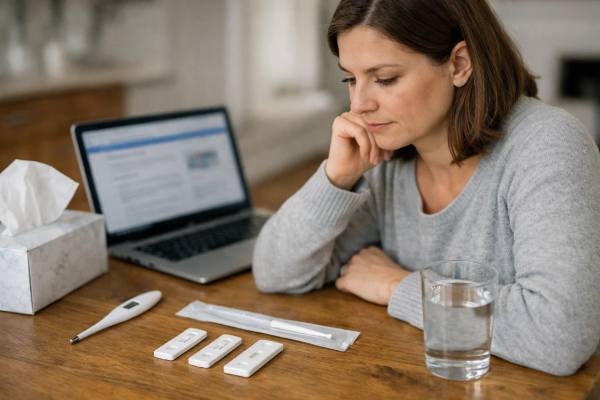
A sore throat in the morning can turn into a fever by nightfall—or it can fade after a day of rest. The challenge is that colds, influenza, and COVID can start with the same “ordinary” symptoms, yet the best next step is not always the same. Testing timing matters for treatment options, for protecting higher-risk people around you, and for avoiding a false sense of reassurance after one early negative test.
This guide helps you compare cold vs flu vs COVID in a practical way: which symptom patterns are more suggestive, how timing and severity usually differ, and when testing is worth doing even if you feel “mostly fine.” You will also get an easy at-home decision plan for repeat testing, a clear list of red flags, and realistic advice on returning to work, school, and normal activities without spreading illness.
Quick symptom and testing takeaways
- Flu often starts abruptly with fever and body aches, while colds more often build gradually with runny nose and mild throat symptoms.
- COVID can resemble either one, so symptom “guessing” is less reliable than pairing symptoms with timing and a smart test plan.
- A single negative rapid test early in illness can be misleading; repeat testing 48 hours later is often more informative.
- If you are high-risk or live with someone high-risk, earlier testing can help you access time-sensitive treatments.
- Stay home while you feel clearly unwell, then add extra precautions for several days after you return to normal activities.
Table of Contents
- The three illnesses in plain language
- Symptom clues that actually help
- Timing, incubation, and how it evolves
- When to test and how to repeat tests
- When to seek care and watch for complications
- Return to activities and protecting others
The three illnesses in plain language
“Cold,” “flu,” and “COVID” are often used like they are points on the same scale, but they are different infections. A common cold is not one single virus. It is a category that includes many viruses that mainly affect the upper airway (nose and throat). A cold is usually annoying rather than dangerous, though it can still trigger sinus problems, ear infections, asthma flares, and a lingering cough in some people.
Influenza (the flu) is caused by influenza viruses and tends to be a more intense whole-body illness. People often notice it not just in the throat and nose, but in the muscles, head, and energy level. Flu can be mild, but it is also more likely than a typical cold to cause complications such as pneumonia, dehydration, and worsening of chronic conditions.
COVID is caused by the SARS-CoV-2 virus. It can look like a cold, flu, or something in between. Some people have a short, mild illness; others develop more serious breathing problems or prolonged symptoms. Prior infections and vaccination can change how COVID presents, so comparing your symptoms to a “classic” description from early in the pandemic is less useful than it used to be.
A helpful way to think about these infections is by what they most often affect:
- Colds: upper airway irritation and mucus, with milder systemic symptoms
- Flu: sudden systemic illness with prominent aches, fatigue, and fever
- COVID: variable; can be upper airway, systemic, or both, and may shift over the first several days
One more practical point: it is possible to have more than one infection in the same season, and co-infections can happen. That is another reason not to rely on symptoms alone if you are deciding about treatment, isolation, or visiting someone vulnerable.
Symptom clues that actually help
Symptoms overlap so much that no single sign is a perfect “tell.” Instead, aim for pattern recognition: which symptoms cluster together, how intense they are, and how quickly they appeared.
Here is a comparison of common symptom patterns. Use it as a guide, not a diagnosis.
| Symptom pattern | More common in colds | More common in flu | More common in COVID |
|---|---|---|---|
| Gradual start over 1–2 days | Yes | Less typical | Sometimes |
| Abrupt start within hours | Less typical | Yes | Sometimes |
| Fever (especially higher fever) | Less common | Yes | Sometimes |
| Prominent body aches and “hit by a truck” fatigue | Less common | Yes | Sometimes |
| Runny or stuffy nose as main complaint | Yes | Sometimes | Often |
| Dry cough early | Sometimes | Sometimes | Often |
| Sore throat | Often | Sometimes | Often |
| Headache | Sometimes | Often | Often |
| Shortness of breath | Uncommon (unless asthma) | Possible | Possible |
| Loss of smell or taste | Uncommon | Uncommon | Possible |
A few “pharmacist-style” clues that tend to be useful in real life:
- The suddenness of the shift matters. Many people can name the hour flu symptoms started: “I was fine at lunch, then I crashed by dinner.” Colds more often build slowly.
- Fever plus aches is a stronger flu signal than cough alone. A cough with mild throat irritation often fits a cold; a cough plus fever, chills, and diffuse aches fits flu or COVID more often.
- Nasal symptoms are not exclusive to colds. Both flu and COVID can cause runny or stuffy nose, especially later in the course. Do not rule out flu or COVID just because you have congestion.
- Gastrointestinal symptoms can occur in all three, but context matters. Vomiting and diarrhea can show up with flu (more often in children) and with COVID. In adults, GI symptoms paired with fever and body aches should keep flu and COVID on the list.
- Breathing symptoms change the urgency. New wheezing, chest tightness, or shortness of breath should move you away from “Which virus is this?” and toward “Do I need clinical evaluation?”
The most honest takeaway: symptoms can narrow possibilities, but they rarely close the case. That is why testing is often the smarter question than guessing—especially when someone in the household is high-risk or you need to make a decision about work, school, travel, or caregiving.
Timing, incubation, and how it evolves
Timing is one of the most underused tools for telling these illnesses apart. Incubation (the time from exposure to symptoms) varies by virus and by person, but it still helps you decide when a negative test is meaningful and when symptoms are likely to peak.
Colds often begin with scratchy throat, sneezing, and mild fatigue, then evolve into runny nose and congestion. Many people feel worst on days 2–3, then gradually improve. A cough can linger because the airway stays irritated even after the virus has mostly cleared.
Flu commonly has a shorter runway: sudden fever, chills, headache, and muscle aches can appear early, sometimes before heavy congestion. The first 2–3 days often feel intense. After that, fever and body aches usually ease, while cough and fatigue can persist for a week or longer. The “after-feel” of flu—low energy and reduced stamina—can be surprisingly long even after the worst symptoms resolve.
COVID can be front-loaded or delayed. Some people start with sore throat and congestion, then develop fever and deeper cough a day or two later. Others start with fever and fatigue and only later notice congestion. A key practical point is that COVID symptoms can evolve over several days, which is one reason early testing can miss it.
Use these timing-based questions:
- How quickly did I go from normal to clearly ill?
- Hours suggests flu (or sometimes COVID).
- A slow build suggests a cold (or sometimes COVID).
- Did symptoms “move” from throat to nose to chest?
- That progression is common with colds and also with some COVID cases.
- When did fever start relative to congestion?
- Fever early, especially with aches, leans flu or COVID.
- Congestion first with little to no fever leans cold.
- Am I improving overall, or am I worsening after day 3–5?
- Worsening after initial improvement can signal a complication (like bacterial sinus infection, ear infection, or pneumonia), or a second infection layered on top.
Timing also matters because treatments can be time-sensitive. If you are in a higher-risk group, you do not want to wait until day 5 or 6 to find out what you have. That is when a “test early and repeat if needed” strategy becomes most valuable.
When to test and how to repeat tests
Testing is most useful when it changes what you do next: whether you seek treatment, protect a vulnerable person, or make decisions about work and social contact. The most common testing mistake is not testing at all—it is testing once, early, and treating a negative result as final.
When testing is strongly worth it
Test as soon as symptoms start (or as soon as you can) if any of these apply:
- You are older, pregnant, immunocompromised, or have chronic conditions that raise risk (heart, lung, kidney disease, diabetes, obesity).
- You live with, care for, or will soon visit someone high-risk.
- You have a job or setting where spread has higher consequences (healthcare, elder care, crowded indoor work).
- You may qualify for time-sensitive antiviral treatment.
- You need to decide about travel, school attendance, or returning to work quickly and responsibly.
Which test to use
- Rapid antigen tests (home tests): fastest and convenient. Best at detecting higher viral loads. More likely to be falsely negative early or late in illness.
- Molecular tests (often called PCR or NAAT): usually more sensitive and helpful when you have symptoms but repeated antigen tests are negative and suspicion remains high.
- Combo tests: some tests can check for multiple viruses (for example, flu and COVID) from a single sample. They are most useful when you need to distinguish flu vs COVID for treatment or isolation decisions.
A repeat-testing plan that works in the real world
If you have symptoms and your first rapid test is negative:
- Treat the first negative as “not yet,” not “no.”
- Repeat the rapid test in 48 hours.
- If you still feel quite ill or have a high-risk situation, consider a third test 48 hours after the second, or a molecular test through a clinic.
If you are testing because of an exposure (but do not have symptoms yet), a practical approach is to test closer to the time you would be most likely to turn positive. Testing immediately after exposure is often too early to help. If symptoms develop, switch to symptom-based testing right away.
Interpreting results without overconfidence
- A positive result is actionable: behave as contagious, protect others, and consider clinical guidance if you are high-risk.
- A negative result is not a free pass if you have clear symptoms. It may mean you tested too early, collected an inadequate sample, or have a different virus.
- If you have worsening breathing symptoms, chest pain, confusion, or dehydration, do not wait for a “perfect” test answer before seeking care.
Testing should support good decisions, not delay them. The best mindset is: test to clarify, repeat when needed, and act based on both results and how your body is doing.
When to seek care and watch for complications
Most people can manage cold, flu, and mild COVID at home with rest, fluids, and symptom relief. The goal is to recognize when the illness is no longer “routine” and may require medical evaluation, prescription treatment, or supportive care.
Urgent red flags
Seek urgent medical care (or emergency care) if you notice:
- Trouble breathing, shortness of breath at rest, or worsening wheezing
- Persistent chest pain or pressure
- Blue, gray, or very pale lips or skin tone changes that concern you
- New confusion, inability to stay awake, or sudden severe weakness
- Signs of dehydration: very little urination, dizziness when standing, inability to keep fluids down
- A fever that is very high, or fever with a stiff neck, severe headache, or rash
- Oxygen saturation readings that are lower than your usual baseline (if you use a home monitor)
When to call a clinician sooner (even if not urgent)
Consider contacting a clinician promptly if:
- You are in a high-risk group and symptoms began within the last few days
- Symptoms are not improving after about a week, or you are clearly worsening
- You had initial improvement and then “relapsed” with new fever or a deeper cough
- You have an underlying condition that can destabilize during viral illness (asthma, COPD, heart failure)
- You are pregnant and have fever, significant fatigue, or breathing symptoms
Complications to watch for
Complications are not always dramatic. Often they show up as a change in the illness pattern:
- Bacterial sinus infection may be more likely if symptoms last longer than expected, facial pain becomes prominent, nasal discharge becomes thick and persistent, or symptoms worsen after initial improvement.
- Ear infection is more common with significant ear pain, pressure, hearing changes, or drainage.
- Pneumonia becomes a concern with worsening shortness of breath, persistent high fever, chest pain with breathing, or a cough that becomes more productive and debilitating.
A practical at-home monitoring approach
You do not need to measure everything, but a few simple checks can prevent delayed care:
- Temperature once or twice daily while feverish
- Hydration check: urine color and frequency
- Breathing check: can you speak full sentences without pausing for air
- Energy check: are you improving overall day to day, or trending down
If you are unsure, a helpful rule is: severity, trajectory, and risk level matter more than the name of the virus. If you are high-risk or trending worse, do not wait for certainty to get help.
Return to activities and protecting others
People often want one clear rule: “How many days do I stay home?” In reality, the safest approach is symptom- and function-based rather than calendar-based. You are most contagious when you feel the most acutely ill, but some contagiousness can persist as you improve—especially early in the return-to-normal phase.
When to stay home
Stay home and away from others when you have clearly active symptoms that make you feel unwell, especially fever, significant fatigue, frequent cough, vomiting, or diarrhea. Staying home is not just etiquette; it reduces the chance of spreading illness in the window when you are most likely to infect others.
When it is reasonable to return
A practical standard for returning to normal activities is:
- Your symptoms are improving overall, and
- If you had a fever, it has been gone for at least a full day without fever-reducing medication
Even when you meet those two conditions, it is wise to assume you could still spread illness for a few more days. That is where added precautions protect others without forcing prolonged isolation.
Added precautions for the next several days
For about five days after you return to normal activities, consider combining several of these:
- Improve ventilation and aim for cleaner indoor air when possible
- Wear a well-fitted mask in crowded indoor spaces or around high-risk people
- Keep some physical distance when feasible
- Avoid long, close-contact visits with older adults or medically vulnerable people
- Use testing strategically before seeing someone high-risk, especially if symptoms are lingering
If you feel worse again after returning—especially if fever comes back—treat that as a reset: stay home again until you are improving and fever-free for a full day.
Preventing future illness without perfectionism
Most prevention works best as a layered system rather than an all-or-nothing plan:
- Stay up to date with recommended immunizations for viruses circulating in your area
- Wash hands regularly and avoid touching your face when you are around illness
- Keep a small “respiratory season kit” at home (thermometer, tests, fluids, fever reducer, tissues)
- Normalize staying home when sick so you do not feel pressure to “push through” early symptoms
Finally, remember that protecting others is not only about rules. It is about identifying the moments that matter most: the first few sick days, contact with high-risk people, and enclosed indoor spaces where viruses spread efficiently.
References
- Cold Versus Flu | Influenza (Flu) | CDC 2024
- Similarities and Differences between Flu and COVID-19 | Influenza (Flu) | CDC 2024
- Testing for COVID-19 | Covid | CDC 2025
- Preventing Spread of Respiratory Viruses When You’re Sick | Respiratory Illnesses | CDC 2025
- Coronavirus disease (COVID-19): Similarities and differences between COVID-19 and Influenza 2024
Disclaimer
This article is for general educational purposes and does not provide medical advice, diagnosis, or treatment. Symptoms and risk vary by person, medical history, and local virus activity. If you are at higher risk for severe illness, take prescription medications that affect immunity, are pregnant, or are unsure which test or next step is appropriate, consult a qualified clinician. Seek urgent care for breathing difficulty, chest pain, confusion, severe weakness, dehydration, or any rapidly worsening symptoms.
If you found this guide helpful, please share it on Facebook, X (formerly Twitter), or any platform you prefer so others can make clearer, safer decisions during respiratory virus season.