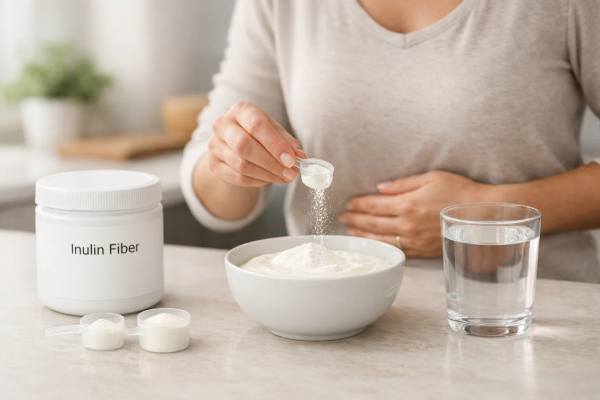
Inulin is a naturally occurring, plant-based fiber that acts as a prebiotic—meaning it feeds helpful gut microbes rather than feeding you directly. Many people use it to support regularity, improve stool softness, and promote a healthier microbiome profile, especially when typical diets fall short on fiber. Inulin is also added to packaged foods as “chicory root fiber,” which can quietly raise your daily intake without you realizing it. The catch is that inulin ferments quickly in the colon, and that same fermentation that supports beneficial bacteria can also trigger gas, bloating, and cramping—particularly when the dose jumps too fast or when someone is sensitive to fermentable carbohydrates. The best results come from treating inulin like a skill: choose the right form, start lower than you think you need, and increase in small steps while tracking stool changes and comfort. This guide explains how inulin works, what benefits are realistic, and how to titrate it without feeling miserable.
Key Insights for Using Inulin Well
- Inulin can improve stool softness and regularity over 1–2 weeks when constipation is linked to low fiber intake and low stool water.
- Prebiotic effects are often strongest in people who start with low fiber diets and low baseline levels of beneficial bacteria.
- Gas and bloating are dose-dependent and usually reflect rapid fermentation, not “toxins leaving your body.”
- Begin with 1 gram daily, increase slowly every few days, and pause at the first dose that improves stools without persistent discomfort.
Table of Contents
- What inulin fiber is
- How inulin works as a prebiotic
- Benefits you can realistically expect
- Why inulin causes gas and bloating
- Best ways to titrate inulin
- Choosing foods and supplement forms
- Who should avoid inulin and safer options
What inulin fiber is
Inulin is a soluble, fermentable fiber found in many plants. It belongs to a family called inulin-type fructans, which are chains of fructose molecules. Your small intestine does not digest these chains well, so inulin reaches the large intestine mostly intact. There, gut microbes ferment it and produce short-chain fatty acids and gas. That fermentation is the reason inulin can be both helpful and uncomfortable.
Where inulin comes from
Inulin occurs naturally in foods such as chicory root, Jerusalem artichoke, onions, garlic, leeks, asparagus, and wheat. For supplements and food manufacturing, chicory root is a common source. On ingredient lists, inulin may appear as:
- Inulin
- Chicory root fiber
- Chicory root extract
- Oligofructose or fructooligosaccharides (related, shorter-chain forms)
Inulin, oligofructose, and chain length
Not all inulin-type fructans behave the same. Chain length influences where and how quickly fermentation happens:
- Shorter-chain fructans (often labeled oligofructose or FOS) tend to ferment faster and can cause symptoms at lower doses in sensitive people.
- Longer-chain inulin may ferment more gradually for some people and can feel slightly easier to tolerate, although individual responses vary.
If you have tried a “prebiotic” powder and felt miserable, you may not be “bad at fiber.” You may have taken a type or dose that ferments too aggressively for your current gut environment.
Why inulin shows up in packaged foods
Manufacturers add inulin because it increases fiber content, improves texture, and can replace some sugar or fat. The practical issue is that you might already be getting several grams daily without noticing. If you add a supplement on top of fiber-fortified bars, cereals, and protein powders, the combined dose can climb quickly—often explaining sudden bloating.
The main point: inulin is a legitimate fiber tool, but it is not a generic “more is better” ingredient. Knowing what it is and where it hides is the first step to using it without side effects.
How inulin works as a prebiotic
A prebiotic is not just “fiber.” It is a substrate that is selectively used by certain gut microbes in a way that can benefit the host. Inulin fits this definition because it tends to favor microbes that produce helpful metabolites—especially short-chain fatty acids—while shifting the gut ecosystem in a direction many people associate with better digestive comfort and metabolic health.
Fermentation and short-chain fatty acids
When inulin reaches the colon, microbes ferment it into short-chain fatty acids (SCFAs) such as acetate, propionate, and butyrate. These metabolites can:
- Support the health of colon cells and the gut barrier
- Influence water movement and stool consistency
- Interact with immune signaling in the gut lining
- Affect appetite-related hormones and glucose regulation in some people
SCFAs are one reason inulin is often discussed beyond constipation. But it is important to keep expectations realistic: inulin is a support tool, not a stand-alone treatment for chronic disease.
Which microbes respond to inulin
Inulin is commonly associated with increased abundance of bacteria in groups often described as beneficial, including Bifidobacterium. But gut microbiomes are personal ecosystems, not identical machines. Your response depends on:
- Your baseline fiber intake (low-fiber diets often show stronger shifts)
- Recent antibiotics or infections
- How quickly your gut moves (slow transit changes fermentation patterns)
- Whether you are already eating a diversity of plant fibers
A practical way to think about this is “fertilizer.” If your gut already has a diverse garden, fertilizer may produce modest changes. If your gut has been running on low fiber for years, fertilizer may produce bigger changes—but also more gas during the transition.
Cross-feeding and why effects vary
Not all microbes digest inulin directly. Often, one group breaks inulin down and produces byproducts that another group uses. This cross-feeding can be helpful because it supports a network of microbes, but it also explains why the same inulin dose can feel soothing for one person and uncomfortable for another. If your microbiome ferments inulin rapidly at the “front end” of the colon, you may get more bloating. If fermentation is more evenly distributed, you may get better stool changes with fewer symptoms.
The take-home message is not that inulin is unpredictable. It is that inulin is interactive: it works through your existing microbiome, so the safest and most effective approach is gradual titration and careful dose selection rather than a single large daily scoop.
Benefits you can realistically expect
Inulin is often marketed as a cure-all, but it shines most when your goals are specific: improve stool quality, support regularity, and gently shift the microbiome in a more favorable direction. Benefits are usually modest but meaningful when they match the right problem.
Regularity and constipation support
Inulin can help constipation by increasing stool water and stool bulk through fermentation effects. In everyday terms, people often notice:
- Softer stools (less dry, less pellet-like)
- Less straining
- More consistent timing of bowel movements
The change is typically gradual. Many people notice stool-form changes within a week and more consistent frequency within 2–4 weeks, especially when inulin is paired with adequate hydration and a consistent morning routine.
Microbiome and digestive comfort
Inulin’s prebiotic effects often show up as shifts in gut bacteria that produce SCFAs. For some people, this correlates with improved comfort and less irregularity over time. For others, the initial phase is gassy, and the benefit only appears once the dose is stabilized and the gut adapts.
Metabolic and appetite-related effects
Some people use inulin-type fructans as part of a broader plan for weight management or metabolic health. In clinical studies, changes can include small improvements in body weight, waist measures, or appetite regulation markers. These effects tend to be:
- More noticeable with consistent use over 8–12 weeks
- More likely when baseline diet quality is low and fiber intake is low
- Less impressive when added as a single intervention without broader nutrition changes
Mineral absorption and other systemic benefits
There is interest in inulin’s potential effects on mineral absorption (especially calcium and magnesium) and gut barrier support. These are plausible and sometimes supported by human data, but they are not guaranteed outcomes. The most consistent “day-to-day” benefits most people can track are still bowel-related: stool form, straining, and abdominal comfort.
Who tends to benefit most
- People who eat few plant foods and fall short on fiber
- People with mild constipation driven by hard stools
- People who tolerate fermentable fibers reasonably well
- People willing to titrate slowly rather than chase a fast fix
If your main symptom is severe bloating, pain, or diarrhea, inulin may not be the best first-line fiber. In those cases, a gentler, lower-fermentation fiber may deliver benefits with fewer side effects.
Why inulin causes gas and bloating
Gas is not a sign that inulin is “cleaning you out.” It is a sign that microbes are fermenting it. The goal is not to eliminate fermentation—that is part of the benefit—but to keep fermentation at a level your body finds tolerable.
The biology of inulin gas
When microbes ferment inulin, they produce gases such as hydrogen and carbon dioxide. Some people also produce methane depending on their microbial profile. Gas becomes uncomfortable when it is produced faster than it can be moved along or expelled. That discomfort can feel like:
- Visible distension (your abdomen looks larger by evening)
- Pressure under the ribs or deep pelvic heaviness
- Cramping that improves after a bowel movement
- Rumbling, frequent passing gas, or trapped gas sensations
Why side effects are so dose-dependent
Most unpleasant reactions are caused by one of these patterns:
- Starting at a high dose (for example, a full tablespoon)
- Increasing too quickly (doubling every day or two)
- Adding inulin on top of other fermentable fibers without adjusting the total load
- Taking inulin when constipation is severe and stool is retained (more time for fermentation)
The “stacking” problem is common: someone adds inulin powder while also eating protein bars with chicory root fiber, drinking a fiber-added beverage, and eating large servings of onions or garlic. The total fermentable load becomes high, and symptoms spike.
IBS, FODMAP sensitivity, and why inulin can backfire
Inulin is a fermentable carbohydrate and is often poorly tolerated by people with IBS who are sensitive to certain fermentable fibers. If you have IBS and notice that onions, garlic, wheat, or certain fruit trigger symptoms, inulin is more likely to cause bloating, pain, or urgency. In that scenario, the correct move is not to “push through.” It is to switch to a fiber strategy that fits your sensitivity profile.
Adaptation is real, but not unlimited
Many people adapt over 1–2 weeks at a stable dose. Gas often decreases as the microbiome adjusts and as your gut becomes more efficient at handling fermentation. But persistent pain, significant distension, or disrupted sleep is a signal that the dose is too high or the fiber type is not a match.
A useful rule: mild gas is acceptable during titration. Persistent bloating that changes your daily functioning is not. Your goal is a dose that improves stools without turning digestion into a daily project.
Best ways to titrate inulin
Titration is the difference between “inulin works for me” and “inulin wrecked my stomach.” Most people start too high, increase too quickly, and never discover their personal effective dose.
Start lower than you think
For many adults, a smart starting dose is 1 gram daily. That is often far less than a typical scoop. If you do not have a gram scale, choose a product with a small measuring spoon or use a cautious visual estimate (for many powders, 1 gram is roughly a small fraction of a teaspoon). Precision is less important than consistency and restraint.
A practical 4-week titration schedule
Use this as a template and adjust based on symptoms:
- Days 1–4: 1 gram once daily
- Days 5–8: 2 grams once daily
- Days 9–12: 3 grams once daily
- Days 13–16: 4 grams once daily
- Days 17–21: 5 grams once daily
- Weeks 4 and beyond: hold at 5 grams if stools improved, or increase by 1–2 grams per week only if needed and tolerated
Many people do well in the 3–6 gram range. Others may tolerate 8–10 grams with slow titration. Going higher is not automatically better and is a common reason for persistent gas.
Split dosing to reduce symptoms
If you get bloating at 3–5 grams, try splitting:
- Half the dose with breakfast
- Half the dose with dinner
Smaller amounts ferment more evenly and may feel less dramatic.
Take it with meals and pair it with water
Taking inulin with food can slow delivery to the colon and reduce the “all at once” fermentation effect. Hydration matters too, especially if you are using inulin for constipation. Fiber works best when stool has enough water available.
How to know you found your dose
Your “right dose” is the lowest dose that produces these changes for at least one week:
- Stools are softer and easier to pass
- Straining decreases
- Bloating is mild and does not disrupt your day
If symptoms worsen, do not quit immediately. Step back to the previous tolerated dose for 3–7 days, then decide whether to retry an increase more slowly. If bloating remains significant at very low doses, inulin may not be the right fiber for you right now.
Avoid the two common mistakes
- Do not increase the dose during travel, major stress, or a constipation flare.
- Do not add multiple new fibers at once. You will not know what helped or harmed.
Titration is not a test of toughness. It is a method to find your effective dose with the least side effects.
Choosing foods and supplement forms
You can increase inulin intake through foods, supplements, or a combination. The best choice depends on your tolerance, your cooking habits, and how sensitive you are to fermentable fibers.
Food sources and the tolerance tradeoff
Natural sources of inulin include onions, garlic, leeks, asparagus, chicory root, and Jerusalem artichoke. Foods offer benefits beyond fiber—vitamins, minerals, and plant compounds—but they also introduce multiple fermentable carbohydrates at once. If you are sensitive, food-based increases can feel unpredictable.
A practical approach is to choose one inulin-rich food, introduce it in a small portion several times per week, and expand slowly. For example:
- Use a small amount of cooked onion or leek rather than large raw servings
- Add asparagus as a side once or twice weekly before increasing frequency
- Treat Jerusalem artichoke as a “high impact” food and start very small
Supplement forms and what labels mean
Common supplement styles include:
- Chicory root inulin powder: often the most straightforward and widely available
- Oligofructose or FOS powders: can be more fermentable and more symptom-provoking in sensitive individuals
- Fiber blends: may combine inulin with other fibers; helpful for some, harder to titrate cleanly
Also check your packaged foods. “Chicory root fiber” in bars, cereals, and protein products can add several grams per serving. If you are titrating inulin, consistency matters. Try to keep your background inulin intake steady so your supplement dose is the main variable.
How to use inulin without “fiber shock”
- Mix thoroughly into yogurt, oatmeal, or a smoothie rather than dumping into a small glass of water and chugging.
- Avoid combining a new inulin dose with a very high-fermentation meal the same day.
- If you are prone to bloating, consider using inulin earlier in the day and keeping dinner simpler.
When a different fiber may be a better starting point
If your goal is constipation relief with minimal gas, you may do better starting with a gentler fiber, then introducing inulin later. Some people tolerate gel-forming fibers or partially fermented fibers better than inulin during the first phase of building regularity.
The best form is the one you can take consistently without dread. If a supplement “works” but makes you feel distended and uncomfortable, it is not a sustainable solution—no matter how impressive the microbiome claims look on the label.
Who should avoid inulin and safer options
Inulin is generally safe as a food ingredient and often safe as a supplement in reasonable doses, but it is not a universal fit. The most important safety skill is recognizing when inulin is the wrong tool for your current situation.
Who should use caution or avoid inulin supplements
Consider avoiding or using only clinician-guided trials if you have:
- IBS with strong sensitivity to fermentable carbohydrates (frequent bloating, pain, or diarrhea triggered by onions, garlic, or wheat)
- Active small intestinal bacterial overgrowth patterns or methane constipation patterns where fermentable fibers worsen symptoms
- Inflammatory bowel disease during a flare, especially if you have significant symptoms or known strictures
- A history of bowel obstruction, severe narrowing, or unexplained severe abdominal pain
- Significant, unexplained weight loss, blood in stool, persistent fever, or anemia
Medication and supplement timing
Gel-forming and fermentable fibers can alter absorption for some oral medications and supplements. A practical habit is to separate inulin from important medications by 1–2 hours unless your clinician advises differently.
Safer alternatives when gas is the main problem
If inulin causes persistent bloating even at low doses, consider alternatives that many people tolerate better:
- Psyllium husk: a gel-forming fiber often used for constipation and stool regulation; start low and increase slowly with water
- Partially hydrolyzed guar gum (PHGG): a gentler prebiotic-style fiber for some people
- Food-based options for constipation: kiwifruit, prunes, and adequate fluids often improve stool softness without requiring high-fermentation powders
- Osmotic laxatives: for stubborn constipation, an osmotic option can be more predictable than escalating fermentable fiber
When to get evaluated instead of titrating fiber
If constipation is severe, painful, or paired with incomplete evacuation, fiber alone may not solve it. Pelvic floor dysfunction and slow transit constipation often require targeted evaluation and treatment. If you have soft stools but still feel blocked, adding more fermentable fiber can worsen bloating without improving evacuation.
Inulin can be an excellent tool when constipation is mild to moderate and the gut tolerates fermentation. When it is not, the right move is not to force it—it is to choose a strategy that matches your physiology and keeps symptoms stable.
References
- The Prebiotic Potential of Inulin-Type Fructans: A Systematic Review – PMC 2021 (Systematic Review)
- Inulin-induced improvements on bowel habit and gut microbiota in adults with functional constipation: findings of a randomized, double-blind, placebo-controlled study – PMC 2025 (RCT)
- The effects of chicory inulin-type fructans supplementation on weight management outcomes: systematic review, meta-analysis, and meta-regression of randomized controlled trials – PMC 2024 (Systematic Review and Meta-Analysis)
- Immunomodulatory effects of inulin and its intestinal metabolites – PMC 2023 (Review)
Disclaimer
This article is for educational purposes and does not provide medical advice, diagnosis, or treatment. Fiber supplements can worsen symptoms or be unsafe in certain conditions, including inflammatory bowel disease flares, known strictures, bowel obstruction risk, and significant swallowing or gastrointestinal motility disorders. Seek prompt medical care for severe abdominal pain, vomiting, inability to pass gas, significant rectal bleeding, black stools, unexplained weight loss, persistent fever, or signs of dehydration. Always consult a qualified clinician before starting new supplements if you are pregnant, breastfeeding, managing chronic illness, or taking prescription medications.
If you found this article helpful, please consider sharing it on Facebook, X (formerly Twitter), or any platform you prefer.