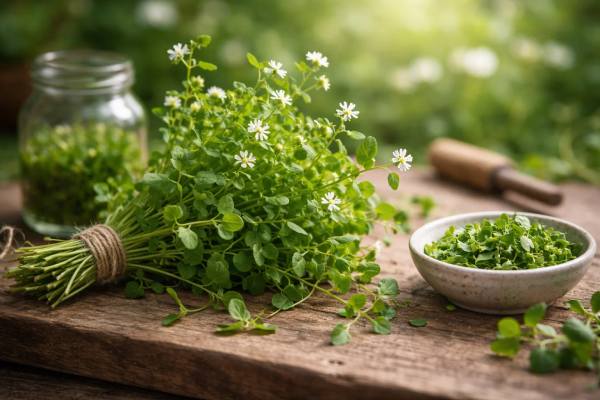
Chickweed (Stellaria media) is one of those humble plants that quietly earns a permanent place in traditional herbalism: soft, green, and often growing at the edges of gardens and paths. Herbalists value chickweed for its cooling, soothing feel—especially on irritated skin—and for gentle support when the body feels “hot,” puffy, or uncomfortable. Fresh chickweed has a mild taste that makes it approachable as a food herb, while topical preparations are commonly used for itchiness, minor rashes, and seasonal skin flare-ups.
Modern interest focuses on chickweed’s blend of flavonoids, saponins, minerals, and plant mucilage. Together, these compounds help explain why chickweed can feel calming on the skin and supportive for everyday inflammation. Still, “natural” does not mean risk-free. Chickweed can upset sensitive stomachs when taken in large amounts, and quality matters because wild-harvested greens can be contaminated by pesticides or misidentified.
This article walks through what chickweed is, what it contains, what it may help with, and how to use it safely and realistically.
Quick Takeaways for Chickweed
- May soothe itchy, irritated skin when used as a fresh poultice or properly made salve.
- Large oral amounts can cause nausea and diarrhea, especially in people sensitive to saponins.
- Typical adult ranges are about 2–4 g dried herb per cup of tea (up to 3 cups/day) or 2–4 mL tincture up to 3 times/day.
- Avoid if pregnant, breastfeeding, or taking blood thinners without clinician guidance.
Table of Contents
- Chickweed and its compounds
- Does chickweed help itchy skin
- Chickweed benefits for digestion and water balance
- How to use chickweed safely
- How much chickweed per day
- Side effects, interactions, and who should avoid
- What the evidence actually says
Chickweed and its compounds
Chickweed (Stellaria media) is a low-growing, tender annual that thrives in cool, moist conditions. Many people first notice it as a “volunteer green” in lawns, garden beds, and sidewalk cracks—often forming soft mats with small, star-like white flowers. It is widely considered edible when correctly identified, and the young stems and leaves are the parts most commonly used in food and herbal preparations.
Because chickweed is a common wild plant, two practical skills matter as much as any benefit claim: correct identification and clean sourcing. Chickweed has smooth, delicate leaves and slender stems that can show a single line of fine hairs running along one side (a classic field marker). It also exudes a mild, watery “green” scent when crushed and can feel slightly mucilaginous. Still, foraging mistakes happen. If you are not confident identifying it, avoid harvesting it from the wild and choose reputable dried herb suppliers instead.
Chickweed’s “feel” in the body is often described as cooling and soothing, especially for skin. That sensory effect is backed by its chemistry. Key constituent groups include:
- Flavonoids (plant pigments and antioxidants): often discussed in chickweed research for their role in oxidative stress and inflammatory signaling.
- Saponins: soap-like compounds that can contribute to traditional “clearing” uses, but can also irritate the digestive tract in high amounts.
- Phenolic acids and related polyphenols: supportive antioxidant compounds that may contribute to skin and tissue comfort.
- Minerals and vitamins: chickweed is sometimes used like other nutrient-dense wild greens. The exact nutrient profile varies by soil and harvest conditions, so it is best viewed as a supportive food herb rather than a reliable supplement replacement.
- Mucilage and gentle polysaccharides: these are part of why fresh chickweed can feel slippery and calming on irritated skin.
If you already enjoy nutrient-dense wild greens, chickweed fits that category, though it tends to be milder and more “soft-textured” than many foraged plants. For comparison, stinging nettle health benefits offers a useful reference point for how another wild green is used for minerals and everyday resilience (with its own handling rules).
The main takeaway: chickweed is best thought of as a gentle, fresh herb with a soothing profile—especially topically—rather than a high-potency botanical. That mindset helps you use it appropriately and avoid overpromising what it can do.
Does chickweed help itchy skin
Chickweed’s strongest reputation is topical: itchiness, mild rashes, and irritated skin that feels hot, tight, or reactive. In traditional use, chickweed is often described as “cooling,” which is a practical way of saying it can reduce the urge to scratch and make the skin feel less inflamed. The most realistic expectation is comfort support—not a cure for chronic skin disease—especially when chickweed is paired with good barrier care and trigger management.
What chickweed may help with
People most often reach for chickweed for:
- Mild itchy patches and “dry, angry” skin days
- Seasonal irritations (for example, when heat, sweat, or pollen make skin more reactive)
- Minor bug bites and mild sting sensations
- Light friction irritation (chafing)
- Minor redness after shaving or grooming
- Supportive care around small scratches once the area is clean and not infected
The most helpful formats are fresh or properly infused preparations, because chickweed’s soothing feel is partly a “whole-plant” effect. When chickweed is crushed, its moisture and mucilage create a slippery layer that can temporarily calm the surface of the skin. Flavonoids and other polyphenols may add a mild anti-inflammatory and antioxidant influence. Saponins can contribute a gentle cleansing quality, though they are also one reason some people find chickweed slightly irritating on very sensitive skin.
Best practice: comfort plus barrier
Chickweed works best when you treat it as one part of a simple skin strategy:
- Calm the surface (chickweed poultice or salve)
- Protect the barrier (a bland moisturizer or occlusive layer, if tolerated)
- Reduce friction and triggers (heat, harsh soaps, scratching)
If you want a straightforward comparison to another widely used soothing plant, aloe vera benefits and safety can help you see how “cooling plants” overlap while still having different best-use cases. Aloe is often chosen for heat-related irritation and minor burns, while chickweed is frequently chosen for itch and reactive patches.
When chickweed is not enough
Topical chickweed is not a substitute for medical care when symptoms suggest infection or a significant inflammatory condition. Seek evaluation if you have:
- Spreading redness, warmth, swelling, or pus
- Fever or systemic symptoms
- A rash that blisters, crusts, or becomes very painful
- Severe eczema, psoriasis flare, or persistent hives
- Any rash in infants that worsens quickly
Also consider the possibility of contact sensitivity. Even gentle herbs can trigger dermatitis in a small subset of people. A patch test on a small area is a smart move—especially if you are using a new salve or a concentrated extract.
Used thoughtfully, chickweed can be a practical “first reach” for itch comfort, especially when fresh. The key is staying in the lane of mild-to-moderate irritation and pairing it with good skin basics.
Chickweed benefits for digestion and water balance
While chickweed is best known as a topical herb, many people also use it internally—most commonly as tea, tincture, or fresh greens. Traditional internal uses often center on “cooling” the system, supporting digestion, and easing a sense of puffiness or fluid retention. These uses can be reasonable for some adults, but they require realistic expectations and a bit more attention to dosing and tolerance than topical use.
Digestive comfort and gentle nourishment
As a food herb, chickweed is mild. People add it to salads, pesto-style blends, or lightly wilt it into soups. In that context, chickweed acts less like a “medicine” and more like a soft, mineral-containing green that some people find easier to eat than bitter wild plants. When digestion feels irritated or overheated, the demulcent (soothing) feel of chickweed may be one reason it’s traditionally chosen.
That said, chickweed contains saponins. In large oral amounts, saponins can irritate the gut lining and cause nausea or diarrhea. So the internal story is a balance: small to moderate amounts may feel soothing for some, while overly large doses can backfire.
Water balance and “puffiness” support
Chickweed is sometimes used as a gentle diuretic—helping the body move excess water. People may describe this as easing “puffiness,” mild bloating, or the heavy feeling that comes from salty meals and long sitting. If this is your goal, it helps to compare chickweed to another classic “water balance” botanical: dandelion benefits and safety provides a practical reference for how mild diuretics can help some people while still requiring caution in kidney disease, dehydration risk, or medication use.
A useful mindset is: water balance herbs can support comfort, but they are not weight-loss tools in the meaningful sense. If a product promises “rapid fat loss” from chickweed, treat that as marketing rather than physiology.
Metabolism and weight-loss claims
Chickweed is sometimes promoted for weight loss. The more realistic interpretation is that chickweed may support habits that indirectly help weight management—like eating more greens, improving meal quality, and reducing ultra-processed snacks. Some preclinical research explores how chickweed extracts influence metabolic pathways, but that does not automatically translate to reliable human fat loss. If you want to experiment, do it as a food habit first: adding chickweed to meals you already eat.
Urinary comfort and general “cooling” use
Traditional uses sometimes include urinary tract comfort. Here, caution is important: urinary symptoms can signal infection or kidney involvement, and delaying evaluation can be risky. If you have burning urination, fever, flank pain, or blood in urine, prioritize medical assessment rather than self-treatment with herbs.
Internal chickweed can be a gentle addition for some people—especially as a fresh green or mild tea—but it should stay in the realm of supportive care. If you are using it primarily for diuretic effects or metabolic goals, keep the dose conservative and watch hydration and electrolytes.
How to use chickweed safely
Chickweed can be used fresh, dried, or as a prepared extract. The best form depends on your goal. For skin comfort, fresh or infused topical preparations are often preferred. For internal use, mild tea or tincture formats are common. Across all forms, the safety foundation is the same: correct identification, clean sourcing, and conservative dosing.
Fresh chickweed (topical and culinary)
For topical comfort, fresh chickweed is often used as a quick poultice:
- Rinse thoroughly and pat dry.
- Crush or chop until the plant becomes wet and slightly slippery.
- Apply to clean skin for 10–20 minutes.
- Remove and rinse gently if needed.
- Follow with a bland moisturizer if your skin tolerates it.
For food use, young chickweed can be added to salads or blended into sauces. If you are new to it, start with small amounts to see how your digestion responds.
Chickweed tea
Tea is usually made from dried herb because fresh chickweed tea can be very mild unless you use a large quantity. A practical approach is a gentle infusion rather than a strong medicinal brew. Many people tolerate a mild tea better than an aggressive “detox” style preparation.
Tincture and glycerite
Tinctures offer convenience and consistent dosing, but they can be more concentrated than tea. They are a reasonable choice when you want predictable amounts and don’t want to drink multiple cups daily. Look for products that clearly state the herb part used (aerial parts), the extraction ratio, and alcohol percentage.
Oil infusion and salve
Chickweed salve is a classic format for itch comfort, but it must be prepared carefully because fresh, watery plants can introduce moisture into oil and increase spoilage risk. Many salve makers use a “wilted” or gently dried chickweed before infusing it into oil.
A simple, safer approach is:
- Use dried chickweed (or thoroughly wilted) for oil infusion
- Infuse into a stable carrier oil (like olive oil)
- Strain well
- Thicken with beeswax to make a salve
- Store cool and watch for changes in smell or texture
Chickweed is often paired with other skin-friendly herbs in topical formulas. calendula health benefits and uses is a common companion in salves because it supports skin comfort and is widely used in barrier-focused topical care.
Capsules and powders
Capsules can be convenient, but quality varies. Choose products with clear labeling, batch information, and ideally third-party testing. Avoid “mega-dose” blends that combine multiple diuretic herbs unless you understand the cumulative effects.
No matter the form, treat chickweed as a gentle herb. If you push the dose to chase faster results, you’re more likely to run into the most common problem: digestive upset.
How much chickweed per day
Chickweed dosage depends on whether you’re using it as food, a tea, a tincture, or a capsule. Human clinical dosing standards are limited, so the most responsible approach is to use conservative ranges and treat your body’s response as a guide. Start low, increase slowly, and stop if you develop stomach upset, unusual fatigue, rash, or other new symptoms.
Fresh chickweed as food
For culinary use, chickweed dosing is naturally self-limiting:
- Start with a small handful mixed into a salad or blended into a sauce
- If tolerated, increase to 1–2 handfuls per day as part of meals
If you are prone to gas, cramping, or loose stools from raw greens, lightly wilting chickweed may be easier to tolerate than eating it raw.
Dried chickweed tea
A practical adult range is:
- 2–4 g dried herb per cup, steeped 10–15 minutes
- 1–3 cups per day, depending on tolerance and goal
If you’re using chickweed for “cooling” or water balance support, consistency is usually more useful than intensity. A mild daily tea is often preferable to a very strong tea that you can’t tolerate.
Tincture dosing
Tinctures vary by strength (for example, 1:5 vs 1:2 extracts), so label guidance matters. A common conservative range for adults is:
- 2–4 mL, up to 3 times daily
If you are combining chickweed tincture with other diuretic herbs, start at the low end to avoid dehydration or dizziness.
Capsules and powdered products
Because chickweed capsules vary widely, follow the product label and avoid stacking multiple high-dose products. A typical conservative range in many products is:
- 500–1,500 mg per day, divided if needed
If a capsule causes nausea, try taking it with food, lowering the dose, or switching to tea.
Timing and duration
- For skin support (internal): consider a 2–4 week trial, then reassess.
- For water balance comfort: use for short windows (days to a couple of weeks), not continuously for months, unless a clinician advises otherwise.
- For food use: ongoing culinary use is reasonable if it’s well tolerated and sourced safely.
One of the most overlooked dosage factors is sourcing. Chickweed harvested from lawns or roadsides may carry pesticides, herbicides, or heavy metals. If you are using chickweed daily, choose clean sources—this matters as much as the milligram number.
Side effects, interactions, and who should avoid
Chickweed is often described as gentle, and for many adults it is—especially when used topically or in modest culinary amounts. Most safety issues come from three areas: digestive irritation from large oral doses, contamination or misidentification, and interactions related to diuretic effects or nutrient content.
Common side effects
The most common side effects are gastrointestinal and dose-related:
- Nausea or stomach discomfort
- Loose stools or diarrhea
- Cramping, especially with strong tea or high-dose capsules
These effects are often linked to saponins and to taking too much too quickly. If this happens, stop and return to smaller amounts (or switch to topical use only).
Topically, chickweed is generally well tolerated, but contact reactions are possible:
- Local redness or itching (especially on very reactive skin)
- Rash in people with plant sensitivities
Patch testing is a smart habit with any new salve.
Who should avoid chickweed
Avoid chickweed supplements (and use extra caution even with tea) if you are:
- Pregnant or breastfeeding, because safety data for concentrated use are limited
- Taking blood thinners (anticoagulants or antiplatelets), unless your clinician approves
- Preparing for surgery, unless your clinician advises it’s safe to continue
- Living with moderate to severe kidney disease, where diuretic herbs can complicate fluid and electrolyte balance
- Highly prone to dehydration, low blood pressure, or fainting
If you take chickweed as a daily green, remember that leafy plants can contain vitamin K, which matters for people using warfarin. The safest approach is consistency and clinician guidance rather than abrupt changes.
Medication and supplement interactions to consider
Chickweed may not be as interaction-prone as some concentrated botanicals, but caution is still reasonable with:
- Diuretic medications (possible additive fluid loss)
- Lithium (diuretic shifts can affect lithium levels)
- Blood pressure medications (if chickweed increases urination and lowers blood pressure slightly)
- Anticoagulants and antiplatelets (especially if you use chickweed heavily as a green)
Quality and contamination risks
With foraged plants, risk is often less about the plant and more about what’s on the plant:
- Pesticides and herbicides from treated lawns
- Heavy metals near roads or industrial areas
- Pet waste contamination
- Mold risk in improperly dried or infused products
If your chickweed product smells musty, looks discolored, or causes unexpected symptoms, stop using it.
Chickweed can be a safe, helpful herb when used in reasonable amounts and sourced well. The simplest safety strategy is to stay modest with internal dosing, prioritize topical use when your goal is skin comfort, and avoid wild harvesting unless you’re confident in identification and clean collection practices.
What the evidence actually says
Chickweed is popular in traditional herbalism, but modern research is still catching up to everyday use patterns. The evidence base is best described as “promising but uneven,” with much stronger support for biological plausibility and lab findings than for large, definitive human trials. That doesn’t make chickweed ineffective—it just means the honest claims should stay grounded.
What research supports most consistently
Modern studies commonly focus on chickweed’s antioxidant, enzyme-inhibiting, and anti-inflammatory activity in laboratory settings. These studies help explain why chickweed is used for irritated skin and general inflammatory comfort. Research also shows chickweed contains flavonoids and other phenolics that can plausibly support skin barrier calm and oxidative stress balance.
A smaller body of research explores topical delivery systems (such as advanced formulations designed to help plant compounds penetrate skin more effectively). This direction is consistent with chickweed’s traditional topical focus: if the goal is skin comfort, enhancing localized delivery may be more relevant than chasing systemic absorption.
What is still uncertain
The biggest gap is human clinical evidence. Many traditional claims—like chickweed for weight loss, cholesterol reduction, or strong metabolic effects—are not strongly supported by robust human trials. Some animal studies explore metabolic parameters, and some show interesting signals, but animal outcomes can be misleading if translated too directly. Differences in dose, extraction method, and administration route matter a lot.
For example, “chickweed tea” and “chickweed extract” are not interchangeable. A concentrated extract may deliver far more active compounds than a mild infusion, and that difference affects both results and side effects.
How to interpret traditional use responsibly
A practical way to use chickweed in evidence-aware terms is to match it to the areas where tradition and biology align:
- Topical itch and irritation comfort: strongest traditional use and plausible mechanism
- Gentle internal support for “hot” discomfort: plausible, but response varies and dose matters
- Water balance comfort: plausible, but can be overstated and may interact with meds
When chickweed is used as part of a broader routine—hydration, barrier skincare, trigger reduction, balanced meals—it often makes more sense than when it is treated as a stand-alone solution.
What to look for in products
If you want the most “evidence-aligned” approach:
- Choose products that specify the plant part (aerial parts) and extraction method
- Avoid proprietary blends that hide actual amounts
- Prefer reputable brands with batch identification and contaminant screening
- Use a realistic trial window (2–8 weeks depending on the goal) and track outcomes
Overall, chickweed’s best-supported role is as a gentle, soothing herb—especially topically—rather than a high-impact supplement for weight loss or major metabolic change. If you keep your expectations matched to that profile, chickweed becomes a useful tool instead of a disappointing promise.
References
- Stellaria media Linn.: A comprehensive review highlights the nutritional, phytochemistry, and pharmacological activities 2022 (Review)
- Evaluation of In Vitro Wound-Healing Potential, Antioxidant Capacity, and Antimicrobial Activity of Stellaria media (L.) Vill 2021
- Small Steps to the Big Picture for Health‐Promoting Applications Through the Use of Chickweed (Stellaria media): In Vitro, In Silico, and Pharmacological Network Approaches 2024
- Stellaria media tea protects against diabetes-induced cardiac dysfunction in rats without affecting glucose tolerance 2021
- Microfluidic Design of Ultradeformable Liposomes for Advanced Skin Delivery of Stellaria media Phytocomplex 2025
Disclaimer
This article is for educational purposes only and does not provide medical advice, diagnosis, or treatment. Herbal products can vary widely in strength, purity, and contamination risk, especially when plants are wild-harvested or used in homemade preparations. If you are pregnant or breastfeeding, have kidney disease, bleeding disorders, or chronic health conditions, or take prescription medications (especially blood thinners, diuretics, blood pressure medicines, or lithium), consult a qualified clinician before using chickweed internally or in concentrated products. Seek medical care promptly for severe allergic reactions, worsening rashes, signs of infection, dehydration, or persistent gastrointestinal symptoms.
If this guide helped, please share it on Facebook, X (formerly Twitter), or your preferred platform so others can use chickweed more safely and effectively.