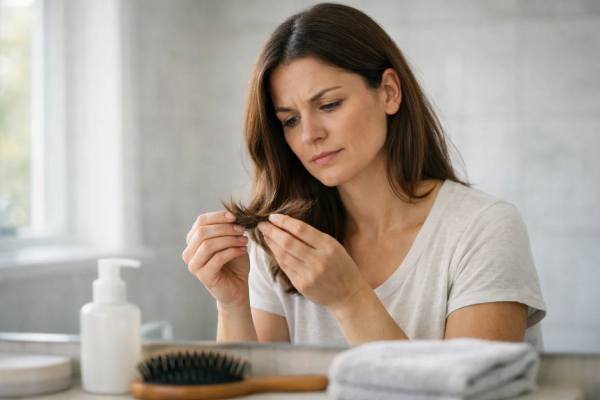
It usually starts with a quiet frustration. You trim your hair, wait months, and the length seems unchanged. The ends still look thin. The ponytail does not feel fuller. The front pieces never catch up. At that point, many people conclude that their hair has simply “stopped growing.” In reality, that is not always what is happening.
Hair that seems stuck can reflect several different problems: a naturally shorter growth phase, heavy breakage, stress-related shedding, scalp inflammation, nutritional strain, hormonal shifts, or early pattern hair loss. Some of these issues slow visible progress without truly shutting down growth. Others shorten the hair cycle, so hairs are shed before they can reach the length or density you expect. The useful part is that these patterns can often be separated once you know what to look for. The goal is not to chase one miracle fix. It is to understand whether your hair is growing too slowly, breaking too fast, shedding too often, or struggling because the scalp and follicles are under strain.
Quick Summary
- Hair that seems stuck is often breaking or shedding before length can accumulate, not failing to grow at all.
- Early identification of scalp issues, nutritional deficits, and pattern hair loss creates more options for improvement.
- Gentle handling, enough protein and calories, and a consistent scalp routine often improve length retention more than trendy products do.
- Persistent thinning, patchy loss, scalp pain, or sudden heavy shedding should not be treated as a simple cosmetic problem.
- Track your part, hairline, and overall length with monthly photos for at least 3 months before judging whether a change is helping.
Table of Contents
- What Normal Hair Growth Looks Like
- When Length Loss Is Really Breakage
- Shedding Can Make Growth Seem Stalled
- Scalp Problems That Hold Hair Back
- Hidden Medical and Lifestyle Triggers
- Fixes That Help and When to Act
What Normal Hair Growth Looks Like
One of the most useful starting points is that hair growth and visible hair length are not the same thing. A follicle can be producing hair normally while the person looking in the mirror feels that nothing is happening. That mismatch is common, and it explains why “my hair is not growing” often turns out to mean “my hair is not getting longer the way I expected.”
Scalp hair grows in repeating cycles. The longest phase is anagen, the active growth phase. Then comes catagen, a short transition phase, followed by telogen, the resting phase, and exogen, the stage in which the old hair is shed. In healthy conditions, individual follicles cycle independently, which helps keep density fairly stable. The reason this matters is simple: length depends on how long a follicle stays in anagen. If your growth phase is shorter, your hair may still grow normally day to day but never reach the same length as someone whose follicles stay in anagen for years longer.
That is why two people can have healthy hair and still have very different “terminal lengths.” One person’s hair may grow to the waist with ordinary care. Another’s may stall around the shoulders because the growth phase is shorter or because the distal ends cannot survive long enough to show the true growth happening at the root. A good way to ground expectations is to understand broader hair growth timelines before concluding that the follicles are inactive.
A few realities help set the frame:
- Scalp hair usually grows gradually, not dramatically.
- Growth is easier to miss when trims, shrinkage, curl pattern, and breakage are involved.
- Dense hair often looks as if it is growing faster because fullness makes length more visible.
- Fine or fragile hair may gain length at the root but still look unchanged at the ends.
Another common misunderstanding is the difference between density and length. People often say their hair is not growing when the real concern is that it looks thinner than before. That points toward shedding, miniaturization, or breakage more than toward complete failure of growth.
This is also where patience matters. Hair biology runs slowly enough that short observation windows are misleading. A product, routine change, or nutrition improvement may need months, not weeks, to become visible. Hair grows in millimeters, but people judge it in inches and photographs. That makes disappointment almost built in.
So before chasing a fix, ask a more precise question. Is your hair failing to emerge from the scalp, or is it emerging but not being retained? Is the problem overall length, thickness, or both? Is it diffuse, concentrated at the ends, or centered at the part and crown? Once those details are clearer, the list of likely causes becomes much shorter.
When Length Loss Is Really Breakage
For many people, “my hair is not growing” is actually a length-retention problem. The roots may be producing new hair on schedule, but the ends are snapping, splitting, fraying, or thinning before that growth can accumulate into visible length. This is one of the most common reasons hair seems stuck at the same point for months.
Breakage usually leaves clues. The ends look uneven or wispy. Short pieces stick out through the mid-lengths. Hair tangles more easily than it used to. The last few inches feel rough, dry, or thinner than the hair near the scalp. The overall shape may look triangular, puffy, or see-through at the bottom. In these cases, the issue is not that follicles have stopped working. It is that the hair shaft is losing the race.
Common reasons include:
- Repeated heat styling without enough protection.
- Bleach, color, relaxers, or keratin-style chemical processing.
- Rough towel drying and aggressive brushing.
- Detangling curly or textured hair without enough slip.
- Tight hairstyles that strain the shaft.
- Sleeping on rough surfaces or with hair rubbing loosely every night.
- Frequent wet-to-dry swelling and friction.
Breakage can be especially deceptive in long hair. If the roots add growth but the ends lose that same amount to damage, the tape-measure result is basically zero. That creates the strong impression that hair growth has stopped when what has stopped is net progress.
This is why length-focused routines should protect the shaft, not just stimulate the scalp. A person can use expensive serums and still see no improvement if the ends are breaking at the same rate they are growing. In many cases, the more useful comparison is not between hair growth products. It is between your current damage load and what the hair can realistically withstand.
A few practical clues help separate breakage from shedding:
- Shed hairs usually come out full length, often with a small club at one end.
- Broken hairs are shorter, uneven, and lack the intact root end.
- Shedding shows up in the drain and brush.
- Breakage shows up on clothing, around the sink, on pillowcases, and as flyaways through the lengths.
If that distinction is not clear, a focused guide to breakage versus hair loss can prevent the wrong solution.
The fix is usually less glamorous than the problem. Reduce thermal stress. Increase lubrication during detangling. Trim only what is actively splitting rather than cutting aggressively in frustration. Space out chemical services. Use lower-tension styles. Protect hair overnight. Wash in a way that cleans without roughening the shaft. These steps do not speed follicle growth, but they improve retention, which is often what the person wanted all along.
The key insight is that healthy length is a survival story, not just a growth story. If the hair shaft cannot remain intact long enough, the mirror will keep telling you the same lie: that nothing is growing, when in fact too much is simply being lost along the way.
Shedding Can Make Growth Seem Stalled
Hair can also seem not to grow because too many follicles have shifted into a shedding pattern. In this situation, the issue is not usually that the scalp has stopped producing hair altogether. It is that the balance between growing hairs and resting hairs has tilted the wrong way. When that happens, density drops, the ponytail feels smaller, and the fresh growth that is coming in is overshadowed by the amount being shed.
This is the classic territory of telogen effluvium. It often follows a trigger by two to three months, which is why the cause is easy to miss. By the time the shedding becomes obvious, the stressful period, fever, surgery, dieting phase, or medication change may already feel like old news. The timing makes people blame their shampoo, season, or haircut instead of the event that actually moved more hairs into telogen.
Typical triggers include:
- Major emotional stress.
- Fever or significant illness.
- Rapid weight loss.
- Severe calorie restriction.
- Surgery or anesthesia.
- Starting or stopping certain medications.
- Hormonal shifts, including postpartum changes.
This kind of shedding is often diffuse. You see more hair on wash day, more on the pillow, and more coming out during detangling. The hairline may stay recognizable, but the overall look is thinner and less stable. That visual thinning makes many people say their hair is not growing, even though new hairs are often already beginning to form underneath the cycle reset. For a closer view of the timeline, stress-related telogen effluvium explains why the lag between trigger and fallout is so characteristic.
Shedding can also overlap with other problems. Someone may have early pattern hair loss plus a stress shed. Or mild breakage plus postpartum shedding. Or iron deficiency plus intense dieting. In those mixed cases, the scalp feels unpredictable because more than one process is affecting visible growth at the same time.
A few clues suggest shedding is part of the story:
- The change feels sudden rather than gradual.
- Hair is coming out from the root rather than snapping.
- The loss is diffuse rather than confined to the ends.
- A major trigger occurred 8 to 12 weeks earlier.
- The scalp does not show clear patchy bald spots or scarring.
The recovery pattern matters too. Telogen-type shedding is often self-limited once the trigger is corrected, but the mirror lags behind the biology. Shedding may calm before density looks better. Regrowth may first appear as short, soft hairs around the part or temples before the rest of the hair looks fuller. That gap between internal recovery and visible improvement is where many people lose patience.
The right response is to identify and correct the trigger, keep the routine gentle, and avoid overhauling everything at once. If the follicles are cycling back into growth, your job is to make the environment easier, not noisier. In many cases, the “fix” is less about forcing faster growth and more about not interrupting recovery with panic styling, harsh treatments, or another round of restriction.
Scalp Problems That Hold Hair Back
A scalp does not have to be severely diseased to interfere with visible hair progress. Persistent itch, scale, heavy oiliness, product buildup, dermatitis, and chronic inflammation can all make hair look and behave worse. In some people, scalp discomfort becomes the first clue that the follicles are not sitting in an ideal environment for steady growth and retention.
This does not mean every flaky scalp causes hair loss. It means that the skin supporting the follicles matters more than people often think. A scalp that is inflamed, heavily coated with residue, or constantly irritated is harder to care for and harder to monitor accurately. It may shed more. It may tolerate treatment poorly. It may cause so much scratching and rubbing that breakage and fallout both become worse.
Common scalp-related reasons hair seems not to grow include:
- Seborrheic dermatitis or persistent dandruff.
- Contact irritation from dyes, fragrance, or harsh products.
- Product buildup from dry shampoo, oils, and styling residue.
- Infrequent washing in scalps that truly need more cleansing.
- Inflammation that makes the scalp tender, itchy, or flaky.
- Folliculitis or other inflammatory bumps.
One practical mistake is assuming that washing less always protects hair growth. For some people, that is exactly backward. If oil, sweat, flakes, and buildup accumulate beyond what the scalp can comfortably handle, irritation can rise and the hair can feel dirtier, heavier, and more fragile. That is why a routine based on scalp behavior is usually better than one based on fear. A useful starting point is adjusting wash frequency according to your actual scalp type rather than a universal rule.
Another overlooked issue is that scalp disease can mimic or hide other forms of hair trouble. A person may think their hair is not growing because the top looks sparse, when the real problem is a combination of seborrheic dermatitis, scratching, and early pattern thinning. Others may believe dandruff alone is causing severe loss when a separate diagnosis is present underneath.
Look more closely if you notice:
- Persistent itching or burning.
- Thick or recurring scale.
- Greasy roots with tender skin.
- Redness around the part line.
- Small bumps or soreness on the scalp.
- A need to scratch often.
The fix depends on the cause. Sometimes it is a better shampoo match. Sometimes it is antifungal or anti-inflammatory treatment. Sometimes it is stopping a fragranced leave-on or hair dye reaction. Sometimes it is simply cleaning the scalp more consistently and using fewer heavy products.
A healthy scalp does not guarantee rapid growth, but it does remove one of the most common obstacles to visible progress. If the scalp is uncomfortable, flaky, or reactive, that issue deserves treatment in its own right. Hair often looks easier to grow once the scalp stops fighting the routine designed to support it.
Hidden Medical and Lifestyle Triggers
When hair seems not to grow, the problem is sometimes outside the hair itself. Follicles are sensitive structures, and they respond quickly to nutritional strain, hormone shifts, metabolic changes, and certain medications. This is one reason the same complaint can show up in very different people for very different reasons.
Nutrition is a major example. Hair is made largely of protein, and the follicle is a highly active structure that depends on adequate calories, amino acids, vitamins, and minerals to keep functioning well. A person does not need to be visibly malnourished for the hair to notice a shortage. Chronic under-eating, aggressive dieting, very low protein intake, rapid weight loss, eating disorders, and some restrictive diets can all make hair cycles less stable.
Iron and thyroid issues are especially important because they are both common and easy to miss. Diffuse hair thinning may be one of the first visible signs. In some cases, fatigue, cold intolerance, menstrual changes, constipation, or palpitations point in the same direction. In others, hair is the only complaint that brings the issue to attention. This is where a targeted guide to hair-loss blood tests and common lab clues becomes more useful than randomly adding supplements.
Hormones can also shift visible growth. Examples include:
- Thyroid dysfunction.
- Postpartum changes.
- Polycystic ovary syndrome.
- Low estrogen states.
- Androgen-sensitive pattern hair loss.
- High stress hormone load paired with poor recovery.
Medications matter too. Some can push follicles into shedding phases, while others affect appetite, weight, hormones, or nutrient absorption in ways that then affect hair secondarily. The key is timing. If the change in hair followed a new medication by weeks or months, that clue belongs in the story.
Lifestyle triggers deserve equal respect. Hair does not thrive in a body that is always overstimulated and under-recovered. Chronic sleep deprivation, heavy alcohol use, poor protein intake, intense training without enough energy, and repeated cycle-cutting diets can all blur the line between cosmetic complaint and physiologic stress response.
A useful mental checklist includes:
- Have you lost weight quickly?
- Are you eating enough protein and total calories?
- Have your periods, energy, or temperature tolerance changed?
- Did a major illness or medication change happen recently?
- Are you supplementing without knowing what you actually need?
The fix here is not to take everything marketed for hair. In fact, excess supplements can sometimes worsen the problem. The smarter path is to identify the missing or disruptive piece and correct that specifically. Hair usually responds best when the body is no longer triaging energy away from nonessential tissues.
This is also why hair complaints deserve respect even when they seem cosmetic. Sometimes “my hair will not grow” is the body’s quiet way of saying that recovery, nutrition, hormones, or basic health are under more strain than the rest of daily life has yet made obvious.
Fixes That Help and When to Act
Once you understand why hair seems stalled, the next step is not to do everything. It is to choose the fix that matches the pattern. Hair responds poorly to panic routines. It responds better to consistency, gentleness, and accurate diagnosis.
The most useful fixes usually fall into a short list.
If the problem is breakage, focus on retention:
- Lower heat and chemical stress.
- Detangle with more slip and less force.
- Use lower-tension styles.
- Protect hair during sleep.
- Trim actively damaged ends without overcutting.
If the problem is shedding, focus on trigger correction:
- Look back 2 to 3 months for illness, stress, dieting, medication changes, or hormonal shifts.
- Stabilize food intake and protein.
- Avoid harsh treatments during recovery.
- Keep washing consistent instead of avoiding wash days out of fear.
If the problem is scalp-related, focus on scalp comfort and cleanliness:
- Treat dandruff, dermatitis, or product buildup.
- Choose a wash schedule that fits oil level.
- Stop obviously irritating leave-ons or dyes.
- Reduce scratching and friction.
If the problem is pattern hair loss, early treatment matters more than waiting for certainty. Pattern thinning does not usually reverse just because the routine becomes gentler. It often needs targeted medical treatment, and earlier action tends to preserve more density than delayed action.
A simple action plan looks like this:
- Take baseline photos now.
- Decide whether the main pattern is breakage, shedding, thinning, or scalp irritation.
- Remove one or two major stressors first.
- Give the new plan at least 8 to 12 weeks unless irritation or rapid worsening occurs.
- Escalate to medical evaluation if the pattern remains unclear.
There are also moments when self-management stops being the right approach. Seek professional evaluation sooner if you notice:
- Patchy bald spots.
- A clearly widening part or thinning crown.
- Scalp pain, burning, or marked inflammation.
- Sudden heavy shedding with systemic symptoms.
- Progressive temple recession or hairline change.
- Ongoing loss despite correcting obvious triggers.
That threshold matters because some causes are much easier to slow early than late. If you are close to that line, guidance on when to see a dermatologist for hair loss can help turn uncertainty into a plan.
The most reassuring truth is that “hair not growing” is usually more solvable once it is described accurately. Hair may be growing but breaking. Growing but shedding. Growing but miniaturizing. Or growing in a scalp and body that are asking for help. Once the real pattern is named, the fix gets smaller, clearer, and much more effective.
References
- Integrative and Mechanistic Approach to the Hair Growth Cycle and Hair Loss 2023 (Review)
- Practical Approach to Hair Loss Diagnosis 2021 (Review)
- Telogen effluvium: a 360 degree review 2023 (Review)
- Male and female pattern hair loss 2025 (Review)
- “Let Food be Thy Medicine”: Value of Nutritional Treatment for Hair Loss 2021 (Review)
Disclaimer
This article is for educational purposes only and is not a substitute for medical advice, diagnosis, or treatment. Hair that seems not to grow can reflect breakage, temporary shedding, scalp disease, nutritional strain, hormone changes, medication effects, or progressive hair-loss disorders that need individualized assessment. Seek care from a qualified clinician if you have patchy loss, scalp pain, heavy ongoing shedding, visible pattern thinning, or symptoms that suggest a broader medical problem.
If this article helped you, please share it on Facebook, X, or another platform you use so more people can recognize the real reasons hair seems stuck and choose smarter next steps.