Hair loss often starts with uncertainty rather than drama. A wider part, more strands in the shower, a temple that looks thinner in bright light, or a ponytail that suddenly feels smaller can leave you wondering whether this is a passing shed or the start of something more serious. That uncertainty is exactly why many people wait too long. They hope it will settle on its own, try a few products, and only book an appointment once the pattern feels obvious.
A dermatologist can be helpful much earlier than that. The real value of the visit is not just treatment. It is diagnosis. Hair loss is not one problem with one fix. It can come from pattern thinning, iron deficiency, recent illness, autoimmune disease, scalp inflammation, traction, or a scarring condition that needs prompt attention. Once you know what kind of hair loss you actually have, the next steps become far more efficient. This guide explains when to book, which tests may come up, and what a first visit usually looks like.
Key Insights
- Sudden shedding, patchy loss, scalp pain, or eyebrow loss are strong reasons to see a dermatologist sooner rather than later.
- Most hair-loss visits focus first on history, scalp examination, and pattern recognition before any tests are ordered.
- Dermatologists usually choose blood tests selectively rather than ordering every possible lab for every patient.
- Bring a timeline, medication list, and clear photos from the last few months so the visit starts with useful evidence instead of guesswork.
Table of Contents
- Signs you should book sooner
- What happens at the first visit
- Which tests a dermatologist may order
- When trichoscopy and biopsy are used
- What diagnoses they are looking for
- How to prepare and what follow-up feels like
Signs you should book sooner
Not every episode of hair shedding needs an urgent specialist visit. Hair can shed more after stress, illness, childbirth, dieting, or seasonal changes and still recover. But some patterns deserve earlier evaluation because they are either more medically important or more time-sensitive.
A good rule is this: the more sudden, patchy, painful, inflamed, or scarring-looking the loss appears, the less useful it is to simply wait. Dermatologists are especially helpful when the story does not look like slow, familiar pattern thinning.
These signs should move a hair-loss appointment higher on your list:
- shedding that becomes obvious over a few weeks rather than gradually over years
- round or sharply defined bald patches
- scalp burning, pain, itching, tenderness, or pustules
- redness, thick scale, crusting, or areas that look smooth and shiny
- eyebrow or eyelash loss
- hair loss after a new medication, major illness, surgery, or rapid weight loss
- thinning that is progressing despite months of self-care
Patchy loss matters because it can point toward alopecia areata, fungal infection, trichotillomania, or another diagnosis that is not handled well by generic “hair growth” advice. Pain or burning matters because ordinary androgenetic alopecia usually does not feel dramatically inflamed. A shiny or scar-like area matters because some scarring alopecias can permanently destroy follicles if treatment is delayed.
Diffuse shedding can be less urgent, but not always. If you are losing hair all over the scalp after a recent fever, bariatric surgery, restrictive diet, or major stressor, the pattern may still be temporary. Even then, it is reasonable to book sooner if the shedding is intense, your part is widening quickly, or the fall has not started easing after a few months. A helpful comparison is the difference between ordinary shedding and more persistent loss patterns in shedding versus hair loss.
There are also emotional reasons to book earlier. Hair loss is highly visible and often psychologically heavy long before it looks severe on paper. You do not have to wait for bare scalp to appear before you deserve a diagnosis.
What usually does not require panic is a mild increase in hair fall after a clear trigger when the scalp looks calm and the density change is subtle. But even there, a visit can still be worthwhile if you want clarity, especially if the trigger is not obvious.
The main mistake people make is waiting for certainty. Dermatologists do not need you to arrive with a perfect diagnosis. In fact, the earlier the pattern is seen, the easier it often is to tell whether you are dealing with shedding, miniaturization, inflammation, traction, or a scarring process. If the loss is new and strange, early evaluation is usually more helpful than repeated product experiments.
What happens at the first visit
A first dermatology appointment for hair loss is usually more methodical than dramatic. Most visits begin with history, because hair loss is often diagnosed by pattern and timeline before any test is ordered. The goal is to answer a few foundational questions: when did the loss start, how fast is it changing, where is it happening, what does the scalp feel like, and what else was happening in your body or routine around that time?
Expect questions about:
- when you first noticed the change
- whether the loss is diffuse, patchy, frontal, crown-focused, or temple-heavy
- recent illness, fever, surgery, childbirth, or major stress
- medications, including acne drugs, hormones, antidepressants, GLP-1 drugs, supplements, and recent changes
- menstrual history, menopause, thyroid symptoms, diet, and weight change
- family history of pattern hair loss or autoimmune disease
- hairstyling habits, extensions, tight styles, chemical treatments, and heat use
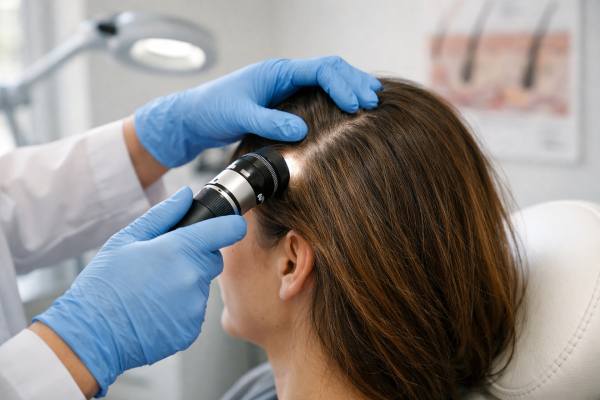
After that comes the scalp exam. The dermatologist will usually look for density patterns, hairline changes, miniaturized hairs, scaling, redness, broken hairs, follicular openings, and signs of inflammation or scarring. In many cases, they will also perform trichoscopy, which is essentially dermoscopy of the scalp. This is a close-up magnified look at hairs and skin that helps distinguish common forms of alopecia more accurately than the naked eye alone.
Some clinicians may do a hair pull test, gently tugging a small group of hairs from different scalp areas to see whether excess shedding is active. It is quick, not elaborate, and often helpful when telogen effluvium is part of the differential.
The visit is also about eliminating confusion. Many patients arrive saying “I have hair loss” when the more precise question is whether they have shedding, breakage, miniaturization, inflammation, or a mix of several. If the loss is diffuse, the conversation may overlap with the broader question of how much hair loss is normal in the shower, but the dermatologist is looking beyond counts and into pattern.
One helpful thing to know in advance is that not every first visit ends with an instant final diagnosis. Sometimes the dermatologist can tell immediately. Sometimes they narrow the possibilities, order targeted tests, start treatment, and recheck the response with photos. That does not mean the visit was inconclusive. It means hair disorders often reveal themselves through pattern plus follow-up.
What you usually will not get is a one-size-fits-all script handed over after a thirty-second glance. A good first visit feels like pattern recognition mixed with detective work. The dermatologist is not just asking “Is hair coming out?” They are asking which type of hair loss this is, whether the scalp is healthy or inflamed, whether the follicles still look recoverable, and whether anything systemic may be driving the change. That framework is what makes the later testing and treatment choices more precise.
Which tests a dermatologist may order
One of the biggest misconceptions about hair-loss appointments is that every patient gets the same battery of lab tests. In reality, dermatologists usually choose tests based on the history and pattern in front of them. Some people need no blood work at all. Others need a focused lab evaluation because the shedding pattern, medical history, or symptoms point to a systemic contributor.
The most common labs tend to cluster around a few themes.
1. Iron status
Ferritin is one of the most commonly discussed tests in diffuse shedding, especially in menstruating women, people with heavy periods, restrictive diets, recent illness, or a history of low iron. A clinician may also look at a complete blood count and sometimes broader iron studies when ferritin needs context. For readers who want a fuller breakdown, a separate guide to hair-loss blood tests such as ferritin and thyroid labs can help.
2. Thyroid testing
Thyroid dysfunction can contribute to diffuse thinning or shedding, especially when fatigue, cold intolerance, constipation, menstrual changes, or other thyroid symptoms are present.
3. Vitamin and nutrition labs
B12, vitamin D, zinc, and folate may be checked in selected patients, but not everyone needs all of them. They are more likely to come up when diet, malabsorption, weight loss, gastrointestinal disease, or specific symptoms suggest a higher yield.
4. Hormone-related testing
Androgen or endocrine labs may be considered when hair loss is paired with acne, irregular periods, excess facial hair, fertility concerns, or signs of polycystic ovary syndrome. This is more selective than many people expect. Hormone panels are not automatically useful in every person with thinning hair.
5. Autoimmune or infectious testing
These are usually driven by the pattern and the broader history. Patchy loss, scalp symptoms, systemic symptoms, or unusual exam findings may expand the lab plan.
The key point is that the lab work should fit the story. A dermatologist is usually not trying to order “everything.” They are trying to identify the highest-yield tests for the type of hair loss they suspect. That is why two patients with the same complaint of “thinning” may leave with very different test plans.
A few useful expectations can keep the process grounded:
- normal labs do not rule out pattern hair loss
- low ferritin may matter, but it is not the only explanation
- hormone testing is most useful when there are clear clinical clues
- supplements should not be started blindly in large doses just because a nutrient appears in online hair forums
This part of the visit also helps protect people from overtesting. Hair loss is emotionally loaded, which makes it easy to want every possible number. But good dermatology is selective. The right test is more useful than a long panel with no clear clinical reason behind it.
In short, a dermatologist may order tests, but only when the history and scalp pattern suggest they will change the diagnosis or management. That is a sign of thoughtful care, not of a doctor “missing” things.
When trichoscopy and biopsy are used
Many hair-loss visits are clarified with examination plus trichoscopy alone. That is one reason dermatologists are so useful in this area. Trichoscopy gives a magnified view of hair shafts, follicular openings, scale, miniaturization, broken hairs, yellow dots, perifollicular redness, and other clues that help sort one diagnosis from another without immediately moving to invasive testing.
In practical terms, trichoscopy is often what turns a vague complaint like “my hair is thinning everywhere” into a more specific impression such as pattern hair loss, telogen effluvium, alopecia areata, traction damage, or inflammatory/scarring alopecia. It is quick, noninvasive, and commonly part of a thoughtful hair exam.
A scalp biopsy is different. It is not routine for every patient with shedding or patterned thinning. It becomes more relevant when the diagnosis is unclear, when a scarring alopecia is suspected, when the scalp is inflamed or painful, or when the pattern does not fit the usual categories. A biopsy may also help when treatment has not gone as expected and the dermatologist needs tissue-level confirmation before escalating care.
People often worry that biopsy means something severe. Not necessarily. It usually means the doctor wants to stop guessing and look directly at the follicle and surrounding tissue.
What to expect from a scalp biopsy:
- The area is numbed with local anesthetic.
- A small sample of scalp skin is removed, often with a punch tool.
- The site may be closed with one or two stitches depending on technique.
- The specimen goes to pathology for microscopic review.
- Results may take days to a few weeks, depending on processing and expertise.
Most patients tolerate the procedure well. The local anesthetic injection is often the most uncomfortable part. Afterward, soreness is usually manageable, and the wound is small. The more important issue is where the biopsy is taken. In suspected scarring alopecia, biopsy location matters, because sampling the wrong spot can reduce the diagnostic value. That is one reason the procedure is best done by clinicians used to scalp disease. If you want a fuller explanation of technique and results, a dedicated guide to scalp biopsy results in hair loss can be helpful.
The main thing to know is that trichoscopy and biopsy serve different purposes. Trichoscopy strengthens bedside diagnosis. Biopsy resolves uncertainty when the stakes are higher or the pattern is unusual. Many patients need the first and not the second.
This is also where timing matters. In possible scarring alopecia, delaying biopsy too long can mean missing the most active edge of disease. In routine shedding or classic androgenetic alopecia, biopsy is often unnecessary. A good dermatologist knows when close-up observation is enough and when tissue confirmation will change the treatment path in a meaningful way.
What diagnoses they are looking for
A hair-loss visit is rarely about one generic diagnosis. Dermatologists are sorting among several big categories, and each one behaves differently. The reason timing and testing matter is that these categories overlap in how they look at home but differ sharply in how they are treated.
One common diagnosis is androgenetic alopecia, also called pattern hair loss. This usually shows gradual thinning, often at the crown, part line, temples, or frontal scalp, with miniaturized hairs rather than sudden bald patches. It is common, chronic, and often easier to treat earlier than later.
Another is telogen effluvium, where more hairs shift into the shedding phase after a trigger such as fever, childbirth, surgery, severe stress, crash dieting, or major illness. This usually causes diffuse loss rather than sharply defined patches. It often improves once the trigger resolves, though the timeline can feel slow.
A third major diagnosis is alopecia areata, which often causes patchy, smooth hair loss and can involve brows or lashes. It is autoimmune, non-scarring, and often diagnosed clinically with help from trichoscopy. When a patient presents with new round patches, the differential can narrow quickly toward patchy alopecia areata and its variants.
Then there is traction alopecia, caused by repeated tension from hairstyles, extensions, braids, buns, or edge styling. This often affects the hairline or temples and can become partly scarring if it goes on too long.
Finally, there are inflammatory and scarring alopecias, which are the group dermatologists most want to catch early. These include conditions such as lichen planopilaris, frontal fibrosing alopecia, central centrifugal cicatricial alopecia, and others. They may present with pain, burning, scale, redness, tufting, or a shiny scalp surface. Because they can permanently damage follicles, early diagnosis matters more here than in routine shedding. A separate page on lichen planopilaris symptoms and diagnosis is useful if that term comes up in your visit.
Sometimes the answer is not one diagnosis but two. A person may have chronic pattern thinning plus a recent telogen effluvium after illness. Another may have traction on top of miniaturization. That mixed picture is one reason self-diagnosis is so often incomplete.
The dermatologist is not just naming the loss. They are deciding whether the follicles are miniaturizing, shedding, inflamed, scarred, or mechanically damaged. That distinction determines whether the right next step is reassurance, blood work, minoxidil, anti-inflammatory treatment, injections, biopsy, or a change in styling habits.
Once you understand that framework, the visit feels less mysterious. The doctor is not searching randomly. They are sorting your hair loss into the category that best explains the pattern, symptoms, scalp findings, and timeline.
How to prepare and what follow-up feels like
A hair-loss visit goes better when you arrive with a timeline rather than a vague sense that “it has been happening for a while.” Hair disorders are strongly pattern-based, and small details often matter. The better the setup, the faster the dermatologist can move from speculation to useful next steps.
Before the appointment, it helps to gather:
- a short timeline of when the loss began and how it changed
- a list of medications, supplements, and recent dose changes
- any major events in the last 3 to 6 months, such as illness, fever, surgery, childbirth, dieting, or stress
- prior blood work if you have it
- phone photos showing the part, temples, crown, or patches over time
Photos are especially helpful because hair loss can be easy to underestimate or overestimate from memory. Standardized pictures often reveal whether the problem is rapidly changing or relatively stable.
You do not need to wash your hair in a special way before the visit unless the office tells you otherwise. It is usually more useful for the dermatologist to see your normal scalp condition than a freshly scrubbed version that hides scale, oil, or redness. Heavy camouflage powders or fibers may make examination harder, though, so it is worth keeping the scalp as visible as practical.
Follow-up after the first visit depends on the diagnosis. A few patterns are common:
- Watchful waiting with guidance for likely telogen effluvium or mild shedding after a clear trigger.
- Targeted treatment plus photos for pattern hair loss, with reassessment over several months.
- Lab review and course correction when ferritin, thyroid, or other systemic factors are involved.
- Closer follow-up for inflammatory or scarring alopecias where disease activity needs monitoring.
The timeline can surprise people. Hair is slow. Even when the diagnosis is correct and the treatment is sensible, visible change often takes months. That is not a sign the dermatologist missed something. It reflects the pace of the hair growth cycle, which is why follow-up visits often compare photos rather than relying on how your hair felt that week. For a refresher on that biology, see the hair growth cycle.
It also helps to know that follow-up may refine the diagnosis. Hair disorders evolve, and a pattern that was uncertain on day one can become clearer after time, lab results, trichoscopy findings, or a response to treatment. That is especially true when more than one process is happening at once.
The most useful expectation is this: a dermatologist visit for hair loss is not a one-visit miracle, but it often replaces months of random guessing with a structured plan. Once you know what the doctor is looking for, which tests are truly relevant, and how progress is usually tracked, the process feels much less intimidating and much more productive.
References
- A Three-Step Diagnostic Algorithm for Alopecia: Pattern Analysis in Trichoscopy 2025 (Review)
- A Brief Review of Scalp Biopsy and its Interpretation 2025 (Review)
- Serum Ferritin Levels: A Clinical Guide in Patients With Hair Loss 2023 (Review)
- Diagnosis and treatment of female alopecia: Focusing on the iron deficiency-related alopecia 2023 (Review)
- Alopecia Areata: An Updated Review for 2023 2023 (Review)
Disclaimer
This article is for educational purposes only and is not a diagnosis or a substitute for medical care. Hair loss can result from common shedding disorders, patterned thinning, autoimmune disease, nutritional deficiency, medication effects, scalp inflammation, or scarring alopecia that needs prompt evaluation. If you have sudden hair loss, patchy bald spots, eyebrow or eyelash loss, scalp pain, redness, or rapidly worsening thinning, seek professional care rather than relying on self-diagnosis alone.
If this article helped you, consider sharing it on Facebook, X, or another platform you use so more people know when a hair-loss appointment is worth making and what they can expect when they get there.