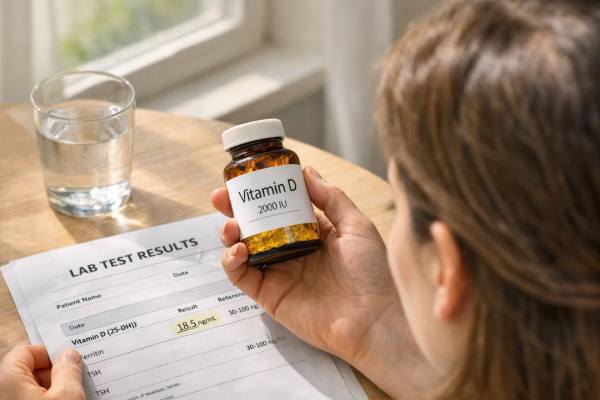
Few nutrients are discussed as often in hair forums as vitamin D, and few are misunderstood as often. Low vitamin D is linked with several forms of nonscarring hair loss, which makes the topic important. But “linked” does not mean “high-dose supplementation will regrow hair on its own,” and that is where many routines go off course.
Vitamin D matters because hair follicles are biologically active tissues with receptors involved in normal cycling. When levels are low, shedding disorders and other hair conditions may be more common. Still, the real-world question is not whether vitamin D matters in theory. It is how to use it wisely: when to test, which lab value counts, what dose is sensible, and how to avoid chasing a perfect number that has never been proven for hair.
The most useful approach is practical. Check the right marker, interpret it in context, correct a true deficiency safely, and avoid treating vitamin D like a stand-alone cure for every thinning pattern.
Essential Insights
- Vitamin D deficiency can be one contributing factor in hair shedding and thinning, but correcting it is not a guaranteed stand-alone hair-growth treatment.
- The best dose depends on your starting blood level, overall health, age, absorption, and whether you are treating deficiency or simply meeting daily needs.
- There is no universally validated hair-specific target blood level, so pushing values higher is not the same as improving hair outcomes.
- High-dose self-treatment can cause harm, especially when stacked with calcium or multiple hair supplements.
- The most practical plan is to use a 25-hydroxyvitamin D blood test when clinically appropriate, correct documented deficiency, and reassess after a defined interval rather than dosing blindly.
Table of Contents
- What vitamin D can and cannot do for hair
- Best dose depends on your starting point
- Which lab target actually matters
- When hair loss actually justifies testing
- Common mistakes that delay results
- A smarter supplement and monitoring routine
What vitamin D can and cannot do for hair
Vitamin D has a real connection to hair biology. Hair follicles express vitamin D receptors, and those receptors are involved in normal follicle cycling, especially the shift back into active growth. That mechanism helps explain why low vitamin D status keeps showing up in studies of nonscarring alopecias such as telogen effluvium, alopecia areata, female pattern hair loss, and androgenetic alopecia. In other words, the signal is not imagined.
Still, the strongest evidence is mostly about association, not a guaranteed treatment effect. Recent systematic reviews and meta-analyses consistently show that people with several kinds of alopecia tend to have lower 25-hydroxyvitamin D levels than controls. That is useful, but it does not prove that vitamin D deficiency is the main driver in every case. Low levels may be one contributing factor, one marker of overall health burden, or one piece of a larger hair-loss puzzle that also includes genetics, inflammation, iron status, thyroid disease, stress, medications, hormones, and dietary intake.
That distinction is the most important starting point for readers searching “vitamin D for hair growth.” Vitamin D is not minoxidil. It is not a direct cosmetic growth stimulant that predictably thickens hair in anyone who takes more of it. The benefit is most plausible when a real deficiency is present and is either triggering shedding, worsening follicle performance, or removing one of the conditions needed for normal cycling. Even then, hair improvement often depends on correcting other factors at the same time.
A good way to think about it is this:
- Vitamin D can help normalize the environment in which follicles function.
- It does not reliably override patterned hair loss, autoimmune alopecia, or chronic shedding by itself.
- It works best when it is correcting something that is actually low.
This is why people often get mixed results online. Someone with diffuse shedding, low vitamin D, low ferritin, poor protein intake, and recent illness may improve after supplementation because deficiency was part of the problem. Someone with established pattern loss and normal vitamin D may see no meaningful difference at all. Both stories can be true.
It also helps to understand the timing. Hair changes lag behind blood changes. Even if vitamin D is relevant in your case, lab correction does not translate into visibly fuller hair the next week. Follicles still move through the normal growth cycle, so improvement, when it happens, usually takes months rather than days.
The balanced conclusion is simple: vitamin D matters enough to check and correct when appropriate, but not enough to treat casually as a universal hair-growth fix. The best use of vitamin D is targeted, measured, and tied to an actual deficiency or clear clinical reason to test.
Best dose depends on your starting point
There is no single “best dose” of vitamin D for hair growth because the right amount depends on what problem you are actually trying to solve. Are you simply meeting normal daily needs? Are you maintaining a level that is already adequate? Or are you correcting a true deficiency confirmed on blood work? Those are different situations, and the dose should reflect that difference.
For general health, standard recommended intakes are modest. In adults, that usually means:
- 600 IU daily for most people through age 70.
- 800 IU daily for adults over 70.
That is a maintenance framework, not a hair protocol. It is also why many healthy adults under 75 do not benefit from routine high-dose vitamin D above standard dietary recommendations when there is no clear indication. For hair-focused readers, that means more is not automatically better.
When a deficiency is documented, clinicians often use a higher short-term repletion plan and then step down to maintenance. The exact regimen varies based on baseline 25-hydroxyvitamin D level, body size, sun exposure, malabsorption, obesity, kidney or liver disease, medications, pregnancy, and whether the patient has symptoms or a related condition. That is why “my friend takes 5,000 IU a day” is not a dosing strategy.
A practical way to frame the dose question is:
- No documented deficiency: stay close to standard intake unless a clinician advises otherwise.
- Mild insufficiency or borderline low level: modest daily supplementation may be reasonable, but the goal is correction, not overshooting.
- Clear deficiency: use a clinician-guided repletion plan, then retest and taper to maintenance.
Daily dosing is often easier to manage than sporadic megadoses because it is simpler to remember, easier to fine-tune, and less likely to create a cycle of underuse followed by overshooting. Some studies and clinical protocols use weekly or monthly dosing, and those can work in medical care. The mistake is copying those regimens without testing, follow-up, or any idea how low your starting level is.
Safety matters here. For most adults, the tolerable upper intake level is 4,000 IU daily. That is not a target. It is a ceiling unlikely to cause harm in the general population. Long-term use above that range, especially in stacked hair supplements, deserves caution. People often forget that vitamin D may already be present in multivitamins, hair gummies, “immune” blends, bone formulas, and calcium products. This is one reason supplement routines can drift into unsafe territory. The same red-flag pattern shows up with many hair supplement routines that look harmless on the label but add up quickly.
The best dose for hair, then, is not the highest dose you can tolerate. It is the smallest effective dose that corrects a documented deficiency and then maintains a reasonable blood level without crossing into excess.
Which lab target actually matters
If you are going to test vitamin D for hair concerns, the lab that matters is serum 25-hydroxyvitamin D, often written as 25(OH)D. This is the standard marker used to assess vitamin D status. It reflects body stores much better than the active hormone test, 1,25-dihydroxyvitamin D, which is not the routine status test for deficiency. Ordering the wrong lab is one of the most common and avoidable errors.
Once you have the right test, interpretation matters more than chasing a fashionable number. A useful general framework is:
- Below 12 ng/mL or below 30 nmol/L: deficiency.
- 12 to 20 ng/mL or 30 to 50 nmol/L: possible inadequacy or borderline low range.
- 20 ng/mL and above or 50 nmol/L and above: sufficient for most people from a bone-health perspective.
- Above 50 ng/mL or above 125 nmol/L: higher than needed and potentially associated with adverse effects at the upper end.
Those ranges are helpful, but here is the key nuance for hair: there is no universally proven hair-specific target 25(OH)D level. This point cannot be overstated. A lot of online advice presents 30 ng/mL, 40 ng/mL, or even 60 ng/mL as the “hair-growth zone.” That sounds precise, but the evidence is not there. Current clinical guidance for vitamin D prevention no longer endorses a universal target level for general disease prevention, and hair research has not established one either.
That means the smartest lab goal is not “as high as possible.” It is “no longer deficient, not unnecessarily high, and interpreted in context.” A person who rises from 11 ng/mL to the low 20s may have corrected a meaningful deficiency. A person who pushes from 28 to 55 ng/mL might not gain anything for hair and may simply increase risk.
Two practical details help readers avoid confusion:
- Labs may report vitamin D in ng/mL or nmol/L. The numbers are not interchangeable without conversion.
- Hair improvement depends on more than one lab result. A normal vitamin D level does not rule out other nutritional or medical causes of shedding.
For many hair-loss workups, vitamin D is best interpreted alongside ferritin, thyroid testing, and the rest of the clinical story. That broader lens is often more useful than obsessing over one nutrient in isolation, especially when diffuse shedding has multiple triggers. In that sense, vitamin D belongs in the wider conversation about which blood tests actually matter in hair loss, not on its own pedestal.
The best target, then, is a stable, non-deficient level that is appropriate for your health status. Hair care gets better when lab interpretation becomes more disciplined and less aspirational.
When hair loss actually justifies testing
Not everyone with a few extra hairs in the shower needs immediate vitamin D testing. But testing becomes much more reasonable when the hair-loss pattern, medical history, or deficiency risk makes low vitamin D a plausible contributor rather than a random guess.
Hair-related situations where vitamin D testing may be worth discussing include:
- Diffuse shedding, especially after illness, stress, dieting, or other triggers consistent with telogen effluvium.
- Patchy autoimmune hair loss, such as alopecia areata, where low vitamin D has been reported more often than in controls.
- Chronic nonscarring thinning when the evaluation has not yet included nutritional status.
- Persistent hair complaints plus other deficiency clues, such as fatigue, low sun exposure, restrictive diet, malabsorption, or bone-health concerns.
Risk factors outside the scalp matter too. Vitamin D testing becomes more relevant when someone has:
- Very limited sun exposure or extensive indoor lifestyle.
- Malabsorption conditions, bariatric surgery, or chronic gastrointestinal disease.
- Obesity, which can alter vitamin D distribution.
- Medications that affect vitamin D metabolism.
- Darker skin living at higher latitudes or in low-UV seasons.
- A history of low vitamin D or recurrent deficiency.
Hair pattern also matters. Vitamin D is most plausibly relevant in forms of nonscarring hair loss linked with shedding, immune activity, or overall follicle health. It is far less convincing as a stand-alone explanation for classic hereditary pattern loss. In pattern loss, a low vitamin D level may still be worth correcting for general health, but it usually does not replace evidence-based therapies. The same is true for stress-related shedding. A person can have low vitamin D and stress-triggered telogen effluvium at the same time, but the stress trigger still matters.
The best candidates for testing are usually those whose story makes deficiency plausible, not those who want a supplement justification. That distinction saves time and prevents overtesting. It also lines up with current guidance, which does not support routine 25(OH)D screening in every healthy adult just for general disease prevention. Hair-related testing should be selective and clinically grounded.
A useful rule is this: test when the answer could change management. If a low result would lead to correction, follow-up, and a broader workup for shedding, the test may be worthwhile. If the plan is to take high-dose vitamin D regardless of the result, the test has already been stripped of its purpose.
The goal is not to prove that vitamin D explains everything. It is to identify whether it is one modifiable factor in a real hair-loss workup.
Common mistakes that delay results
Most problems with vitamin D and hair are not caused by the nutrient itself. They are caused by the way people use it. A few mistakes come up repeatedly, and they can waste months.
The first is assuming low vitamin D is the main cause of every thinning pattern. People often see one low-normal or borderline result and build their whole hair plan around it. Meanwhile, the real driver may be androgenetic hair loss, iron deficiency, thyroid disease, major weight loss, medication-induced shedding, or an inflammatory scalp disorder. Vitamin D can matter and still not be the lead actor.
The second is taking a large dose without measuring a baseline level. This turns supplementation into guesswork. If you are already adequate, more vitamin D may add nothing for hair and only increase the chance of overshooting.
The third is ordering or interpreting the wrong lab. The correct routine marker is 25-hydroxyvitamin D. Another common version of this mistake is focusing on a decimal-perfect target instead of the clinical picture. A level of 24 that rises to 34 is not a failure because it did not reach 50.
The fourth is using vitamin D as a substitute for proven treatment. In alopecia areata, vitamin D is not a replacement for appropriate autoimmune management. In patterned thinning, it does not replace minoxidil or other indicated therapies. In acute shedding, it does not cancel out the trigger. Readers looking into patchy autoimmune hair loss often run into this problem early.
The fifth is stacking supplements without checking the total dose. Hair formulas often combine vitamin D with biotin, zinc, selenium, iron, collagen, and other ingredients. A person may add a separate vitamin D capsule on top and accidentally reach a long-term intake well beyond what they intended. Some formulas can also complicate lab interpretation or distract from the main diagnosis, which is part of the broader problem of supplement-driven lab confusion.
The sixth is expecting fast cosmetic regrowth. Even when vitamin D correction helps, visible hair recovery is slow. Shedding may improve before density does. New growth must survive several months of cycling before the mirror changes.
The seventh is forgetting safety signals. Excess vitamin D can lead to hypercalcemia, kidney issues, nausea, constipation, thirst, weakness, and other symptoms. Risk rises further when high-dose calcium is added casually.
The most productive mindset is disciplined rather than enthusiastic. Test selectively. Dose with intent. Retest when appropriate. Keep vitamin D in its proper role: important, sometimes helpful, but rarely the whole answer.
A smarter supplement and monitoring routine
A good vitamin D plan for hair is simple enough to follow and structured enough to prevent drift. The goal is not to create a perfect supplement stack. It is to correct a modifiable problem safely and then move on to the rest of the hair workup.
A practical routine looks like this:
- Start with the right question.
Are you trying to meet general daily needs, or correct a known deficiency? If you do not know, that is the first issue to solve. - Use the right test when testing is justified.
Ask for 25-hydroxyvitamin D, not an alternative vitamin D marker that does not reflect routine status well. - Choose a sensible form and dose.
Over-the-counter vitamin D3 is commonly used for maintenance. If deficiency is documented, follow the regimen your clinician recommends rather than copying someone else’s dose from social media. - Take it consistently.
A daily dose is usually easier to remember and easier to monitor than improvised bursts of large weekly amounts. Taking vitamin D with a meal that contains some fat can also support absorption. - Reassess after a defined interval.
If deficiency is being corrected, many clinicians recheck after a few months rather than endlessly supplementing without feedback. The point of retesting is to confirm that the number moved in the right direction and did not overshoot. - Track hair on a slower timeline than labs.
It is reasonable for blood levels to improve before hair density does. Think in terms of months, not weekends. - Keep the rest of the hair plan active.
Adequate protein, treatment of iron deficiency when present, thyroid evaluation when indicated, and diagnosis-specific therapies still matter. Vitamin D does not cancel out the need for a broader assessment.
This approach also helps prevent overcorrection. The target is adequacy, not a heroic level. Once you are no longer deficient, the strategy often shifts from repletion to maintenance. That is the point where some people should lower the dose rather than keep pushing upward.
Medical guidance becomes more important if you have kidney disease, calcium disorders, sarcoidosis or other granulomatous disease, malabsorption, pregnancy, recurrent kidney stones, or multiple interacting supplements and prescriptions. It is also worth seeking help if hair loss continues despite corrected vitamin D, because that strongly suggests another driver is still active. In those cases, a more complete dermatology evaluation for persistent hair loss is often more useful than another supplement change.
The best routine, then, is not dramatic. It is measured. Correct what is low, avoid what is excessive, and let vitamin D take its proper place as one tool in a broader, evidence-based hair strategy.
References
- Serum 25 hydroxyvitamin D in non-scarring alopecia: A systematic review and meta-analysis 2024 (Systematic Review)
- Vitamin D deficiency in non-scarring and scarring alopecias: a systematic review and meta-analysis 2024 (Systematic Review)
- Oral Vitamin D Treatment in Patients with Telogen Effluvium: Clinical and Dermoscopic Evaluation 2024
- Vitamin D for the Prevention of Disease: An Endocrine Society Clinical Practice Guideline 2024 (Guideline)
- Vitamin D – Health Professional Fact Sheet 2025
Disclaimer
This article is for educational purposes only and does not replace personal medical advice. Vitamin D supplementation can interact with medical conditions, medications, calcium balance, and kidney health, and hair loss has many possible causes beyond vitamin D status. Use lab testing and treatment decisions with a qualified clinician when deficiency, significant shedding, or ongoing thinning is involved.
If this article helped clarify the vitamin D conversation, please share it on Facebook, X, or another platform you use so more readers can make better decisions about hair supplements and lab testing.