Sun damage to hair is easy to underestimate because it rarely arrives all at once. Instead, it accumulates. A few beach days, a week of long walks in bright weather, a summer of outdoor workouts, and suddenly hair that once felt smooth begins to look duller, drier, rougher, and less true to its color. For color-treated hair, the shift can feel even faster: brassiness, faded gloss, and brittle ends that seem to appear ahead of schedule.
This happens because sunlight does not only warm the hair surface. Ultraviolet radiation can affect the hair’s proteins, lipids, and pigment, while heat, wind, salt, and chlorine often add another layer of stress. The result is not usually a medical emergency, but it is a real form of weathering that changes how hair looks and behaves.
The good news is that a smart routine can make a clear difference. The best protection plan is not complicated. It is consistent, layered, and built around the simple idea that prevention works better than trying to restore sun-worn hair later.
Fast Facts
- UV exposure can fade hair color, increase dryness, reduce shine, and make strands feel rougher and more brittle.
- Bleached, highlighted, gray, and already porous hair usually show sun damage faster than darker, less processed hair.
- Physical coverage is often the most reliable protection, while hair UV products work best as support rather than as the whole plan.
- Hair that feels dry after sun exposure is not always permanently ruined, but repeated exposure can accelerate long-term weathering.
- A practical routine is to cover the hair during peak outdoor exposure, use a leave-in protective product, and rinse plus condition soon after sun, salt, or chlorine.
Table of Contents
- What Sun Actually Does to Hair
- Why Color Fades So Fast in Sun
- How UV Damage Shows Up in Real Life
- Which Hair Types Need the Most Protection
- The Best Protection Routine for Daily Life
- How to Recover Hair After Heavy Sun Exposure
What Sun Actually Does to Hair
Hair does not sunburn the way skin does, so many people assume it is largely safe from UV exposure. It is not. The hair fiber is a dead structure once it leaves the scalp, but that does not make it invulnerable. In fact, because it cannot biologically heal itself, repeated sunlight damage can accumulate in ways that become more visible over time.
Most of the trouble begins in three places: the cuticle, the cortex, and the hair’s protective lipids. The cuticle is the outer shield, made of overlapping cells that help hair stay smooth and reflective. The cortex sits deeper inside and holds much of the hair’s strength, moisture behavior, and pigment. UV exposure can disrupt proteins, oxidize lipids, and degrade melanin, which is the pigment that gives hair its color and also offers some natural photoprotection.
That is why sun-damaged hair often changes in several ways at once. It may feel drier because the surface lipids are compromised. It may look rougher because the cuticle no longer lies as flat. It may lose shine because rougher surfaces scatter light instead of reflecting it evenly. And it may become more fragile because the protein structure has been weakened.
There is also a useful distinction between UVA and UVB. In simplified terms, UVA is more associated with deeper oxidative stress inside the fiber, while UVB is more strongly linked to surface-level protein and pigment damage. Daily life exposes hair to both. That means the overall effect is not one tidy process, but a blend of fading, weathering, and structural stress.
An important practical insight is that UV rarely acts alone. Outdoor exposure usually brings wind, heat, sweat, salt water, chlorine, lower humidity, and more washing afterward. That combination is why summer damage often feels bigger than “sun” alone should explain. The fiber is not just being irradiated. It is being repeatedly dried out, rubbed, rinsed, heated, and restyled.
This is also why sun damage can be confused with general wear and tear. Someone may blame a rougher texture on shampoo, brushing, or age when the real issue is cumulative environmental exposure. A helpful way to think about it is that UV accelerates hair weathering. It does not always create a brand-new problem. It often speeds up the ones hair was already drifting toward.
The final nuance is worth remembering: hair-shaft UV damage is not the same as follicle loss. Most sun-related changes in this context involve the fiber itself rather than true baldness. That means the main problem is usually fading, dryness, brittleness, dullness, and breakage, not sudden medical hair loss. Understanding that distinction helps readers focus on protection and repair instead of panicking over every rough strand.
Why Color Fades So Fast in Sun
Color fading is often the first sun-related change people notice, and there is a good reason for that. Hair pigment is not only cosmetic. It also plays a protective role. Melanin absorbs and filters part of the incoming radiation, helping reduce damage to the underlying proteins. But that protection comes at a cost: the pigment itself degrades in the process.
In natural hair, this can show up as subtle lightening, warmth, dullness, or a less rich-looking tone after repeated exposure. In color-treated hair, the effect is usually faster and more obvious because the fiber is already less protected. Bleaching and highlighting oxidize the hair’s natural melanin and increase porosity, which means the strand has less built-in defense before it even reaches the sun. That is one reason bleached and highlighted hair often fades, dries out, and roughens more quickly in summer than darker virgin hair.
Sunlight also changes the way artificial color behaves. Oxidative dyes may lose depth, glossy brunette shades may turn flatter or warmer, reds may fade faster than expected, and blonds may become brassier or more washed out. The specific shift depends on the starting color, the underlying pigment, the condition of the cuticle, and how much pool, sea, or heat exposure is layered on top. But the basic principle is the same: UV exposure interferes with color retention by degrading pigment and worsening the surface condition that helps hair look polished.
Gray and white hair deserve special mention too. They may seem as if they should resist visible fading because there is little or no pigment left to lose. In practice, they often show weathering in a different way. Without melanin, they have less natural photoprotection, so they may yellow, look dull, feel coarse, or lose luster more easily. The problem is not “fading” in the classic sense. It is increased vulnerability.
This leads to one of the most helpful insights in the article: not all hair-protection claims are as standardized as skin SPF claims. Hair products marketed for sun protection may contain UV filters or protective films, but the field is still much less standardized than skin sunscreen testing. Some products may help, but labels do not guarantee robust or uniform hair protection in the same way people expect from facial or body sunscreen.
That is why color retention depends on layered protection rather than one magic spray. The sun fades color fastest when the hair is already porous, already oxidized, or already stressed by bleach, heat, or frequent washing. The best prevention strategy is to keep the fiber from being overexposed in the first place, then reduce the extra stressors that make pigment loss look worse.
If readers remember one principle from this section, it should be this: sun does not only lighten hair. It changes the whole surface environment around the color. And once that surface becomes rougher, drier, and more porous, fading becomes easier, faster, and harder to hide.
How UV Damage Shows Up in Real Life
UV damage has a signature look, but it does not always announce itself clearly. Many people notice “summer hair” before they connect it to photodamage. The hair feels puffier, looks less reflective, tangles more easily, and stops behaving the way it usually does. That is often the real-life version of cuticle wear, lipid loss, and pigment disruption.
The most common visible sign is dryness. Hair may feel thirsty even after conditioning, but the issue is not always a lack of water alone. Sun exposure can alter the outer lipid layer and the cuticle surface, which changes how well the strand manages moisture. As a result, the hair may absorb water quickly and lose it quickly, or feel rough even when it is technically hydrated.
Shine loss is another clue. Healthy-looking shine depends on a relatively smooth surface. When UV exposure roughens the cuticle, the fiber scatters light instead of reflecting it cleanly. Hair then looks flatter, chalkier, or “tired,” even if the color has not changed dramatically. This is especially noticeable on straight or dark hair, where gloss is often easier to see.
Texture changes matter too. Some people notice stiffness. Others notice frizz, tangling, or ends that feel more straw-like than soft. Fine hair may feel weaker and more fragile. Coarser or curlier hair may feel drier and less elastic. Split ends can become more visible, not because the sun alone caused every split, but because repeated UV exposure helped accelerate weathering in already vulnerable areas.
Breakage is another important sign. Sun-damaged hair is often easier to snap during brushing, detangling, or styling. That does not necessarily mean the person is developing true hair loss from the root. More often, it means the fiber has become more brittle and is breaking along the shaft. This distinction matters because prevention and repair depend on knowing whether the problem is fragility or shedding. Readers comparing the two often benefit from understanding the difference between breakage and true hair loss, especially when summer roughness makes both seem possible.
One of the trickiest signs is behavioral change. Hair may suddenly take longer to dry, respond worse to styling, feel less defined, or require more product to look polished. These changes are easy to dismiss, but they often reflect the strand’s altered surface chemistry. In other words, the hair is not just “being annoying.” It is behaving differently because its structure has been stressed.
A final clue is that UV damage tends to show up where exposure is greatest: the top layer, the part line, the outer canopy, and the ends. The underside often feels healthier because it has been physically shielded. That contrast is useful. If the top looks faded, frizzy, and dry while lower layers seem relatively intact, environmental damage becomes much more likely.
Which Hair Types Need the Most Protection
All hair can be weathered by sun, but not all hair is equally vulnerable. Some fibers start with more natural defense, while others reach the damage threshold much faster. That is why the same beach day can leave one person with barely any visible change and another with brassy, rough, swollen-looking ends.
The first high-risk group is color-treated hair, especially bleached, highlighted, or high-lift blond hair. Once melanin has been oxidized out of the fiber and the cuticle has been opened repeatedly, the strand has less natural photoprotection and less structural reserve. UV exposure can then fade tone faster and worsen the roughness that makes color look older than it is.
Gray, white, and very light hair also need more protection. Melanin does more than provide color; it helps filter radiation. When pigment is sparse or absent, the strand has less built-in shielding. That does not always mean dramatic fading, but it does mean a greater tendency toward dullness, dryness, yellowing, and surface roughness.
High-porosity hair is another major category. When the cuticle is already more lifted or uneven, the strand tends to lose smoothness and resilience faster under environmental stress. Sun exposure often makes that behavior more obvious. Hair that already frizzes easily, tangles quickly, or struggles to hold color tends to show outdoor damage sooner. Readers who recognize that pattern often see the same logic explained in high- and low-porosity hair care: the more open and weathered the surface, the harder it is to keep the fiber balanced.
Curly, coily, and textured hair can also be especially vulnerable to dryness because the natural sebum from the scalp has a longer and less direct path down the strand. That does not mean textured hair is inherently weaker. It means the fiber may have less surface lubrication along its full length, so repeated UV, wind, and washing can show up as dryness more quickly, especially at the ends.
Long hair deserves mention too. The longer the fiber, the older it is. Older ends have already survived more brushing, washing, heat, friction, and styling. Add a season of bright sun and the oldest part of the strand is usually where the damage becomes most visible.
Finally, hair that is already under stress from bleach, heat tools, smoothing treatments, or aggressive styling routines should be treated as higher risk even if the person’s natural hair type is otherwise resilient. UV damage loves a head start. It rarely begins with completely untouched hair and then acts alone. It usually compounds what is already there.
The most practical way to interpret risk is not by asking, “Is my hair weak?” A better question is, “How many protective layers has my hair already lost?” The more color processing, porosity, dryness, or age the fiber already carries, the more seriously a sun-protection routine matters.
The Best Protection Routine for Daily Life
The best UV-protection routine for hair is not built around one hero product. It is built around layers, with physical coverage as the backbone. That is important because hair UV protection is less standardized than skin sunscreen, and product performance is more variable than many labels imply. A routine works best when it assumes no single spray can do everything.
A strong daily plan usually has five parts.
- Use physical coverage first. A wide-brim hat, tightly woven cap, scarf, or other sun-blocking head covering is the most reliable single step for prolonged outdoor exposure. It protects both the hair fiber and the scalp, especially along the part line and crown.
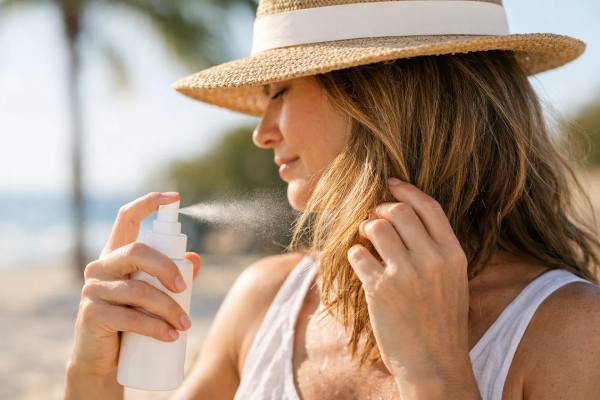
- Add a leave-in protective layer. A leave-in conditioner, cream, or spray with UV filters, film-formers, silicones, or conditioning agents can help reduce roughness and moisture loss. Think of this as support, not absolute armor.
- Reduce peak exposure when you can. You do not need to hide indoors, but long midday exposure is harder on both hair and scalp than shorter or more shaded outdoor time.
- Prepare before pool or sea exposure. Wet the hair with fresh water first, add a conditioner or protective leave-in, and use a swim cap when practical. Sun damage and water damage often travel together, especially with chlorine. If pool days are a major issue, a dedicated guide to chlorine-related hair damage helps explain why the combination is so rough on color and texture.
- Rinse and condition after exposure. Salt, sweat, sand, and chlorine keep stressing the strand after the sun is gone. A prompt rinse and conditioning step limits that second round of damage.
There is also a useful difference between protecting hair and protecting scalp skin. Hair can benefit from coatings and coverage. The scalp, especially the part and thinning areas, may need direct sun protection too. For readers who spend long hours outdoors or wear defined parts, practical scalp sun-protection basics matter just as much as protecting the strand itself.
What about hair products labeled with SPF or UV protection? They can be useful, especially for improving feel and reducing some exposure, but the smartest way to use them is as backup. Relying on a mist alone while spending hours in direct sun is rarely the best strategy. The better logic is hat first, product second.
One more routine rule is worth adding: do not pile heat styling on top of a heavy sun day if you can avoid it. Hair that has already been dehydrated and weathered outdoors is less forgiving under a flat iron or curling wand that evening. Spacing those stressors apart often makes a visible difference.
The best routine, then, is not glamorous. It is simply protective enough to repeat: cover, coat, reduce exposure, rinse, and condition. That is what keeps summer from quietly undoing the work of your normal hair-care routine.
How to Recover Hair After Heavy Sun Exposure
Recovery starts with a realistic goal. Sun-damaged hair can often be improved cosmetically, but the damaged part of the fiber cannot biologically heal itself. That distinction matters because it shifts the question from “How do I repair this completely?” to “How do I restore comfort, appearance, and manageability while preventing further weathering?”
The first move is to calm the routine down. After a week of strong sun, pool water, salt water, and heat, the hair usually needs less aggression, not more. Use a gentle cleanse, follow with a richer conditioner or mask, detangle carefully, and reduce unnecessary heat for several days. Hair that feels dry after sun exposure often responds better to consistent conditioning than to a single dramatic “rescue” product.
The second move is to match the treatment to the kind of damage you actually see. If the main problem is roughness, frizz, and dullness, a smoothing conditioner, lightweight serum, or acidifying formula may help the cuticle lie flatter and reflect more light. If the main problem is brittleness and weakness, protein-containing or targeted bond-repair treatments may make more sense. If the main problem is color dullness, a gloss or tone-refreshing step may improve the appearance faster than any repair mask.
A simple recovery sequence often works well:
- Cleanse off salt, chlorine, sweat, and buildup
- Condition generously and detangle with low friction
- Use a leave-in to reduce roughness and moisture loss
- Air-dry when possible or use lower heat
- Trim ends that have become visibly split or crispy
- Delay fresh bleaching or major color changes until the fiber feels steadier
One helpful truth is that not all post-sun dryness reflects permanent damage. Sometimes the strand simply needs its surface rebalanced. But repeated UV exposure can create enough cumulative weathering that the difference between “dry” and “damaged” becomes smaller over time. That is why a recovery routine should always include a prevention update. If the same exposure pattern continues unchanged, the strand will keep returning to the same stressed state.
It also helps to watch for overcorrection. Hair that feels rough after sun can tempt people into layering heavy oils, strong protein, and intense masks all at once. That usually makes the routine harder to interpret and sometimes leaves the hair stiff, coated, or dull in a different way. Better results usually come from one or two focused steps used consistently.
The last point is emotional as much as cosmetic: faded, dry summer hair often looks worse before it truly is worse. Shine and smoothness are powerful visual signals. When those drop, the hair can seem ruined even when much of the problem is surface-level weathering. With careful conditioning, reduced stress, and better protection, the hair often looks and feels significantly better before the season changes. The catch is that prevention has to start before the next bright stretch, not after it.
References
- UV and visible light exposure to hair leads to widespread changes in the hair lipidome 2022
- On Hair Care Physicochemistry: From Structure and Degradation to Novel Biobased Conditioning Agents 2023 (Review)
- Assessment of the photoprotection properties of hair cosmetics using the hemispherical directional reflectance method 2023
- Modeling of solar UV-induced photodamage on the hair follicles in human skin organoids 2024
- Correlation Between Sun Protection Factor and Hair Color Difference Index in a New Method for Evaluating Sunscreens’ Ultraviolet Protection Efficacy in Hair: An Experimental Study 2025
Disclaimer
This article is for educational purposes only and is not personal medical advice. UV damage to hair usually affects the hair fiber’s color, texture, and strength, but similar changes can also come from bleach, heat tools, chlorine, hard water, rough handling, or underlying scalp and hair disorders. If your hair changes are sudden, severe, or paired with scalp burning, patchy loss, or marked shedding, seek professional evaluation rather than assuming sun exposure is the whole cause.
If this article helped you, please share it on Facebook, X, or another platform your readers use most.