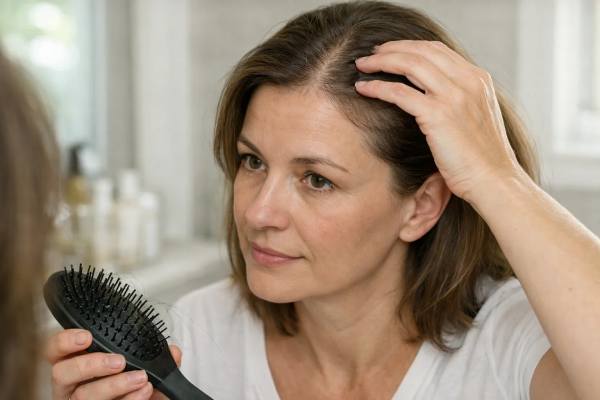
Hair often changes gradually after 40, but the shift can still feel sudden when it finally becomes visible. A part looks wider in bright light. The crown shows more scalp than it used to. The ponytail feels lighter, or the temples seem less dense than they were a few years ago. For many people, this is not one single problem with one single cause. It is a layered change shaped by age, genetics, hormones, nutrition, stress, medication use, and the health of the scalp itself.
That complexity is why thinning hair after 40 is so often misunderstood. Some cases are classic pattern hair loss becoming more noticeable with time. Others are driven by menopause, thyroid changes, low iron stores, rapid weight loss, or a shed that overlaps with long-term miniaturization. The encouraging part is that many of these factors can be identified and managed.
This guide explains why thinning becomes more common after 40, how hormones and nutrition fit into the picture, and which treatment options are most worth discussing with a clinician.
Core Points
- Hair thinning after 40 is often multifactorial, so progress usually comes from treating more than one contributor at a time.
- Pattern hair loss often responds best when treatment starts early, before miniaturization becomes advanced.
- Correcting iron deficiency, thyroid disease, or low protein intake can improve shedding and support better treatment response.
- Supplements are not automatically helpful and can be counterproductive when taken without a documented need.
- Take baseline photos in the same lighting every 4 to 6 weeks, because slow improvement is easier to see in images than in the mirror.
Table of Contents
- Why Hair Often Thins After 40
- Hormones That Change Hair Density
- Nutrition and Lab Issues Worth Checking
- How to Recognize Common Thinning Patterns
- Treatment Options That Actually Help
- When a Doctor Visit Matters
Why Hair Often Thins After 40
Hair thinning after 40 is common, but it is not a single diagnosis. In some people, the main driver is age-related pattern hair loss. In others, the issue is a combination of slower growth, smaller hair shafts, more time spent in the resting phase, and years of accumulated stress on the follicle and the fiber. This is why the mirror can show “less hair” even when the person has not noticed dramatic shedding.
The follicle changes first. Over time, some follicles begin producing finer, shorter hairs than they used to. This process is called miniaturization. It does not always happen evenly. On women, it often shows up as a gradually widening central part or reduced density over the crown with the frontal hairline relatively preserved. On men, it more often appears at the temples and vertex. In either case, the result is lower visual density rather than obvious bald patches at the start.
Hair also becomes less forgiving with age. Growth cycles may shorten, regrowth may be slower after a shed, and the shaft itself may be more vulnerable to cosmetic weathering. Coloring, heat styling, relaxing, and repeated friction do not usually cause true follicle loss on their own, but they can make hair look much thinner by reducing diameter, shine, and length retention. That is one reason people sometimes confuse fragility with follicle-driven thinning. A closer look at breakage versus true hair loss can help separate what is happening at the shaft from what is happening at the root.
Another reason thinning becomes more visible after 40 is that several smaller forces often arrive together. A person may be entering perimenopause, sleeping less well, carrying more chronic stress, changing diet habits, or taking medications that affect the hair cycle. Add one episode of illness, surgery, or rapid weight loss, and a previously subtle thinning pattern can suddenly become much easier to see.
Scalp health plays a role too. Ongoing dandruff, inflammation, seborrheic dermatitis, or chronic irritation does not always cause major hair loss by itself, but it can increase shedding, worsen hair quality, and make a scalp feel less hospitable overall. The same is true of persistent tight styling or frequent chemical processing.
Perhaps the most important point is that “after 40” should not be treated as a diagnosis. Age is a context, not an answer. Thinning can be expected to some degree over time, but that does not mean every case is untreatable or that every person needs the same plan. One person may need treatment for female pattern hair loss. Another may need iron repletion and thyroid evaluation. Another may need to stop chasing supplements and start using evidence-based therapy consistently.
The right question is not simply why hair changes with age. It is which changes in your case are genetic, hormonal, nutritional, inflammatory, or mechanical, and which of those can still be meaningfully improved.
Hormones That Change Hair Density
Hormones are one of the main reasons hair thinning becomes more noticeable after 40, especially in women moving through perimenopause and menopause. The key issue is not that hormones suddenly “switch off” hair growth. It is that shifts in estrogen, progesterone, and androgen balance can change how long hairs stay in growth phase, how much shaft diameter follicles can maintain, and how strongly genetically susceptible follicles respond to androgens.
In women, declining estrogen during the menopausal transition often coincides with reduced hair fullness, a widening part, and more visible scalp at the crown. Estrogen appears to support aspects of the hair cycle, so its decline may make underlying susceptibility more visible. At the same time, even if androgen levels do not rise dramatically, the balance can become relatively more androgen-dominant at the follicle. That is one reason female pattern hair loss often becomes more apparent in the late 40s and 50s. For readers looking at that phase specifically, this overview of hair loss during menopause adds helpful context.
In men, hormones matter differently. After 40, the most common issue is still androgenetic alopecia driven by genetically determined follicle sensitivity to dihydrotestosterone, or DHT. The overall hormone story is not just “high testosterone equals baldness.” Many men with normal hormone levels lose hair because susceptible follicles respond differently over time. That is why family history and follicle sensitivity often matter more than a standard testosterone number.
Thyroid hormones also deserve attention in both sexes. Low thyroid function can contribute to diffuse thinning, slower regrowth, dry texture, and eyebrow changes, while overactive thyroid disease can also increase shedding. Thyroid issues are especially worth considering when hair thinning appears alongside fatigue, cold intolerance, palpitations, constipation, menstrual changes, or unexpected weight shifts.
Hormones may also overlap with other conditions rather than act alone. A woman with a long history of irregular cycles, acne, or hirsutism may have androgen sensitivity or polycystic ovary syndrome that continues to affect hair after 40. Someone using or stopping hormone therapy may notice a change in shedding. Postpartum changes are less relevant after 40 for many people, but in those who have children later, they still matter.
This is where nuance matters. Hormone replacement therapy is not considered a primary hair-loss treatment, even though some women feel their hair behaves better when menopausal symptoms are otherwise well controlled. Decisions about HRT should be based on the full menopause picture, not on hair alone. Likewise, antiandrogen treatments may help some women with pattern thinning, but they need appropriate medical selection and monitoring.
A helpful mindset is to see hormones as amplifiers. They do not always create hair loss from nothing, but they often reveal or accelerate what the follicles were already predisposed to do. That is why successful treatment often blends hormonal context with scalp findings, family history, nutrition, and the pattern of actual thinning.
Nutrition and Lab Issues Worth Checking
Nutrition matters for hair, but not in the oversimplified way many supplement ads suggest. Hair follicles are metabolically active structures, so they depend on adequate energy, protein, iron, and a range of micronutrients. At the same time, not every case of thinning after 40 is caused by a deficiency, and not every “hair vitamin” improves density in someone whose labs and diet are already sufficient.
Protein is the first place to look. Hair is a low priority tissue when the body is under stress, so inadequate protein or prolonged calorie restriction can shift follicles into a shedding pattern. This is especially relevant after 40 because many people begin dieting more aggressively, increase exercise without increasing intake, or use appetite-suppressing medications that change eating patterns. Rapid weight loss may improve metabolic markers while still triggering a temporary hair shed.
Iron status is another common issue, particularly in women with a history of heavy periods, frequent blood donation, restrictive diets, or chronic gastrointestinal problems. Ferritin is often discussed because it reflects iron stores, but the useful interpretation depends on the clinical context, the rest of the iron panel, and the patient’s symptoms. Iron deficiency can contribute to shedding and can also blunt how well hair seems to recover. A practical guide to hair-loss blood tests can help clarify why ferritin and thyroid studies are commonly ordered together.
Vitamin B12, zinc, and vitamin D may also be relevant in selected people, especially when diet is limited, absorption is impaired, or symptoms point in that direction. But this is where caution helps. Evidence for blanket supplementation is much weaker than evidence for correcting a documented deficiency. Many people spend months taking large supplement stacks without addressing the real issue, which might be low protein intake, thyroid disease, iron depletion, pattern hair loss, or a medication effect.
Excess is its own problem. Too much vitamin A and too much selenium can worsen hair concerns. High-dose biotin is another common trap. It is often marketed aggressively, but deficiency is uncommon, and unnecessary high-dose biotin can interfere with some lab tests. That matters because accurate lab work is often part of the evaluation when hair changes after 40.
When nutritional causes are suspected, doctors often tailor testing rather than ordering every possible marker at once. Common starting points may include a complete blood count, ferritin or iron studies, and thyroid testing. Depending on the story, B12, vitamin D, zinc, folate, or other labs may be added. The clinical history matters just as much as the number. A person who has recently lost 25 pounds quickly, eats very little protein, and is shedding diffusely needs a different interpretation from someone with a stable diet and a slow widening part.
The most useful nutrition strategy is usually not glamorous. Eat enough. Eat enough protein. Correct what is actually low. Avoid extreme dieting. Do not assume that more capsules mean faster regrowth. Hair responds better to adequacy and consistency than to supplement experimentation.
How to Recognize Common Thinning Patterns
Recognizing the pattern of hair loss is often more useful than counting hairs. Two people can both say, “My hair is thinning,” while having very different conditions. After 40, the most common possibilities are pattern hair loss, diffuse shedding layered on top of pattern loss, or a less common inflammatory or autoimmune process that needs faster evaluation.
Female pattern hair loss usually appears as a gradual widening of the central part, reduced density over the crown, or a smaller ponytail without a sharply receding front hairline. Many women describe the change as “less volume everywhere,” but the scalp often tells a more specific story. The frontal hairline may still be present, while the density just behind it becomes more see-through. A more detailed breakdown of female pattern hair loss stages can help readers decide whether their thinning follows that classic distribution.
Male pattern hair loss typically starts with recession at the temples, thinning at the vertex, or both. Over time, the affected hairs become finer and shorter, so the scalp shows through even before the area looks bald. Men sometimes miss the early stage because the change is easier to see in photos than in the mirror.
Diffuse shedding looks different. Instead of a slow pattern change, people often notice more hair all at once on the brush, shower floor, pillow, or clothes. The common trigger is a telogen shed after illness, surgery, stress, medication changes, or rapid weight loss. In that scenario, the density drop can make underlying pattern hair loss look suddenly worse. That overlap is common after 40 because more than one trigger may be present at the same time.
Certain clues should make you think beyond routine age-related thinning:
- patchy loss rather than diffuse or patterned thinning
- eyebrow or eyelash loss
- scalp pain, burning, or significant itch
- thick scale, pustules, or crusting
- many broken short hairs rather than full-length shed hairs
- rapid change over weeks rather than months
These features raise the possibility of alopecia areata, inflammatory scalp disease, traction, shaft fragility, or scarring alopecia. Those diagnoses matter because delayed treatment can have more lasting consequences than with ordinary pattern thinning.
Texture changes can also confuse the picture. Finer shafts, more frizz, reduced length retention, and cumulative color damage can make hair look much thinner even when the number of follicles has not changed dramatically. That is why a good evaluation includes both the scalp and the hair fiber. Is the scalp producing fewer visible terminal hairs, or are the lengths becoming too fragile to create volume?
The most practical way to assess your own pattern is to compare consistent photos over time: front hairline, central part, temples, and crown under the same lighting. Day-to-day mirror checks are noisy. Monthly photo comparison is far more reliable and can help a doctor distinguish gradual miniaturization from a superimposed shed or another diagnosis entirely.
Treatment Options That Actually Help
Treatment works best when it matches the diagnosis. That sounds obvious, but many people with thinning hair after 40 spend months cycling through shampoos, collagen powders, scalp serums, and “growth oils” before they ever try the options with the strongest evidence. In pattern hair loss, the goal is usually to slow progression, preserve miniaturizing follicles, and improve visible density over time. That means consistency matters more than novelty.
Topical minoxidil remains one of the most established treatments for pattern thinning in both women and men. It is often the first serious option because it is accessible and evidence-based. Results are slow. Most people need at least 4 to 6 months to judge early benefit, and a fuller assessment often takes closer to 6 to 12 months. Early shedding can happen as follicles shift cycles, which is unsettling but not always a sign the treatment is failing. Readers comparing routes may find topical and oral minoxidil differences helpful before discussing options with a clinician.
Low-dose oral minoxidil is increasingly used off label, especially when topical use is irritating, impractical, or ineffective. It is not a casual substitute, though. It requires clinician guidance because side effects can include fluid retention, lightheadedness, unwanted facial hair growth, and changes in heart rate in susceptible people.
For women, spironolactone is a commonly used antiandrogen option, especially when the pattern and history suggest androgen sensitivity. It may be particularly useful in women with acne, excess facial hair, or a clearly androgen-influenced pattern, though it is also used more broadly in selected cases. Finasteride or dutasteride may be considered in some postmenopausal women under specialist care, but the evidence is stronger in men and the risk profile requires thoughtful prescribing.
For men, finasteride remains one of the most effective oral treatments for androgenetic alopecia, with dutasteride sometimes used in selected cases. These treatments target the androgen pathway more directly than minoxidil does, which is one reason combination therapy is common in clinical practice.
Other options exist, but their evidence is more variable. Low-level laser therapy, platelet-rich plasma, and microneedling may help some patients, particularly as adjuncts, but the quality and consistency of results are not the same as for first-line therapies. Cosmetic support matters too. Hair fibers, strategic cuts, improved scalp care, and camouflage are not trivial. They can meaningfully improve quality of life while medical therapy takes time.
The best treatment plan is rarely just one bottle. It often includes correcting a deficiency or scalp issue, using a proven treatment long enough to judge it fairly, and resisting the urge to abandon it after a few weeks. Hair biology rewards persistence, not quick pivots.
When a Doctor Visit Matters
A doctor visit is worthwhile any time thinning hair is causing distress or uncertainty, but some situations make evaluation especially important. The biggest mistake people make after 40 is assuming that all hair change is “just age.” Age can set the stage, but it can also mask treatable problems that deserve attention.
Medical review becomes more important when thinning is sudden, patchy, painful, or accompanied by scalp symptoms. A pattern that has evolved gradually over years is different from one that accelerates over a few months. Likewise, a widening part with a calm scalp is different from hair loss with burning, heavy flaking, pustules, or tenderness. Those details help distinguish routine pattern thinning from telogen shedding, autoimmune loss, inflammatory scalp disease, or scarring alopecia.
You should move a visit higher on your list if you notice:
- rapid thinning over weeks to a few months
- patchy or sharply defined loss
- eyebrow, eyelash, or beard involvement
- scalp pain, burning, marked itch, or crusting
- shedding after major illness, surgery, or rapid weight loss that is not easing
- symptoms of thyroid disease, anemia, or hormonal imbalance
- no response after 6 to 12 months of consistent evidence-based treatment
The visit is also valuable when the history suggests overlapping contributors. This is common after 40. A woman may have early female pattern hair loss plus perimenopausal shedding plus low iron stores. A man may have classic crown thinning plus seborrheic dermatitis plus recent illness. Without sorting out the layers, treatment becomes guesswork.
Before the appointment, it helps to bring a concise timeline. Note when the thinning first became visible, whether the change is diffuse or patterned, any relevant illnesses or surgeries in the prior few months, medications or supplements started or stopped, dietary changes, menopausal symptoms, and family history. Consistent photos are often more useful than vague recollections. If you are unsure whether specialist input is warranted, this guide on when to see a dermatologist for hair loss can help frame the decision.
What can a clinician add? Often quite a lot. They can examine the scalp, look for miniaturization, perform a pull test if shedding is active, decide which labs are worth ordering, and tell you whether the pattern fits androgenetic loss, telogen effluvium, or something else. They can also discuss which treatments are realistic for your sex, age, risk profile, and goals.
Hair thinning after 40 is common, but it should not be dismissed as inevitable or untouchable. Earlier evaluation often means more follicles can be stabilized, fewer months are lost to ineffective products, and the treatment plan becomes grounded in the actual cause rather than in marketing.
References
- The Menopausal Transition: Is the Hair Follicle “Going through Menopause”? 2023
- Micronutrients and Androgenetic Alopecia: A Systematic Review 2024 (Systematic Review)
- Female-pattern hair loss: therapeutic update 2023 (Review)
- Treatment of Androgenetic Alopecia: Current Guidance and Unmet Needs 2023 (Review)
- Male and female pattern hair loss 2025 (Review)
Disclaimer
This article is for educational purposes only and is not a substitute for medical advice, diagnosis, or treatment. Hair thinning after 40 can reflect common age-related pattern loss, but it can also be linked to thyroid disease, iron deficiency, menopause-related changes, medication effects, inflammatory scalp disorders, or other medical conditions. Seek care from a qualified clinician if thinning is sudden, patchy, painful, associated with scalp changes, or not improving with appropriate treatment.
If this article helped, please share it on Facebook, X, or another platform you trust so more readers can find clear, evidence-based guidance on hormones, nutrition, and realistic treatment options for thinning hair after 40.