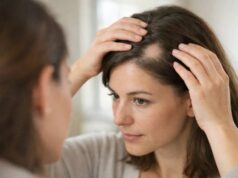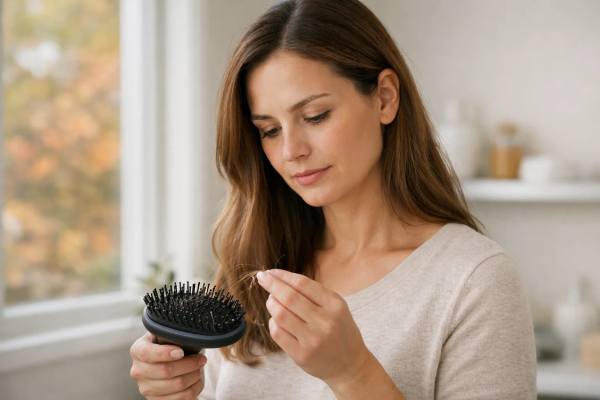
Most people notice hair in the shower year-round. What makes fall different is the sudden sense that the amount has doubled: more strands on the pillow, more in the drain, more wrapped around the brush. That can be alarming, especially when the scalp itself looks unchanged. In many cases, this pattern is real, temporary, and tied to the way human hair cycles through growth, rest, and release over time.
Seasonal hair shedding is not the same as permanent hair loss, and it is not proof that your hair is “dying.” It is better understood as a short-lived shift in timing. A larger group of hairs moves into the shedding phase together, often after late-summer changes in light, heat, stress, travel, diet, or scalp wear and tear. The good news is that most fall shedding settles on its own. The better news is that smart care can keep a seasonal spike from turning into unnecessary thinning, breakage, or panic.
Key Insights
- Fall shedding is often temporary and usually reflects more hairs entering the shedding phase at the same time.
- Gentle care can reduce extra breakage, scalp irritation, and the visual impact of seasonal shedding.
- A hidden trigger such as illness, rapid weight loss, low iron, thyroid issues, or medication changes can make a fall shed heavier.
- Shedding that lasts beyond a few months, creates visible thin spots, or comes with itching, pain, or bald patches deserves medical evaluation.
- For the next 8 to 12 weeks, focus on regular washing, enough protein, low-tension styling, and minimal heat to support recovery.
Table of Contents
- What Seasonal Hair Shedding Really Is
- Why Fall Brings a Shedding Spike
- How Much Shedding Is Still Normal
- How to Reduce Fall Shedding Gently
- Habits That Can Make Shedding Worse
- When Seasonal Shedding Needs a Workup
What Seasonal Hair Shedding Really Is
Seasonal hair shedding is best thought of as a timing issue inside the follicle cycle, not a sign that follicles have stopped working. Each scalp hair moves through growth, transition, rest, and release. At any given moment, most hairs are growing, while a smaller share are resting and preparing to shed. Because those cycles are usually staggered, daily loss stays fairly stable. But sometimes the rhythm becomes more synchronized, and more hairs exit over the same stretch of weeks.
That is why seasonal shedding often feels dramatic even when it is still temporary. You do not have to lose a large percentage of your total density for the change to feel very noticeable. Long hair makes it look even bigger, because a single shed strand takes up more visual space in the sink or brush than a shorter one. People with thick hair may also see a startling amount without actually having major thinning. If you want a fuller explanation of the cycle itself, a quick refresher on the hair growth cycle helps put the pattern in context.
What makes seasonal shedding different from many other forms of hair loss is that the follicle is still active. The hair is released, but the follicle usually remains capable of growing another strand. That is why this type of shedding often resolves without aggressive treatment. The key question is whether the shed is truly seasonal or whether fall is simply the moment you notice a process that started earlier.
A few features make seasonal shedding more likely:
- The loss is diffuse, not patchy.
- The hairline usually stays intact.
- The scalp looks normal, without scars or thick scaling.
- The shedding tends to rise for several weeks, then gradually ease.
It is also common for the shed to feel worse than it looks. Many people can point to heavy shower loss but cannot identify a sharply widening part or a new bald area. That does not mean the experience is imaginary. It means the change is often more about turnover than destruction.
One important nuance: seasonal shedding can overlap with other conditions. A person with early pattern hair loss, low iron, thyroid disease, or chronic stress may have a predictable fall spike that sits on top of an ongoing issue. In those cases, the season is not the whole story. It is simply the moment the scalp becomes less forgiving.
The most useful mindset is this: a seasonal shed is usually a reversible shift in hair cycling, but it should never be used as an excuse to ignore persistent thinning, scalp symptoms, or major changes in density.
Why Fall Brings a Shedding Spike
Fall shedding has been observed often enough to be more than a beauty myth, but the exact reason it happens is still not fully settled. The strongest evidence suggests that many people experience a late-summer to fall increase in telogen hairs, meaning more follicles have moved into the resting and release phase. In plain language, a larger batch of hairs is ready to let go around the same time.
Why would that happen? The best answer is probably that several influences stack together rather than one single “fall cause” explaining everything.
One likely piece is seasonality in hair cycling itself. Human hair is not perfectly random across the calendar. Some follicles appear to shift with seasonal rhythms, which may help explain why a peak often appears toward the end of summer or early fall. That does not mean everyone sheds in September, and it does not mean the same timing is seen in every climate. But it does support the idea that the scalp is at least somewhat seasonal.
The second piece is delayed fallout from summer stressors. Hair shedding often begins weeks after a trigger, not during it. A rough period in June or July may show up on your scalp in September. That delay is classic for stress-related telogen effluvium and helps explain why fall often gets blamed for events that actually happened months earlier.
Common warm-weather contributors include:
- More ultraviolet exposure, which can dry the hair fiber and stress the scalp surface.
- Salt water and chlorine, which leave hair rougher and more breakable.
- More frequent washing after sweating, swimming, or travel.
- Tight summer hairstyles, including slick buns, braids, ponytails, and hats worn on repeat.
- Diet shifts, especially reduced protein intake or crash dieting after vacations.
- Poor sleep, dehydration, and schedule disruption.
These factors do not all cause true follicle shedding on their own. Some increase breakage, some irritate the scalp, and some act as physiologic stressors that can nudge more follicles into telogen. The result is that fall can look like one event when it is really a cumulative after-effect.
Hormones may also matter. Postpartum shifts, stopping estrogen-containing contraception, perimenopause, thyroid changes, and high stress hormones can all influence the timing and intensity of shedding. In many women, the seasonal spike becomes more obvious during periods of hormonal transition because the baseline margin of resilience is lower.
The main takeaway is that fall shedding is real, but not mysterious. It is usually a convergence of normal seasonal rhythm and delayed response to earlier triggers. That is why the most effective way to reduce it is not chasing one miracle product in October. It is looking back over the prior two to three months and asking what changed in your body, routine, scalp, diet, or stress load.
How Much Shedding Is Still Normal
This is the question that unsettles people most, and the honest answer is that there is no single number that perfectly separates “normal” from “too much.” Healthy scalps shed every day. The problem is that daily counts are messy. Wash frequency, hair length, curl pattern, styling habits, and overall density change what you see. Someone who shampoos every day may notice fewer hairs per wash than someone who washes twice a week, even if their average daily loss is similar.
That said, there are still useful guideposts. A mild seasonal increase often means more visible strands during washing, brushing, and detangling, but without sharp focal thinning. The part line may look nearly the same. The temples do not suddenly recede. The scalp is not developing smooth bald patches. In many cases, the experience is intense but temporary.
What deserves closer attention is not just the number of hairs, but the pattern.
Signs the shedding may still fit a seasonal pattern include:
- The loss is diffuse across the scalp.
- The change began gradually over a few weeks.
- You can see full-length hairs with a small white club at the root.
- The shedding is heavier in the shower or on wash days.
- Your scalp feels mostly normal.
Signs it may be more than seasonal include:
- Shedding continues beyond about 8 to 12 weeks without easing.
- Your ponytail feels clearly smaller.
- The part line is visibly wider.
- You notice miniaturized hairs, increased temple thinning, or crown thinning.
- There is scalp pain, burning, heavy itching, or marked flaking.
- Hair is breaking mid-shaft rather than shedding from the root.
That last point matters. Many people confuse breakage with shedding. When hair snaps from heat, bleach, friction, or mechanical stress, the overall volume can drop quickly, but the solution is different. Understanding how shedding and hair loss differ can prevent the wrong fix.
Another practical clue is timing. True telogen-type shedding often follows a trigger by two to three months. If your fall shed appeared after a summer illness, emotional strain, travel-heavy period, rapid weight change, or medication shift, the timeline makes sense. If there is no clear trigger and the thinning has been slowly progressing for six months or longer, seasonal shedding alone becomes less likely.
Try not to count every strand. That usually increases anxiety without improving accuracy. Instead, take the same photos every two weeks in consistent light: center part, both temples, crown, and ponytail circumference if relevant. Those comparisons are far more useful than drain panic. They help answer the question that really matters: is this a temporary surge in release, or is density actually continuing to decline?
How to Reduce Fall Shedding Gently
You cannot force hairs to skip the shedding phase once they are committed to it, but you can reduce the severity of the episode, protect the hair that remains, and create better conditions for regrowth. The goal is not to stop every strand from coming out. It is to lower added stress on the follicle and prevent true shedding from being amplified by breakage, inflammation, or poor scalp habits.
A simple fall routine works better than a crowded shelf. Focus on these priorities for the next 8 to 12 weeks:
- Keep washing consistently.
Avoid the urge to wash less just because seeing shed hairs is upsetting. Delaying wash days often makes the next shower look worse because more released hairs have accumulated. A steady routine based on scalp oil level is usually best. If you are unsure, use your scalp type as the guide and build around a realistic schedule, much like the approach outlined in washing for your scalp type. - Reduce friction and tension.
Use a wide-tooth comb, start detangling at the ends, and avoid yanking through wet hair. Choose loose styles over tight ponytails, claw clips over elastic strain, and soft scrunchies over thin bands. Sleep on a smooth pillowcase or use a bonnet if friction is a problem. - Lower heat and harsh processing.
Fall is a poor time for repeated bleaching, tight blowouts, or high-heat styling marathons. If you do use heat, keep temperatures moderate and use a protectant. The less shaft damage you create now, the less the shed will seem to spiral. - Eat for recovery, not restriction.
Hair is metabolically expensive tissue. If you are under-eating, especially protein, your scalp notices. Aim for regular meals, adequate protein distributed through the day, and enough total calories to avoid sending another stress signal. A short “reset diet” after summer can easily backfire on your hair. - Look back at triggers.
Review the prior 8 to 12 weeks. Fever, surgery, rapid weight loss, medication changes, stopping hormonal contraception, intense stress, and low iron are all common reasons a seasonal shed becomes unusually heavy. Correcting the trigger matters more than adding trendy serums. - Calm the scalp environment.
If your scalp is itchy, greasy, flaky, or sore, treat that seriously. Inflammation adds noise to the picture and can make shedding feel worse. Use products that clean well but do not leave the scalp tight or burning.
Some people ask about supplements first. Unless a deficiency or clear dietary gap exists, they are rarely the first intervention to reach for. A seasonal shed responds best to consistency, nutrition, scalp comfort, and time. When growth resumes, the improvement often appears as softer short hairs along the part and hairline. That stage is easy to miss if you are only watching what falls out and not what is returning.
Habits That Can Make Shedding Worse
The most frustrating part of a fall shed is that well-meaning “fixes” often make it look worse. People panic, overhaul everything at once, and then cannot tell which change helped, which irritated the scalp, and which simply increased breakage. When shedding rises, restraint is usually more useful than intensity.
One common mistake is reducing washing too much. People often assume shampooing is making hair fall out, when in reality it is only revealing hairs that were already released. Skipping washes can lead to oil, sweat, flakes, and styling buildup, which may irritate the scalp and make the eventual wash day feel catastrophic. Another mistake is scrubbing aggressively, trying to “stimulate” growth with pressure that actually causes tangling and mechanical stress.
Another pitfall is confusing fragility with fallout. Bleached, over-processed, or dehydrated hair snaps more easily, so the total amount of hair you see around you rises from two directions at once: true shedding from the root and breakage from the shaft. If that distinction is blurry for you, breakage and hair loss should be separated before you decide on treatment.
Habits that commonly make seasonal shedding look worse include:
- Tight buns, slick ponytails, braids, or extensions worn daily.
- Repeated flat-ironing or hot-tool touch-ups on already dry hair.
- Rough towel drying, fast brushing, or detangling without slip.
- Frequent bleaching, relaxing, perming, or glossing during a shed.
- Crash dieting, fasting aggressively, or cutting protein too low.
- Taking random high-dose supplements “for hair” without a reason.
- Switching among multiple scalp actives at the same time.
The supplement issue deserves emphasis. More is not better. Large doses of zinc, selenium, or vitamin A can backfire, and biotin can interfere with some lab tests. Unless you are correcting a documented deficiency or following a clinician’s plan, “hair vitamins” often add expense without solving the problem.
Stress behavior also matters. Repeatedly checking the mirror, counting hairs after every wash, or photographing the same area several times a day can intensify distress and make normal fluctuation feel like rapid deterioration. Hair does not recover on an hourly timeline. The more helpful interval is week to week.
A better rule is to protect what is attached while the cycle resets. That means low tension, lower heat, steady nourishment, gentle cleansing, and fewer experiments. It also means resisting overly restrictive diets. In fact, low-calorie diets can intensify shedding long after the scale has changed.
Fall shedding is often temporary. The damage people do while trying to stop it sometimes is not. Keep the routine boring, consistent, and scalp-friendly until the shedding wave passes.
When Seasonal Shedding Needs a Workup
A true seasonal shed should gradually calm down. If it does not, or if the pattern looks wrong from the start, it is time to think beyond the calendar. The reason this matters is simple: “seasonal shedding” is a description, not a diagnosis. It may be the whole story, but it can also be the label people apply to early pattern hair loss, iron deficiency, thyroid disease, inflammatory scalp disorders, medication-related shedding, or chronic telogen effluvium.
You should consider a medical evaluation if any of the following are happening:
- The shedding lasts longer than about three months.
- Density is clearly decreasing, not just daily fallout increasing.
- The part is widening or the crown is showing more scalp.
- You see bald patches, eyebrow loss, or eyelash loss.
- Your scalp burns, hurts, itches intensely, or develops heavy scale.
- The timing followed a major illness, surgery, childbirth, rapid weight loss, or medication change.
- Fatigue, menstrual changes, cold intolerance, or other systemic symptoms are present.
At that visit, the most useful step is a careful history. A good clinician will ask what changed two to three months before the shed started, not just what happened the week it became noticeable. They may review nutrition, stress, recent illnesses, family history, medications, hormones, and scalp symptoms. Depending on the picture, targeted labs may be appropriate, especially when history suggests iron deficiency, thyroid problems, or other medical contributors.
Not everyone with a fall shed needs a long blood panel. Broad testing without clinical clues can have low yield. But targeted testing can be worthwhile when the story fits. The point is not to medicalize every seasonal change. It is to avoid missing the patients whose “seasonal” hair loss is actually a signpost to something treatable.
The diagnosis also changes management. Seasonal shedding and acute telogen effluvium are often handled with trigger correction and time. Pattern hair loss may call for evidence-based medical treatment. Inflammatory scalp disease may need anti-inflammatory or antifungal care. Traction requires hairstyle change. Those are very different paths.
If you are on the fence, use this rule: a temporary seasonal shed should look like release without destruction. Once you see a shrinking ponytail, visible pattern change, patchiness, or scalp symptoms, it deserves a closer look. Guidance on when to see a dermatologist for hair loss becomes especially relevant if the shed is recurrent every year but progressively heavier.
Seasonal shedding should reassure you that regrowth is usually possible. It should not talk you out of getting help when the pattern no longer behaves like a short-lived cycle shift.
References
- Seasonal changes in human hair growth 1991. ([PubMed][1])
- Seasonality of hair shedding in healthy women complaining of hair loss 2009. ([PubMed][2])
- Hair Shedding Evaluation for Alopecia: A Refined Wash Test 2022. ([PMC][3])
- Integrative and Mechanistic Approach to the Hair Growth Cycle and Hair Loss 2023. ([PMC][4])
- Telogen effluvium: a 360 degree review 2023. ([PubMed][5])
Disclaimer
This article is for educational purposes and is not a medical diagnosis or a substitute for personal care from a qualified clinician. Seasonal shedding is often temporary, but persistent or severe hair loss can reflect underlying medical, hormonal, nutritional, inflammatory, or medication-related causes that need proper evaluation. Seek prompt medical advice if you develop bald patches, scalp pain, marked itching, rapid thinning, or shedding that continues beyond a few months.
If you found this article helpful, please share it on Facebook, X, or your preferred platform.