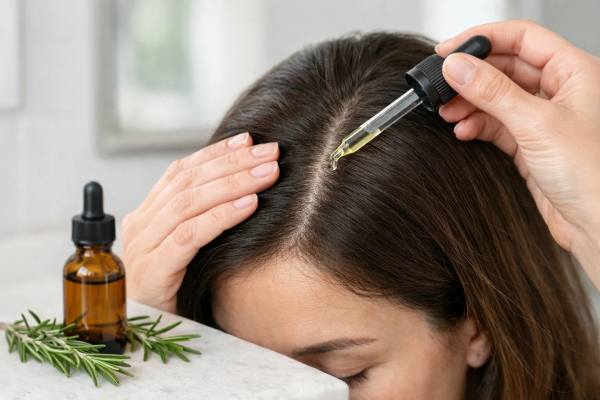
Rosemary oil has moved from beauty folklore into mainstream hair-loss conversations, and that shift has happened for a reason. Unlike many viral remedies, it does have some clinical evidence behind it. Still, the evidence is narrower than the hype suggests. Rosemary oil may help certain people with early thinning, especially when the follicles are still active, but it is not a universal fix for every type of hair loss, and it is not a shortcut to dramatic regrowth. The real value of this ingredient lies in understanding its limits as clearly as its promise. How you apply it, how often you use it, what type of product you choose, and whether your scalp can tolerate it all matter more than the trend itself. If you approach rosemary oil as a supportive treatment rather than a miracle one, it becomes much easier to use well. This guide explains what the research actually shows, how to apply rosemary oil safely, and what kind of results are realistic over time.
Core Points
- Rosemary oil may modestly improve hair density in some people with early pattern thinning, but it does not reliably restore long-bald areas.
- The best outcomes are usually gradual and measured over 3 to 6 months, not after a few applications.
- Pure essential oil should not be applied straight to the scalp without dilution, especially on sensitive or inflamed skin.
- A practical starting point is a 1% to 2% dilution used 2 to 4 times per week, or a well-formulated leave-on product used exactly as directed.
- Burning, rash, worsening itch, or scalp tenderness are signals to stop and reassess rather than push through.
Table of Contents
- What rosemary oil can and cannot do
- What the research actually shows
- How to use rosemary oil safely
- Who may benefit most and who should skip it
- What results to expect and when
- Common mistakes and when to see a dermatologist
What rosemary oil can and cannot do
Rosemary oil sits in a useful but limited category: it is a potentially helpful topical support, not a proven cure for hair loss. That difference matters because most disappointment begins with the wrong expectation. People often apply it to a rapidly worsening hairline, a long-bare crown, or sudden heavy shedding and expect the oil itself to solve the entire problem. In reality, rosemary oil appears most relevant for early pattern thinning, when follicles are still present but underperforming.
The idea behind it is biologically plausible. Rosemary contains compounds with antioxidant and anti-inflammatory activity, and it may support scalp microcirculation. Some laboratory and animal data also suggest possible effects on pathways involved in androgen-driven miniaturization. That is enough to make it scientifically interesting, but not enough to claim that it reverses every kind of alopecia. A treatment can be promising without being broadly powerful.
This is also why rosemary oil should be viewed as a follicle-support strategy rather than a hair-creation strategy. It may help weak follicles function better. It does not build brand-new follicles where they are gone. If an area has been smooth, shiny, or clearly bald for a long time, the ceiling for improvement is low. If the area still has many fine, short, or miniaturized hairs, the odds are better. That is true for many nonsurgical treatments, not just this one.
Readers often ask whether rosemary oil “makes hair grow faster.” The more honest answer is that it may help preserve or improve growth in follicles that are still capable of producing hair, but it does not change the basic speed limits of biology. The hair shaft still has to cycle, emerge, and lengthen. That is why it helps to understand the hair growth cycle before judging any topical product too quickly.
It is also worth separating hair growth from scalp comfort. Some people use rosemary oil because they like the sensation of scalp massage, the ritual of oiling, or the temporary softness it gives the hair. Those effects can be pleasant, but they are not the same as evidence of regrowth. A scalp that feels “tingly” is not necessarily a scalp that is responding well. In some people, that feeling is simply irritation.
The clearest way to think about rosemary oil is this:
- It may modestly support density in early androgenetic alopecia.
- It may fit best as part of a larger routine, not as a standalone rescue.
- It is less convincing for advanced loss, scarring loss, or sudden medically driven shedding.
- It works slowly enough that short trials often lead to false conclusions.
That balance is important. Rosemary oil is not empty hype, but it is also not a substitute for diagnosis. It tends to work best when the problem is mild enough to be salvageable and the user is disciplined enough to be consistent without overdoing it.
What the research actually shows
The research on rosemary oil for hair growth is encouraging, but it is still much thinner than many product labels imply. The most frequently cited human study is a randomized trial that compared rosemary oil with 2% minoxidil in 100 men with androgenetic alopecia over 6 months. Both groups improved by month 6, and the study did not find a significant difference in hair count between them. Scalp itching was reported more often in the minoxidil group. That result is the main reason rosemary oil became widely discussed as a natural alternative.
The study matters, but its limits matter too. It involved men only, the sample size was modest, and the comparator was 2% minoxidil rather than the stronger 5% concentration that is more commonly used in many hair-loss routines today. It also does not prove that rosemary oil will work equally well in women, in advanced recession, or in hair loss caused by nutritional deficiency, thyroid disease, autoimmune conditions, or inflammatory scalp disorders. A useful trial is not the same thing as universal proof.
Later reviews have generally landed in the same place: rosemary oil is promising, probably helpful for some patients with androgenetic alopecia, and still supported by limited human data. Reviews of natural alternatives and nonprescription treatments repeatedly describe it as a candidate worth considering, but not one backed by the same breadth of evidence as better-established treatments. That is an important distinction for anyone deciding how much trust to place in it.
A few practical conclusions come out of the literature:
- The best-studied context is androgenetic alopecia, also called pattern hair loss.
- Improvement, when it happens, is gradual and usually assessed over months.
- Evidence is not strong enough to claim that rosemary oil outperforms standard treatment.
- Most studies and reviews still call for larger, better-designed trials.
This is one reason readers often compare it with minoxidil and its expected response pattern. Minoxidil has far more extensive clinical use and a stronger evidence base. Rosemary oil has a smaller but interesting evidence trail. That does not make rosemary oil useless. It makes it a lower-certainty option.
Another important research point is that product form matters. “Rosemary oil” in conversation can mean pure essential oil, a diluted oil blend, a cosmetic scalp serum, or an herbal lotion with multiple supporting ingredients. Those are not interchangeable. One of the biggest gaps in the literature is that formulations, concentrations, and application methods vary. So when people say, “Rosemary oil worked” or “Rosemary oil did nothing,” they may not even be talking about similar products.
The fairest summary is that the evidence supports cautious optimism, especially for early pattern thinning. That is stronger than anecdote, but weaker than certainty. If you understand that middle ground, the research becomes useful instead of misleading. It tells you rosemary oil may be worth a thoughtful trial. It does not tell you to expect a dramatic reversal of established hair loss.
How to use rosemary oil safely
Safe use starts with one simple rule: pure rosemary essential oil is too concentrated to apply directly to the scalp without dilution. Essential oils are potent aromatic compounds, not ready-made scalp treatments. Applying them neat can increase the risk of stinging, redness, irritant dermatitis, and allergic reactions, especially on sensitive skin or a scalp that is already inflamed.
If you are using pure essential oil, a cautious starting range is a 1% to 2% dilution in a carrier oil. For a 1-ounce, or 30 mL, bottle of carrier oil, that is roughly 6 drops for a 1% dilution and about 12 drops for a 2% dilution. Sensitive scalps should start lower, not higher. Good carrier options include jojoba, squalane, grapeseed, or a lighter scalp-friendly oil that does not leave heavy residue. Thick, occlusive oils are not automatically better just because they feel richer.
If you are using a commercial serum or scalp product, do not add extra rosemary oil to it. Use the product as formulated. One of the easiest ways to create irritation is to assume more equals better and start combining concentrated oils, scalp actives, and massage tools in the same routine.
A practical approach looks like this:
- Start with a patch test on a small area of skin before widespread scalp use.
- Use the diluted oil or formula 2 to 3 times per week at first.
- Apply a small amount to thinning areas rather than soaking the whole scalp.
- Leave it on according to the product type, then reassess tolerance.
- Increase only if your scalp remains calm.
For many people, a pre-shampoo application works well because it limits residue and reduces the temptation to overapply. A light leave-on scalp formula can also be reasonable if it is specifically designed for that purpose. What matters most is that the scalp stays comfortable. If application causes burning, persistent itching, rash, tightness, or flaking that is new for you, stop. Trying to “push through” is more likely to worsen the barrier than improve the hair.
This is also where understanding allergy versus irritation from scalp products becomes useful. Irritation can happen from concentration, overuse, or a damaged scalp barrier. Allergy can happen even with small amounts once sensitization develops. Both deserve respect.
A few safety rules are worth stating plainly:
- Do not use rosemary essential oil on broken, sunburned, or visibly inflamed scalp skin.
- Do not get it into the eyes or onto the eyelids.
- Do not swallow it.
- Do not use it on infants or children without medical guidance.
- Be more cautious if you have eczema, seborrheic dermatitis, psoriasis, fragrance sensitivity, or a history of product reactions.
The safest users are often the least aggressive ones. They start low, use fewer variables, monitor the scalp carefully, and let tolerance decide the pace. A rosemary oil routine should feel gentle, not medicinally punishing. The moment it starts feeling harsh, it is no longer a smart hair-growth plan.
Who may benefit most and who should skip it
Rosemary oil is most likely to help when the pattern of loss matches the pattern of evidence. That usually means mild to moderate androgenetic alopecia with visible thinning, miniaturized hairs, or increased scalp show-through, not a long-standing smooth bald zone. In simpler terms, it is most useful when follicles are still there and still trying.
That makes it potentially relevant for people with early temple thinning, widening of the part, diffuse crown thinning, or subtle loss of density that has developed gradually over time. It may also appeal to people who want a lower-intensity option before moving into prescription therapy, or who want to add a topical botanical to a broader routine. That does not mean it is the best first-line choice for everyone. It means it may be reasonable for carefully selected users.
The people most likely to be disappointed are those applying rosemary oil to the wrong diagnosis. Sudden shedding after illness, low iron, thyroid disease, rapid weight loss, childbirth, medication changes, or major stress usually requires a different line of thinking. In those cases, the scalp may not need botanical stimulation as much as the body needs the underlying issue recognized. The same is true for patchy loss, eyebrow loss, scalp pain, or inflammatory change. If the problem does not look like straightforward pattern thinning, rosemary oil should not be your only plan.
Some users should be especially cautious or skip it altogether:
- Anyone with a history of fragrance allergy or essential-oil sensitivity.
- Anyone with active scalp eczema, psoriasis, folliculitis, or severe dandruff flare.
- Anyone with burning, tenderness, or unexplained scalp pain.
- Anyone with long-bare areas and expectations of full regrowth.
- Anyone using multiple strong scalp actives who cannot tell what is causing irritation.
The scalp environment matters as much as the follicle. A calm scalp gives any topical treatment a better chance. A compromised scalp often reacts first and grows later, if at all. That is why it is helpful to think about overall scalp health and the follicle environment before treating a cosmetic concern as though it exists in isolation.
Pregnancy and breastfeeding deserve a conservative mindset too. While rosemary as a culinary herb is common, concentrated essential oil use on the scalp for hair growth is different from normal food exposure. In that setting, many people prefer to ask a clinician before using any strong essential-oil routine. That caution is sensible.
The best candidate for rosemary oil is not the person who is most desperate. It is the person with early, likely non-scarring thinning, a calm scalp, realistic expectations, and the patience to use one product consistently without changing ten other variables at once. In that setting, rosemary oil can be a reasonable experiment. Outside that setting, it can become a distraction from a diagnosis that needs more than an oil bottle.
What results to expect and when
The most realistic expectation is improvement at the margins, not a dramatic before-and-after transformation. Rosemary oil is more likely to reduce visible thinning modestly than to rebuild a dense hairline from scratch. The people who like their results usually describe the scalp showing less, the part looking a little tighter, shedding seeming calmer, or the hair feeling fuller when styled. Those are worthwhile outcomes, but they are not the same as a major reversal.
Timing matters as much as outcome. Hair does not respond on a cosmetic schedule. A follicle has to move through its cycle, produce a stronger fiber, and grow enough length for that change to be visible. That is why most users should think in 3- to 6-month windows, not 3-week windows. The well-known trial on rosemary oil did not show a meaningful hair-count change at 3 months, but did show improvement at 6 months. That timeline should temper expectations from the start.
A reasonable progression looks like this:
- In the first few weeks, the main question is tolerance, not growth.
- By 2 to 3 months, some people notice less shedding or a slightly healthier look.
- By 4 to 6 months, responders may start to see visible density improvement.
- After 6 months, lack of any meaningful change suggests the routine may not be doing enough.
This is why progress photos matter. Hair is emotionally charged, and memory is a poor measuring tool. If you use rosemary oil, photograph the same area monthly in the same lighting with dry hair and the same part placement. Otherwise, you risk mistaking hope, disappointment, or daily styling variation for real change.
It also helps to set the right endpoint. The goal should not be “hair looks like it did at sixteen.” A better goal is one of these:
- Slower progression of early thinning.
- Better preservation of density.
- Less scalp show-through in one target area.
- An added boost within a broader hair-loss plan.
People often ask whether rosemary oil can be combined with other treatments. In principle, yes, but the total routine must remain tolerable. Layering rosemary oil with frequent exfoliating acids, medicated shampoos, microneedling, and strong leave-ons can create irritation that cancels out the benefit. Sometimes the most effective combined routine is also the simplest one.
For anyone already worried about slow length retention, it helps to separate new growth from shaft survival. Even if follicles improve, the visible hair still has to stay intact long enough to show progress. That is one reason broader expectations about hair growth timelines and length change matter. A treatment can support the follicle without making the hair appear dramatically longer overnight.
The healthiest expectation is modest optimism. Rosemary oil may help if you are a good candidate and use it consistently. It will not usually produce instant density, guaranteed regrowth, or a precise month-by-month transformation. It works, when it works, in the quiet way many supportive treatments do: slowly, unevenly, and most clearly when you look back after several months rather than forward after several days.
Common mistakes and when to see a dermatologist
Most rosemary oil failures fall into one of three categories: the wrong diagnosis, the wrong concentration, or the wrong expectations. People often assume a natural treatment is automatically gentle, so they apply too much, too often, or on a scalp that is already irritated. Others use it correctly but expect it to treat a problem it was never designed to solve.
One common mistake is applying pure essential oil directly to the scalp. Another is using so much oil that buildup, itch, and occlusion become part of the problem. A third is judging the treatment after two or three weeks, deciding it failed, and then switching immediately to something else. Constant switching makes it hard to know what your scalp can tolerate and what, if anything, is helping.
Another frequent error is using rosemary oil as a stand-in for diagnosis. A widening part, new recession, or increased shedding may be caused by pattern loss, but it may also reflect iron deficiency, thyroid change, postpartum shedding, medication effects, traction, seborrheic dermatitis, psoriasis, or inflammatory alopecia. If you use rosemary oil without asking what the thinning pattern actually means, you may lose time that would be better spent identifying the cause.
Practical mistakes to avoid include:
- Combining rosemary oil with too many new scalp products at once.
- Massaging so aggressively that the scalp becomes sore.
- Leaving heavy oil on the scalp for days and assuming more exposure is better.
- Using it on a broken, flaky, or actively inflamed scalp.
- Continuing despite burning, rash, tenderness, or worsening itch.
It is also important not to confuse “natural” with “risk-free.” Essential oils and fragrances can cause dermatitis, and repeated exposure can increase the chance of sensitization in some people. If you develop redness, persistent itch, facial rash, swollen eyelids, or worsening flakes after use, stopping is more important than staying committed to the trend.
A dermatologist is worth seeing if you have any of the following:
- Sudden or heavy shedding over weeks rather than slow thinning over months.
- Patchy hair loss, eyebrow loss, or smooth bare areas.
- Scalp pain, burning, pustules, or persistent scale.
- Hair loss that continues despite gentle care and a thoughtful routine.
- Concern that the problem may reflect a broader medical cause.
These are the situations where timely evaluation for hair loss matters most. Early treatment depends on early clarity. Rosemary oil can be a useful part of some routines, but it should never become the reason you delay a proper workup when the pattern looks unusual, rapid, or symptomatic.
The smartest use of rosemary oil is disciplined and humble. It can be tried carefully, tracked honestly, and stopped without drama if it is not helping. That mindset protects both your scalp and your time. In hair care, that is often more valuable than chasing every promising ingredient that appears on your feed.
References
- Rosemary oil vs minoxidil 2% for the treatment of androgenetic alopecia: a randomized comparative trial 2015 (RCT)
- An Overview of Commonly Used Natural Alternatives for the Treatment of Androgenetic Alopecia, with Special Emphasis on Rosemary Oil 2024 (Review)
- Complementary and alternative supplements: a review of dermatologic effectiveness for androgenetic alopecia 2023 (Review)
- Herbal Remedies for Hair Loss: A Review of Efficacy and Safety 2025 (Review)
- What is New in Contact Allergy To Cosmetics for Physicians, Cosmetologists, and Cosmetic Users? 2025 (Review)
Disclaimer
This article is for educational purposes only and is not a substitute for medical advice, diagnosis, or treatment. Rosemary oil may be a reasonable supportive option for some forms of early thinning, but it cannot diagnose the cause of hair loss and should not replace medical evaluation when loss is sudden, patchy, painful, inflamed, or rapidly progressive. Essential oils can also trigger irritation or allergic reactions, especially on sensitive scalps.
If this article helped you, consider sharing it on Facebook, X, or another platform where it may help someone use hair-growth remedies more safely and realistically.