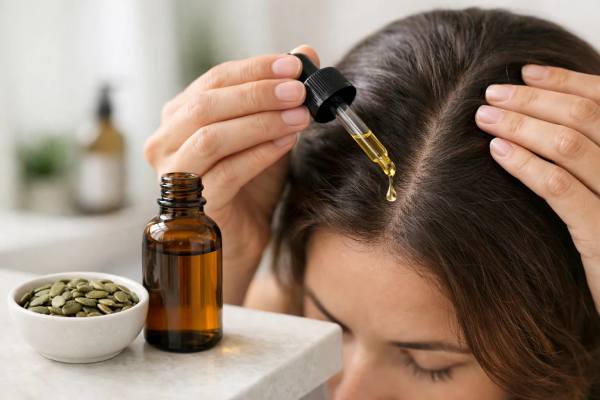
Pumpkin seed oil sits in an interesting corner of hair-loss care. It is not a prescription treatment, and it does not have the deep evidence base of minoxidil or finasteride. Yet it keeps coming up for a reason: a small clinical trial in men with androgenetic alopecia found meaningful improvement over 24 weeks, and newer reviews continue to place it among the more plausible supplement options for pattern hair loss. That combination of promise and uncertainty is exactly why people search for it.
The real question is not whether pumpkin seed oil sounds natural or appealing. It is whether it fits your type of hair loss, whether the dose you are taking resembles what has actually been studied, and whether you are using it in place of treatments with stronger proof. Used thoughtfully, it may be a reasonable adjunct for some people. Used casually, it can become another supplement that delays a correct diagnosis while expectations drift upward and results stay modest.
Quick Facts
- Pumpkin seed oil may help some people with pattern hair loss, especially when thinning is mild and early rather than advanced.
- The best-known oral study used 400 mg daily for 24 weeks, so it is not a quick fix and it is not proven for every hair-loss type.
- Evidence is much weaker than for minoxidil and finasteride, and supplement quality can vary from one brand to another.
- It is most sensible as a structured trial with baseline photos, a clear stop point, and a diagnosis that actually fits androgen-driven thinning.
Table of Contents
- What Pumpkin Seed Oil Might Do
- What the Studies Actually Show
- Dosage Forms and How to Use It
- Who May Benefit and Who Should Skip It
- How It Compares with Minoxidil and Finasteride
- When to See a Dermatologist Instead of Experimenting
What Pumpkin Seed Oil Might Do
Pumpkin seed oil is usually discussed in hair care because it may affect one of the main pathways behind androgenetic alopecia: signaling related to dihydrotestosterone, or DHT. In male and female pattern hair loss, follicles gradually miniaturize. The hairs become finer, shorter, and less pigmented over time. If a treatment helps, it usually does one or more of the following: reduce androgen-related stress on the follicle, support a healthier growth cycle, calm local inflammation, or improve the scalp environment enough for thicker hairs to return.
Pumpkin seed oil is thought to matter here because it contains phytosterols and fatty acids that may inhibit 5-alpha-reductase activity, the enzyme involved in converting testosterone to DHT. That is the theory that keeps it in the conversation. It also contains antioxidant compounds and vitamin E–related components, which may have supportive effects, although those are best understood as biologically interesting rather than clinically decisive.
That distinction matters. A plausible mechanism is not the same thing as proof of strong hair regrowth. Hair-loss supplements often sound impressive on paper because they touch many pathways at once. In real life, the question is narrower: does enough of that biological activity reach the follicle, in the right people, for long enough, to create visible change? With pumpkin seed oil, the answer appears to be “possibly, in some cases,” not “reliably, for most people.”
This is why pattern matters so much. Pumpkin seed oil is most relevant when the problem looks androgen-driven: gradual thinning at the crown, widening of the central part, reduced density over time, and a family history that fits. That is very different from a sudden burst of shedding after illness, crash dieting, major stress, surgery, or postpartum recovery. It is also different from patchy bald spots, inflamed scalp disease, or scarring alopecia.
A useful mental model is to see pumpkin seed oil as a modest signal, not a rescue therapy. It may be most helpful in early thinning, when follicles are still active and not yet severely miniaturized. It is unlikely to outperform standard treatment in advanced cases. It is also unlikely to be the right first move if you do not yet know whether you are dealing with male or female pattern thinning in the first place. For a fuller overview of pattern-related thinning, this guide to male pattern hair-loss options can help place it in context.
The strongest reason to consider pumpkin seed oil is not that it is “natural.” It is that it has a biologically sensible rationale and at least some human data. The strongest reason to stay realistic is that the data remain limited, and limited evidence should shape both your expectations and your timeline.
What the Studies Actually Show
The evidence for pumpkin seed oil is more specific than many product pages suggest. The best-known oral study involved 76 men with mild to moderate androgenetic alopecia. They took 400 mg of pumpkin seed oil daily or placebo for 24 weeks. By the end of the trial, the pumpkin seed oil group had higher self-rated improvement and satisfaction, and their mean hair count increased more than the placebo group. That is the study that built pumpkin seed oil’s reputation in hair-loss circles.
It is encouraging, but it is also easy to overread. One small trial is not the same as broad confirmation. The study was limited to men with pattern hair loss, not women, not teenagers, not patients with patchy autoimmune hair loss, and not people with heavy inflammatory scalp disease. It also lasted 24 weeks, which is long enough to be meaningful but not long enough to answer every question about durability, relapse, or long-term safety.
There is also a small randomized trial in women with female pattern hair loss that compared topical pumpkin seed oil with 5% minoxidil foam for 3 months. The findings were promising, but this study does not prove that over-the-counter pumpkin seed oil products are interchangeable with the oral 400 mg approach used in the men’s trial. The route of delivery, concentration, and target population were different. In other words, “pumpkin seed oil helped in a study” does not automatically tell you which version to buy.
Newer reviews place pumpkin seed oil in a middle category: potentially helpful, generally well tolerated, but supported by relatively few high-quality trials. That is a useful way to frame it. It is not fair to dismiss it as hype, because there is actual human evidence behind it. It is also not fair to treat it like a proven equivalent of first-line therapy, because the study count and long-term data are still thin.
A few practical conclusions follow from that evidence:
- It makes the most sense for androgenetic alopecia, not every kind of shedding.
- The oral data are stronger than the casual “just rub some oil on your scalp” advice seen online.
- The evidence supports a months-long trial, not a two-week verdict.
- Lack of response does not mean your hair loss is untreatable; it may mean the diagnosis, route, or treatment strength is wrong.
This is also why readers should keep the difference between thinning and shedding clear. Pattern hair loss often unfolds gradually, while telogen shedding tends to come on faster and look more dramatic day to day. If you are unsure which pattern fits you, start with this explainer on shedding versus true hair loss before assuming a DHT-focused supplement is the answer.
The most honest summary is this: pumpkin seed oil has better evidence than many trendy hair supplements, but still nowhere near enough evidence to be treated as universally effective.
Dosage Forms and How to Use It
The dosage question is where many readers get lost, because “pumpkin seed oil” can mean several very different things on a label. It may be a plain oil, a softgel, a concentrated extract, or one ingredient inside a blend that also contains saw palmetto, biotin, marine compounds, zinc, or amino acids. That creates a basic problem: the better-known oral hair trial used 400 mg daily of pumpkin seed oil for 24 weeks, but many commercial products do not map neatly onto that setup.
That does not mean every product outside that exact formula is useless. It means you should be cautious about assuming equivalence. Hair supplements often borrow the language of a study while quietly changing the ingredient form, the dose, or the number of combined actives. Once that happens, it becomes harder to know what is actually doing the work.
A practical way to approach a trial of pumpkin seed oil is this:
- Choose one product with a clearly labeled amount of pumpkin seed oil per daily serving.
- Avoid starting it at the same time as three or four other new hair products.
- Take baseline photos of the hairline, part, crown, and temples.
- Recheck those same angles monthly in similar lighting.
- Give it a realistic window, usually 3 to 6 months, before judging.
- Stop early if you develop persistent itching, rash, or gastrointestinal discomfort.
This kind of structure sounds simple, but it solves a common problem. People often start a supplement, change shampoo, begin microneedling, reduce stress, and improve protein intake all at once. Then they cannot tell what helped, what irritated the scalp, or whether the improvement was just the natural end of a shedding episode.
Topical use is even less standardized. A topical female trial exists, but over-the-counter oils and serums vary widely in concentration, spreadability, stability, and added fragrance. That makes dose interpretation harder than it is with a capsule. If you want to try a topical product, patch testing is reasonable, especially if you have reactive skin or scalp symptoms.
There is also a quality issue that deserves plain language. Pumpkin seed oil is sold as a supplement or cosmetic ingredient, not as an approved hair-loss medication. That means brand choice matters. A product with vague labeling, proprietary blends, or inflated marketing claims is harder to trust. For a grounded way to vet bottles and blends, this guide to supplement red flags is worth reading before you spend money.
One more practical point: food and supplements are not the same thing. Eating pumpkin seeds can be part of a nutrient-dense diet, but the hair studies did not test “more pumpkin seeds in meals.” They tested defined interventions. So it is better to think of diet and supplementation as related but separate tools.
The best use case is a measured one: pick a form, confirm the dose, commit to a clear trial period, and track outcomes as if you actually want an honest answer.
Who May Benefit and Who Should Skip It
Pumpkin seed oil is most defensible for people with early or mild androgenetic alopecia who want a lower-intensity option, cannot tolerate a standard treatment, or prefer to add a supplement to a broader plan rather than rely on it alone. It may also appeal to people who are willing to accept a smaller evidence base in exchange for a gentler side-effect profile.
The key phrase there is may benefit. That group is narrower than marketing suggests. The best fit usually looks like this:
- gradual thinning rather than sudden handfuls of shedding
- crown or part-line changes rather than isolated bald patches
- follicles that are still active, not long-standing smooth bald areas
- realistic expectations about modest improvement rather than dramatic reversal
The people who should skip self-treating with pumpkin seed oil, or at least pause before starting it, are just as important to define.
First are people whose hair-loss pattern does not match androgen-driven thinning. Patchy loss may point toward alopecia areata. Diffuse shedding after fever, weight loss, low iron, medication changes, or childbirth calls for a different workup. Inflamed or scarring conditions need faster medical attention. In those settings, taking a DHT-focused supplement can waste time and create false reassurance. If patchy loss is part of the picture, this overview of patchy autoimmune hair loss shows why the diagnosis matters.
Second are people in groups not actually represented in the better hair trials. That includes children, adolescents, pregnant people, and breastfeeding people. The problem is not that pumpkin seed oil is automatically dangerous in every one of those groups. The problem is that the hair-loss evidence does not meaningfully answer the question for them. That is a good reason not to improvise.
Third are people with a known pumpkin or seed allergy, or those who notice reproducible itching, rash, or gastrointestinal symptoms after starting it. Mild abdominal discomfort and itching have been reported in supplement reviews. “Natural” does not mean nonreactive.
Fourth are people with a history of hormone-sensitive breast cancer or another situation where antiandrogen-related supplementation should not be started casually. Pumpkin seed oil is discussed in the literature partly because of its potential effect on 5-alpha-reductase and hormone-related pathways. That does not make it equivalent to prescription antiandrogens, but it is enough to justify caution and clinician input rather than self-prescribing.
The final group to pause is people already overwhelmed by supplements. If your hair loss could be driven by iron deficiency, thyroid disease, nutritional underfueling, or medication effects, another bottle may distract from the real driver. In that case, “skip it for now” is not pessimistic. It is disciplined.
The right question is not simply “can pumpkin seed oil help?” It is “am I the kind of person this evidence actually applies to?” That is where sensible use begins.
How It Compares with Minoxidil and Finasteride
Most readers do not want pumpkin seed oil in isolation. They want to know whether it is a serious alternative to the treatments doctors mention first. In most cases, the answer is no. It is better understood as a lower-evidence option that may serve as an adjunct, a fallback, or a preference-based trial for people who are not ready for prescription treatment.
Minoxidil has a far stronger evidence base than pumpkin seed oil. It is approved for pattern hair loss, available in topical form, and supported by many more studies across both men and women. Its job is different too. It does not primarily work as an antiandrogen. It helps prolong the growth phase and support follicle activity. That is why it remains the better-established first-line option for many patients. If you want a direct overview, this guide on how minoxidil works explains why it is still the benchmark.
Finasteride also has much stronger evidence in men with androgenetic alopecia. Its mechanism overlaps more closely with the pumpkin seed oil discussion because it targets DHT more directly and more predictably. That also means it carries a different side-effect conversation. For men who tolerate it and are appropriate candidates, finasteride is usually expected to do more than pumpkin seed oil.
So where does pumpkin seed oil fit?
It may fit in one of four lanes:
- adjunct: used alongside a standard treatment, not instead of one
- bridge: used while someone is deciding whether to start minoxidil or a prescription antiandrogen
- alternative attempt: used by someone who refuses or cannot tolerate standard options
- maintenance experiment: used in early thinning when the person understands the evidence is modest
What it should not be treated as is a natural duplicate of finasteride. That is where comparison articles often go wrong. Sharing a possible 5-alpha-reductase angle does not mean equal potency, equal consistency, or equal outcomes.
It is also helpful to compare pumpkin seed oil with other “natural” hair options. Reviews frequently mention rosemary oil, saw palmetto, caffeine, and blended nutraceuticals in the same breath. The problem is that these products are often studied in different populations, different routes, different durations, and different formulations. That makes head-to-head claims weak. Natural therapies are often grouped together because patients ask about them together, not because the evidence is equally strong.
A balanced way to think about it is this: pumpkin seed oil may belong in the conversation, but it does not lead the conversation. If your goal is the treatment with the strongest chance of visible regrowth, it will usually rank below minoxidil and below finasteride for the appropriate patient. If your goal is a gentler, more conservative, or more preference-driven trial, then pumpkin seed oil becomes more reasonable.
That is not a dismissal. It is simply the difference between a promising supplement and a treatment standard.
When to See a Dermatologist Instead of Experimenting
Supplements are most likely to disappoint when they are used as a substitute for diagnosis. That is especially true in hair loss, where several conditions can look similar in the mirror during the first few months. A widening part may be female pattern hair loss, but it can also overlap with chronic shedding. A thin crown may reflect androgenetic alopecia, but it can coexist with inflammation, low ferritin, thyroid disease, or recent illness. If you guess wrong, even a reasonable supplement choice can feel like a failure.
See a dermatologist sooner rather than later if you have any of these features:
- sudden or rapid shedding
- patchy bald spots
- scalp pain, burning, or heavy itching
- redness, scaling, pustules, or crusting
- eyebrow loss or body-hair changes
- a hairline changing unusually fast
- no improvement after a structured 3- to 6-month trial
Medical review is also smart if you are already using several interventions and still cannot tell whether your loss is improving, worsening, or simply fluctuating. Trichoscopy, a careful scalp exam, and a targeted lab workup can save months of guesswork. If diffuse thinning or heavy shedding is part of the picture, these common blood-test clues for hair loss are often part of the discussion.
A good consultation also helps with sequencing. For example, someone may do best with topical minoxidil first, while another person with clear male pattern hair loss may be a better candidate for a DHT-focused plan. Another person may need treatment for seborrheic dermatitis or scalp inflammation before any growth strategy has a fair chance of working.
This is also where expectations get recalibrated. Hair growth is slow, and even good treatments work gradually. But there is a difference between patience and drift. If a supplement is helping, you should usually be able to document some meaningful trend over time: less widening, improved density, fewer visibly miniaturized hairs, or better coverage in photos. If all you have after months is hope plus inconsistent lighting, that is not enough.
Pumpkin seed oil can be part of a reasonable hair-loss plan. It just should not become the reason you delay a diagnosis that needs more than supplementation. When pattern hair loss is caught earlier, follicles have more room to recover. When the diagnosis is wrong, time is the one resource you do not get back.
The best outcome is not finding the most “natural” bottle. It is matching the right tool to the right kind of thinning at the right moment.
References
- Effect of pumpkin seed oil on hair growth in men with androgenetic alopecia: a randomized, double-blind, placebo-controlled trial 2014 (RCT)
- Pumpkin seed oil vs. minoxidil 5% topical foam for the treatment of female pattern hair loss: A randomized comparative trial 2021 (RCT)
- Do Non-Prescription Products Help in Managing Androgenic Alopecia? 2024 (Review)
- Herbal Remedies for Hair Loss: A Review of Efficacy and Safety 2025 (Review)
- Safety First: A Comprehensive Review of Nutritional Supplements for Hair Loss in Breast Cancer Patients 2025 (Review)
Disclaimer
This article is for educational purposes and does not replace medical advice, diagnosis, or treatment. Hair loss can result from androgenetic alopecia, telogen effluvium, nutritional deficiencies, autoimmune disease, scalp inflammation, medication effects, and scarring disorders, among other causes. Pumpkin seed oil may be a reasonable option for some people with pattern hair loss, but it is not appropriate for every type of thinning and should not delay evaluation when hair loss is sudden, patchy, painful, inflamed, or rapidly progressive.
If this article was helpful, please share it on Facebook, X, or your preferred platform so more people can make informed decisions about hair-loss treatments.