The scalp is one of the easiest places to miss and one of the easiest places to burn. A clean part line, thinning crown, shaved head, or slightly widened hairline can leave skin exposed long before it looks “bald.” That is why scalp sunscreen has moved from niche beauty product to practical sun-protection tool. Yet once you start shopping, the choices get confusing fast. Powders promise mess-free touch-ups. Sprays promise quick coverage. Both sound convenient, but convenience is not the same as protection.
The real question is not which format sounds more elegant. It is which one gives your scalp the most reliable coverage in the way you actually live. That depends on how much scalp is exposed, whether your hair is styled, how oily or sweaty you get, and whether you need a first application or a midday reapplication. In most cases, spray and powder are not true duplicates. They work best in different roles, and using the right one at the right time makes a noticeable difference.
Fast Facts
- Spray usually works better for first full coverage on exposed scalp, wide parts, and thinning areas.
- Powder is often better for midday touch-ups on styled hair, oily scalps, and makeup-adjacent routines.
- Both formats fail most often because people apply too little, not because the SPF number is too low.
- Avoid inhaling either format, and do not rely on scalp sunscreen alone for long, intense sun exposure.
- Apply on dry hair and scalp, work section by section, and reapply every two hours outdoors or after sweating.
Table of Contents
- Why scalp sun protection is different
- How powder and spray behave
- Which format protects better
- How to apply spray correctly
- How to apply powder correctly
- Best choice by hair type and situation
Why scalp sun protection is different
Scalp sun protection is not just face sunscreen moved a few inches higher. The scalp behaves differently because hair changes how product reaches the skin, how evenly it spreads, and how quickly it wears off. A lotion that works beautifully on the forehead can feel greasy in the hair, cling to strands instead of skin, and leave the wearer looking as though they skipped wash day. That is one reason people under-protect the scalp even when they are very diligent with the rest of their face and body.
The scalp is also easy to underestimate. Many people assume hair provides enough coverage by default. Sometimes it does, especially when the hair is dense and the sun exposure is brief. But exposed scalp can show up in several common situations: a center part, a cowlick, a widened part from thinning, post-partum regrowth patterns, buzz cuts, receding temples, and slicked-back or tightly parted styles. Those areas can burn surprisingly fast because the skin is thin, often forgotten, and hard to inspect.
This matters for more than comfort. Repeated UV exposure on the scalp contributes to sunburn, inflammation, pigment change, and cumulative skin damage. A burned scalp can also feel worse than people expect because it is difficult to cool, difficult to ignore, and often irritated by brushing, shampooing, and sleeping. If you have ever washed a sunburned part line, you know how disproportionate the discomfort can feel.
The scalp also creates a practical protection problem: coverage has to compete with hair density. That is why sun safety on the head often works best as a layered strategy rather than a single-product strategy. Sunscreen helps, but hats, shade, and timing still matter. In real life, the most reliable protection for prolonged outdoor exposure is often a combination of scalp sunscreen plus a physical barrier, especially when the sun is strong, the exposure is long, or the scalp is already vulnerable.
A few people benefit from extra vigilance:
- anyone with thinning hair or visible scalp at the part
- people with shaved or closely cropped hair
- those with a history of scalp sunburn
- people using photosensitizing products or treatments
- outdoor exercisers, golfers, runners, gardeners, and beachgoers
If scalp coverage is a regular concern, a guide to protecting the scalp with hats and SPF can help you think beyond product format alone. That is useful because the best answer is not always “buy a better sunscreen.” Sometimes it is “change the exposure pattern, too.”
The bottom line is simple: the scalp deserves its own strategy. Hair complicates sunscreen placement, and that is exactly why powder and spray formats exist in the first place.
How powder and spray behave
Powder and spray scalp sunscreens may share the same goal, but they behave very differently once they leave the package. Understanding that difference is the fastest way to stop buying the wrong format for the wrong job.
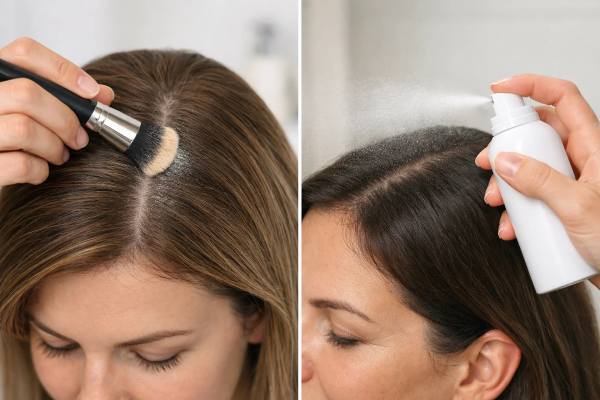
Spray sunscreen is usually the more intuitive of the two. It can cover larger exposed areas quickly, it can reach awkward scalp angles more easily, and it often lays down a more continuous film when applied generously and rubbed in. That makes spray especially practical for obvious exposure: shaved heads, thin crowns, wide parts, receding hairlines, and days when you know you will be outdoors for a while. The trade-off is technique. Sprays are easy to underapply, easy to miss in wind, and easy to inhale if used carelessly.
Powder sunscreen behaves more like a precision tool. It is usually applied with a built-in brush or shaker system and works best on dry hair and scalp. The appeal is cosmetic elegance. Powder does not usually leave the same wetness or shine as spray, and it can be easier to tap into a part line without flattening styled hair. That is why people with oily roots, fine hair, bangs, or blowouts often prefer it for touch-ups. It feels cleaner in the hair and less likely to collapse volume.
But powder has its own weakness: it is harder to judge coverage. With spray, you can usually see whether the scalp looks coated before rubbing it in. With powder, it is easier to fool yourself into thinking a light dusting counts as full protection. It often does not. This is why powder tends to work best as a convenience format, not as the most dependable first line for long exposure.
Their behavior also differs across scalp conditions:
- spray tends to suit larger exposed areas
- powder tends to suit narrow parts and quick midday refreshes
- spray can feel heavier on oily roots
- powder can feel cleaner on hair that already picks up grease fast
- spray usually performs better when you need a fresh full application
- powder usually performs better when you need not to ruin your styling
Sweat changes the equation too. Sprays generally hold their role better in active, sweaty settings, especially when the label is water resistant and you reapply correctly. Powder can be convenient, but on a sweaty scalp it may clump, disappear faster, or sit less evenly than you expect. The same applies at the beach, pool, or during long outdoor sports sessions.
This is also why powder’s overlap with oil-control products can be a mixed blessing. On an oily scalp, powder can make the roots look fresher while adding UV protection. That is a real advantage. But it can also encourage over-layering if you are already using dry shampoo, texture products, and scalp powders. If your roots tend to get greasy or coated, a review of oily scalp routine mistakes can help you avoid turning a sunscreen step into a buildup problem.
In short, spray behaves more like a true primary sunscreen, while powder behaves more like a strategic, cosmetic-friendly add-on. That difference is what drives most of the comparison.
Which format protects better
For most people, spray is the better primary scalp sunscreen and powder is the better reapplication sunscreen. That is the clearest answer, but it needs context.
There are not strong, scalp-specific head-to-head trials proving that one format always outperforms the other in daily life. So the comparison comes down to how these formats are designed, how official guidance treats them, and how people actually apply them. Protection depends less on marketing language and more on whether you can put on enough product, spread it evenly, and reapply it when the day wears on.
By that standard, spray has the edge for initial coverage. It is easier to apply more generously over a visible part line, thinning crown, or shaved scalp. It is also easier to see where you have already covered, especially if you work section by section and rub it in. For someone heading into sustained exposure, that matters more than elegance. A slightly less glamorous first layer that truly reaches the skin is usually the better protection choice.
Powder wins in a different way. It is often the format people will actually reapply. That is not a small point. A spray that sits at home is less protective than a powder kept in a bag and used at lunch, after commuting, or between outdoor errands. Powder also makes more sense when the hair is styled and dry and you want to protect the part without re-wetting the roots. For office workers, drivers, walkers, and people with makeup-and-hair routines, that practicality can be the difference between some reapplication and none.
So which protects better depends on the moment:
- for first full coverage, spray usually wins
- for midday touch-ups, powder usually wins
- for sports, beach days, and sweating, spray usually wins
- for oily roots and polished styling, powder often wins
- for broad exposed scalp, spray usually wins
- for narrow exposed lines, powder can be enough if applied thoroughly
There is also one case where neither is the best answer: intense, prolonged sun. If you are hiking at noon, sitting at a pool for hours, gardening all afternoon, or spending a day on the water, a hat often matters more than the powder-versus-spray debate. Sunscreen helps, but scalp sunscreen alone is not the strongest strategy for long, high-UV exposure.
It is also worth saying what powder is not. Powder is not the smartest sole choice for a brand-new, full scalp application on a hot beach day when the scalp is heavily exposed. It can help, but it is harder to know whether you have applied enough. That makes it more vulnerable to the most common sunscreen error: underapplication.
A practical ranking works well here:
- Best primary protection for exposed scalp: spray.
- Best touch-up protection for styled or oily hair: powder.
- Best overall protection for long outdoor exposure: hat plus sunscreen.
- Best choice for people who hate sunscreen texture: the one they will actually reapply.
If you have had a scalp burn before, that memory is useful. People who burn at the part or crown usually do best when they stop treating sunscreen as an occasional cosmetic step and start treating it as routine scalp care. A guide to scalp sunburn prevention and warning signs can help make that shift feel more concrete.
The most honest conclusion is this: spray protects better when coverage is the priority, powder works better when convenience is the priority, and the smartest routine often uses both.
How to apply spray correctly
Spray sunscreen only works as well as the layer you actually get onto the skin. That sounds obvious, but scalp sprays are often used too quickly, too far from the scalp, and too lightly to match the protection people think they are getting.
Start with dry hair and a dry scalp whenever possible. Wet roots, sweat, styling oils, and damp hair can all make it harder to see where the product lands and how evenly it spreads. Then part the hair deliberately. If you have a visible part, thinning crown, or receding areas, do not try to mist vaguely over the top and hope for the best. Expose the skin you are trying to protect.
A strong spray routine looks like this:
- Shake the product if the label says to do so.
- Hold the nozzle close to the scalp rather than spraying from far away.
- Spray generously over the exposed skin until the area visibly glistens.
- Use your fingertips to spread the product into an even layer.
- Create a second nearby part if a wider strip of scalp is exposed.
- Let it dry before lying down, putting on a hat, or styling further.
The rubbing step matters. Many people skip it because the spray looks evenly distributed at first glance. On the scalp, that is risky. Hair interferes with the mist, and rubbing helps catch missed spots and move product onto actual skin rather than just nearby strands.
A few safety rules matter with sprays:
- do not inhale the mist
- do not spray near the face, eyes, or mouth
- spray into your hands first if you need to cover the hairline more precisely
- avoid windy conditions when possible
- keep aerosol sprays away from heat, flames, and smoking
Reapplication is where technique often falls apart. If you are outdoors, plan to reapply about every two hours, and sooner after sweating heavily. The most common mistake is assuming a morning mist over the part is enough for the day. It rarely is, especially in heat, humidity, or direct overhead sun.
Spray also works best when it is not fighting too many other products. A scalp already coated with dry shampoo, root powder, or heavy styling residue can make it harder for sunscreen to sit evenly. If you notice that your protection step is landing on product instead of skin, the routine may need simplification. Sometimes the answer is not more sunscreen. It is a cleaner scalp and a more realistic wash schedule. That is where a guide to washing frequency by scalp type can help.
The biggest practical tip is to slow down. Spray sunscreen is sold as a quick format, which is true, but “quick” should not mean careless. On the scalp, good spray use is less like perfume and more like painting in rows. Once you adopt that mindset, the coverage usually gets much better.
How to apply powder correctly
Powder scalp sunscreen is easiest to love and easiest to underuse. It feels clean, polished, and low-mess. It also tempts people into applying a whisper-thin layer and assuming the brush did the rest. On the scalp, that is the main risk.
Powder works best on dry hair and scalp. If the roots are damp, sweaty, oily, or coated with fresh styling product, the powder may cling unevenly or disappear into the hair without creating a reliable film over the exposed skin. Dry, styled hair is where powder usually shines. It is especially useful for part lines, frontal scalp exposure, and quick midday reapplication when a wet spray would flatten everything.
To get better protection from powder, think in passes rather than a single sweep. A reliable routine looks like this:
- Start with dry hair and a clearly visible part or exposed area.
- Tap or brush the product directly along the exposed scalp, not just over the surrounding hair.
- Make several overlapping passes rather than one light stroke.
- Widen or shift the part slightly if more scalp is showing nearby.
- Repeat until the coverage feels deliberate, not symbolic.
- Reapply after sweating, outdoor exposure, or friction from hats.
The advantage of powder is precision. The weakness is dosage. You usually cannot see a “glistening” endpoint the way you can with spray. That is why powder is best treated as a targeted tool and not as the most dependable choice for first full application before a long day in intense sun.
Powder also works well for certain people:
- those with oily roots
- those who wear their hair down and styled
- commuters who need lunch-break reapplication
- people who dislike wet or shiny scalp products
- those touching up narrow parts rather than broad exposed areas
Still, powder has limits. It is usually less convincing as a sole strategy for:
- beach days
- all-day outdoor sports
- sweaty workdays
- heavily exposed shaved scalps
- wide or visibly thinning crowns
It can also irritate some people if the formula is heavily fragranced or if the scalp is already reactive. If you notice itching, burning, redness, or persistent discomfort, do not assume it is just “powdery dryness.” A look at product allergy versus simple irritation can help you think through whether the problem is the formula, the fragrance, or the frequency of use.
The most useful mindset with powder is this: it is a top-up tool. It is often excellent for maintaining protection when the hair is already styled and you need something discreet. It is less ideal when the day begins with a large amount of exposed scalp and high UV intensity.
Used correctly, powder can be extremely practical. Used lazily, it becomes sunscreen theater. The difference is not the format itself. It is whether you are applying it as though a brush stroke counts as coverage or as though you truly mean to protect skin.
Best choice by hair type and situation
The easiest way to choose between powder and spray is to stop asking which one is universally better and start asking which one fits your hair and your day.
If you have thinning hair, a widened part, or visible scalp at the crown, spray is usually the better primary choice. You need coverage more than elegance, and spray makes it easier to build that first protective layer. The same is true for shaved heads, very short cuts, and anyone spending long stretches outdoors.
If you have fine hair that collapses easily, the answer can split. Spray is still often better for your first application before going out, but powder may be far better for reapplication because it is less likely to flatten the roots. This is especially true when oil control matters and you want protection without the look of damp scalp.
If your scalp gets oily quickly, powder often becomes the daytime favorite. It can sit more comfortably in the routine, feel cleaner, and reduce the resistance many people have to reapplying sunscreen on hair. But oily scalp does not erase the need for enough product. Convenience helps only if the application is still generous enough to matter.
For curly, coily, or textured hair, the decision depends more on exposure pattern than curl pattern. If the scalp shows mainly at defined part lines, powder can work very well for targeted touch-ups. If broader scalp areas are visible or the day involves strong sun, spray may still be the better first layer. People with textured hair often do best when they treat spray as prep and powder as maintenance.
Use this quick guide:
- wide exposed scalp or shaved head: spray
- narrow part line and styled dry hair: powder
- beach, sport, hiking, or sweating: spray plus hat
- oily roots and office-day touch-ups: powder
- sensitive scalp: whichever fragrance-light formula you tolerate best
- long, high-UV exposure: sunscreen plus physical shade, not sunscreen alone
The same logic applies to situations. Driving to work with a visible part is different from spending four hours at a tennis court. A polished blowout at lunch is different from a trail run at noon. The format should match the exposure, not just the hairstyle.
One final point: neither powder nor spray fixes a poor sun routine by itself. If you burn easily, ignore reapplication, or stay in direct midday sun without shade, even a good format will be working uphill. And if you notice ongoing tenderness, peeling, or repeated scalp redness after sun exposure, treat that as a sign to upgrade the routine rather than simply switching brands.
The most reliable answer for most people looks like this: spray at the start of the day, powder for discreet touch-ups if needed, and a hat whenever the sun is intense or the exposure is long. That combination respects both protection and real life, which is usually what makes a routine stick.
References
- How to use stick and spray sunscreens 2025
- How to apply sunscreen 2025
- Sunscreen: How to Help Protect Your Skin from the Sun | FDA 2025
- Ask The Expert: How to Apply Sunscreen 2025
- Sunscreen Safety and Efficacy for the Prevention of Cutaneous Neoplasm 2024 (Review)
Disclaimer
This article is for educational purposes only and does not replace medical advice, diagnosis, or treatment. Scalp redness, tenderness, peeling, or persistent irritation after sun exposure can reflect sunburn, skin sensitivity, or another scalp condition that needs proper evaluation. Seek medical care promptly if you develop severe scalp pain, blistering, fever, signs of infection, or a new or changing lesion on the scalp, especially if you have thinning hair or a history of skin cancer.
If this article helped, please share it on Facebook, X, or your preferred platform.