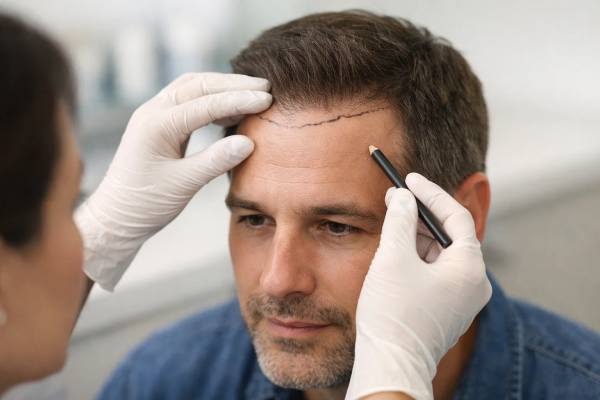
A hair transplant can fail aesthetically even when every graft survives. The reason is usually not the number of follicles. It is the design. A natural-looking hairline depends on proportion, restraint, irregularity, and long-term planning. The best results do not look “done.” They look like the kind of hairline that could have aged there on its own.
That makes hairline design one of the most important parts of transplant planning. It affects how the face is framed, how density is perceived, how well the result holds up as future hair loss progresses, and whether the transplant still looks believable ten or fifteen years later. A line that is too low, too straight, too dense, or too youthful can look impressive in the first week and artificial for years after.
Patients often focus on graft counts, but surgeons think in patterns, angles, donor limits, and future recession. That is the right mindset. The goal is not simply to lower the hairline. It is to build one that matches the face, the age, the donor supply, and the likely path of future thinning.
Core Points
- Natural hairlines are usually soft, irregular, and age-appropriate rather than perfectly straight or aggressively low.
- The most believable transplant designs use a feathered front edge and gradually increasing density behind it.
- Overdesigning the hairline can waste donor grafts and create a result that looks unnatural as future loss continues.
- A strong before-and-after plan should include medical stabilization and a long-term donor strategy, not just a frontal rebuild.
- Review the proposed hairline from the front, profile, and wet-hair view before surgery rather than judging it from a single angle.
Table of Contents
- What Makes a Hairline Look Natural
- How Surgeons Decide Where the Hairline Belongs
- Density, Irregularity, and Graft Selection
- Common Signs of an Obvious Transplant
- Age, Future Loss, and Donor Limits
- How to Evaluate a Plan Before Surgery
What Makes a Hairline Look Natural
A natural hairline does not look drawn on. It does not form a hard border, and it does not announce itself from across the room. Instead, it creates a gradual visual transition from bare forehead skin to denser hair-bearing scalp. That soft transition is the first major difference between a believable transplant and an obvious one.
The front edge of a natural hairline is usually irregular in a controlled way. That does not mean random. It means the tiny rises and dips, the variation in spacing, and the subtle unevenness that real hairlines have. Nature is asymmetric, but not chaotic. When a surgeon recreates that balance well, the result looks effortless. When the edge is too geometric or too perfectly mirrored from left to right, the eye notices something is off, even if the viewer cannot explain why.
Another major feature is age-appropriateness. Adult hairlines are not the same as teenage hairlines. In men especially, a completely flat, very low juvenile line can look unnatural on an adult face, even if the graft work itself is technically clean. A believable design usually respects normal frontotemporal recession rather than trying to erase it entirely. In many cases, a slightly conservative hairline looks younger than an aggressively lowered one, because it still fits the person.
Naturalness also depends on softness at the leading edge. The first few rows should usually not be packed with thick multi-hair grafts. Real frontal hairlines often begin with finer, less crowded hairs before density builds behind them. This is why experienced surgeons talk about transition zones rather than just density. The transplant should move from soft to fuller, not from bare skin to a dense wall.
Visual harmony matters too. A hairline is not judged in isolation. It is judged against forehead height, brow shape, facial width, temple structure, hairstyle, and even beard density. On some faces, a modest central lowering makes sense. On others, preserving more forehead height creates a stronger and more natural appearance. Hairline design is facial design.
Several details often work together in a natural result:
- A slightly irregular front edge
- A density gradient from front to back
- Appropriate temporal recession
- Graft direction that matches native hair flow
- A line that fits the patient’s age and likely future loss
Patients sometimes expect dramatic symmetry because symmetry sounds ideal. In practice, perfect symmetry often looks manufactured. The best transplant hairlines are usually the ones people do not study twice. They frame the face, soften the signs of loss, and still leave enough natural imperfection to look real.
How Surgeons Decide Where the Hairline Belongs
The biggest design mistake in hair transplantation is thinking the question is simply, “How low can we go?” A better question is, “Where should this person’s hairline sit so it still looks believable in five, ten, and twenty years?” That shift in thinking changes the entire plan.
Surgeons usually consider several factors at once. Age is one of the most important. A low hairline on a man in his early twenties may look acceptable on paper, but if his hair loss continues, the contrast between the transplanted front and the thinning behind it can become very obvious. A mature, slightly higher position usually ages better and preserves donor supply.
Forehead size and facial proportions matter as well. The central frontal point, frontotemporal angles, and lateral contour all influence how the face is framed. Even small adjustments can change how broad the forehead appears or how strong the brow and eyes look. A design that seems good in a close-up photo may feel wrong when viewed from conversational distance, from the side, or with the eyebrows raised. That is why good consultations examine the face from several angles rather than drawing a single marker line and calling it final.
Hair characteristics also affect placement. Coarse, curly, or wavy hair can create more visual coverage than fine, straight hair. Dark hair against light skin creates more contrast and often needs even more thoughtful design. Someone with fine, straight hair and limited donor density may need a more conservative position because the illusion of fullness is harder to achieve.
Sex and ethnic patterning also shape expectations. Male hairlines often include some frontotemporal recession and a more angular frame. Female hairlines are usually lower, rounder, and less deeply recessed at the temples. Ethnic differences in hair caliber, curl pattern, temple contours, and facial proportions can also change what looks natural. There is no universal template.
A good surgeon is also planning around existing loss. A patient with mostly frontal recession may need a different design than one with diffuse thinning through the mid-scalp. If the crown is also likely to thin further, placing too many grafts into a very low frontal line can create a donor budget problem later. That is one reason ongoing medical treatment for male pattern hair loss is often part of the broader plan, even when surgery is the main intervention.
The strongest consultations usually test the proposed line with practical questions:
- Will this look believable if the patient loses more native hair?
- Can the donor area support the design without being overharvested?
- Does the hairline look good in motion, not just in a still photo?
- Will the temples, forelock, and frontal corners still make sense later?
Natural hairlines are not found by pushing lower until the patient smiles. They are found by balancing aesthetics with biology, which is why restraint is often one of the most important design skills in hair restoration.
Density, Irregularity, and Graft Selection
When people imagine a good transplant, they often picture density. Density matters, but it is only one part of the illusion. A natural hairline depends just as much on where the density sits, how it builds, what kind of grafts are used, and how the hairs are angled as they emerge.
The front edge should usually be the softest zone. This is where single-hair follicular units matter most. If the very first line is packed with multi-hair grafts, especially thick-caliber hairs, the result can look pluggy even when the grafts are technically small by modern standards. The eye reads the front border first. Once that edge looks harsh, the entire transplant looks less believable.
Behind the front edge, density should gradually increase. This layered build is what makes a transplant look like it grew there. The leading zone creates softness. The zone behind it creates substance. The denser central forelock often carries the most visual weight, because that is the area people see first from the front. Surgeons can sometimes create a stronger cosmetic effect by placing density strategically rather than spreading it evenly.
Irregularity matters here too. Natural hairlines are not only uneven in outline. They are uneven in microdistribution. Small variations in spacing, caliber, and grouping help break up the impression of a manufactured row. The key is controlled irregularity. Too much disorder can look messy; too little can look artificial.
Hair direction is another major factor. Frontal hairs rarely point straight up or straight out. They usually emerge at a low angle and follow a specific flow pattern that changes across the hairline, temples, and forelock. When graft direction is wrong, even good density can look unnatural because light reflects differently and the hair does not style the way native hair would.
Several variables influence how much density is needed to create a natural look:
- Hair shaft thickness
- Curl or wave
- Color contrast between hair and skin
- Scalp laxity and donor capacity
- Whether native hair is still present in the zone
The best surgeons often create density illusions rather than chasing mathematically high counts everywhere. A patient with limited donor supply may still look much improved if the frontal framing is designed well and density is concentrated intelligently. In some cases, non-surgical camouflage such as hair fibers for thinning areas may still have a role while additional loss stabilizes or while a staged plan is being considered.
Patients should also understand that “dense packing” is not automatically the same as “natural.” High graft density at the wrong place can make the front look sharp and artificial. Moderate density with excellent graft selection, angulation, and transition often looks more convincing.
The lesson is simple but easy to miss: density is most powerful when it is shaped. A natural hairline is not a wall of hair. It is a gradient built with the right grafts in the right sequence.
Common Signs of an Obvious Transplant
Most unnatural transplant results are recognizable for the same reasons. The problem is rarely a single flaw. More often, several design errors combine to create a look that seems too hard, too youthful, or disconnected from the rest of the scalp.
The classic mistake is a hairline that is too low and too straight. This often happens when the design aims to recreate a teenage line on an adult with progressive androgenetic loss. It may look dramatic on day one because the forehead appears smaller and the frontal frame looks stronger. But as the face ages or the surrounding native hair continues to thin, that line can start to look fixed in place, almost like a permanent cosmetic border.
Another obvious sign is harsh leading-edge density. When thick multi-hair grafts sit right at the front without a soft transition zone, the result can look like a row instead of a hairline. Even modern follicular unit surgery can look old-fashioned if the hairline is built without enough softness or caliber variation.
Wrong angulation is another giveaway. Hair that emerges too upright, points in the wrong direction, or ignores the natural sweep of the frontal scalp tends to catch light oddly and style poorly. People may not know why it looks wrong, but they often sense that it does.
Common design problems that make a transplant look less natural include:
- A flat front edge with little or no recession at the corners
- Dense grafts placed too close to the forehead skin
- Temporal points built too aggressively
- Hair directions that do not match nearby native hair
- A frontal “island” with thinning behind it
- Donor overharvesting that creates a moth-eaten back or sides
Future loss is often the reason an initially acceptable transplant ages badly. A patient may have a solid-looking frontal result, then continue thinning through the mid-scalp and crown. If the original design did not account for that progression, the hairline can begin to look isolated. That is why overly aggressive frontal work can create long-term problems even when the surgery itself was technically skilled.
There is also a corrective side to this topic. Some patients already have an older or poorly planned transplant and want to improve the appearance. Correction may involve softening the front edge, redistributing grafts, refining the angles, adding density behind the hairline, or reducing contrast with options such as scalp micropigmentation camouflage. The exact strategy depends on donor reserves and the severity of the original design error.
A believable transplant usually disappears into the face. An obvious transplant competes with it. That is the clearest difference. If the first thing a viewer notices is “the hairline,” something in the design may have been pushed too far.
Age, Future Loss, and Donor Limits
Hairline design is never just a front-of-the-forehead decision. It is a donor-management decision. Every graft used low in the frontal scalp is a graft that cannot be used later in the mid-scalp, crown, temples, scar correction, or revision work. That is why long-term planning matters as much as artistry.
Future loss is the central issue. Pattern hair loss is progressive in many patients, especially men. A person may present with temple recession at 28, but by 38 the crown and mid-scalp may also be involved. If the early design used too many grafts to create a dense juvenile line, the rest of the scalp may thin around it in a way that looks unnatural. The transplant did not fail technically. The planning failed biologically.
Age changes the risk calculation. Younger patients are often the most eager to lower the hairline aggressively, but they are also the group most likely to outpace the original design if their hair loss evolves. That does not mean younger adults should never have surgery. It means they need a more conservative plan, realistic expectations, and a serious discussion about long-term maintenance.
Donor quality sets the ceiling on what is possible. Surgeons look at density, caliber, curl, color contrast, scalp laxity, and the size of the safe donor zone. Some patients have excellent donor capacity and can support more ambitious restoration. Others have finer hair, lower density, or a smaller reserve and need a more strategic use of grafts. Donor supply is not infinite, even when the back of the scalp looks strong.
This long-term view often leads to a staged plan:
- Stabilize loss if possible.
- Rebuild the frontal frame conservatively.
- Preserve donor reserves for later needs.
- Reassess progression over time.
- Consider additional work only if the pattern remains favorable.
That first step matters more than many patients expect. Medical treatment can reduce the speed of ongoing miniaturization and help protect the native hair behind the transplant. Discussions about finasteride benefits and side effects often belong in transplant planning for exactly this reason. Surgery creates placement. Medicine can help preserve the surrounding context.
Patients should also be careful with the idea of “maximum density now.” The frontal scalp is the most visible zone, but not the only one that matters later. A wise design leaves room for the future. That may sound less exciting in the consultation room, yet it is often what separates a transplant that still looks good a decade later from one that needs difficult repair.
Natural hairlines age well because they are planned as part of a whole scalp strategy. Artificial ones are often the product of short-term thinking. When the donor area, the frontal design, and the likely future pattern are treated as one problem, the result is usually safer and more believable.
How to Evaluate a Plan Before Surgery
Patients do not need to become transplant technicians, but they do need to know how to judge a plan before committing. A careful consultation can reveal whether the design is thoughtful or whether it is mainly selling a dramatic line.
Start by asking to see the proposed hairline from multiple angles. A front view alone is not enough. Look at the profile, the three-quarter view, and the position with the eyebrows raised. A hairline that seems attractive head-on can look too flat or too low from the side. Ask how the temporal corners and frontal tuft are being handled, because those areas often determine whether the result looks adult and natural.
Then ask how the design would still make sense if your native hair thins further behind it. This is one of the most important questions in all of hair restoration. If the answer is vague, the planning may be too focused on the first year instead of the next ten. The same applies to donor management. Ask how many grafts are being used, how many may still be available later, and how the donor zone will look if you wear your hair short.
A strong consultation should also cover technique, but not in a simplistic “which is better” way. FUE and FUT can both produce good results in the right hands. What matters for hairline appearance is not just harvesting method. It is graft quality, donor protection, placement angle, graft selection, and design discipline.
Helpful questions to ask include:
- Why is this exact height right for my face and age?
- How are you keeping the front edge soft?
- Where will single-hair grafts be used?
- How will this plan age if I continue losing hair?
- What medical treatment do you recommend before or after surgery?
- What does the donor area look like short and long term?
Recovery planning also matters. Patients should understand shock shedding, the slow timeline of growth, and the fact that the final appearance may take many months to judge. Some clinics discuss supportive options such as oral minoxidil considerations or topical therapy when appropriate, but those decisions belong in individualized medical care rather than sales messaging.
Finally, study the clinic’s results critically. Look for wet-hair photos, close frontal shots, side angles, and results in patients with similar age, hair caliber, and degree of loss. Be cautious with only styled, dry, brightly lit before-and-afters. The best result is not always the lowest line or the densest front. It is the one that still looks like it belongs to the person.
A good transplant plan should feel slightly restrained, highly specific, and grounded in the future. That is usually the design that ends up looking the most natural.
References
- Hair Transplantation: State of the Art 2025 (Review)
- Hair transplantation: Basic overview 2021 (Review)
- Is Every Patient of Hair Loss a Candidate for Hair Transplant?-Deciding Surgical Candidacy in Pattern Hair Loss 2021 (Review)
- The Progressive Loss Risk Scale for Hair Restoration Surgery 2022
- Hairline design and frontal hairline restoration 2013 (Review)
Disclaimer
This article is for educational purposes only and is not medical advice or a substitute for a personal consultation. Hair transplant planning depends on the cause and stability of hair loss, donor density, scalp characteristics, medical history, and long-term risk of future thinning. Surgical and medical treatments can carry risks, limitations, and maintenance needs. Decisions about hairline design, graft counts, and drug therapy should be made with a qualified clinician experienced in hair restoration.
If this article was useful, please share it on Facebook, X, or any other platform your audience uses.