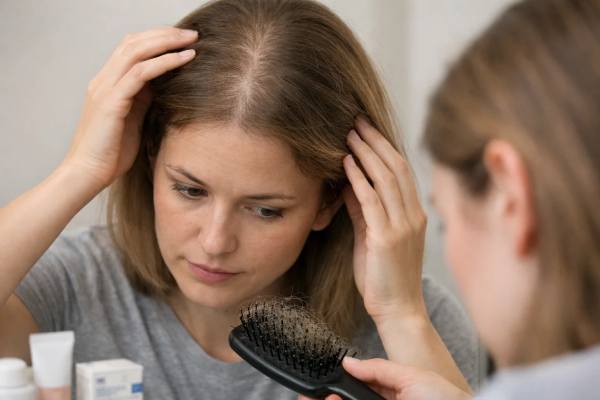
Accutane, the former brand name for isotretinoin, can be life-changing for severe acne. It often clears deep, scarring breakouts when standard topical treatments and antibiotics have not done enough. That benefit matters. But because isotretinoin affects oil production, skin barrier function, and the wider hair cycle, some people notice a new worry while their acne improves: more hair in the shower, on the brush, or on the pillow.
The good news is that this side effect is usually not the same as permanent balding. In most cases, the pattern looks more like temporary shedding than permanent follicle damage. The harder part is timing. Hair loss from a medication often shows up weeks to months after the trigger, so it can feel sudden and confusing. It can also overlap with stress, dieting, illness, iron deficiency, or early pattern thinning, which makes the cause easy to misread.
Here is what isotretinoin-related shedding usually looks like, why it happens, how long it tends to last, and when it deserves a closer medical workup.
Key Insights
- Isotretinoin can dramatically improve severe acne, and hair shedding is a recognized but usually uncommon trade-off.
- When shedding happens, it is most often diffuse telogen effluvium rather than scarring or permanent follicle destruction.
- Visible shedding often appears after a delay of about 2 to 3 months, and fuller cosmetic recovery usually takes longer than the shedding phase itself.
- Do not stop isotretinoin or add vitamin A supplements on your own; review the dose, other triggers, and a gentle hair routine with your prescriber.
Table of Contents
- What Accutane-related hair loss usually looks like
- Why isotretinoin can trigger shedding
- When it starts and how long it lasts
- Who is more likely to notice it
- What to do while you are still on treatment
- When to see a dermatologist
What Accutane-related hair loss usually looks like
The typical pattern after isotretinoin is diffuse shedding. That means more hairs come out across the whole scalp rather than in one sharply defined patch. Many people first notice it when they wash their hair, clean out their brush, or see a wider part than usual under bright bathroom lighting. The hairline usually does not vanish overnight, and the scalp usually does not develop smooth bald spots. That distinction matters, because patchy loss points toward different conditions, such as alopecia areata, while a receding hairline or gradual miniaturization may suggest underlying pattern hair loss that isotretinoin has merely made more visible.
Another important detail is that not every complaint of “hair loss” on Accutane is true shedding from the root. Isotretinoin reduces sebum production, and that drier environment can leave the hair shaft rougher, flatter, and easier to tangle. Some strands then snap instead of shed. Broken hairs tend to be shorter, uneven, and missing the pale club-shaped bulb at one end. Shed hairs are full-length strands with that tiny bulb. If you can tell the difference, you already have a useful clue about what is happening.
For most people, the overall density change is mild to moderate. It can still feel alarming, especially if you started isotretinoin to feel better about your appearance and suddenly your hair seems thinner. But the usual medication-related pattern is non-scarring, which means the follicles are still alive. That is very different from conditions that permanently destroy follicles.
There is also a perception problem. Because isotretinoin often makes the scalp and hair less oily, your hair may lose some of the volume and separation that oil used to provide. A drier, flatter texture can make density seem worse than it truly is. People with long hair, dark hair, fine hair, or a center part often notice this most.
In plain terms, the classic story is this: acne gets better, the scalp feels drier, then weeks later the person notices extra hair fall from all over the scalp. There may be a temporary widening of the part, but not usually clear bald patches, scarring, pus, or thick scale. If those other features appear, the diagnosis may not be simple isotretinoin shedding.
Why isotretinoin can trigger shedding
The leading explanation is telogen effluvium, a form of reactive shedding. Hair follicles cycle through active growth, transition, rest, and shedding. A medication can disturb that schedule and push more follicles than usual out of growth mode and into the resting phase. The hairs do not fall immediately. They sit in that resting phase for a while, then shed later, which is why the timeline can feel delayed and mysterious.
Isotretinoin is a retinoid, a vitamin A derivative. Its main job in acne treatment is to shrink sebaceous glands and reduce sebum production, but retinoids also influence cell turnover, differentiation, and signaling in the skin and hair environment. The exact mechanism behind shedding is not fully settled, which is one reason the medical literature still sounds careful on this topic. Still, the broad model is plausible and consistent: isotretinoin can shift the hair cycle, making a larger share of follicles enter telogen early.
That does not mean isotretinoin “kills” the follicle. In most reported cases, the follicles are not destroyed. They are cycling differently for a period of time. This is why most cases look temporary rather than permanent. It is also why the shedding pattern resembles other medication-related or stress-related telogen effluvium episodes more than aggressive inflammatory scalp disease.
Dose likely matters, though not in a perfectly predictable way. Higher daily dosing appears to be associated with more reported hair loss than lower daily dosing, and longer treatment duration or higher cumulative exposure may also increase the odds. That does not mean everyone on a higher dose will shed, and it does not mean low-dose treatment eliminates the risk. It means risk seems to rise, not that outcomes are guaranteed.
A second nuance is that isotretinoin can unmask a problem that was already developing. Someone with a strong family history of androgenetic alopecia, recent weight loss, low iron stores, thyroid dysfunction, or major life stress may have been close to noticeable shedding already. Add a retinoid to that background, and the scalp finally crosses the line from “hidden problem” to visible thinning. In those cases, isotretinoin may be part of the story without being the only cause.
If you want the simplest version, it is this: isotretinoin treats acne by changing how the skin behaves, and those same biological shifts can nudge more follicles into a temporary resting state. Understanding the hair growth cycle phases makes the delay and the recovery pattern much easier to understand.
When it starts and how long it lasts
This is the question most people care about most, and the answer depends on whether you are asking about the start of shedding, the end of shedding, or the return of visible density. Those are not the same event.
With telogen effluvium, the trigger usually comes first and the shedding becomes obvious later. For isotretinoin, many people notice increased fall roughly 2 to 3 months after starting treatment, though some report it earlier and some only notice it near the end of the course or shortly after stopping. That delay fits the normal biology of telogen hairs, which rest before they shed. So if you began isotretinoin in January and you are seeing extra hair in March or April, the timing is biologically plausible.
How long does the shedding phase last? Mild episodes may settle within a few months, especially once the drug is stopped or the triggering window has passed. A common real-world pattern is noticeable shedding for 6 to 12 weeks, followed by gradual improvement. But cosmetic recovery almost always trails behind biological recovery. In other words, your shedding may slow before your hair looks normal again.
That lag can be frustrating. Hair regrowth is slow, and length matters. Even if follicles re-enter growth promptly, short new hairs do not instantly restore the fullness of a ponytail or the density around the part. People with long hair often need 6 to 12 months before the regrowth is obvious enough to feel reassuring. The scalp may be biologically recovering well before the mirror reflects it.
A few practical signs suggest the episode is improving:
- Fewer hairs coming out during washing and brushing.
- Less dramatic hair accumulation on the pillow or bathroom floor.
- Fine short regrowth along the part or temples.
- The widened part slowly becoming less conspicuous.
What should make you pause? Shedding that continues well beyond 6 months, a steadily receding frontal hairline, obvious thinning at the crown, patchy bald areas, lash or brow loss, scalp pain, burning, thick scale, or redness. Those clues suggest you may be dealing with more than a simple drug-triggered shed.
It also helps to remember that “recovery” is not one fixed date. The follicles restart on their own schedule, and visible improvement tracks with the pace of regrowth. That is why a short medication-triggered shed can still feel like a long cosmetic problem. Compared with other telogen effluvium triggers, isotretinoin-related shedding tends to follow the same basic rule: the trigger is earlier than the hair fall, and the hair fall is earlier than the return of density.
Who is more likely to notice it
Not everyone who takes isotretinoin gets hair shedding, and even among those who do, the experience varies. Some notice a modest increase in daily fall without real cosmetic thinning. Others see a clear drop in density. The difference is partly biological and partly visual.
Dose is one of the biggest clues. In published reviews, reported hair loss has been more common at daily doses of 0.5 mg per kilogram and above than at lower-dose regimens. Longer courses and higher cumulative doses also seem to matter. That fits clinical common sense: the longer and more intensely the hair cycle is exposed to a potential trigger, the greater the chance that more follicles are shifted at once.
Age may matter too. In one retrospective review, patients who developed hair loss after isotretinoin were older than the comparison group. That does not mean the drug becomes dangerous with age. It may simply reflect that older patients are more likely to have background androgenetic thinning, nutritional issues, hormonal shifts, or a lower margin of scalp density before treatment begins.
People are also more likely to notice shedding when they already have one or more of these factors:
- Fine hair or low baseline density.
- Long hair, where shedding is easier to see.
- A center part, where diffuse thinning shows quickly.
- Recent illness, surgery, crash dieting, or rapid weight loss.
- Low iron stores or poor protein intake.
- Thyroid disease.
- Family history of pattern hair loss.
- High psychological stress.
Texture and styling practices matter as well. If isotretinoin has made the hair shaft drier and more brittle, heat styling, bleaching, tight hairstyles, and rough brushing can add breakage on top of true shedding. That combination can make the loss look more dramatic than it is.
This is also why online anecdotes are so hard to interpret. One person may describe “huge hair loss” that is mostly breakage and temporary telogen shedding. Another may actually be seeing early androgenetic alopecia that happened to become obvious during an isotretinoin course. Both stories sound similar, but they are not the same diagnosis.
A useful way to think about risk is not “Will isotretinoin make my hair fall out?” but rather “How many other shedding triggers are already stacked around me?” If the answer includes restrictive dieting, low ferritin, heavy stress, or a strong family history, your scalp has less buffer. In that setting, even a medication with a relatively low overall hair-loss risk may become the final push that makes shedding visible.
What to do while you are still on treatment
The first rule is simple: do not stop isotretinoin on your own. For many patients, it is the most effective treatment they have tried for severe acne, and abrupt decisions can create confusion about what is helping, what is harming, and whether the acne will rebound. If you think the medication is affecting your hair, bring it to the prescriber early and discuss it in a practical way.
A good visit usually covers four questions:
- When did the shedding start?
- What dose are you on now, and how long have you been taking it?
- Have there been other triggers in the last 3 to 4 months?
- Are you seeing root shedding, breakage, or both?
From there, the plan may include watching it, adjusting the dose, reviewing total cumulative exposure, or looking for additional causes. Some people can continue treatment with reassurance and gentler hair care alone. Others may benefit from a lower dose or a different dosing strategy if the acne situation allows it.
At home, the goal is not to “force” growth but to reduce avoidable stress on the fibers and the follicles:
- Keep washing gentle and regular rather than avoiding shampoo out of fear.
- Use a conditioner consistently, especially on mid-lengths and ends.
- Limit bleaching, relaxers, high-heat styling, and aggressive brushing.
- Avoid tight ponytails, slick buns, and extension-related tension.
- Aim for adequate calories and protein goals that support hair, especially if your appetite has changed.
- Do not add vitamin A supplements unless your clinician specifically tells you to.
- Be cautious with “hair gummies” and other products that promise fast regrowth, especially if they hide megadoses or questionable blends. Learn the common red flags in hair supplements before spending money.
You can also take standardized photos every 2 to 4 weeks in the same lighting. That sounds minor, but it is often more reliable than day-to-day mirror checks, which are strongly influenced by stress and styling.
What about minoxidil? Sometimes dermatologists use it when shedding is prolonged or when isotretinoin seems to have uncovered underlying pattern thinning. But it is not a universal first step for every mild, short-lived shed. The best choice depends on whether you are dealing with temporary telogen effluvium alone or a second diagnosis sitting underneath it.
The main point is this: support the scalp, protect the hair shaft, review the medication plan with the prescriber, and avoid impulsive supplement or treatment stacking while the picture is still unfolding.
When to see a dermatologist
Some shedding during or after isotretinoin is something a prescribing clinician may monitor without alarm. But there are clear situations where a dermatologist evaluation becomes more important, especially if the pattern no longer looks like straightforward medication-related telogen effluvium.
Book a visit sooner rather than later if you notice:
- Patchy bald spots.
- Rapid frontotemporal recession or clear crown thinning.
- Loss of eyebrows or eyelashes.
- Shedding that continues beyond about 6 months.
- Scalp redness, burning, tenderness, pustules, or thick scale.
- Signs of nutritional or endocrine problems such as fatigue, heavy periods, recent major weight change, or temperature intolerance.
A dermatologist will usually start with history and pattern recognition. They may ask about dose, timing, family history, recent illnesses, diet, menstrual changes, stress, and other medications. Then they may examine the scalp with dermoscopy, perform a hair-pull test, and decide whether the picture fits telogen effluvium, androgenetic alopecia, alopecia areata, seborrheic dermatitis, or a less common inflammatory condition.
Lab work is not automatic for everyone, but it can be helpful when the history suggests another contributor. Depending on the case, clinicians may consider a complete blood count, ferritin, thyroid testing, vitamin D, or other targeted studies. If iron status is a concern, understanding ferritin and its role in shedding can help you follow that part of the discussion.
The reassuring truth is that isotretinoin-related shedding is usually recoverable. The less reassuring truth is that recovery may be slower than most people expect, and some cases reveal an underlying hair-loss tendency that was already there. That is why expert evaluation is worthwhile when the pattern is atypical, prolonged, or emotionally distressing.
If you are trying to decide whether your situation is “normal,” use this test: temporary diffuse shedding with no scalp inflammation and a believable timeline is usually less urgent; patchy, painful, scaly, or relentlessly progressive loss deserves a proper diagnosis. The sooner the pattern is identified correctly, the better the odds of choosing the right next step instead of guessing.
References
- Comparing the frequency of isotretinoin-induced hair loss at <0.5-mg/kg/d versus ≥0.5-mg/kg/d dosing in acne patients: A systematic review 2022 (Systematic Review). ([PMC][1])
- Characteristics of Patients with Hair Loss after Isotretinoin Treatment: A Retrospective Review Study 2022 (Retrospective Review). ([PMC][2])
- Telogen effluvium: a 360 degree review 2023 (Review). ([PubMed][3])
- Guidelines of care for the management of acne vulgaris 2024 (Guideline). ([PubMed][4])
Disclaimer
This article is for educational purposes only and is not a substitute for personal medical advice, diagnosis, or treatment. Hair shedding after isotretinoin can overlap with other causes of thinning, including nutritional deficiencies, thyroid problems, pattern hair loss, and inflammatory scalp disease. Do not stop or change a prescribed medication without speaking with your clinician, and seek prompt medical care for patchy hair loss, scalp pain, significant inflammation, or shedding that persists.
If this article helped, consider sharing it on Facebook, X, or your preferred platform so someone else dealing with post-Accutane shedding can find clear, practical guidance.