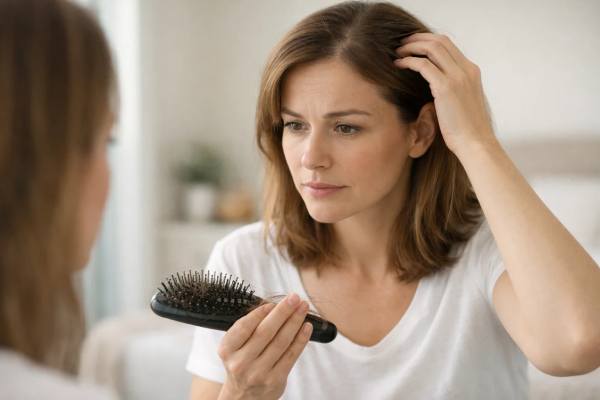
Hair loss caused by thyroid problems is rarely dramatic at first. More often, it begins as a slow change you notice in the shower drain, on your brush, or in the way your ponytail feels thinner than it used to. Because thyroid hormones help regulate the hair cycle, both underactive and overactive thyroid states can push more hairs into shedding mode. The result is usually diffuse thinning rather than a single bald patch, which is one reason thyroid-related hair loss is easy to miss or misread.
The difficulty is that thyroid disease is only one of several common reasons for increased shedding. Iron deficiency, recent illness, major stress, postpartum changes, weight loss, medications, and androgen-related hair loss can all overlap. That is why the most useful approach is not to ask whether thyroid disease can cause hair loss. It can. The better question is how thyroid hair loss tends to look, which lab patterns support it, and how long regrowth usually takes once the underlying problem is corrected.
Core Points
- Thyroid-related hair loss is usually diffuse, non-scarring, and more noticeable as overall thinning or increased shedding than as sharp bald spots.
- High TSH with low free T4 points toward overt hypothyroidism, while low TSH with high free T4 or T3 points toward hyperthyroidism.
- Patchy hair loss, scalp inflammation, or sudden severe shedding often means another cause should be considered alongside thyroid testing.
- Hair regrowth usually lags behind thyroid treatment, so visible improvement often takes several months rather than a few weeks.
- Track shedding, eyebrow changes, hair texture, and other symptoms for 8 to 12 weeks while following your treatment and lab plan.
Table of Contents
- How thyroid changes the hair cycle
- How thyroid hair loss usually looks
- Lab clues that point to thyroid
- What can mimic thyroid shedding
- Treatment and regrowth timeline
- When to worry and get help
How thyroid changes the hair cycle
Hair does not grow in a steady straight line. Each follicle cycles through growth, transition, rest, and shedding. Most scalp hairs are normally in the growth phase, called anagen, while a smaller percentage sit in the resting phase, called telogen. Thyroid hormone helps regulate that balance. When thyroid hormone levels fall too low or rise too high, more follicles can shift out of active growth and into telogen. A few months later, the shedding becomes visible.
This delay is one reason people often miss the connection. Thyroid hair loss does not always begin on the same day as fatigue, palpitations, constipation, heat intolerance, or weight change. The hair cycle moves more slowly than symptoms do. Someone may start noticing extra shedding two or even three months after thyroid function changed, after an illness, or after treatment began to stabilize. That lag can make the trigger seem unclear.
Both hypothyroidism and hyperthyroidism can cause hair problems, but the texture and pattern may look slightly different. In hypothyroidism, the hair often becomes dry, coarse, brittle, and slow-growing in addition to shedding more. The outer third of the eyebrows may thin as well, which is a classic clue, though not a universal one. In hyperthyroidism, the hair may feel finer, softer, and thinner, with more diffuse shedding rather than obvious breakage. People who are trying to sort through broader low-thyroid symptoms often notice that hair changes travel with the same cluster described in common hypothyroid symptom patterns.
The most important thing to understand is that thyroid-related hair loss is usually non-scarring. The follicles are not destroyed. They are behaving abnormally because the hormonal environment is off. That distinction matters because non-scarring hair loss has a much better chance of recovery once the trigger is corrected.
Thyroid hair loss is also usually diffuse. Instead of one sharply defined bald spot, you are more likely to see more hairs on the brush, thinning through the mid-scalp, a wider part, reduced ponytail volume, or hair that seems to stop growing to its usual length. That is very different from scarring alopecias, where follicles are permanently damaged, or from classic patchy alopecia areata, which often produces smooth round areas of sudden hair loss.
Another nuance is that thyroid medication changes can temporarily affect shedding too. Correcting severe hypothyroidism does not instantly flip every follicle back into growth mode. The hair cycle needs time to reset. In some cases, people notice continued shedding even after the right treatment has started, which can feel discouraging but does not necessarily mean the therapy is failing. Hair recovery tends to follow biochemical recovery, not happen at the same time.
That is why thyroid and hair loss should be understood as a timing issue as much as a hormone issue. The thyroid influences the cycle. The cycle responds slowly. And visible regrowth almost always trails behind symptom and lab improvement.
How thyroid hair loss usually looks
The look of thyroid-related hair loss is often more informative than the amount. Most people with thyroid-driven shedding do not go bald overnight. Instead, they notice one or more of these patterns:
- Increased hair on the pillow, shower floor, or brush
- Diffuse thinning across the scalp rather than isolated patches
- A wider central part or reduced ponytail thickness
- Hair that feels drier, coarser, or easier to break in hypothyroidism
- Finer, silkier, or flatter hair in hyperthyroidism
- Eyebrow thinning, especially at the outer edges, in some hypothyroid cases
This pattern fits a process called telogen effluvium, where more hairs than usual shift into the resting and shedding phase. Thyroid problems are not the only cause of telogen effluvium, but they are one of the endocrine causes that matter because they are treatable.
What thyroid hair loss does not usually look like is just as important. Patchy round bald spots suggest alopecia areata. Recession at the temples or gradual thinning over the crown, especially with miniaturized hairs, suggests androgenetic hair loss. Tender, inflamed, scaly, or scarred areas suggest a scalp disorder that needs a different workup. If the pattern does not fit diffuse shedding, thyroid dysfunction may still be present, but it may not be the main reason the hair is changing.
The symptom context helps too. Hair loss tied to hypothyroidism often travels with dry skin, constipation, cold intolerance, fatigue, slower thinking, hoarseness, or weight gain. Hair loss tied to hyperthyroidism may appear alongside heat intolerance, tremor, anxiety, loose stools, palpitations, or unintentional weight loss. People whose shedding comes with restlessness, sweating, and heart-racing episodes may want to compare that picture with common hyperthyroid symptoms rather than assuming the hair issue is isolated.
The scalp itself is usually not the main problem in thyroid hair loss. There is typically no major redness, crusting, pustules, or permanent loss of follicular openings. That is why scalp tenderness, patchiness, or obvious inflammation should widen the differential diagnosis right away.
Another common source of confusion is shedding versus breakage. Thyroid-related hair changes can involve both, especially in hypothyroidism where the hair shaft becomes dry and brittle. True shedding usually means you see full-length hairs coming out from the root. Breakage means the hair shaft snaps and leaves shorter uneven fragments. People often have some of both, but a strong breakage pattern should also raise questions about heat styling, bleaching, traction, nutrition, or underlying hair shaft fragility.
Timing is another clue. Thyroid-related shedding often becomes noticeable weeks to months after thyroid dysfunction begins or worsens. It can also appear during treatment transitions if thyroid levels move too quickly or remain off target. The result is that the hair story often sounds like this: “My hair was fine, then over a few months it started coming out more, and now it feels thinner all over.” That slow, diffuse pattern is more typical of thyroid-related shedding than a sudden sharply localized loss.
Lab clues that point to thyroid
When hair loss raises the question of thyroid disease, the lab work should be practical rather than excessive. In most cases, TSH is the best starting test because it is the most sensitive early marker of primary thyroid dysfunction. If TSH is abnormal, free T4 is usually the next key lab because it helps confirm whether the thyroid is underactive or overactive in a clinically meaningful way.
A simple pattern guide looks like this:
- High TSH and low free T4 suggest overt hypothyroidism
- High TSH with normal free T4 suggests subclinical hypothyroidism
- Low TSH and high free T4 or high T3 suggest hyperthyroidism
- Low or normal TSH with low free T4 can suggest central hypothyroidism, which is less common and needs broader evaluation
That said, hair loss is not the same as a thyroid diagnosis. A mildly abnormal TSH does not automatically prove it is causing the shedding, and a normal TSH does not mean the hair complaint is imagined. It means the explanation may be somewhere else.
Thyroid antibody testing can help in selected cases, especially when autoimmune thyroid disease is suspected. TPO antibodies may support Hashimoto’s thyroiditis as the underlying cause of hypothyroidism, and thyroid-stimulating immunoglobulin or related antibodies may help when Graves’ disease is suspected. But antibodies do not measure the severity of hair loss, and they do not tell you how quickly hair will regrow. They are cause-finding tools, not hair-growth tests.
There are also practical testing mistakes worth knowing about. Biotin supplements can distort some thyroid assays, especially when taken in high doses in hair, skin, and nail products. Timing, lab method, and supplement use matter, which is why people who are preparing for hormonal bloodwork often benefit from a broader guide to lab timing and testing basics. It is also wise to tell your clinician about thyroid medication timing, supplements, recent illness, pregnancy, and large weight changes before the labs are interpreted.
One of the most useful parts of the workup is often not the thyroid panel itself, but what sits beside it. Hair loss that seems thyroid-related may actually reflect multiple overlapping issues. Common companion tests, chosen based on history, may include:
- Complete blood count
- Ferritin and iron studies
- Vitamin B12 in selected cases
- Vitamin D in selected cases
- Zinc or other nutrient testing when diet or malabsorption raises concern
This is especially important because iron deficiency, restrictive eating, heavy periods, and recent illness can all produce diffuse shedding that looks very similar to thyroid hair loss. When the history points that way, a narrow thyroid-only workup can miss the bigger picture.
The best lab clue is not just a number. It is a pattern that matches symptoms and timing. Hair thinning plus fatigue plus high TSH plus low free T4 makes much more sense than hair thinning with a normal thyroid panel and no other thyroid symptoms. The labs work best when they confirm a clinical story that already hangs together.
What can mimic thyroid shedding
This is the section that often saves people months of frustration. Thyroid disease is a real and important cause of hair loss, but it is not the only common one, and it is not always the main one even when thyroid labs are slightly abnormal.
The most common mimic is telogen effluvium from another trigger. A fever, surgery, crash diet, major emotional stress, postpartum recovery, rapid weight loss, new medication, or significant illness can all push hairs into the shedding phase. The hair pattern looks very similar: diffuse loss, more shedding in the shower, and a lag of a few months between the trigger and the visible thinning.
Iron deficiency is another major imitator, especially in people with heavy periods, restrictive diets, gastrointestinal blood loss, or endurance training. Low ferritin can cause hair shedding with or without anemia, and the symptoms may overlap with thyroid problems through fatigue and reduced exercise tolerance. That is one reason thyroid hair loss and “general hormone-related fatigue” often blur together with the wider issues described in common hormone causes of persistent fatigue.
Androgenetic hair loss is also commonly misread as thyroid shedding. Instead of abrupt increased shedding, it tends to cause gradual miniaturization. The part widens, the crown thins, or the temples recede. Some people have both androgenetic thinning and telogen effluvium at the same time, which makes the pattern harder to recognize. In those cases, correcting thyroid dysfunction may reduce the shedding but not fully restore density because another process is also present.
Alopecia areata belongs in a separate category. It is patchy, autoimmune, and sometimes associated with autoimmune thyroid disease, but it is not the same thing as thyroid hormone-related diffuse shedding. Smooth round patches, eyebrow or eyelash loss, or sudden sharply defined bald areas should shift the conversation away from “thyroid hair loss” as the only explanation.
Hair breakage from cosmetic damage can confuse the picture too. Bleaching, relaxers, tight hairstyles, frequent heat, and chemical straightening can make hair look thinner even when the follicles are not shedding more. If the strands are snapping off mid-length, the cause may be shaft damage rather than endocrine disease.
Medications are another overlooked factor. Retinoids, anticoagulants, some antidepressants, certain anticonvulsants, and rapid changes in hormone therapy can all provoke hair shedding. Even thyroid medication itself can become part of the problem if dosing is off and pushes the body toward under- or over-replacement.
This is why the best question is never “Can thyroid disease cause this?” It is “Does thyroid disease explain all of this?” When the answer is only partly, the workup has to widen. A person with corrected thyroid labs but ongoing hair loss may need a scalp exam, iron testing, medication review, nutrition review, or dermatology input rather than more thyroid dose changes. That broader view prevents the hair from becoming a one-hormone mystery when the real explanation is more layered.
Treatment and regrowth timeline
The regrowth timeline is the part most people want to know, and it is also the part most likely to create false expectations. Hair almost never rebounds as quickly as thyroid labs do. Even when treatment is correct, follicles need time to move back into a healthier rhythm.
In hypothyroidism, treatment usually means levothyroxine adjusted until TSH is back in range and symptoms are improving. In hyperthyroidism, treatment depends on the cause and may involve antithyroid medication, definitive therapy, or close monitoring. Either way, the goal is the same: restore a stable euthyroid state. Hair recovery depends more on that stability than on any single supplement or shampoo.
A practical timeline often looks like this:
- First 6 to 8 weeks
Thyroid labs may start to improve, especially in hypothyroidism after the right dose is started or adjusted. Hair shedding may not improve yet. - Around 2 to 3 months
Many people begin to notice less active shedding if thyroid function is stabilizing and no second cause is driving loss. - Around 3 to 6 months
Early regrowth or better density may become visible, often as shorter new hairs along the hairline or part. - Around 6 to 12 months
Fuller improvement becomes easier to see, especially when the original problem was diffuse telogen effluvium rather than long-standing androgenetic thinning.
Longer timelines are common when the thyroid problem was severe, when hair loss was present for many months before treatment began, or when another cause is layered on top. That is why “my labs are better but my hair is not back” is a common and frustrating stage, not necessarily a sign of treatment failure.
Two caveats matter here. First, overtreatment can also worsen hair loss. If thyroid medication pushes someone too far toward hyperthyroidism, diffuse shedding can continue. Second, the hair may recover more slowly than energy, bowel habits, or temperature tolerance. People sometimes interpret that lag as evidence they still need more medication, when the real issue is that the follicles are simply slower responders.
Supportive care helps, but it should stay realistic. Gentle hair care, avoiding tight traction, reducing high-heat styling, adequate protein intake, and correcting iron deficiency or other nutrient gaps can support recovery. What usually does not help is chasing every “thyroid hair supplement” on the market. Many are expensive, redundant, or include ingredients that confuse the picture rather than clarify it.
This is also the point where medication patience matters. Constantly changing thyroid doses too quickly can prolong instability. If your numbers are improving but the hair is lagging, the next best step is often to let a stable plan work long enough rather than make rapid repeated changes. That is especially important for people who feel better overall but remain worried because the hair has not yet caught up, a pattern that overlaps with the concerns explored in why some people still feel hypothyroid on treatment.
When to worry and get help
Most thyroid-related hair loss is not dangerous, but some patterns deserve faster evaluation because they suggest either a more serious thyroid issue or a non-thyroid diagnosis that should not be missed.
Seek medical assessment sooner if you notice:
- Rapid diffuse shedding with obvious thyroid symptoms
- Patchy bald spots rather than overall thinning
- Scalp pain, redness, scale, pustules, or scarring
- Significant eyebrow loss
- Hair loss with palpitations, tremor, chest symptoms, or severe fatigue
- Hair loss during pregnancy or postpartum with other thyroid symptoms
- Ongoing shedding despite thyroid labs returning to target
- Signs of anemia, major weight change, or nutritional deficiency
Patchy hair loss is especially worth emphasizing because it often means alopecia areata or another dermatologic process, not typical thyroid hormone imbalance alone. Scarring, tenderness, or inflamed scalp changes also push the evaluation away from classic thyroid shedding and toward dermatology.
Lab context matters too. A mildly off TSH in someone with months of shedding may deserve follow-up, but a clearly abnormal TSH with a low free T4 or a suppressed TSH with high thyroid hormones warrants more direct treatment planning. The greater the biochemical abnormality, the less likely it is that the hair complaint is incidental.
Persistent hair loss after thyroid correction is another good reason to widen the net. At that point, the next step is often not “more thyroid medication.” It is a reassessment of whether the original diagnosis explained the whole picture. Sometimes the answer is yes, and the hair simply needs more time. But often there is a second contributor such as iron deficiency, androgenetic hair loss, chronic telogen effluvium, or autoimmune alopecia.
A specialist is especially helpful when the history is complex, the thyroid pattern is atypical, or the labs do not match the symptoms. That may mean endocrinology, dermatology, or both. Endocrinology becomes more important when the thyroid diagnosis itself is unclear, treatment targets are hard to reach, pregnancy is involved, or central thyroid dysfunction is being considered. Dermatology becomes more important when the pattern is patchy, inflamed, scarring, or resistant to recovery. If the picture keeps feeling harder to sort out than it should, it helps to know when specialist input makes sense.
The most reassuring bottom line is that thyroid-related hair loss is usually reversible, but it asks for patience and accurate diagnosis. The follicles need time. The labs need context. And the best outcomes come from treating the right cause rather than assuming every thinning scalp is sending the same message.
References
- Impact of Thyroid Dysfunction on Hair Disorders 2023. (Review)
- Is thyroid dysfunction a common cause of telogen effluvium?: A retrospective study 2024. (Retrospective Study)
- An Update on Alopecia and its Association With Thyroid Autoimmune Diseases 2023. (Scoping Review)
- Hypothyroidism: A Review 2025. (Review)
- Thyroid testing in primary hypothyroidism 2025. (Practice Guidance)
Disclaimer
This article is for educational purposes only and does not diagnose or treat hair loss. Thyroid-related shedding can overlap with iron deficiency, medication effects, autoimmune hair loss, androgen-related thinning, pregnancy-related changes, and scalp disorders. Seek medical care promptly if hair loss is patchy, painful, scarring, paired with significant thyroid symptoms, or not improving despite treatment and follow-up labs.
If this article helped you, please share it on Facebook, X, or another platform so others trying to understand thyroid-related hair changes can find clear, practical guidance.