A lot of people have discovered blood sugar advice through short videos and clever graphics: eat your salad first, drink vinegar before pasta, walk after dessert, never eat carbs alone. The appeal is obvious. These ideas feel practical, inexpensive, and less overwhelming than a full nutrition overhaul. Some of them do help. But most work best as small adjustments, not as magic shields against a high-sugar, low-fiber routine.
The more useful question is not whether glucose hacks are real. It is which ones make a measurable difference, for whom, and under what conditions. Meal order has better support than many people realize. Post-meal movement is often even more reliable. Vinegar may help some people, but its effect is modest and its downsides are easy to gloss over. The biggest win still comes from the boring fundamentals: carbohydrate quality, fiber, protein, movement, and consistency.
Essential Insights
- Eating vegetables and protein before starch can modestly reduce post-meal glucose rises.
- A short walk after a meal often lowers spikes more reliably than vinegar alone.
- Vinegar is an optional add-on, not a cure, and aggressive use can be hard on teeth.
- The strongest payoff still comes from meal composition, fiber, portion size, and regular activity.
Table of Contents
- Why Glucose Hacks Are So Popular
- What a Glucose Spike Really Means
- Meal Order: What the Evidence Shows
- Vinegar Before Meals: Benefits and Limits
- What Lowers Spikes More Reliably
- Who Should Be More Careful
Why Glucose Hacks Are So Popular
“Glucose hacks” usually refer to simple tactics meant to blunt the rise in blood sugar after eating. The best-known examples are eating vegetables before starch, pairing carbohydrates with protein or fat, taking a walk after meals, and using vinegar before carbohydrate-heavy foods. These ideas spread quickly because they promise a sense of control. They are concrete. They feel doable tonight, not six months from now. And for many people, they seem more realistic than a complete dietary reset.
There is also a reason these tactics sound plausible: they line up with real physiology. If you slow gastric emptying, increase fiber, add protein, or get muscles to use glucose after a meal, the glucose rise is often smaller and smoother. That does not mean every “hack” is equally strong, or that a good trick can rescue a poor overall pattern. A bowl of refined cereal and juice will still behave differently from eggs, berries, and yogurt even if you drink vinegar first. The underlying meal still matters more than the trick layered on top of it.
Another reason these ideas catch on is emotional. Blood sugar graphs can look dramatic, especially on continuous glucose monitors. A single upward spike can feel like proof that something is wrong. In reality, glucose is supposed to rise after meals. A useful article on this topic has to resist two extremes at once: dismissing everything as hype, and treating every transient bump as metabolic damage. That middle ground is where the evidence lives.
It also helps to understand that most hacks are trying to influence one of four levers:
- how fast carbohydrates are absorbed
- how much carbohydrate arrives in one sitting
- how much insulin the body needs to release
- how quickly working muscle pulls glucose out of circulation
When a tactic works, it usually works through one or more of those pathways. When it fails, it is often because the meal is still too refined, too large, too liquid, or too disconnected from the rest of the day’s routine. That is why the same person can see a modest benefit from salad-first at one dinner and almost none at another.
So yes, glucose hacks are real in the sense that some can meaningfully soften post-meal rises. But they are not shortcuts around the bigger determinants of glycemic control. Think of them as steering adjustments, not a new engine. The difference matters. It keeps expectations realistic and helps people focus on what moves the needle most over weeks and months, not just on a prettier graph after lunch.
What a Glucose Spike Really Means
A glucose spike is simply a rise in blood sugar after eating. That rise is normal. Your body breaks food down, absorbs glucose, releases insulin, and moves that glucose into tissues. The problem is not that glucose rises at all. The problem is when it rises too high, stays elevated too long, happens over and over, or shows up alongside other signs that glucose regulation is under strain. Repeated large excursions are more concerning in people with prediabetes, diabetes, gestational diabetes, central weight gain, or symptoms that suggest insulin resistance.
This is where social media often flattens nuance. A dramatic graph from one meal does not diagnose a disease. Even healthy adults can have visible rises after high-glycemic or low-fiber meals. What matters more is the pattern: fasting levels, lab trends, symptoms, medication use, and the broader food context. Someone whose overall markers are stable may not need to chase every bump. Someone whose fasting glucose, A1C, waist size, or hunger pattern is changing probably should not rely on hacks alone. For readers trying to interpret labs, understanding A1C and prediabetes ranges is often more useful than trying to achieve a perfectly flat daily trace.
It also helps to separate three different questions:
- Is this meal causing a large, fast rise?
- Is my body bringing glucose back down efficiently?
- Is my overall metabolic picture improving or worsening over time?
A person can improve the first question a bit with meal order and still ignore the second and third. That is one reason glucose hacks can feel effective while the bigger issue remains. A repeated pattern of high-carb, low-fiber meals, long sedentary stretches, poor sleep, and weight gain will usually overwhelm any single trick.
On the other hand, this topic does not need to become a source of fear. Not every person needs a device, a spreadsheet, or a set of rules about the order of every bite. A meal that includes intact carbohydrates, enough protein, and some fiber is already doing much of the work that so-called hacks are trying to create artificially. Good glucose control often looks less like constant vigilance and more like a routine that is quietly well built.
A better mindset is this: use post-meal spikes as information, not as moral judgment. If a meal regularly leaves you sleepy, ravenous again in ninety minutes, very thirsty, unusually irritable, or foggy, that is a clue worth respecting. If not, the goal is not perfection. The goal is fewer sharp peaks, better satiety, and steadier energy in a way you can sustain.
Meal Order: What the Evidence Shows
Among popular glucose hacks, meal order is one of the more credible. The core idea is simple: eat fiber-rich vegetables, beans, or other lower-glycemic components first, then protein and fat, and leave the starchier carbohydrate portion for later in the meal. Studies in both healthy adults and people with type 2 diabetes suggest that this sequence can reduce post-meal glucose excursions compared with eating the same foods in a carbohydrate-first order. In practice, that makes sense. Foods rich in fiber and protein change the pace of digestion and may soften the glucose rise that follows.
Why might this work? Fiber and protein can slow gastric emptying, influence gut hormone responses, and reduce how quickly glucose hits the bloodstream. In practical terms, that means a plate of salmon, lentils, and roasted vegetables behaves differently depending on whether you lead with bread and sweet drink or begin with vegetables and protein. The same calories are not necessarily handled the same way in the short term.
This does not mean you need to turn dinner into a rigid ceremony. In fact, the most useful version of meal order is fairly relaxed:
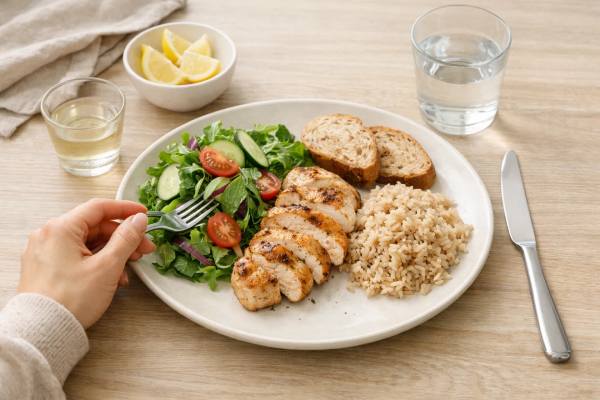
- Start with non-starchy vegetables, beans, or a salad when they are part of the meal.
- Eat the protein portion early rather than saving it for last.
- Leave bread, rice, pasta, potatoes, or dessert until later in the meal.
- Avoid beginning with liquid sugar or refined starch on an empty stomach when possible.
The effect is real, but it is modest. It is strongest when the meal already has fiber and protein to work with. It is weaker when the meal is mostly refined carbohydrate, or when portion size is so large that sequence cannot compensate. A giant bakery muffin and a sweet coffee do not become a balanced breakfast because you nibble a few nuts first.
Meal order is also best seen as a repeatable habit, not a rescue strategy for every indulgence. People often benefit most when they apply it to the meals that predictably cause trouble: pasta nights, rice bowls, sushi, restaurant brunches, and sweets eaten alone. Used there, it can smooth the curve enough to improve energy and appetite later in the day.
The bottom line is that the carbohydrates-last idea is not a gimmick. It is a practical way to make the same mixed meal easier to handle. But it is still second to meal composition itself. The plate that starts with vegetables and protein usually helps because those foods were there to begin with. That is the more important lesson.
Vinegar Before Meals: Benefits and Limits
Vinegar is the most polarizing glucose hack because it sits right at the border between “interesting adjunct” and “overhyped ritual.” The proposed mechanism is plausible. Acetic acid may slow gastric emptying and influence carbohydrate digestion in ways that reduce the glucose rise from a meal. Some clinical research also suggests benefit in people with type 2 diabetes, especially for fasting blood sugar and longer-term markers. That makes vinegar interesting, but not magical.
Context matters. Most vinegar studies are small, short, and focused on people who already have impaired glucose regulation. The evidence is not strong enough to conclude that vinegar “blocks sugar,” neutralizes desserts, or replaces standard nutrition care. Even when it helps, the effect tends to be additive rather than transformative. If the meal is low in fiber, highly refined, and oversized, vinegar is unlikely to do much beyond shaving the edge off the curve.
There is also a practical problem with how vinegar gets marketed. The safest and most sensible way to use it is as an optional food-level strategy, not as a shot, a dare, or a daily ritual of increasing doses. If someone wants to try it, a small diluted amount alongside a carbohydrate-heavy meal is more reasonable than concentrated vinegar on an empty stomach. More is not automatically better, and “natural” does not mean harmless.
The safety caveat is real. Vinegar is highly acidic. Repeated medicinal-style use can irritate the mouth and stomach and may contribute to tooth enamel wear over time. That does not mean a splash in salad dressing is dangerous. It does mean routine use deserves more caution than social media usually gives it. Straight shots are a poor idea. Repeated exposure without attention to dental and gastrointestinal tolerance is not trivial.
So where does vinegar belong? Near the bottom of the hierarchy. Useful for some, optional for most, and never the main event. If you like vinegar on food, that is easy. If you hate it, there is no reason to force it. The measurable wins from protein, fiber, meal structure, and movement are usually easier to sustain and less likely to irritate your mouth, teeth, or stomach. That is a better trade.
What Lowers Spikes More Reliably
If the goal is fewer and smaller glucose spikes, the strongest strategies are usually less glamorous than the viral hacks. They also work across more meals, more days, and more types of people. The first is improving meal structure. A plate built around minimally processed carbohydrates, enough protein, and plenty of fiber will usually outperform a refined meal plus any accessory trick. Fiber matters because it changes both the speed and the feel of a meal: slower rise, better fullness, fewer rebound cravings.
The second reliable lever is movement, especially after eating. A short walk after a meal often lowers post-meal glucose more consistently than pre-meal exercise or no movement at all. That is one reason a ten- to twenty-minute walk after lunch or dinner can beat a complicated supplement routine. You do not need to turn every meal into a workout. What matters is giving your muscles a reason to use circulating glucose when it is highest.
The third lever is consistency over the whole week. Regular physical activity, reducing long sedentary stretches, and breaking up prolonged sitting all support better blood sugar handling. That sounds plain because it is plain. But it is also why the basics keep winning in real life. Someone who walks after meals, does resistance training regularly, and eats more beans, vegetables, yogurt, eggs, fish, tofu, and intact grains is stacking several moderate benefits at once. Those layers add up.
A useful order of operations looks like this:
- Fix liquid sugar first.
- Add protein and fiber to meals that are mostly starch.
- Use meal order when it fits naturally.
- Walk after the meals that cause the biggest rise.
- Treat vinegar as optional, not essential.
That order works because it respects effect size. Replacing soda, juice, sweet coffee drinks, or dessert-only snacks usually matters more than debating the perfect vinegar dose. Building a breakfast that is actually filling usually matters more than chasing a clever graph trick at dinner. And if large spikes are happening alongside cravings, fatigue, belly weight gain, or strong family history, it is worth learning the broader picture of early insulin resistance signs instead of focusing on a single meal ritual.
In other words, the most effective glucose hack is often a better meal plus a short walk. Not because it is trendy, but because it changes the biology more reliably.
Who Should Be More Careful
For many healthy adults, these tactics are optional refinements. For some groups, they deserve more care and less improvisation. That includes people with diagnosed diabetes, prediabetes, gestational diabetes, people taking insulin or sulfonylureas, and anyone who is having symptoms that clearly track with meals. In those situations, a glucose hack should not replace treatment, medication review, or a proper nutrition plan. It can sit alongside those things, but it should not crowd them out.
The main red flag is when the conversation becomes narrower as the problem gets bigger. If you are obsessing over the order of bites while fasting numbers are worsening, hunger is getting harder to control, or your clinician has already flagged abnormal labs, you are past the point where a hack is enough. The same is true if you are pregnant, have a history of disordered eating, or feel increasingly anxious around food because every meal seems like a test.
It is also important to distinguish high glucose from low glucose. Some people do not mainly have sharp highs; they feel shaky, sweaty, anxious, lightheaded, or intensely hungry a few hours after eating. Those patterns may reflect medication effects, meal composition issues, or something more specific than “bad spikes.” If that sounds familiar, the right next step may be evaluation for reactive hypoglycemia after meals, not another vinegar routine.
The other caution is psychological. Glucose data can make people feel informed, but it can also make them rigid. Food does not need to become a sequence of rules, punishments, and corrections. A strategy is only truly healthy if it improves both metabolic control and day-to-day livability. If a tactic makes meals stressful, socially difficult, or hard to sustain, it may not be helping as much as the graph suggests.
The most mature way to use glucose hacks is to demote them. Let them be helpful, but small. Use meal order when it is easy. Walk after the meals that hit you hardest. Use vinegar only if you tolerate it and do not mind it. Then keep most of your attention on the higher-yield work: better carbohydrate quality, enough protein, more fiber, regular movement, and getting evaluated when the pattern looks bigger than a hack can fix. That is what actually lowers spikes in a lasting way.
References
- Effects of meal sequence intervention on blood glucose response in healthy adults: a systematic review 2026 (Systematic Review)
- Effects of apple cider vinegar on glycemic control and insulin sensitivity in patients with type 2 diabetes: A GRADE-assessed systematic review and dose-response meta-analysis of controlled clinical trials 2025 (Systematic Review and Meta-analysis)
- After Dinner Rest a While, After Supper Walk a Mile? A Systematic Review with Meta-analysis on the Acute Postprandial Glycemic Response to Exercise Before and After Meal Ingestion in Healthy Subjects and Patients with Impaired Glucose Tolerance 2023 (Systematic Review and Meta-analysis)
- 5. Facilitating Positive Health Behaviors and Well-being to Improve Health Outcomes: Standards of Care in Diabetes-2025 2025 (Guideline)
- Evidence That Daily Vinegar Ingestion May Contribute to Erosive Tooth Wear in Adults 2021 (Clinical Trial)
Disclaimer
This article is for education only and does not diagnose, treat, or replace medical care. Glucose responses vary based on diabetes status, medications, pregnancy, sleep, activity, stress, and the full composition of a meal. If you have diabetes, are pregnant, take glucose-lowering medication, or are having symptoms such as unusual thirst, frequent urination, shakiness, sweating, confusion, or repeated high or low readings, discuss changes with your clinician.
If this article helped clarify the difference between trendy glucose hacks and the habits that matter most, please consider sharing it on Facebook, X, or your preferred platform.