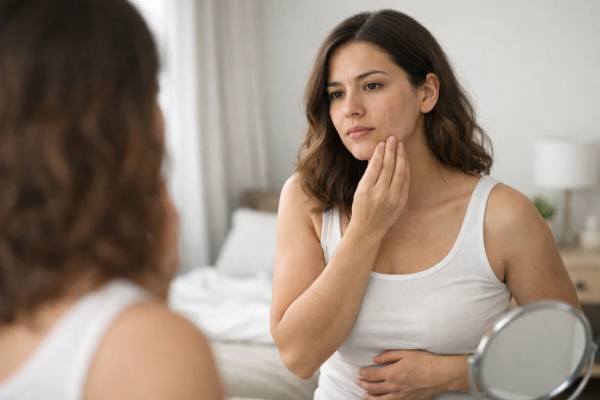
PCOS symptoms rarely arrive as one neat package. More often, they build slowly: a cycle that keeps drifting, acne that no longer behaves like teenage acne, darker or coarser hair in places that feel new, or weight changes that seem out of step with effort. That gradual pattern is one reason polycystic ovary syndrome is so often missed, minimized, or mistaken for separate problems that happen to be occurring at the same time.
What makes PCOS especially confusing is that it is not defined by one symptom and it does not look identical in every person. Some people mainly notice irregular periods. Others are troubled most by hirsutism, scalp hair thinning, acne, or insulin-related weight gain. Some have classic symptoms early. Others are told for years that their labs are “not that bad” even though their cycle and skin say otherwise. A helpful guide to PCOS symptoms has to do more than list them. It should show which patterns matter, what can mimic them, and when the symptom mix is strong enough to justify a proper workup.
Core Points
- PCOS symptoms usually cluster around irregular ovulation, androgen excess, and insulin-related metabolic changes rather than one isolated complaint.
- Irregular periods, acne, facial or body hair growth, and weight gain are common signs, but not everyone with PCOS has every symptom.
- Acne and excess hair growth are more suggestive when they persist into adulthood, worsen over time, or appear with cycle changes.
- Similar symptoms can also be caused by thyroid disease, high prolactin, nonclassic congenital adrenal hyperplasia, or other hormone disorders.
- Track cycle length, skipped periods, acne pattern, new hair growth, waist change, and symptoms of insulin resistance for 2 to 3 months before an appointment.
Table of Contents
- How PCOS Symptoms Usually Show Up
- Irregular Periods and Ovulation Clues
- Acne, Hair Growth, and Hair Thinning
- Weight Gain and Metabolic Signs
- What Can Look Like PCOS
- When to Get Checked
How PCOS Symptoms Usually Show Up
PCOS symptoms tend to follow three main themes: irregular ovulation, higher androgen activity, and metabolic strain linked to insulin resistance. The reason the condition can feel confusing is that those themes do not always appear at the same time or with the same intensity. One person may first notice skipped periods. Another may seek help for stubborn acne. Another may feel that the real issue is unexplained weight gain and intense cravings, only later realizing the cycle pattern has been off for years.
This is why PCOS is best understood as a pattern rather than a single symptom checklist. The most recognizable features include:
- infrequent, absent, or unpredictable periods
- difficulty knowing when ovulation is happening
- acne, especially on the jawline, lower face, chest, or back
- coarse hair growth on the face, chest, abdomen, or thighs
- scalp hair thinning
- weight gain or unusual difficulty losing weight
- signs of insulin resistance such as acanthosis nigricans or strong post-meal crashes in some people
At the same time, not everyone with PCOS looks textbook. Some people are in a lower-weight body. Some never develop visible excess hair. Some have mainly reproductive symptoms, while others feel the metabolic symptoms much more strongly. This variability matters because people often rule out PCOS too early. They assume, “I do not have facial hair, so this cannot be PCOS,” or “My weight is normal, so that does not fit.” Neither assumption is reliable.
Another common source of confusion is that many of these symptoms overlap with other life stages and conditions. Acne can be dismissed as cosmetic. Irregular periods can be blamed on stress. Weight gain can be reduced to willpower. Hair growth may be treated only as a dermatology problem. What raises suspicion is not any one symptom alone, but the clustering of symptoms that point to the same hormonal pattern.
PCOS can also affect quality of life long before formal diagnosis. People may spend years moving between skin care, dieting, waxing, and period tracking without anyone stepping back to ask whether the bigger picture suggests a hormone disorder. That delay happens partly because symptoms are often treated one by one instead of as a connected syndrome.
A useful mental shift is to ask not, “Do I have the full PCOS look?” but, “Are these symptoms connected in a way that suggests irregular ovulation and androgen excess?” When that answer starts to look like yes, it becomes easier to justify a fuller evaluation rather than piecemeal fixes. This is also why a broader understanding of common hormone imbalance symptoms can help frame PCOS as one possible endocrine pattern rather than a catch-all label.
Irregular Periods and Ovulation Clues
Irregular periods are often the symptom that brings PCOS into focus, but “irregular” means more than a cycle that is merely inconvenient. In PCOS, the underlying issue is usually inconsistent or absent ovulation. When ovulation is delayed or does not happen reliably, periods can become infrequent, widely spaced, unpredictable, or occasionally very heavy after a long gap.
People describe this in different ways:
- cycles that are always more than a month apart
- skipped months
- periods that come twice close together and then disappear
- long stretches of spotting followed by a heavy bleed
- never really knowing when the next period will start
This matters because a period pattern is not just a calendar problem. It is a clue about whether the ovaries and brain are coordinating ovulation normally. In PCOS, that coordination is often disrupted by androgen excess, insulin resistance, or both. The result may be oligo-ovulation, meaning ovulation happens only sometimes, or anovulation, meaning it does not happen at all in that cycle.
One mistake people make is assuming that any bleeding means ovulation happened. That is not always true. Breakthrough bleeding or a delayed shed of the uterine lining can look like a period without reflecting a normal ovulatory cycle. That is one reason cycle length alone does not tell the whole story. It helps to notice whether the pattern is stable, whether there are long gaps between bleeds, and whether the cycle has changed over time.
In adolescence, interpretation is trickier because cycles can be irregular for a while after periods first begin. In adults, persistent irregularity is more likely to deserve a PCOS workup, especially if acne, excess hair growth, infertility, or weight-related metabolic symptoms are also present. If you are trying to decide whether your pattern sounds hormone-related rather than random, a more detailed guide to irregular periods and next-step testing can help separate common variation from a stronger endocrine clue.
There are also practical health reasons not to ignore chronic cycle disruption. Long gaps without regular shedding of the uterine lining can matter over time. So can the fertility implications. A person may think pregnancy is impossible because cycles are erratic, but ovulation may still happen unpredictably. That means both pregnancy planning and pregnancy prevention can become harder if the cycle is not being tracked thoughtfully.
Symptoms that make irregular periods more suggestive of PCOS include:
- cycles that stay widely spaced over time
- skipped periods plus acne or hirsutism
- difficulty conceiving because ovulation feels unpredictable
- weight gain or insulin resistance signs appearing alongside cycle changes
- menstrual irregularity that began around puberty and never fully settled
The key point is that irregular periods in PCOS are usually not random bad luck. They are often the visible sign of inconsistent ovulation. Once that is recognized, the rest of the symptom pattern becomes easier to interpret.
Acne, Hair Growth, and Hair Thinning
Acne, excess hair growth, and scalp hair thinning all point toward the same core issue in PCOS: androgen excess. These symptoms do not always appear together, but when they do, they are often some of the most distressing parts of the condition because they are visible, persistent, and easy for other people to misunderstand.
PCOS-related acne is often not just ordinary teen acne that never quite ended. It tends to show up as deeper, more inflamed breakouts on the lower cheeks, jawline, chin, chest, or back, and it may continue well into adulthood. Many people notice that it flares even when their skin care is consistent. That is because the driver is not only clogged pores. It is hormonal stimulation of oil glands.
Excess hair growth, or hirsutism, usually appears in androgen-sensitive areas such as the upper lip, chin, sideburn area, chest, lower abdomen, lower back, or inner thighs. The hair is typically darker, coarser, or denser than before. Some people notice this gradually, while others feel they woke up one day and realized the pattern had changed. The emotional burden can be heavy, especially when removal becomes a daily task instead of an occasional one.
At the same time, scalp hair may thin. That combination can feel especially unfair: more hair where it is unwanted and less where it is wanted. Hair thinning in PCOS usually shows up as diffuse reduction at the crown or widening of the part rather than sharply defined bald patches. It may be subtle at first, which is why comparison photos over time can be useful.
What makes these symptoms medically meaningful is not vanity. It is that they often reflect the same hormonal pattern that is also affecting ovulation and metabolism. If you want a more focused breakdown of how androgen-related symptoms are evaluated, androgen excess symptoms and treatment options can help connect the skin and hair changes to the broader endocrine picture.
Still, not every case of acne or hair growth equals PCOS. Adult acne can happen without androgen excess. Some ethnic backgrounds normally have more terminal hair growth than others. Hair loss can also reflect iron deficiency, thyroid disease, postpartum change, or other causes. What raises suspicion is the combination of skin and hair symptoms with irregular periods, infertility, or metabolic changes.
Helpful questions include:
- Did the acne worsen after adolescence instead of improving?
- Is the hair growth new, darker, or more widespread than before?
- Has scalp density changed along with cycle irregularity?
- Are these symptoms happening alongside weight gain or insulin resistance?
These visible signs often drive people to seek care, but they are also easy to normalize or hide. The more important point is that persistent acne and hair changes can be clinical clues, not just cosmetic frustrations. When they cluster with irregular cycles, they deserve to be read as part of a hormonal pattern rather than dismissed one symptom at a time.
Weight Gain and Metabolic Signs
Weight gain in PCOS is often described too simply. Many people are told that if they just ate less or moved more, the problem would settle. That framing misses how strongly PCOS can interact with insulin resistance, appetite regulation, and fat storage patterns. Weight gain is not universal in PCOS, but when it happens, it is often more biologically stubborn than standard lifestyle advice admits.
Insulin resistance is a major part of this picture. When the body needs more insulin to manage blood sugar, the ovaries and adrenal system may be pushed toward greater androgen production. Higher insulin can also make hunger, cravings, and post-meal energy swings worse. This creates a frustrating loop: insulin resistance may worsen PCOS symptoms, and PCOS can make weight management more difficult, especially around the abdomen.
People often describe the metabolic side of PCOS as:
- gaining weight more easily than before
- carrying more weight centrally
- feeling unusually hungry or craving carbohydrates
- crashing after meals
- struggling to lose weight even with effort
- noticing darkened skin folds or skin tags in some cases
What matters here is nuance. PCOS does not require obesity, and a person in a leaner body can still have significant insulin resistance or reproductive symptoms. But when weight gain is present, it can intensify menstrual irregularity, androgen symptoms, sleep problems, and cardiometabolic risk over time.
This is one reason the weight conversation should not focus only on appearance. The more useful question is whether weight-related changes are traveling with other metabolic clues such as acanthosis nigricans, elevated fasting insulin, rising blood sugar, triglyceride changes, or a strong family history of type 2 diabetes. If that pattern sounds familiar, a closer look at early insulin resistance signs can help explain why PCOS symptoms sometimes feel both hormonal and metabolic at the same time.
Weight gain also affects how people interpret their other symptoms. Someone may notice acne and irregular periods but assume the weight gain is separate. In PCOS, it often is not. The endocrine and metabolic sides of the syndrome are intertwined. That does not mean every person with weight gain has PCOS, but it does mean the symptom becomes more meaningful when paired with cycle disruption or hyperandrogenic features.
The most helpful approach is to stop treating weight gain as a moral issue and read it as clinical context. Ask whether it is recent or long-standing, whether it came with changes in cycles or skin, whether it is accompanied by blood sugar problems, and whether prior weight-management advice has consistently failed despite real effort. In PCOS, that pattern often reflects physiology, not lack of discipline.
What Can Look Like PCOS
PCOS is common, but it is also a diagnosis that can be given too quickly when the symptoms look familiar. That matters because several other conditions can mimic part of the PCOS picture. If the workup stops too early, a person may be labeled with PCOS when the real issue is thyroid disease, high prolactin, nonclassic congenital adrenal hyperplasia, hypothalamic amenorrhea, Cushing syndrome, or a rarer androgen-secreting disorder.
This overlap happens because many endocrine conditions affect periods, skin, hair, or weight. A few examples illustrate why careful diagnosis matters:
- thyroid dysfunction can disturb cycles and weight, and can also affect skin and hair
- hyperprolactinemia can cause irregular or absent periods
- nonclassic congenital adrenal hyperplasia can resemble PCOS with acne, hirsutism, and menstrual disruption
- hypothalamic amenorrhea can lead to missed periods, but usually in the context of low energy availability, significant exercise, or weight loss
- Cushing syndrome can cause weight gain, acne, and cycle changes, but often with a different overall physical pattern
The timeline and severity help sort these apart. Gradual symptom development from adolescence or early adulthood often fits PCOS more easily than a rapid onset of severe hirsutism or virilization. Very fast progression, deepening voice, marked muscle change, or sudden dramatic symptoms require more urgent evaluation because they are less typical of standard PCOS.
This is also where self-diagnosis can become risky. Social media often reduces PCOS to a short list: belly weight, chin hairs, and irregular periods. While those features can be real, they are not specific enough on their own. The right question is not “Do I match a PCOS video?” but “Does my overall pattern fit PCOS better than the other hormone conditions that can mimic it?”
A helpful clue is context. PCOS usually combines signs of ovulatory dysfunction and hyperandrogenism, often with metabolic features. A person with very low weight, high exercise load, and missing periods but no acne or hirsutism may fit a different diagnosis better. Someone with panic-like symptoms, palpitations, weight loss, and irregular bleeding may need thyroid evaluation first. Someone with missed periods and breast discharge may need prolactin testing.
This is why a proper evaluation typically includes ruling out other endocrine conditions rather than simply confirming the first diagnosis that seems plausible. A broader guide to which hormone tests actually help can make that process easier to understand, especially if you have already been told conflicting things about what should be checked.
PCOS is common enough to be high on the list, but not so universal that it should be diagnosed by symptom collage alone. A good workup asks not only what fits, but what must be excluded first.
When to Get Checked
The right time to seek evaluation is usually earlier than people think. Many wait until symptoms become severe, or until fertility concerns force the issue. But PCOS is easier to manage when the pattern is recognized before years of cycle disruption, worsening insulin resistance, or mounting frustration over skin and hair symptoms.
It is worth bringing up PCOS if you have:
- persistent irregular periods or skipped periods
- acne that is stubborn, adult-onset, or worsening
- new or increasing coarse facial or body hair
- scalp hair thinning with other hormone symptoms
- unexplained weight gain plus cycle changes
- trouble conceiving because ovulation seems unpredictable
- a strong family history of diabetes or similar symptoms
A good evaluation usually starts with the history. A clinician should ask about cycle length, onset of symptoms, acne pattern, hair growth, scalp hair loss, weight history, medications, pregnancy goals, and family history. The next step often includes targeted lab testing and, in some cases, ultrasound or AMH depending on age and context. The point is not to order everything. It is to answer two questions: does the pattern meet PCOS criteria, and have important mimics been excluded?
Before the visit, it helps to track:
- cycle start dates and how many days occur between periods
- skipped months or unusually heavy bleeds
- acne locations and severity
- new hair growth areas
- scalp shedding or widening part line
- waist or weight trend
- symptoms of high or low blood sugar
- fertility goals, if relevant
That record often makes the appointment more productive than vague recall. It also helps your clinician decide whether the main problem looks reproductive, dermatologic, metabolic, or mixed.
You should also seek care sooner if symptoms are changing quickly. Rapid onset hirsutism, voice deepening, clitoromegaly, severe pelvic pain, or very heavy bleeding are not symptoms to watch casually. They may require a broader or more urgent endocrine and gynecologic evaluation. If the picture is complex, or if the first workup is inconclusive, it may be time to review when an endocrinologist should step in.
The most important point is this: PCOS symptoms are medically meaningful even when they are common. Irregular periods are not just annoying. Acne is not always “just skin.” Hair growth is not merely cosmetic. Weight gain is not always about effort. When these symptoms cluster, they deserve the kind of attention that looks for a unifying explanation rather than treating each one in isolation.
References
- Recommendations From the 2023 International Evidence-based Guideline for the Assessment and Management of Polycystic Ovary Syndrome 2023 (Guideline)
- Diagnosis and management of polycystic ovarian syndrome 2024 (Review)
- Polycystic ovary syndrome 2024 (Review)
- Understanding hirsutism in PCOS 2024 (Review)
- Obesity and Polycystic Ovary Syndrome 2024 (Review)
Disclaimer
This article is for educational purposes only and is not a substitute for personal medical care. PCOS symptoms can overlap with thyroid disease, high prolactin, nonclassic congenital adrenal hyperplasia, hypothalamic amenorrhea, medication effects, and other endocrine or gynecologic conditions. Diagnosis should be based on a qualified clinician’s evaluation, not symptoms alone. Seek prompt care for very heavy bleeding, rapidly worsening hair growth, voice deepening, severe pelvic pain, or months without periods when pregnancy is possible.
If this article helped, consider sharing it on Facebook, X, or another platform so someone else dealing with irregular periods, acne, hair growth, or weight changes can recognize the pattern sooner.