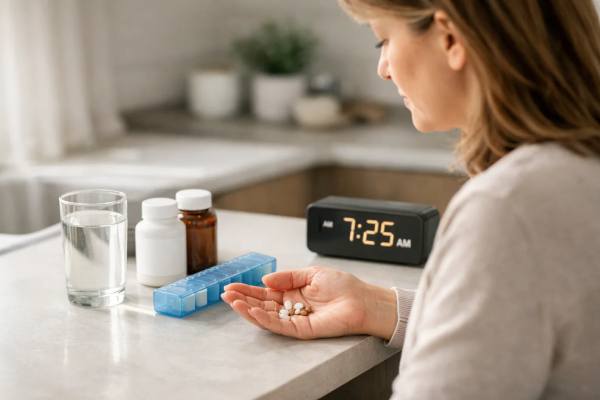
A thyroid blood test looks simple on paper, but the details around it matter more than many people realize. A pill taken too early, a high-dose hair supplement, an unusually late blood draw, or even a different breakfast routine can make results harder to compare. That does not mean thyroid testing is fragile. It means thyroid markers, especially TSH and free T4, are best interpreted in context and under consistent conditions.
Most mistakes happen before the needle ever goes in. People stop the wrong medication, keep taking a supplement that interferes with the assay, or assume “fasting” matters more than the timing of levothyroxine. Others panic over a single borderline result that was drawn at a different time of day than prior tests. Good preparation reduces that noise. It gives your clinician a cleaner result to interpret and lowers the chance of unnecessary dose changes, repeat tests, or confusion about whether the thyroid is truly underactive, overactive, or simply being measured under different conditions.
Key Facts
- The most useful thyroid blood tests are easier to compare when you use the same lab, similar timing, and the same medication routine each time.
- For people taking thyroid hormone replacement, the morning dose is often best taken after the blood draw unless the clinician specifically wants a post-dose level.
- High-dose biotin can distort thyroid results and often needs to be stopped before testing.
- Do not stop prescribed thyroid medications for days on your own just to “get a true result.”
- A practical rule is to schedule the test in the morning, keep preparation consistent, and bring a full list of thyroid medications, vitamins, powders, and supplements.
Table of Contents
- Why Prep Changes the Result
- Best Timing for the Blood Draw
- What to Do With Thyroid Medications
- Supplements That Can Skew Results
- Food Coffee and Common Morning Mistakes
- Special Situations and a Simple Checklist
Why Prep Changes the Result
Thyroid blood tests are not just snapshots of the thyroid itself. They also reflect timing, biology, medication exposure, and lab method. That is why preparation matters. A TSH level drawn first thing in the morning can differ from one drawn late in the afternoon. A free T4 level can look temporarily higher if blood is taken soon after a levothyroxine dose. A supplement such as biotin can make results appear abnormal even when thyroid function in the body has not changed.
For most people, the goal is not to chase a perfect number on one day. It is to get a result that can be interpreted accurately and compared fairly with past and future tests. That is especially important in three common situations:
- You are being evaluated for a new thyroid problem.
- You already take thyroid medication and your dose is being monitored.
- Your prior test was borderline and your clinician is deciding whether it truly reflects disease or normal variation.
TSH, the test most often used to screen for thyroid dysfunction and to monitor levothyroxine treatment, is especially sensitive to context. It follows a daily rhythm and can shift modestly even when nothing important has changed clinically. That means differences between one test and the next do not always signal worsening thyroid disease. Sometimes they reflect a different draw time, a different lab platform, a recent dose, or a supplement that interfered with the assay.
This is one reason people get frustrated after hearing different advice from different sources. One lab says fasting is unnecessary. Another recommends morning fasting samples. One clinician says to take levothyroxine after the test. Another says consistency matters more than the exact rule. These instructions are not always contradictory. They often reflect different priorities. For diagnosis, the key is usually a clean, interpretable sample. For long-term monitoring, consistency matters just as much as the exact method.
A useful way to think about preparation is to separate three questions:
- What could temporarily change the result?
- What could interfere with the laboratory method?
- What can I keep consistent from test to test?
When people miss these distinctions, they often make the wrong adjustment. They may stop prescribed medication for several days, which is rarely the right move. Or they may keep taking a hair supplement that can distort the test itself. The better approach is targeted and practical: do not overcorrect, do not improvise, and do not assume a thyroid panel is just like any other routine blood draw.
In short, preparation is not about perfectionism. It is about reducing avoidable noise so the result reflects your thyroid status as clearly as possible. The more stable the preparation, the more meaningful the interpretation becomes.
Best Timing for the Blood Draw
If you want the most reliable comparison over time, morning testing is usually the best default. Thyroid markers, especially TSH, are not completely static across the day. TSH tends to run higher overnight and in the early morning, then drift lower later in the day. For many patients this difference is small, but when the result is borderline, the timing can matter enough to change how a clinician reads it.
That is why morning blood draws are often preferred, particularly when:
- You are being tested for the first time
- Your TSH has been only mildly abnormal
- Your clinician is deciding whether a dose needs to change
- You are trying to compare one result with an earlier one
The most practical target is a morning draw in roughly the same time window each time. If your last test was at 8:00 a.m., it is better to repeat at 8:00 or 9:00 a.m. than at 4:30 p.m. That consistency does not guarantee identical results, but it removes one common reason for unnecessary variation.
Fasting is more nuanced. Some laboratories and reviews recommend fasting morning samples because food intake can lower TSH modestly and make comparisons less clean. In everyday practice, however, not every clinician insists on strict fasting for every thyroid test. The most sensible middle ground is this: if the lab or clinician gave a specific fasting instruction, follow it. If they did not, a morning pre-breakfast draw is still a good choice when you want the cleanest and most repeatable result.
The deeper principle is sameness. If one test is fasting, another is after coffee and toast, and a third is drawn after lunch, you are not comparing like with like. That is how people end up worrying about a tiny shift that may mean little biologically.
Timing also matters around dose changes. If you have recently started levothyroxine or adjusted the dose, testing too soon can mislead both you and your clinician. TSH changes slowly. In many cases, routine rechecking is more useful after about six weeks than after just a few days. Testing earlier can be appropriate in special situations, but for standard outpatient monitoring it often creates confusion rather than clarity.
Two additional timing rules are easy to forget:
- Try to use the same laboratory when possible.
- Avoid drawing labs during major acute illness unless testing is truly needed.
Acute illness can distort thyroid results in ways that do not reflect ordinary thyroid function. The same is true for hospital stays, severe infection, or the immediate aftermath of surgery. If you are very sick, a mildly odd thyroid panel may say more about the illness than the gland.
The best timing strategy is therefore simple: morning, similar conditions, same lab when possible, and patience after medication changes. These steps do not make the test perfect, but they make it far more useful.
What to Do With Thyroid Medications
The single most common question before thyroid bloodwork is whether to take thyroid medication first. For many people taking levothyroxine, the safest general rule is to have the blood drawn before the morning dose, then take the medication afterward. This is especially helpful when free T4 is being checked along with TSH, because levothyroxine can temporarily raise circulating T4 levels after ingestion and make the result harder to interpret.
That does not mean you should skip medication for a day or stop it for several days. Those are very different choices. Holding only the morning dose until after the blood draw is often reasonable. Stopping treatment on your own for multiple days is usually not.
This distinction matters because thyroid hormones behave differently:
- Levothyroxine has a long half-life, so one delayed morning dose usually does not destabilize your treatment.
- T3-containing medications such as liothyronine can create faster and more noticeable swings after dosing.
- Combination therapy and thyroid cancer suppression therapy often require even more careful timing and documentation.
If you take liothyronine or a T3-containing regimen, it is especially useful to ask your clinician how they want the blood drawn. These medications can influence serum levels more quickly than levothyroxine alone, so the exact timing of the sample may matter more. In many outpatient settings, the cleanest option is still to test before the dose.
People taking desiccated thyroid extract or mixed T4/T3 therapy should also avoid guessing. The preparation on the lab day can change interpretation, and many clinicians want results drawn in a standardized pre-dose state.
There is another trap here: people sometimes try to “optimize” the result by changing how they take their medication for several days before testing. That is usually a mistake. If you normally take levothyroxine first thing in the morning on an empty stomach, do not suddenly switch to bedtime the week before your lab just to see what happens. The goal of monitoring is to reflect your usual routine, not a short experiment.
This is also the right place to think about absorption problems. If you take levothyroxine with coffee, breakfast, calcium, iron, fiber powders, or certain acid-lowering medications, your labs may look off even when you are taking the right dose. Many people who struggle with unstable TSH eventually discover that the issue is not the thyroid itself but how the medication is being taken. For readers sorting out that problem, how long to wait before coffee after levothyroxine is often more useful than another dose increase.
A practical summary for test day looks like this:
- Take thyroid medication exactly as prescribed on ordinary days.
- On the morning of routine bloodwork, many people should wait and take the dose after the draw.
- Do not stop thyroid medication for days unless a clinician specifically instructs you to.
- If you take T3-containing medication, ask about the exact timing your clinician prefers.
- If you already took the dose by mistake, tell the lab or clinician rather than hiding it.
Honest timing information is often more helpful than a “perfect” test day that does not match real life.
Supplements That Can Skew Results
If there is one supplement every thyroid patient should know by name before bloodwork, it is biotin. Often sold for hair, skin, and nails, biotin can interfere with certain laboratory assays and make thyroid results look falsely abnormal. A person can appear biochemically hyperthyroid on paper even when their thyroid status in the body has not changed.
The pattern can be especially misleading:
- TSH may look falsely low
- Free T4 and free T3 may look falsely high
- Thyroglobulin and some other tests may also be affected
That is why biotin deserves its own pre-test rule rather than being treated like an ordinary multivitamin. Many clinicians and laboratories advise stopping it for at least 48 hours before thyroid testing, and some assays or higher doses may require a longer washout. The safest move is to ask the ordering clinician or the laboratory if they have a preferred interval, especially if you take high-dose biotin or a supplement blend marketed for hair growth.
The hidden problem is that many people do not realize they are taking biotin at all. It may be in:
- Hair and nail gummies
- “Beauty” blends
- B-complex vitamins
- Multivitamins
- Energy powders
- Some metabolic or wellness supplements
This is why bringing bottles or photos of labels can be genuinely helpful. A person may say, “I do not take biotin,” and still be swallowing 5 to 10 mg daily inside a beauty supplement.
Biotin is not the only supplement issue, though it is the most famous one. Other products may not directly distort the assay but can still affect interpretation by changing absorption or thyroid physiology. Examples include:
- Iron supplements
- Calcium supplements
- Fiber powders
- Soy protein supplements
- Kelp or iodine-heavy products
- Over-the-counter “thyroid support” blends
These do not all need to be stopped before the blood draw, but they do need to be disclosed. The main question is whether they interfere with the test method, with thyroid hormone absorption, or with thyroid biology itself.
“Thyroid support” supplements deserve extra caution because they are often more complicated than the label suggests. Some contain iodine, glandular material, tyrosine, selenium, ashwagandha, or other ingredients that can muddy both symptoms and labs. They can make it harder to tell whether the thyroid is changing or the supplement is doing the changing.
A good rule is this: do not quietly stop or start several supplements right before the blood draw in an effort to get a better-looking panel. That makes interpretation harder, not easier. Instead:
- Hold biotin as instructed
- Keep the rest of your routine stable unless told otherwise
- Tell the clinician exactly what you take and when
This is one of the clearest examples of why thyroid testing is not just a lab event. It is also a medication-and-supplement history event. The more complete that history is, the less likely the result will send everyone in the wrong direction.
Food Coffee and Common Morning Mistakes
Many test-day errors are not about prescription drugs at all. They are about the small morning habits people barely notice: coffee, protein shakes, milk, calcium chews, fiber drinks, or a breakfast taken right after levothyroxine because the day got busy. These choices matter less for the needle stick itself than for the interpretability of the result, especially in someone on thyroid hormone replacement.
Coffee is one of the biggest offenders. It can reduce levothyroxine absorption when taken too close to the dose. That matters because a person may seem to “need more thyroid medication” when the real issue is the breakfast routine. On a blood-test morning, this becomes even more important. If you are holding levothyroxine until after the blood draw, then coffee timing becomes a medication issue after the test rather than before it. If you already took your dose, coffee can complicate both your routine absorption and the meaning of follow-up labs.
Milk can also matter because of calcium and protein interference. So can calcium-fortified drinks, iron-fortified shakes, and supplements hidden inside wellness beverages. Fiber powders, soy products, and some protein supplements can create similar problems when used too close to levothyroxine.
That does not mean you need a joyless morning forever. It means your thyroid medication and your thyroid blood test both work better when the routine is consistent and appropriately spaced. The biggest mistakes usually look like this:
- Taking levothyroxine with breakfast
- Taking it with coffee
- Taking calcium or iron soon afterward
- Alternating between careful timing on some days and rushed timing on others
- Changing the routine right before a blood draw
For many patients, the best standard routine is still plain water, medication, then a waiting period before coffee or food. The exact interval depends partly on the formulation and the clinician’s advice, but a longer gap is usually safer than a shorter one.
If you are not taking thyroid medication and are only being tested for diagnosis, food and coffee matter less dramatically than they do for someone on replacement therapy. Even then, however, consistency still helps. If your first borderline TSH was drawn fasting at 8:00 a.m., repeating it after a large lunch at 2:30 p.m. adds unnecessary noise.
Exercise is another overlooked factor. Strenuous exercise the day before or morning of the test may influence hormone concentrations and make interpretation less clean. The same is true for major sleep disruption. A single bad night does not invalidate thyroid testing, but if you are trying to clarify a subtle borderline result, stable conditions are better than chaotic ones.
A good test morning is boring in the best possible way:
- similar wake time
- similar draw time
- plain water okay
- no surprise supplements
- no rushed dosing
- no guesswork
Thyroid testing often becomes more accurate not because people do something heroic, but because they stop doing the small inconsistent things that blur the picture.
Special Situations and a Simple Checklist
Some people need more individualized preparation than the standard “morning lab, hold the dose, stop biotin” advice. Pregnancy is one example. Thyroid targets are tighter, testing may be repeated more often, and the urgency of dose adjustment is higher. In that setting, it is especially important not to improvise or wait weeks after a significant dose change without guidance.
Recent dose changes are another common source of confusion. If you increased or decreased levothyroxine a few days ago, the bloodwork may not yet reflect the new steady state. That is why routine TSH checks are often spaced several weeks after a dose adjustment rather than immediately. If your clinician ordered an earlier test, there is usually a reason, but patients should know that early rechecks can mislead when they are done too soon.
Central hypothyroidism and pituitary disease are also special cases. In these situations, TSH may not tell the usual story, and free T4 becomes more important. The preparation rules still matter, but interpretation becomes more individualized and should be matched to the condition being followed.
Thyroid cancer follow-up can be even more specific. Tests such as thyroglobulin, anti-thyroglobulin antibodies, and suppression targets may be part of the plan. Biotin becomes especially important here because it can distort not only standard thyroid tests but also tumor-marker-related measurements in some assays.
Recent iodine exposure is another situation worth mentioning. Iodinated contrast from imaging studies, iodine-containing supplements, or certain medications can affect thyroid function for weeks or months in susceptible people. That does not mean routine thyroid labs become useless, but it does mean your clinician needs to know that exposure occurred.
This is also the right place to address the “complete thyroid panel” question. More tests are not always better. In many outpatient situations, TSH is the key first test, with free T4 added when needed. T3, reverse T3, repeated antibody testing, or large custom panels are often less useful than advertised. Preparation is not just about what to hold. It is also about getting the right test for the right question.
A simple pre-test checklist can prevent most mistakes:
- Schedule the test in the morning if possible.
- Use the same lab and similar timing as prior tests when you can.
- Ask whether the test should be fasting; if unclear, morning before breakfast is often the cleanest option.
- Hold the morning thyroid dose until after the draw unless your clinician told you otherwise.
- Stop biotin in advance based on your lab’s or clinician’s instructions.
- Bring or photograph all vitamins, gummies, powders, and prescription medications.
- Tell the clinician about pregnancy, recent dose changes, iodine contrast, recent illness, or T3-containing therapy.
- Do not stop prescribed medication for several days unless you are explicitly told to do so.
The best preparation is not complicated, but it is intentional. When the timing is right and the lab knows what you are taking, thyroid bloodwork becomes far more useful and far less likely to send you into unnecessary worry.
References
- National recommendations of the Croatian society of medical biochemistry and laboratory medicine: Thyroid function tests from the laboratory point of view 2025 (Recommendations)
- ETA guidelines for the use of levothyroxine sodium preparations in monotherapy to optimize the treatment of hypothyroidism 2025 (Guideline)
- Biotin interference in routine clinical immunoassays 2025 (Review)
- Thyroid testing in primary hypothyroidism 2025 (Clinical Guidance)
- AACC Guidance Document on Biotin Interference in Laboratory Tests 2020 (Guidance Document)
Disclaimer
This article is for educational purposes only and is not medical advice. Thyroid blood test preparation can vary based on why the test is being ordered, whether you take levothyroxine or liothyronine, whether you are pregnant, and which laboratory assay is being used. Do not stop prescription thyroid medication, antithyroid drugs, or other regular medicines unless your clinician specifically tells you to. If you are unsure what to take or hold before testing, contact the ordering office or laboratory before the blood draw.
If this article helped you feel more confident about preparing for thyroid labs, consider sharing it on Facebook, X, or another platform where it may help someone avoid a preventable testing mistake.