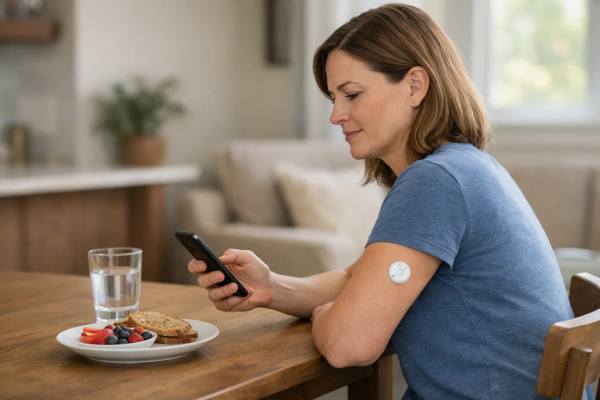
A continuous glucose monitor can seem almost futuristic the first time you see one in action. Instead of a few fingerstick numbers scattered across the day, it offers a moving picture of glucose: where it is now, which direction it is headed, and how meals, exercise, sleep, illness, stress, and medication shape the pattern. For many people, that shift is more than a convenience. It changes how diabetes is understood and managed.
But a CGM is not just a gadget that makes graphs. It measures glucose in interstitial fluid rather than directly in blood, it can lag during rapid changes, and it is only useful when the data are interpreted well. The most important question is not whether a CGM is impressive. It is what the device actually shows, which patterns matter, and who gets enough clinical value to make it worthwhile.
That is where CGM becomes most useful: not as constant data for its own sake, but as a tool that helps the right person make better decisions with less guesswork.
Key Facts
- A CGM shows glucose trends, direction, variability, and time spent in range rather than only isolated spot checks.
- It is especially helpful for people using insulin, people with hypoglycemia risk, and many people with type 2 diabetes who need clearer pattern data.
- CGM values can lag behind blood glucose during fast rises or drops, so symptoms and context still matter.
- More data does not always mean better care; the benefits come from using CGM patterns to guide food, medication, activity, and safety decisions.
- The most practical way to use CGM is to look for repeatable patterns over days to weeks rather than reacting emotionally to every single reading.
Table of Contents
- What a CGM Actually Measures
- What the Data Can Show You
- Who Benefits Most from CGM
- Where CGM Has Limits
- How to Use CGM Data Well
- Whether CGM Is Worth It for You
What a CGM Actually Measures
A continuous glucose monitor does not measure blood glucose directly in the same way a fingerstick meter does. Instead, it measures glucose in interstitial fluid, the fluid that surrounds cells just under the skin. A small sensor sits under the skin, usually on the arm or abdomen depending on the device, and records glucose values frequently throughout the day and night.
That distinction matters because interstitial glucose and blood glucose usually move together, but they are not identical moment to moment. During steady conditions, the numbers are often quite close. During rapid changes, such as right after a meal, during intense exercise, or when glucose is falling quickly, the sensor reading may lag behind blood glucose. This is one reason people are sometimes told to confirm certain readings with a fingerstick, especially if symptoms do not match the number or if they suspect severe hypoglycemia.
Most modern CGMs provide more than a raw number. They also show:
- a trend arrow indicating whether glucose is rising, falling, or stable
- a graph showing how glucose has moved over the last several hours
- alarms or alerts for low or high glucose on some devices
- summary reports that organize patterns over days to weeks
This is what makes CGM fundamentally different from self-monitoring with fingersticks. Fingersticks answer, “What is my glucose right now?” A CGM answers, “What is it now, where is it going, and how has the pattern behaved over time?”
That broader view matters because glucose management is not only about isolated highs and lows. It is about timing, variability, and exposure. A person may have an acceptable fasting glucose but large after-meal spikes. Another may look fine during the day but dip low overnight. Someone else may spend much of the day slightly above target without ever seeing a dramatic number on a meter. A CGM can reveal these patterns much more clearly than occasional checks.
It also changes the practical meaning of control. Instead of relying only on lab measures such as A1C, CGM adds daily texture. Two people can have the same A1C and very different glucose profiles. One may have relatively smooth readings. The other may swing between highs and lows that average out to the same final number. CGM helps separate those patterns.
This is the most basic but important truth about CGM: it is a pattern tool. It is not simply a more frequent meter. When used well, it helps people and clinicians understand how glucose behaves across real life, not just at a few selected moments.
What the Data Can Show You
The real value of a continuous glucose monitor is not just that it gives more numbers. It gives better context. That context is what turns glucose from a mystery into something you can actually work with.
The most useful CGM metrics usually include time in range, time above range, time below range, average glucose, and glucose variability. Of these, time in range is often the most intuitive. It refers to the percentage of time glucose stays within a target zone, commonly 70 to 180 mg/dL for many adults with diabetes, though targets can differ by age, pregnancy, comorbidities, and risk of hypoglycemia.
A CGM can also show patterns that would be easy to miss with fingersticks:
- repeated overnight lows
- morning rises before breakfast
- delayed post-meal spikes
- exercise-related drops
- sustained afternoon hyperglycemia
- glucose instability after certain foods or alcohol
This is where the device becomes clinically useful. A person may think they are “doing fine” because they only check fasting glucose and it looks acceptable. A CGM may show that dinner is producing large evening spikes or that a basal insulin dose is driving overnight lows. In another person, a meal that seems harmless may produce a larger or longer rise than expected, which can create a chance to rethink timing, portion size, or medication.
Trend arrows add another layer of meaning. A reading of 95 mg/dL is not the same if it is steady, dropping rapidly, or rising fast after treatment for a low. The same number can imply very different next steps. That makes CGM particularly useful in people at risk for hypoglycemia, where the direction of travel may be as important as the absolute value.
CGM data also help separate one-off events from true patterns. A single high reading after a birthday dinner is less important than a week of similar spikes after the same type of meal. A single low after an unusually long walk may not matter much. Repeated lows after ordinary activity probably do.
This pattern-based view is why CGM can improve day-to-day decisions about:
- insulin timing and dose adjustment
- meal composition and portion size
- correction timing
- exercise planning
- identifying high-risk windows for lows
For people without diabetes who are curious about glucose, the device can also reveal how normal bodies respond to food, exercise, and stress. But that use is less straightforward, and the meaning of every spike is often overinterpreted. Not every rise is abnormal. A healthy glucose response is supposed to move.
That is why the best use of CGM is not to chase a perfectly flat line. It is to understand what your glucose pattern looks like, where it departs from target in a meaningful way, and what specific habits or medications improve it. In other words, CGM is most helpful when it turns curiosity into a plan.
Who Benefits Most from CGM
A CGM can help many people, but it does not help everyone equally. The strongest evidence and clearest benefit are in people whose treatment decisions or safety depend on understanding glucose patterns in real time.
The group that benefits most is people with type 1 diabetes. In this setting, CGM is now a central part of modern care because it improves glucose awareness, reduces hypoglycemia risk, and helps users and clinicians make more precise insulin decisions. It is especially useful for people with frequent lows, reduced awareness of hypoglycemia, variable schedules, exercise-related fluctuations, pregnancy, or a need for tighter control without constant fingersticks.
Many people with type 2 diabetes also benefit, especially those using insulin. This includes people on multiple daily injections and many people using basal insulin alone. In these cases, CGM can reveal patterns that make insulin adjustment safer and more effective. It may also improve time in range, reduce hypoglycemia, and help users understand how meals and medication timing affect control.
There are also groups where benefit is more individualized but still meaningful:
- people with recurrent unexplained hypoglycemia
- people with diabetes in pregnancy
- people with significant dawn rises or overnight concerns
- older adults where avoiding lows is a major priority
- people who struggle with frequent fingersticks
- people whose A1C and daily experience do not seem to match
CGM can also be helpful in selected people with prediabetes or early glucose dysregulation, but the evidence here is still evolving. In that setting, the device is often used less as a medical necessity and more as a behavior-feedback tool. Some people find that seeing the effect of sleep, late meals, or refined carbs helps them change habits more effectively than general advice alone. Others become overly focused on normal fluctuations and get more anxiety than benefit. For this group, context matters a lot.
That is also true for people with insulin resistance but not established diabetes. A CGM may sometimes help show how certain meals or daily routines relate to blood sugar spikes, but it should not replace a proper metabolic assessment. It is one tool, not the diagnosis.
The people least likely to benefit are usually those who want a CGM only for novelty, who are not prepared to use the data constructively, or who become highly anxious when they see normal physiologic movement. Constant data can be useful, but only when it leads to better choices rather than compulsive monitoring.
So who benefits most? In practical terms, the answer is people for whom pattern visibility changes treatment, improves safety, or reduces uncertainty in a meaningful way. That is why CGM has become standard or near-standard in some diabetes groups while remaining more optional in others.
Where CGM Has Limits
A continuous glucose monitor can be powerful, but it is not a perfect window into metabolism. Understanding its limits is what prevents good technology from becoming bad interpretation.
The first limitation is physiologic lag. Because CGMs measure interstitial fluid rather than blood directly, readings may trail blood glucose during rapid changes. This can matter after treating a low, during intense exercise, right after meals, or when glucose is moving quickly for any reason. A person may feel low before the sensor fully shows it, or the sensor may continue to look low briefly after treatment has started working.
The second limitation is accuracy under certain conditions. Modern sensors are much better than earlier generations, but no CGM is flawless. Compression lows can happen when pressure on the sensor produces a falsely low reading, especially during sleep. Sensor placement issues, adhesive problems, hydration shifts, and the first day of a sensor session can sometimes affect reliability.
The third limitation is psychological. A CGM can reduce anxiety for some people and increase it for others. More data does not automatically create more confidence. Some users begin to overreact to every rise above a target line, even when the rise is brief, expected, or clinically minor. This is particularly common in people using CGM outside clear medical indications, where normal post-meal movement may be misread as pathology.
Another limit is that CGM is not the same as diagnosis. It can show patterns that raise concern, but it does not replace formal diagnostic criteria. You still diagnose diabetes, prediabetes, and hypoglycemia disorders using accepted clinical standards, not by staring at a graph alone. A CGM can add context to normal A1C with concerning metabolic clues, but it should not be treated as a standalone verdict.
CGM also cannot tell you why glucose is behaving a certain way. It can show that a spike happened, but it cannot by itself distinguish whether the driver was meal composition, stress hormones, sleep loss, illness, medication timing, or a problem with insulin delivery. The device gives data; interpretation still requires context.
Practical limitations matter too:
- cost and insurance coverage
- skin irritation or adhesive intolerance
- alert fatigue
- data overload
- the need for training to use reports well
This is why a CGM should not be sold as a universal answer. It is a useful instrument, but it still sits inside a larger clinical picture. It works best when a person knows what questions they are trying to answer, understands that the graph is not perfect, and uses the information to find repeated patterns rather than to judge every small fluctuation.
The healthiest relationship with a CGM is respectful but not reverent. It is extremely informative, but it is not infallible, and it should never replace symptoms, clinical judgment, or the broader medical picture.
How to Use CGM Data Well
The best way to use a CGM is to think like a pattern analyst, not a stock trader. Reacting to every rise and dip usually leads to frustration. Looking for repeated trends over several days is where the real benefit shows up.
A strong starting rule is to ask the same questions every time you review the data:
- When is glucose most often out of range?
- Is the main problem highs, lows, or both?
- Are the issues linked to meals, overnight periods, exercise, or medication timing?
- Is the pattern consistent enough to act on?
- What one change is most likely to improve it?
This keeps the device from becoming a source of constant emotional noise. A CGM works best when it helps narrow attention to the few things that matter most.
For example, if a person sees repeated large spikes after breakfast, the most useful next steps may involve breakfast composition, meal order, or timing of medication. That might include more protein and fiber, fewer rapidly absorbed carbs, or a strategy such as protein before carbs to blunt post-meal rises. If the pattern is overnight lows, the conversation shifts toward medication safety, evening exercise, alcohol, or dinner timing instead.
It also helps to separate action thresholds from curiosity. Not every number needs intervention. Sometimes the right move is simply to note the pattern and discuss it at the next visit. Many people improve their CGM use once they stop asking, “How do I correct this number?” and start asking, “What keeps causing this pattern?”
Review timing matters too. Looking at the graph right after every meal can teach some useful lessons early on, but longer summaries are often more valuable. Ambulatory glucose profile reports can reveal whether the same glucose problem appears at the same time most days. That is far more actionable than isolated readings.
Good CGM use also includes knowing when to verify. If a reading seems implausible, if symptoms do not match, if the number is rapidly changing, or if treatment decisions are high stakes, fingerstick confirmation may still be appropriate depending on the device and situation.
Another smart practice is to connect the graph to real-life notes:
- what you ate
- when you exercised
- medication timing
- sleep quality
- alcohol intake
- illness or stress
Without context, CGM reports become pretty pictures. With context, they become clinical clues.
The final skill is restraint. A CGM is not asking for perfection. Glucose will move. The goal is not to flatten every curve. The goal is to reduce truly harmful patterns, improve time in range where it matters, and make daily management safer and more informed. When used that way, CGM becomes less about watching numbers and more about learning how your body behaves.
Whether CGM Is Worth It for You
Whether a CGM is worth it depends less on how impressive the technology is and more on whether the information will change what you do. That is the central question.
A CGM is usually worth strong consideration if you use insulin, have frequent or hard-to-detect lows, need more confidence overnight, or keep running into unexplained glucose swings. In these situations, the device can improve both safety and decision-making enough to justify the cost, training, and daily attention.
It may also be worth it if you have type 2 diabetes and want clearer treatment feedback, especially if fasting readings alone do not explain your A1C or if meal responses are hard to interpret. Many people in this group discover that their biggest glucose problems happen at times they were not checking before.
For others, the answer is more mixed. A person with prediabetes, insulin resistance, or metabolic curiosity may get useful behavioral insight, but the value depends heavily on temperament and goals. If the device helps you identify repeatable changes that improve meals, exercise timing, or sleep, it may be worthwhile. If it leads to fear of ordinary foods, obsessive checking, or overinterpretation of normal fluctuations, it may not be helping.
A simple checklist can guide the decision:
- Do you have a clear reason to want pattern data?
- Will the information change treatment, safety, or habits?
- Are you likely to use the reports rather than just watch the app?
- Can you tolerate occasional inaccuracy and data lag without losing trust?
- Do cost, access, and adhesive issues make the tradeoff realistic?
It is also worth thinking about duration. Some people need CGM continuously. Others benefit from periodic use. A short-term sensor period can sometimes answer a specific question, such as whether lows are happening overnight, whether meals are causing large excursions, or whether a new treatment plan is working. In that sense, CGM does not always have to be an all-or-nothing commitment.
The best candidates are not just people with diabetes. They are people with a use case. They know what problem they are trying to solve, and they are ready to treat the data as information rather than identity.
That is ultimately why CGM has become such an important tool. It makes glucose visible in a way older methods never could. But visibility alone is not the win. The win is when that visibility leads to safer treatment, clearer choices, and fewer surprises in real life.
References
- 7. Diabetes Technology: Standards of Care in Diabetes-2024 2024 (Guideline)
- American Association of Clinical Endocrinology Clinical Practice Guideline: The Use of Advanced Technology in the Management of Persons With Diabetes Mellitus 2021 (Guideline)
- Diabetes Technology in People with Type 2 Diabetes: Novel Indications 2024 (Review)
- Effectiveness of continuous glucose monitoring in maintaining glycaemic control among people with type 1 diabetes mellitus: a systematic review of randomised controlled trials and meta-analysis 2022 (Systematic Review)
- Continuous Glucose Monitoring for Prediabetes: Roles, Evidence, and Gaps 2025 (Review)
Disclaimer
This article is for educational purposes only and is not a substitute for medical advice, diagnosis, or treatment. CGM data should be interpreted with your symptoms, medications, medical history, and the known limits of sensor accuracy and lag in mind. Seek prompt medical care for severe hypoglycemia, confusion, loss of consciousness, repeated unexplained lows, or persistently very high glucose, especially if ketones, vomiting, or dehydration are present.
If this article helped you, please share it on Facebook, X, or another platform where it may help someone use CGM data more safely and effectively.